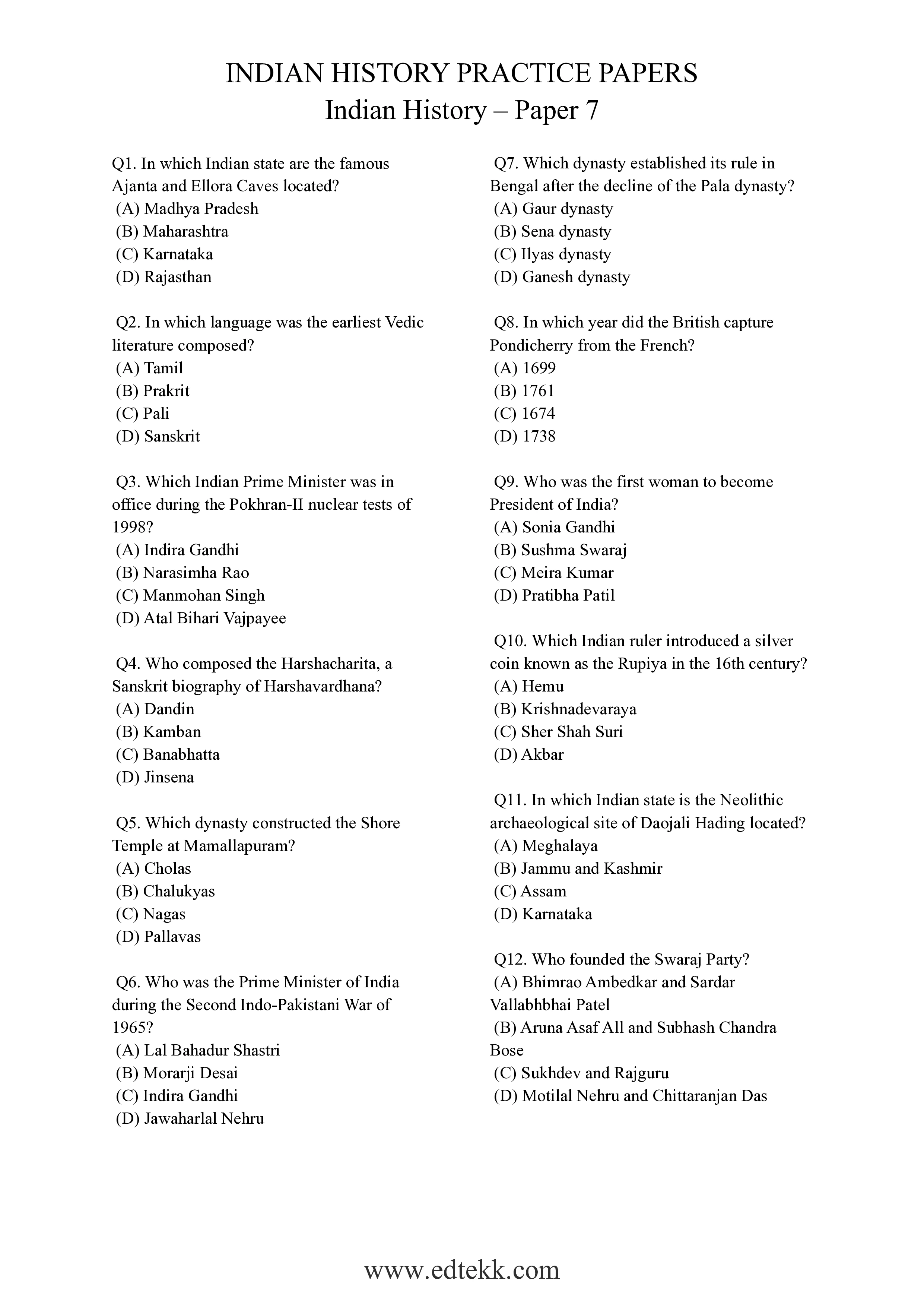
Prepare for upcoming competitive examinations through Indian History Practice Paper 7. Suitable for SSC exams, RRB NTPC, RRB Group D, Police Constable and Police SI, this practice set offers objective-type questions to assess your knowledge, along with correct answers and explanations for effective learning and revision.
Test Details
Topic: Indian History
Total Questions: 20
Question Format: MCQs – Single Correct Answer
Suitable for: SSC exams, RRB NTPC, RRB Group D, Police Constable, Police SI
Download All Papers in This Series (PDF)
Questions and Answers
Q1. In which Indian state are the famous Ajanta and Ellora Caves located?
(A) Madhya Pradesh
(B) Maharashtra
(C) Karnataka
(D) Rajasthan
Explanation: The Ajanta and Ellora Caves are located in Maharashtra, near Chhatrapati Sambhajinagar (formerly Aurangabad). Ajanta is renowned primarily for its Buddhist paintings and sculptures, while Ellora features Buddhist, Hindu and Jain monuments. Both are UNESCO World Heritage Sites.
Q2. In which language was the earliest Vedic literature composed?
(A) Tamil
(B) Prakrit
(C) Pali
(D) Sanskrit
Explanation: The earliest Vedic literature, including the Rigveda, was composed in Vedic Sanskrit, an ancient form of Sanskrit that differs in certain grammatical and linguistic features from Classical Sanskrit. These texts were transmitted orally across generations and preserve hymns, prayers, ritual formulas, and other material central to understanding early Vedic religious traditions.
Q3. Which Indian Prime Minister was in office during the Pokhran-II nuclear tests of 1998?
(A) Indira Gandhi
(B) Narasimha Rao
(C) Manmohan Singh
(D) Atal Bihari Vajpayee
Explanation: Atal Bihari Vajpayee was Prime Minister when India conducted the Pokhran-II nuclear tests in May 1998. Five underground nuclear explosions were carried out on 11 and 13 May. The tests established India’s declared nuclear weapons capability and triggered international diplomatic and economic reactions, including sanctions.
Q4. Who composed the Harshacharita, a Sanskrit biography of Harshavardhana?
(A) Dandin
(B) Kamban
(C) Banabhatta
(D) Jinsena
Explanation: Banabhatta, also known as Bana, was the court poet of Harshavardhana. He composed Harshacharita in Sanskrit, providing a biographical account of the emperor and valuable information about seventh-century Indian society, administration and political conditions. The work is an important example of classical Sanskrit prose literature.
Q5. Which dynasty constructed the Shore Temple at Mamallapuram?
(A) Cholas
(B) Chalukyas
(C) Nagas
(D) Pallavas
Explanation: The Shore Temple at Mamallapuram was constructed under the Pallava dynasty, particularly during the reign of Narasimhavarman II, also known as Rajasimha, in the eighth century CE. It is a structural stone temple complex overlooking the Bay of Bengal and represents an important achievement of Pallava architecture.
Q6. Who was the Prime Minister of India during the Second Indo-Pakistani War of 1965?
(A) Lal Bahadur Shastri
(B) Morarji Desai
(C) Indira Gandhi
(D) Jawaharlal Nehru
Explanation: Lal Bahadur Shastri was the Prime Minister of India during the Second Indo-Pakistani War in 1965. His leadership during the conflict strengthened India’s national resolve. His famous slogan “Jai Jawan, Jai Kisan” highlighted the importance of soldiers and farmers in national development.
Q7. Which dynasty established its rule in Bengal after the decline of the Pala dynasty?
(A) Gaur dynasty
(B) Sena dynasty
(C) Ilyas dynasty
(D) Ganesh dynasty
Explanation: The Sena dynasty rose to power in Bengal as the Pala dynasty declined. Its prominent rulers included Vijayasena, Ballalasena and Lakshmanasena. The Senas expanded their authority over substantial parts of Bengal and supported Brahmanical Hindu traditions. Their rule continued until Turkish military expansion brought major political changes to eastern India during the early thirteenth century.
Q8. In which year did the British capture Pondicherry from the French?
(A) 1699
(B) 1761
(C) 1674
(D) 1738
Explanation: The British captured Pondicherry from the French in 1761 during the Third Carnatic War (1756–1763). This significantly weakened French political influence in India. Under the Treaty of Paris (1763), Pondicherry was restored to French control, although French military and political influence remained restricted.
Q9. Who was the first woman to become President of India?
(A) Sonia Gandhi
(B) Sushma Swaraj
(C) Meira Kumar
(D) Pratibha Patil
Explanation: Pratibha Devisingh Patil became India’s first woman President on 25 July 2007. She served as the country’s 12th President until 25 July 2012. Before her election, she held several public offices, including Governor of Rajasthan. Her presidency marked a historic milestone in women’s representation in India’s highest constitutional office.
Q10. Which Indian ruler introduced a silver coin known as the Rupiya in the 16th century?
(A) Hemu
(B) Krishnadevaraya
(C) Sher Shah Suri
(D) Akbar
Explanation: Sher Shah Suri introduced a standardised silver coin called the Rupiya during the sixteenth century. It weighed approximately 178 grains, or 11.5 grams, and became an important precursor to the modern Indian rupee. His monetary reforms also included copper and gold coinage, contributing to greater consistency in the currency system.
Q11. In which Indian state is the Neolithic archaeological site of Daojali Hading located?
(A) Meghalaya
(B) Jammu and Kashmir
(C) Assam
(D) Karnataka
Explanation: Daojali Hading is a Neolithic archaeological site located in the Dima Hasao district of Assam. It is known for stone tools, including shouldered celts, and pottery. The site provides important evidence of Neolithic cultural developments in northeastern India and cultural connections with neighbouring regions of Southeast Asia.
Q12. Who founded the Swaraj Party?
(A) Bhimrao Ambedkar and Sardar Vallabhbhai Patel
(B) Aruna Asaf All and Subhash Chandra Bose
(C) Sukhdev and Rajguru
(D) Motilal Nehru and Chittaranjan Das
Explanation: The Swaraj Party was founded in January 1923 by Motilal Nehru and Chittaranjan Das. It emerged following disagreements within the Congress over the suspension of the Non-Cooperation Movement. The party advocated entering legislative councils to oppose and obstruct colonial administration from within.
Q13. The Barabar Caves, among the oldest surviving rock-cut caves in India, primarily belong to which historical period?
(A) Chola Dynasty
(B) Maurya Empire
(C) Chera Dynasty
(D) Gupta Empire
Explanation: The Barabar Caves were excavated during the Mauryan period, mainly in the third century BCE, under the patronage of Ashoka and his successors. Several inscriptions record donations to the Ajivika sect. Their remarkably smooth, polished granite interiors demonstrate sophisticated Mauryan stone-working techniques. These caves are among the earliest surviving examples of India’s rock-cut architectural tradition.
Q14. Which dynasty established Khajuraho as an important religious and cultural centre?
(A) Gupta
(B) Chandella
(C) Chola
(D) Maurya
Explanation: The Chandella rulers established Khajuraho as an important religious and cultural centre in central India. They patronised the construction of numerous Hindu and Jain temples, particularly between the tenth and eleventh centuries CE. These monuments reflect the Chandellas’ political power, religious patronage and contribution to medieval Indian temple architecture.
Q15. Who is traditionally credited with composing the Tamil epic Silappadikaram?
(A) Ilango Adigal
(B) Kalidasa
(C) Tholkappiyar
(D) Bharavi
Explanation: Ilango Adigal is traditionally regarded as the author of Silappadikaram, one of the five great Tamil epics. The epic narrates the story of Kannagi and Kovalan and belongs to classical Tamil literature. Ilango Adigal is traditionally associated with the Chera royal family, although his precise historical identity and the date of composition remain debated.
Q16. Who was affectionately known as the “Grand Old Man of India”?
(A) Dadabhai Naoroji
(B) Lal Bahadur Shastri
(C) Rajendra Prasad
(D) Bipin Chandra Pal
Explanation: Dadabhai Naoroji was popularly known as the “Grand Old Man of India.” He was an early nationalist leader, economist, and founding member of the Indian National Congress. His Drain Theory explained how British colonial rule transferred India’s wealth to Britain, contributing to India’s economic impoverishment. He also became the first Asian elected to the British House of Commons in 1892.
Q17. Who was the first President of the Republic of China?
(A) Yuan Shikai
(B) Li Xiannian
(C) Yang Shangkun
(D) Hu Jintao
Explanation: Yuan Shikai became the first regular President of the Republic of China in 1912. Sun Yat-sen had served as provisional president earlier that year following the 1911 Revolution. Yuan assumed the presidency in March 1912, marking the transition to the new republican government.
Q18. Who among the following was one of the founders of the Hindustan Republican Association?
(A) Ram Prasad Bismil
(B) Lala Lajpat Rai
(C) Surya Sen
(D) Jatindranath Mukherjee
Explanation: Ram Prasad Bismil was one of the prominent founders of the Hindustan Republican Association (HRA), established in 1924 to achieve India’s independence through revolutionary activities. Other important founders included Sachindra Nath Sanyal and Jogesh Chandra Chatterjee. In 1928, the organisation was reorganised as the Hindustan Socialist Republican Association (HSRA).
Q19. Which Indian state is associated with the Sakewa festival of the Kirat Khambu Rai community?
(A) Meghalaya
(B) Arunachal Pradesh
(C) Sikkim
(D) Nagaland
Explanation: Sakewa is an important religious and cultural festival of the Kirat Khambu Rai community, particularly in Sikkim. It is associated with the worship of Mother Nature and the Earth. Traditional rituals and dances are performed to seek prosperity, good health and agricultural abundance.
Q20. Who composed the music and wrote the lyrics of India’s national anthem, ‘Jana Gana Mana’?
(A) Bankim Chandra Chattopadhyay
(B) Sarvepalli Radhakrishnan
(C) M.S. Subbulakshmi
(D) Rabindranath Tagore
Explanation: Rabindranath Tagore composed the lyrics and music of India’s national anthem, Jana Gana Mana. It was first publicly sung at the Indian National Congress session in Calcutta in December 1911. Its first stanza was officially adopted as India’s national anthem by the Constituent Assembly on 24 January 1950.
Question Paper Images