Prepare for competitive examinations with these General Awareness revision questions on International and National Organisations. This practice set covers important organisations, their headquarters, objectives, functions and key facts through MCQs with answers and explanations for SSC, Railway, Banking and Police exams.
Test Details
Topic: International and National Organisations
Total Questions: 20
Question Format: MCQs – Single Correct Answer
Suitable for: SSC exams, Railway exams, Banking exams, Police Constable, Police SI
Download All Papers in This Series (PDF)
Questions and Answers
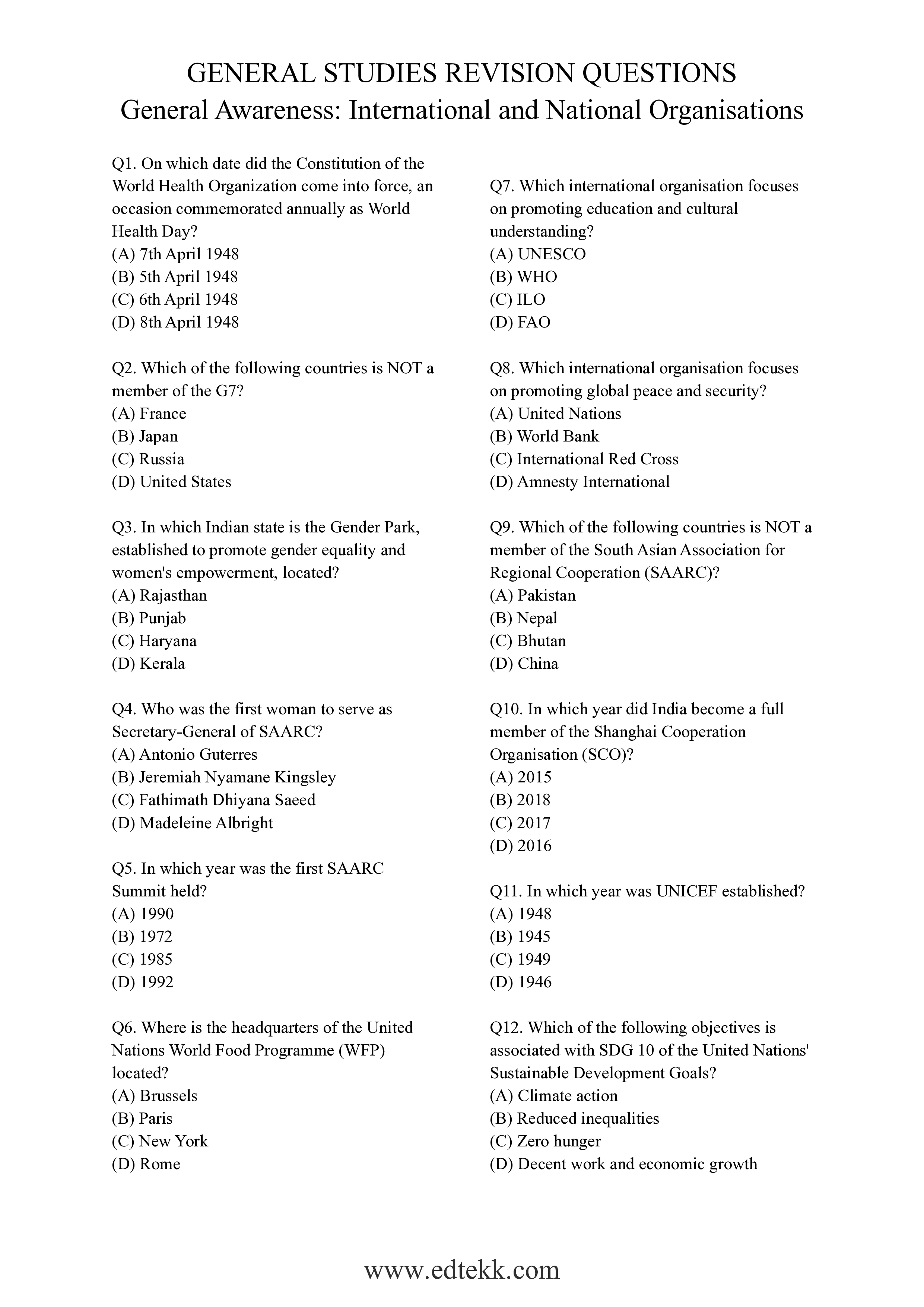
Q1. On which date did the Constitution of the World Health Organization come into force, an occasion commemorated annually as World Health Day?
(A) 7th April 1948
(B) 5th April 1948
(C) 6th April 1948
(D) 8th April 1948
Explanation: The Constitution of the World Health Organization (WHO) came into force on 7 April 1948, marking its formal establishment. World Health Day is observed annually on 7 April to commemorate this occasion and promote awareness of global public health issues.
Q2. Which of the following countries is NOT a member of the G7?
(A) France
(B) Japan
(C) Russia
(D) United States
Explanation: Russia is not currently a member of the G7. The group consists of Canada, France, Germany, Italy, Japan, the United Kingdom and the United States. Russia was previously part of the G8 but its participation was suspended in 2014 following its annexation of Crimea. The European Union also participates in G7 meetings but is not counted as a member country.
Q3. In which Indian state is the Gender Park, established to promote gender equality and women’s empowerment, located?
(A) Rajasthan
(B) Punjab
(C) Haryana
(D) Kerala
Explanation: The Gender Park is located in Kozhikode, Kerala. Established by the Government of Kerala, it is an institution dedicated to promoting gender equality, women’s empowerment and gender-inclusive development through research, education, policy initiatives and other programmes.
Q4. Who was the first woman to serve as Secretary-General of SAARC?
(A) Antonio Guterres
(B) Jeremiah Nyamane Kingsley
(C) Fathimath Dhiyana Saeed
(D) Madeleine Albright
Explanation: Fathimath Dhiyana Saeed of the Maldives became the first woman Secretary-General of the South Asian Association for Regional Cooperation (SAARC) in March 2011. She was also the first Maldivian to hold the position. SAARC was established in 1985 to promote regional cooperation among South Asian countries.
Q5. In which year was the first SAARC Summit held?
(A) 1990
(B) 1972
(C) 1985
(D) 1992
Explanation: The first SAARC Summit was held in Dhaka, Bangladesh, on 7–8 December 1985. The leaders of the seven founding member countries adopted the SAARC Charter, formally establishing the organisation to promote regional cooperation in economic, social and cultural development.
Q6. Where is the headquarters of the United Nations World Food Programme (WFP) located?
(A) Brussels
(B) Paris
(C) New York
(D) Rome
Explanation: The World Food Programme (WFP) is headquartered in Rome, Italy. Established in 1961, it is the United Nations’ principal humanitarian organisation providing food assistance during emergencies and supporting nutrition and food security. It received the Nobel Peace Prize in 2020 for its efforts to combat hunger and prevent the use of hunger as a weapon of conflict.
Q7. Which international organisation focuses on promoting education and cultural understanding?
(A) UNESCO
(B) WHO
(C) ILO
(D) FAO
Explanation: UNESCO stands for the United Nations Educational, Scientific and Cultural Organization. It promotes international cooperation in education, science, culture and communication. Its activities include protecting cultural heritage, supporting educational development, encouraging scientific collaboration and promoting intercultural dialogue and mutual understanding among nations.
Q8. Which international organisation focuses on promoting global peace and security?
(A) United Nations
(B) World Bank
(C) International Red Cross
(D) Amnesty International
Explanation: The United Nations (UN) promotes international peace and security through diplomacy, conflict prevention, peacekeeping operations and collective action by member states. Its responsibilities also include promoting international cooperation and human rights. The International Red Cross provides humanitarian assistance, Amnesty International campaigns for human rights, and the World Bank primarily supports economic development.
Q9. Which of the following countries is NOT a member of the South Asian Association for Regional Cooperation (SAARC)?
(A) Pakistan
(B) Nepal
(C) Bhutan
(D) China
Explanation: China is not a full member of SAARC; it holds observer status. Established in 1985, SAARC has eight member countries: Afghanistan, Bangladesh, Bhutan, India, Maldives, Nepal, Pakistan and Sri Lanka.
Q10. In which year did India become a full member of the Shanghai Cooperation Organisation (SCO)?
(A) 2015
(B) 2018
(C) 2017
(D) 2016
Explanation: India became a full member of the Shanghai Cooperation Organisation (SCO) in June 2017 at the Astana Summit in Kazakhstan, alongside Pakistan. India had previously held observer status since 2005. The SCO promotes regional security, counterterrorism, economic cooperation and political dialogue.
Q11. In which year was UNICEF established?
(A) 1948
(B) 1945
(C) 1949
(D) 1946
Explanation: UNICEF was established on 11 December 1946 by the United Nations General Assembly to provide emergency assistance to children affected by World War II. Originally called the United Nations International Children’s Emergency Fund, it was renamed the United Nations Children’s Fund in 1953 while retaining its acronym.
Q12. Which of the following objectives is associated with SDG 10 of the United Nations’ Sustainable Development Goals?
(A) Climate action
(B) Reduced inequalities
(C) Zero hunger
(D) Decent work and economic growth
Explanation: Sustainable Development Goal 10 focuses on reducing inequality within and among countries. It promotes social, economic and political inclusion, equal opportunities and reduced inequalities. It is one of the 17 Sustainable Development Goals adopted by United Nations member states in 2015 under the 2030 Agenda for Sustainable Development.
Q13. What is the name of India’s national space agency?
(A) ESA
(B) NASA
(C) ISRO
(D) ROSCOSMOS
Explanation: The Indian Space Research Organisation (ISRO) is India’s national space agency. Established in 1969, it conducts space research and develops satellites, launch vehicles and space-based applications. Its activities support communication, navigation, weather forecasting and Earth observation. ESA serves European countries, NASA is the United States’ space agency, and Roscosmos is Russia’s state space corporation.
Q14. Which organisation replaced the UN Commission on Human Rights?
(A) Secretariat
(B) Trusteeship Council
(C) Economic and Social Council
(D) Human Rights Council
Explanation: The United Nations Human Rights Council (UNHRC) replaced the UN Commission on Human Rights in 2006. Established by the UN General Assembly, it promotes and protects human rights worldwide. It consists of 47 member states elected by the General Assembly and conducts the Universal Periodic Review to assess human rights situations across UN member states.
Q15. In which city is the headquarters of the United Nations located?
(A) Geneva
(B) Brussels
(C) New York
(D) Paris
Explanation: The United Nations (UN) is headquartered in New York City, United States. Established in 1945, the organization works to maintain international peace and security, develop friendly relations among nations, promote international cooperation and protect human rights. Geneva, Paris and Brussels host other important international organizations but are not the UN’s headquarters.
Q16. In which year did Afghanistan become a member of SAARC?
(A) 2008
(B) 2005
(C) 2007
(D) 2006
Explanation: Afghanistan became the eighth member of SAARC in 2007 during the 14th SAARC Summit held in New Delhi, India. Its admission expanded the organisation beyond its seven founding members: Bangladesh, Bhutan, India, Maldives, Nepal, Pakistan and Sri Lanka.
Q17. Which international organisation focuses on promoting economic and social progress in Asia and the Pacific?
(A) ADB
(B) ASEAN
(C) SAARC
(D) OECD
Explanation: The Asian Development Bank (ADB) promotes economic and social development across Asia and the Pacific. It provides loans, grants, technical assistance and other development support to its member countries. Its activities include infrastructure development, poverty reduction and regional cooperation. ASEAN focuses on Southeast Asian cooperation, SAARC on South Asian cooperation, and the OECD on international economic and public-policy coordination.
Q18. In which city was the SAARC Charter signed during the organisation’s first summit in 1985?
(A) Colombo
(B) Delhi
(C) Thimphu
(D) Dhaka
Explanation: The SAARC Charter was signed in Dhaka, Bangladesh, on 8 December 1985 during the first SAARC Summit. The seven founding members were Bangladesh, Bhutan, India, Maldives, Nepal, Pakistan and Sri Lanka. The Charter established a framework for regional cooperation and collective self-reliance.
Q19. Which of the following countries is NOT a member of the South Asian Association for Regional Cooperation (SAARC)?
(A) Thailand
(B) Afghanistan
(C) Maldives
(D) Bangladesh
Explanation: Thailand is not a member of the South Asian Association for Regional Cooperation (SAARC). SAARC has eight member countries: Afghanistan, Bangladesh, Bhutan, India, Maldives, Nepal, Pakistan and Sri Lanka. Thailand belongs to Southeast Asia and is a member of the Association of Southeast Asian Nations (ASEAN).
Q20. Which institution is the sister organisation of the International Development Association (IDA) within the World Bank Group?
(A) UNDP
(B) IBRD
(C) UNIDO
(D) IFAD
Explanation: The International Bank for Reconstruction and Development (IBRD) is the sister institution of the International Development Association (IDA) within the World Bank Group. IBRD primarily provides loans to middle-income and creditworthy low-income countries, whereas IDA provides concessional loans and grants to the world’s poorest countries.
Question Paper Images