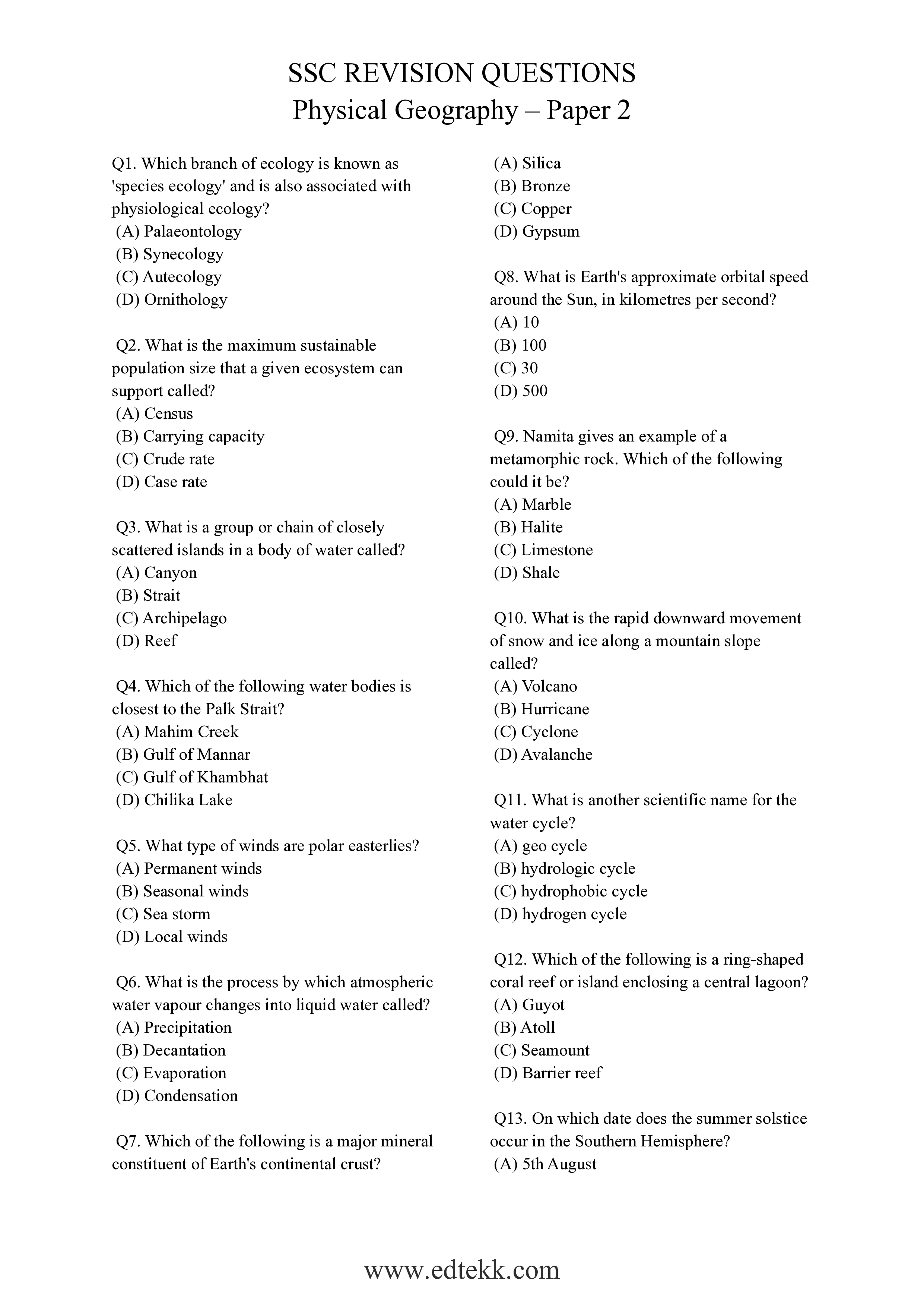
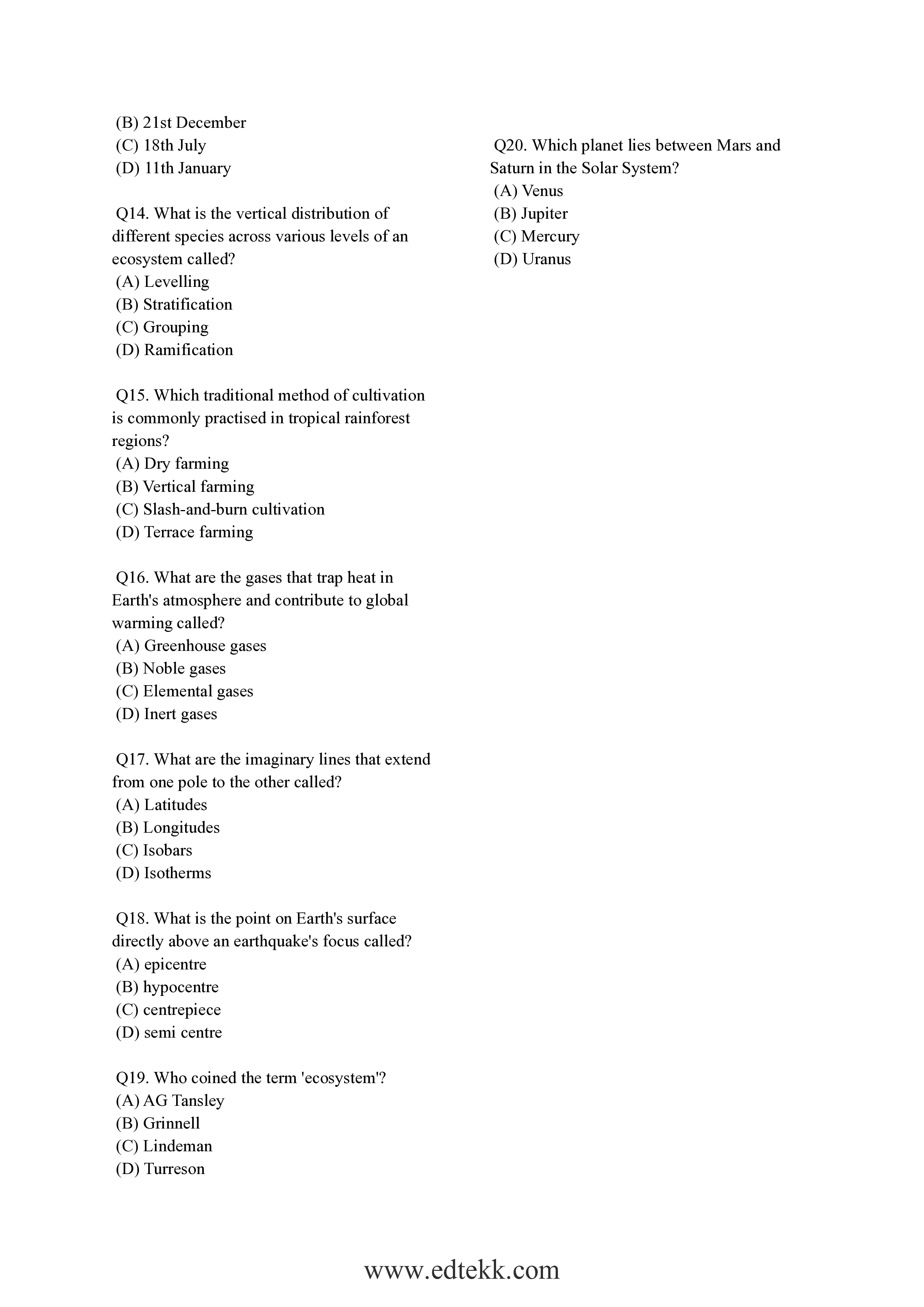
Strengthen your conceptual understanding with Paper 2 of the Physical Geography SSC revision series. This practice set includes objective-type questions covering important physical geography concepts for competitive-exam preparation. It is suitable for SSC CGL, CHSL, CPO, MTS, GD and Selection Post candidates, with answers and explanations.
Test Details
Topic: Physical Geography
Total Questions: 20
Question Format: MCQs – Single Correct Answer
Suitable for: SSC CGL, CHSL, CPO, MTS, GD, Selection Post
Download All Papers in This Series (PDF)
Questions and Answers
Q1. Which branch of ecology is known as ‘species ecology’ and is also associated with physiological ecology?
(A) Palaeontology
(B) Synecology
(C) Autecology
(D) Ornithology
Explanation: Autecology, also known as species ecology, studies an individual species in relation to its environment. It examines physiological responses, ecological requirements and adaptations. Physiological ecology overlaps with autecology because both investigate how organisms respond to environmental factors such as temperature, moisture and light. Synecology, in contrast, studies ecological communities.
Q2. What is the maximum sustainable population size that a given ecosystem can support called?
(A) Census
(B) Carrying capacity
(C) Crude rate
(D) Case rate
Explanation: Carrying capacity is the maximum population size of a species that an environment can sustainably support under prevailing conditions. It depends on available resources such as food, water, space and shelter, as well as competition, predation and disease. Carrying capacity is dynamic and may change with environmental conditions.
Q3. What is a group or chain of closely scattered islands in a body of water called?
(A) Canyon
(B) Strait
(C) Archipelago
(D) Reef
Explanation: An archipelago is a group or chain of islands located relatively close to one another within a body of water. Archipelagos may originate through volcanic activity, tectonic movements, coral formation or other geological processes. Examples include the Andaman and Nicobar Islands and the Indonesian Archipelago.
Q4. Which of the following water bodies is closest to the Palk Strait?
(A) Mahim Creek
(B) Gulf of Mannar
(C) Gulf of Khambhat
(D) Chilika Lake
Explanation: The Gulf of Mannar lies between southeastern India and Sri Lanka, immediately south of the Palk Strait and Adam’s Bridge (Rama Setu). The Palk Strait connects the Bay of Bengal with Palk Bay. The Gulf of Mannar is the closest listed water body.
Q5. What type of winds are polar easterlies?
(A) Permanent winds
(B) Seasonal winds
(C) Sea storm
(D) Local winds
Explanation: Polar easterlies are permanent planetary winds that blow from the polar high-pressure regions towards the subpolar low-pressure belts. Due to Earth’s rotation, they are deflected westward by the Coriolis force, producing easterly winds. They occur in both the Northern and Southern Hemispheres and form part of the global atmospheric circulation system.
Q6. What is the process by which atmospheric water vapour changes into liquid water called?
(A) Precipitation
(B) Decantation
(C) Evaporation
(D) Condensation
Explanation: Condensation is the process by which water vapour changes into liquid water, generally when air cools to its dew point and becomes saturated. In the atmosphere, condensation contributes to the formation of clouds, fog and dew. Evaporation is the reverse process, in which liquid water changes into water vapour.
Q7. Which of the following is a major mineral constituent of Earth’s continental crust?
(A) Silica
(B) Bronze
(C) Copper
(D) Gypsum
Explanation: Silica is a major constituent of the continental crust and occurs in minerals such as quartz and in numerous silicate minerals. Continental crust is generally richer in silica and aluminium than oceanic crust, which has relatively higher proportions of iron and magnesium. Among the given options, silica is the correct answer.
Q8. What is Earth’s approximate orbital speed around the Sun, in kilometres per second?
(A) 10
(B) 100
(C) 30
(D) 500
Explanation: Earth travels around the Sun at an average orbital speed of approximately 29.8 km/s, commonly rounded to 30 km/s. Its orbital speed varies because its orbit is elliptical: Earth moves faster near perihelion and slower near aphelion.
Q9. Namita gives an example of a metamorphic rock. Which of the following could it be?
(A) Marble
(B) Halite
(C) Limestone
(D) Shale
Explanation: Marble is a metamorphic rock formed mainly when limestone or dolostone undergoes recrystallisation under heat and pressure. This process produces interlocking crystals, primarily of calcite or dolomite. Halite is a mineral commonly found in evaporite deposits, while limestone and shale are sedimentary rocks.
Q10. What is the rapid downward movement of snow and ice along a mountain slope called?
(A) Volcano
(B) Hurricane
(C) Cyclone
(D) Avalanche
Explanation: An avalanche is the rapid downward movement of a mass of snow along a mountain slope, often carrying ice, rocks and other debris. It may be triggered by heavy snowfall, changes in temperature, disturbances in snow layers or human activity. Avalanches are significant natural hazards in mountainous regions.
Q11. What is another scientific name for the water cycle?
(A) geo cycle
(B) hydrologic cycle
(C) hydrophobic cycle
(D) hydrogen cycle
Explanation: The water cycle, also called the hydrologic cycle, describes the continuous circulation of water between the Earth’s surface, atmosphere and subsurface. Its major processes include evaporation, transpiration, condensation, precipitation, infiltration and surface runoff. Solar energy and gravity are the principal forces driving this natural cycle.
Q12. Which of the following is a ring-shaped coral reef or island enclosing a central lagoon?
(A) Guyot
(B) Atoll
(C) Seamount
(D) Barrier reef
Explanation: An atoll is a ring-shaped coral reef or island that surrounds a central lagoon, either completely or partially. Atolls commonly develop around volcanic islands as coral reefs grow while the original island gradually subsides. They are particularly common in tropical and subtropical regions of the Indian and Pacific Oceans.
Q13. On which date does the summer solstice occur in the Southern Hemisphere?
(A) 5th August
(B) 21st December
(C) 18th July
(D) 11th January
Explanation: The summer solstice in the Southern Hemisphere occurs around 21 December, when this hemisphere experiences its longest day and shortest night. The exact date and time may vary slightly from year to year. Conversely, the December solstice marks the beginning of astronomical winter in the Northern Hemisphere.
Q14. What is the vertical distribution of different species across various levels of an ecosystem called?
(A) Levelling
(B) Stratification
(C) Grouping
(D) Ramification
Explanation: Stratification refers to the vertical distribution of organisms within an ecosystem into distinct layers. In forests, vegetation is commonly arranged into canopy, understory, shrub and ground layers. Different species occupy these layers according to their requirements for sunlight, moisture, temperature and other environmental resources.
Q15. Which traditional method of cultivation is commonly practised in tropical rainforest regions?
(A) Dry farming
(B) Vertical farming
(C) Slash-and-burn cultivation
(D) Terrace farming
Explanation: Slash-and-burn cultivation is a traditional agricultural practice commonly associated with tropical rainforest regions. It involves cutting and burning vegetation to clear land and temporarily enrich the soil with ash. It is frequently practised as part of shifting cultivation, in which farmers move to another plot after soil fertility declines.
Q16. What are the gases that trap heat in Earth’s atmosphere and contribute to global warming called?
(A) Greenhouse gases
(B) Noble gases
(C) Elemental gases
(D) Inert gases
Explanation: Greenhouse gases absorb and re-emit outgoing infrared radiation, trapping heat in the atmosphere and contributing to global warming. Important greenhouse gases include carbon dioxide, methane, nitrous oxide and water vapour. Human activities, particularly fossil fuel combustion and deforestation, have increased the atmospheric concentrations of several long-lived greenhouse gases.
Q17. What are the imaginary lines that extend from one pole to the other called?
(A) Latitudes
(B) Longitudes
(C) Isobars
(D) Isotherms
Explanation: Longitudes, also called meridians, are imaginary semicircles extending from the North Pole to the South Pole. They are used to determine locations east or west of the Prime Meridian. Latitudes, in contrast, are imaginary circles running parallel to the Equator.
Q18. What is the point on Earth’s surface directly above an earthquake’s focus called?
(A) epicentre
(B) hypocentre
(C) centrepiece
(D) semi centre
Explanation: The epicentre is the point on Earth’s surface directly above the earthquake’s focus, also called the hypocentre. The focus is the underground location where an earthquake originates and seismic energy is first released. Therefore, the epicentre is the surface point vertically above the focus, not necessarily the location of maximum damage.
Q19. Who coined the term ‘ecosystem’?
(A) AG Tansley
(B) Grinnell
(C) Lindeman
(D) Turreson
Explanation: British ecologist Arthur George Tansley introduced the term ecosystem in 1935. It describes an integrated system comprising living organisms and their physical environment. The concept emphasises interactions between biotic and abiotic components, including energy flow and nutrient cycling.
Q20. Which planet lies between Mars and Saturn in the Solar System?
(A) Venus
(B) Jupiter
(C) Mercury
(D) Uranus
Explanation: The correct sequence of planets from the Sun is Mercury, Venus, Earth, Mars, Jupiter, Saturn, Uranus and Neptune. Therefore, Jupiter lies between Mars and Saturn in order of increasing distance from the Sun.
Question Paper Images