Build your General Awareness knowledge with 20 Books and Authors MCQs – Paper 1 for Police Constable and Police SI examinations. This practice set covers famous books, their authors, notable literary works and important Indian and international writers, with answers and explanations to support effective competitive-exam preparation.
Test Details
Topic: Books and Authors
Total Questions: 20
Question Format: MCQs – Single Correct Answer
Suitable for: Police Constable, Police SI
Download All Papers in This Series (PDF)
Questions and Answers
Q1. Who authored Principles of Political Economy?
(A) Milton Friedman
(B) John Stuart Mill
(C) Joseph Schumpeter
(D) David Ricardo
Explanation: John Stuart Mill authored Principles of Political Economy, first published in 1848. The book discusses major economic concepts, including production, distribution, economic value, wages, profits and international trade. It became one of the influential works of classical economics and significantly shaped nineteenth-century economic thought.
Q2. Which of the following books was NOT written by Ruskin Bond?
(A) The Room on the Roof
(B) Midnight’s Children
(C) The Blue Umbrella
(D) Roads to Mussoorie
Explanation: Midnight’s Children was written by Salman Rushdie and published in 1981. The novel follows Saleem Sinai, whose life becomes connected with India’s independence and subsequent political history. Ruskin Bond authored the other three listed works: The Room on the Roof, The Blue Umbrella and Roads to Mussoorie.
Q3. Which of the following ancient literary works was written by Banabhatta?
(A) Mrichchhakatika
(B) Kadambari
(C) Meghadutam
(D) Gitagovinda
Explanation: Kadambari is a classical Sanskrit prose romance attributed to Banabhatta, a prominent writer in the court of King Harshavardhana during the seventh century CE. Banabhatta began the work, which was completed by his son Bhushanabhatta. He also authored Harshacharita, a biography of Harshavardhana.
Q4. Who authored the book The Idea of India?
(A) Amartya Sen
(B) Girish Kuber
(C) Amitav Ghosh
(D) Sunil Khilnani
Explanation: The Idea of India was authored by Sunil Khilnani and published in 1997. The book examines the evolution of modern India, its democratic foundations, secularism, diversity and political identity. It explores the ideas and institutions that shaped the Indian nation after independence.
Q5. Who authored the book The Bird of Time: Songs of Life, Death and the Spring?
(A) Vikram Seth
(B) Sarojini Naidu
(C) Rabindranath Tagore
(D) Kamala Suraiyya
Explanation: The Bird of Time: Songs of Life, Death and the Spring is a collection of poems by Sarojini Naidu, first published in 1912. The collection explores themes of love, nature, Indian culture, mortality and the passage of time. Sarojini Naidu is popularly known as the Nightingale of India.
Q6. Which of the following books is the autobiography of former US President Bill Clinton?
(A) Becoming
(B) Long Walk to Freedom
(C) My Life
(D) My Country My Life
Explanation: My Life is the autobiography of former US President Bill Clinton, published in 2004. It covers his childhood, education, political career, presidency and personal experiences. Clinton served as the 42nd President of the United States from 1993 to 2001.
Q7. Whose autobiography is titled Daughter of Destiny: An Autobiography?
(A) Benazir Bhutto
(B) Kamala Das
(C) Urvashi Butalia
(D) Malala Yousafzai
Explanation: Daughter of Destiny: An Autobiography is the autobiography of Benazir Bhutto, former Prime Minister of Pakistan. The book describes her childhood, family background, political upbringing and experiences in Pakistani politics.
Q8. What is the title of Nirad C. Chaudhuri’s autobiography?
(A) The Autobiography of an Unknown Indian
(B) Matters of Discretion
(C) the Race of My Life
(D) An Autobiography of a Yogi
Explanation: The Autobiography of an Unknown Indian is the autobiography of Nirad C. Chaudhuri, an Indian writer and intellectual. Published in 1951, the book describes his childhood, upbringing and experiences in colonial India. It is widely regarded as an important work of Indian autobiographical literature.
Q9. Who wrote the historical novel The Enchantress of Florence?
(A) William Dalrymple
(B) Salman Rushdie
(C) Rajmohan Gandhi
(D) Arunima Sinha
Explanation: The Enchantress of Florence is a historical novel written by Salman Rushdie and published in 2008. It connects Mughal India under Emperor Akbar with Renaissance Florence through an imaginative narrative involving history, mythology, love and political intrigue. The novel explores storytelling, power and cultural exchange.
Q10. Who wrote Si-yu-ki, also known as The Records of the Western World?
(A) Hiuen Tsiang
(B) Marco Polo
(C) Fa-Hien
(D) Abdur Razzak
Explanation: Si-yu-ki, commonly known as the Records of the Western Regions, is associated with the Chinese Buddhist monk and traveller Xuanzang (Hiuen Tsang/Hiuen Tsiang). It records his seventh-century journey through Central Asia and India and provides valuable information on contemporary Indian society and Buddhism.
Q11. Which freedom fighter wrote The Story of My Experiments with Truth?
(A) BR Ambedkar
(B) Jawaharlal Nehru
(C) Mahatma Gandhi
(D) Bhagat Singh
Explanation: Mahatma Gandhi wrote The Story of My Experiments with Truth, his autobiography. Originally written in Gujarati under the title Satya Na Prayogo Athva Atmakatha, it recounts his life, personal experiences, moral struggles and experiments with truth and non-violence. Mahadev Desai translated the autobiography into English.
Q12. Who wrote the novel The Satanic Verses?
(A) Salman Rushdie
(B) Kushal Das
(C) Rammurthy
(D) John Grisham
Explanation: The Satanic Verses is a novel by Salman Rushdie, published in 1988. It explores migration, identity, religion, cultural conflict and transformation through magical-realism elements. The novel became highly controversial internationally because of its treatment of religious themes.
Q13. Which of the following books is the autobiography of Indian novelist Khushwant Singh?
(A) My Confession
(B) My Story
(C) My Autobiography
(D) Truth, Love and A Little Malice
Explanation: Truth, Love and a Little Malice is the autobiography of Khushwant Singh, the renowned Indian novelist, journalist and columnist. Published in 2002, it provides candid accounts of his personal life, literary career, political experiences and interactions with prominent personalities.
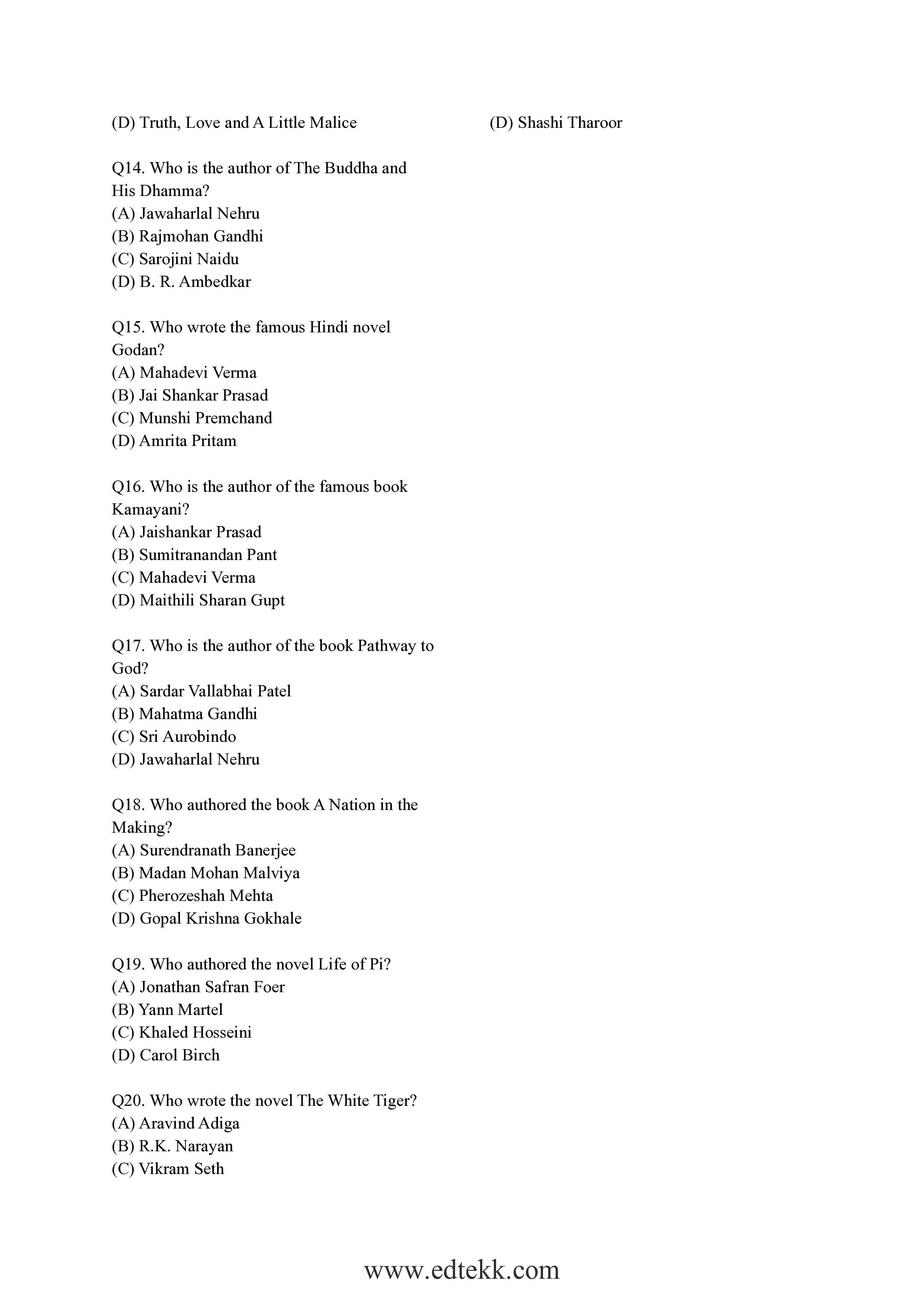
Q14. Who is the author of The Buddha and His Dhamma?
(A) Jawaharlal Nehru
(B) Rajmohan Gandhi
(C) Sarojini Naidu
(D) B. R. Ambedkar
Explanation: Dr. B. R. Ambedkar authored The Buddha and His Dhamma, which was published posthumously in 1957. The book presents his interpretation of Buddhism, emphasising rationality, morality, social equality and the rejection of caste discrimination. It became an important philosophical text for the Navayana Buddhist movement associated with his conversion in 1956.
Q15. Who wrote the famous Hindi novel Godan?
(A) Mahadevi Verma
(B) Jai Shankar Prasad
(C) Munshi Premchand
(D) Amrita Pritam
Explanation: Munshi Premchand authored the famous Hindi novel Godan, published in 1936. The novel portrays the struggles of Indian peasants, particularly through the life of its central character, Hori. It is widely regarded as one of the most significant works of modern Hindi literature.
Q16. Who is the author of the famous book Kamayani?
(A) Jaishankar Prasad
(B) Sumitranandan Pant
(C) Mahadevi Verma
(D) Maithili Sharan Gupt
Explanation: Jaishankar Prasad wrote Kamayani, a celebrated Hindi epic poem published in 1936. It is regarded as a major work of the Chhayavad movement in Hindi literature. The poem features mythological characters such as Manu, Shraddha and Ida to explore human emotions, intellect, faith and the relationship between human consciousness and civilisation.
Q17. Who is the author of the book Pathway to God?
(A) Sardar Vallabhai Patel
(B) Mahatma Gandhi
(C) Sri Aurobindo
(D) Jawaharlal Nehru
Explanation: Mahatma Gandhi is the author of Pathway to God, a compilation of his writings and speeches edited and compiled by M. S. Deshpande. First published in 1971 by Navajivan Publishing House, the book discusses Gandhi’s spiritual philosophy, truth, non-violence, selfless service and the pursuit of God.
Q18. Who authored the book A Nation in the Making?
(A) Surendranath Banerjee
(B) Madan Mohan Malviya
(C) Pherozeshah Mehta
(D) Gopal Krishna Gokhale
Explanation: Surendranath Banerjee authored A Nation in the Making, published in 1925. The autobiography provides an account of his political activities, public life and contribution to Indian nationalism. He was one of the prominent early leaders of the Indian National Congress and advocated constitutional reforms.
Q19. Who authored the novel Life of Pi?
(A) Jonathan Safran Foer
(B) Yann Martel
(C) Khaled Hosseini
(D) Carol Birch
Explanation: Yann Martel, a Canadian author, wrote Life of Pi, published in 2001. The novel follows Piscine Molitor Patel, an Indian boy who survives a shipwreck and is stranded on a lifeboat with a Bengal tiger named Richard Parker. It won the 2002 Booker Prize.
Q20. Who wrote the novel The White Tiger?
(A) Aravind Adiga
(B) R.K. Narayan
(C) Vikram Seth
(D) Shashi Tharoor
Explanation: Aravind Adiga authored the novel The White Tiger, published in 2008. The novel explores social inequality, class divisions, poverty and corruption in India through the experiences of its protagonist, Balram Halwai. It won the 2008 Booker Prize.
Question Paper Images