Test your knowledge of the Indian Constitution with this comprehensive topicwise MCQ practice set. It covers constitutional features, the Preamble, sources, constitutional provisions, schedules, parts and important constitutional principles. With accurate answers and explanations, these questions support preparation for SSC, Railway, Police Constable and Police SI examinations.
Test Details
Topic: Polity: The Constitution
Total Questions: 20
Question Format: MCQs – Single Correct Answer
Suitable for: SSC exams, Railway exams, Police Constable, Police SI
Download All Papers in This Series (PDF)
Questions and Answers
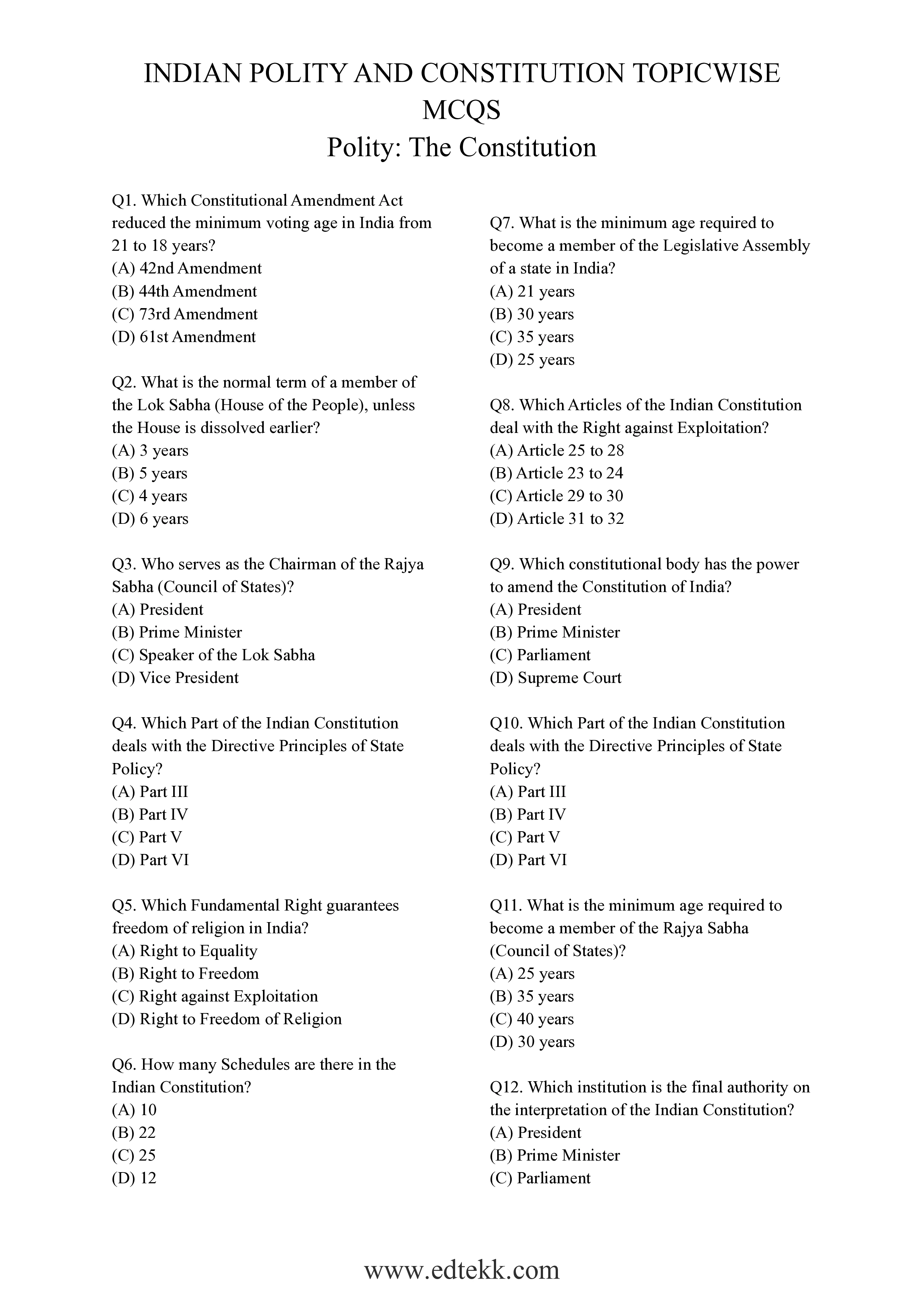
Q1. Which Constitutional Amendment Act reduced the minimum voting age in India from 21 to 18 years?
(A) 42nd Amendment
(B) 44th Amendment
(C) 73rd Amendment
(D) 61st Amendment
Explanation: The 61st Constitutional Amendment Act, 1988, reduced the minimum voting age from 21 to 18 years for elections to the Lok Sabha and State Legislative Assemblies. It amended Article 326 of the Constitution, thereby expanding democratic participation by allowing younger citizens to exercise their voting rights.
Q2. What is the normal term of a member of the Lok Sabha (House of the People), unless the House is dissolved earlier?
(A) 3 years
(B) 5 years
(C) 4 years
(D) 6 years
Explanation: The normal tenure of the Lok Sabha is five years from the date appointed for its first meeting, unless dissolved earlier. During a National Emergency, Parliament may extend its term by one year at a time, but such an extension cannot continue beyond six months after the Emergency ceases to operate.
Q3. Who serves as the Chairman of the Rajya Sabha (Council of States)?
(A) President
(B) Prime Minister
(C) Speaker of the Lok Sabha
(D) Vice President
Explanation: The Vice-President of India is the ex-officio Chairman of the Rajya Sabha under Article 89(1) of the Constitution. The Chairman presides over its proceedings, maintains order and ensures that parliamentary business is conducted according to established rules. The Vice-President is not a member of the Rajya Sabha.
Q4. Which Part of the Indian Constitution deals with the Directive Principles of State Policy?
(A) Part III
(B) Part IV
(C) Part V
(D) Part VI
Explanation: Part IV (Articles 36–51) of the Indian Constitution deals with the Directive Principles of State Policy (DPSP). These principles guide the State in establishing social and economic justice and promoting public welfare. They are not directly enforceable by courts under Article 37 but are fundamental to the governance of the country.
Q5. Which Fundamental Right guarantees freedom of religion in India?
(A) Right to Equality
(B) Right to Freedom
(C) Right against Exploitation
(D) Right to Freedom of Religion
Explanation: The Right to Freedom of Religion is one of the six categories of Fundamental Rights under Part III of the Constitution. Articles 25–28 protect freedom of conscience, the right to profess, practise and propagate religion, and certain related religious freedoms, subject to constitutional restrictions.
Q6. How many Schedules are there in the Indian Constitution?
(A) 10
(B) 22
(C) 25
(D) 12
Explanation: The Indian Constitution originally contained eight Schedules. Following subsequent constitutional amendments, their number increased to 12. The Schedules deal with various subjects, including the allocation of Rajya Sabha seats, administration of tribal areas, official languages, anti-defection provisions and distribution of legislative powers.
Q7. What is the minimum age required to become a member of the Legislative Assembly of a state in India?
(A) 21 years
(B) 30 years
(C) 35 years
(D) 25 years
Explanation: A person must be at least 25 years old to become a member of the Legislative Assembly of a State under Article 173(b) of the Constitution. The candidate must also be an Indian citizen and fulfil the prescribed electoral and other statutory qualifications under the Representation of the People Act, 1951.
Q8. Which Articles of the Indian Constitution deal with the Right against Exploitation?
(A) Article 25 to 28
(B) Article 23 to 24
(C) Article 29 to 30
(D) Article 31 to 32
Explanation: Articles 23 and 24 of the Indian Constitution deal with the Right against Exploitation. Article 23 prohibits human trafficking, begar and other forms of forced labour. Article 24 prohibits the employment of children below 14 years of age in factories, mines and other hazardous employment, thereby protecting human dignity and preventing exploitation.
Q9. Which constitutional body has the power to amend the Constitution of India?
(A) President
(B) Prime Minister
(C) Parliament
(D) Supreme Court
Explanation: Parliament has the power to amend the Indian Constitution under Article 368. Most constitutional amendments require a special majority in both Houses of Parliament, while amendments affecting specified federal provisions also require ratification by at least half of the State Legislatures. The President is constitutionally required to give assent to a duly passed Constitution Amendment Bill.
Q10. Which Part of the Indian Constitution deals with the Directive Principles of State Policy?
(A) Part III
(B) Part IV
(C) Part V
(D) Part VI
Explanation: Part IV (Articles 36–51) of the Indian Constitution deals with the Directive Principles of State Policy. These principles guide the State in promoting social and economic justice and public welfare. Although they are not directly enforceable by courts, Article 37 declares them fundamental to the governance of the country.
Q11. What is the minimum age required to become a member of the Rajya Sabha (Council of States)?
(A) 25 years
(B) 35 years
(C) 40 years
(D) 30 years
Explanation: A person must be at least 30 years old to become a member of the Rajya Sabha under Article 84(b) of the Indian Constitution. This minimum age is higher than the 25-year requirement for membership of the Lok Sabha. Candidates must also satisfy the applicable citizenship and other statutory qualifications.
Q12. Which institution is the final authority on the interpretation of the Indian Constitution?
(A) President
(B) Prime Minister
(C) Parliament
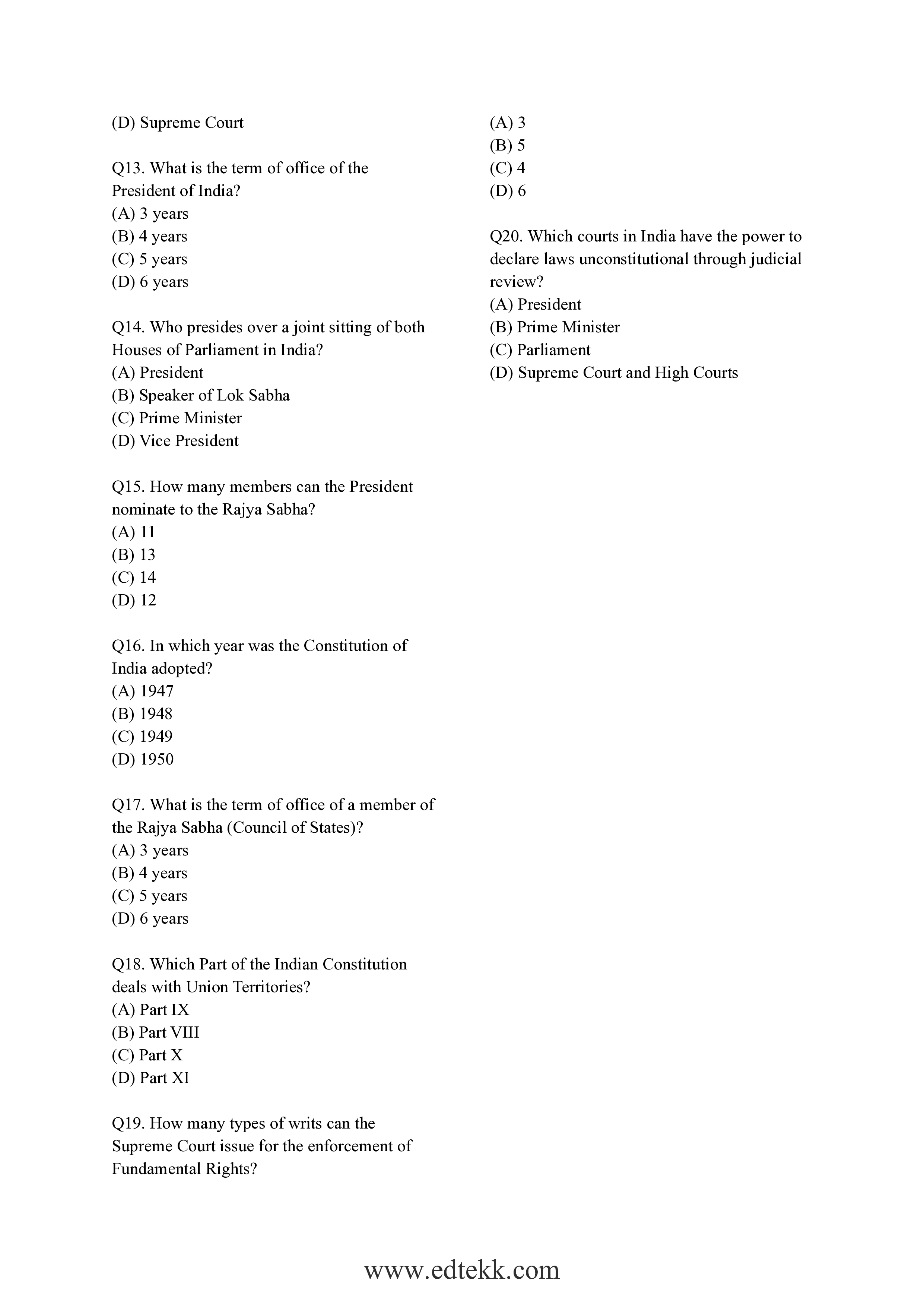
(D) Supreme Court
Explanation: The Supreme Court of India is the highest judicial authority and the final interpreter of the Constitution within the Indian judicial system. It interprets constitutional provisions, adjudicates constitutional disputes and exercises judicial review to examine the constitutional validity of laws and government actions. Its judgments are binding on all courts in India under Article 141.
Q13. What is the term of office of the President of India?
(A) 3 years
(B) 4 years
(C) 5 years
(D) 6 years
Explanation: The President of India holds office for a term of five years from the date of assuming office. The President may resign, be removed through impeachment for violation of the Constitution, or continue in office until the successor assumes office. The Constitution permits re-election without prescribing a maximum number of terms.
Q14. Who presides over a joint sitting of both Houses of Parliament in India?
(A) President
(B) Speaker of Lok Sabha
(C) Prime Minister
(D) Vice President
Explanation: The Speaker of the Lok Sabha presides over a joint sitting of both Houses of Parliament under Article 118(4) of the Constitution. In the Speaker’s absence, the Deputy Speaker presides, followed by the Deputy Chairman of the Rajya Sabha. If all three are absent, another member may preside as determined by the rules of procedure.
Q15. How many members can the President nominate to the Rajya Sabha?
(A) 11
(B) 13
(C) 14
(D) 12
Explanation: The President nominates 12 members to the Rajya Sabha under Article 80(1)(a) of the Constitution. These members are selected for their special knowledge or practical experience in literature, science, art and social service. Their nomination enables individuals with expertise in these fields to contribute to parliamentary deliberations.
Q16. In which year was the Constitution of India adopted?
(A) 1947
(B) 1948
(C) 1949
(D) 1950
Explanation: The Indian Constitution was adopted by the Constituent Assembly on 26 November 1949. It came into force on 26 January 1950, which is celebrated as Republic Day. The distinction between adoption and commencement is important for understanding the constitutional timeline.
Q17. What is the term of office of a member of the Rajya Sabha (Council of States)?
(A) 3 years
(B) 4 years
(C) 5 years
(D) 6 years
Explanation: A member of the Rajya Sabha serves a six-year term. Under Article 83(1), the Rajya Sabha is a permanent House and is not subject to dissolution. Approximately one-third of its members retire every two years, ensuring continuity in parliamentary functioning.
Q18. Which Part of the Indian Constitution deals with Union Territories?
(A) Part IX
(B) Part VIII
(C) Part X
(D) Part XI
Explanation: Part VIII of the Indian Constitution (Articles 239–242) deals with Union Territories. It provides for their administration by the President through appointed administrators and includes special constitutional arrangements for certain Union Territories having legislatures.
Q19. How many types of writs can the Supreme Court issue for the enforcement of Fundamental Rights?
(A) 3
(B) 5
(C) 4
(D) 6
Explanation: The Supreme Court can issue five types of writs under Article 32 to enforce Fundamental Rights: Habeas Corpus, Mandamus, Prohibition, Certiorari and Quo Warranto. These writs protect individuals against unlawful detention, improper exercise of jurisdiction and other violations of legal or constitutional rights.
Q20. Which courts in India have the power to declare laws unconstitutional through judicial review?
(A) President
(B) Prime Minister
(C) Parliament
(D) Supreme Court and High Courts
Explanation: The Supreme Court and High Courts exercise the power of judicial review in India. They can examine the constitutional validity of legislative enactments and executive actions. If a law or action violates the Constitution, the courts may declare it unconstitutional and invalidate it, wholly or partially.
Question Paper Images