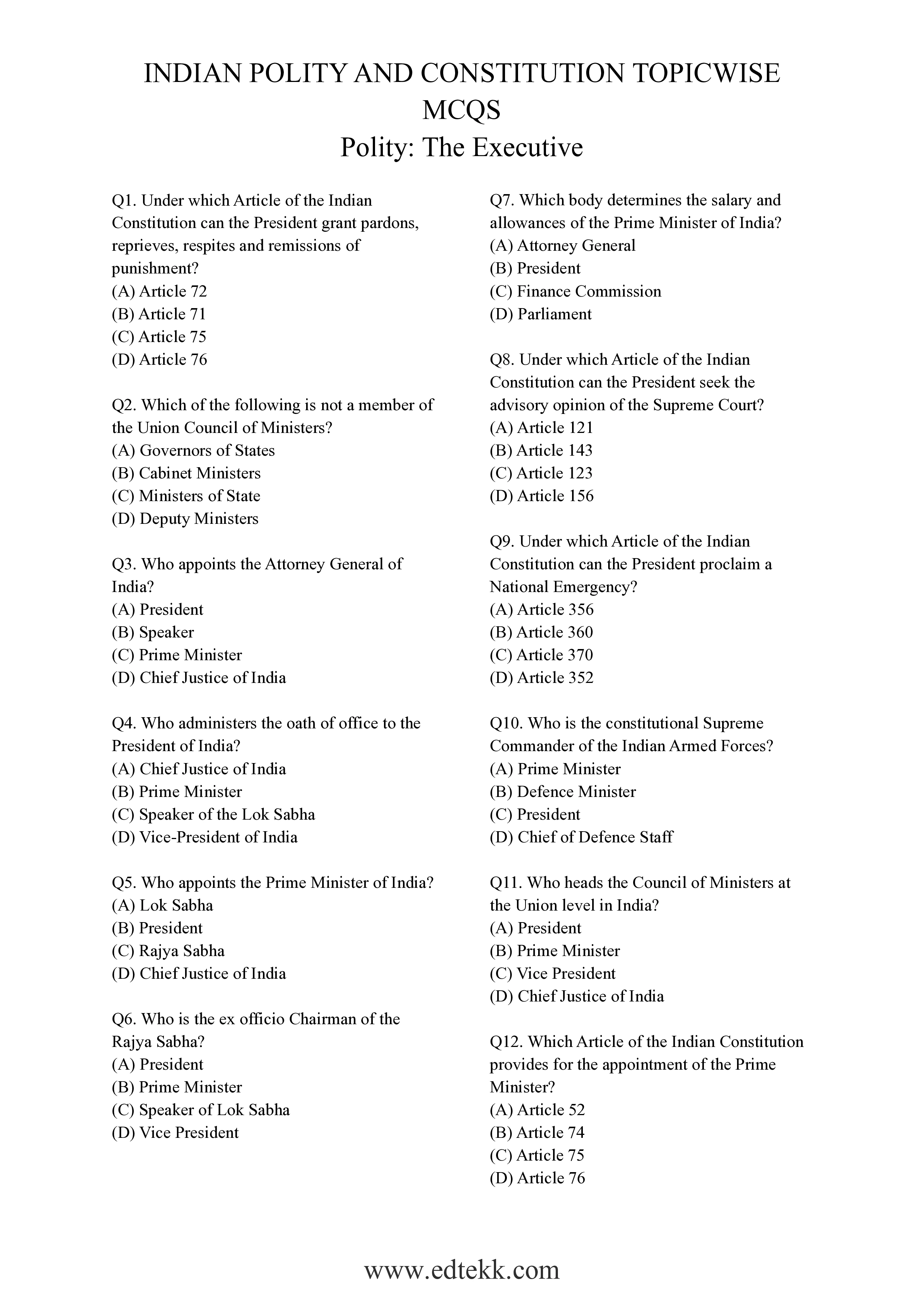
Prepare for competitive examinations with Indian Polity MCQs on the Executive. This topicwise question set covers the President, Vice-President, Prime Minister, Council of Ministers, Governor and Chief Minister, along with their constitutional powers and functions. Each question includes an answer and explanation for SSC, Railway and Police exam preparation.
Test Details
Topic: Polity: The Executive
Total Questions: 20
Question Format: MCQs – Single Correct Answer
Suitable for: SSC exams, Railway exams, Police Constable, Police SI
Download All Papers in This Series (PDF)
Questions and Answers
Q1. Under which Article of the Indian Constitution can the President grant pardons, reprieves, respites and remissions of punishment?
(A) Article 72
(B) Article 71
(C) Article 75
(D) Article 76
Explanation: Article 72 of the Indian Constitution empowers the President to grant pardons, reprieves, respites and remissions of punishment, as well as suspend, remit or commute sentences in specified cases. This power extends to court-martial cases, offences under laws within the Union’s executive power and all cases involving death sentences.
Q2. Which of the following is not a member of the Union Council of Ministers?
(A) Governors of States
(B) Cabinet Ministers
(C) Ministers of State
(D) Deputy Ministers
Explanation: The Union Council of Ministers consists of the Prime Minister and other ministers, including Cabinet Ministers, Ministers of State and, where appointed, Deputy Ministers. Governors are not members of the Union Council of Ministers; they serve as constitutional heads of their respective states.
Q3. Who appoints the Attorney General of India?
(A) President
(B) Speaker
(C) Prime Minister
(D) Chief Justice of India
Explanation: Under Article 76, the President appoints the Attorney General of India, who must be qualified for appointment as a Supreme Court judge. The Attorney General is the highest law officer of the Union Government and advises the Government of India on legal matters.
Q4. Who administers the oath of office to the President of India?
(A) Chief Justice of India
(B) Prime Minister
(C) Speaker of the Lok Sabha
(D) Vice-President of India
Explanation: The Chief Justice of India administers the oath of office to the President of India under Article 60 of the Constitution. In the Chief Justice’s absence, the senior-most available judge of the Supreme Court administers the oath. The President swears to faithfully execute the office and preserve, protect and defend the Constitution and the law.
Q5. Who appoints the Prime Minister of India?
(A) Lok Sabha
(B) President
(C) Rajya Sabha
(D) Chief Justice of India
Explanation: The President of India appoints the Prime Minister under Article 75(1) of the Constitution. Normally, the President appoints the leader of the political party or coalition commanding a majority in the Lok Sabha. The Prime Minister heads the Union Council of Ministers and advises the President on the appointment of other ministers.
Q6. Who is the ex officio Chairman of the Rajya Sabha?
(A) President
(B) Prime Minister
(C) Speaker of Lok Sabha
(D) Vice President
Explanation: Under Article 64 of the Constitution, the Vice-President of India is the ex-officio Chairman of the Rajya Sabha. The Vice-President presides over its proceedings and maintains order but is not a member of the Rajya Sabha. The Chairman ordinarily does not vote, except when exercising a casting vote in the event of a tie.
Q7. Which body determines the salary and allowances of the Prime Minister of India?
(A) Attorney General
(B) President
(C) Finance Commission
(D) Parliament
Explanation: The salary and allowances of the Prime Minister of India are determined by Parliament through legislation. They are governed by the law applicable to the Prime Minister and other ministers, rather than being independently determined by the President, Attorney General or Finance Commission.
Q8. Under which Article of the Indian Constitution can the President seek the advisory opinion of the Supreme Court?
(A) Article 121
(B) Article 143
(C) Article 123
(D) Article 156
Explanation: Article 143 empowers the President to refer questions of law or fact of public importance to the Supreme Court for its advisory opinion. Under Article 143(1), the Court may report its opinion after hearing the matter. Such opinions are advisory rather than judgments resolving an ordinary dispute.
Q9. Under which Article of the Indian Constitution can the President proclaim a National Emergency?
(A) Article 356
(B) Article 360
(C) Article 370
(D) Article 352
Explanation: Article 352 empowers the President to proclaim a national emergency when the security of India or any part of its territory is threatened by war, external aggression or armed rebellion. Article 356 concerns President’s Rule in a state, while Article 360 deals with a financial emergency.
Q10. Who is the constitutional Supreme Commander of the Indian Armed Forces?
(A) Prime Minister
(B) Defence Minister
(C) President
(D) Chief of Defence Staff
Explanation: The President of India is the constitutional Supreme Commander of the Indian Armed Forces, comprising the Army, Navy and Air Force. However, the elected government, acting through the Ministry of Defence and established military command structures, manages defence administration and operational matters.
Q11. Who heads the Council of Ministers at the Union level in India?
(A) President
(B) Prime Minister
(C) Vice President
(D) Chief Justice of India
Explanation: The Prime Minister is the head of the Council of Ministers at the Union level. The Prime Minister leads the government, coordinates the functioning of various ministries and advises the President on ministerial appointments. Under Article 75(3) of the Constitution, the Council of Ministers is collectively responsible to the Lok Sabha.
Q12. Which Article of the Indian Constitution provides for the appointment of the Prime Minister?
(A) Article 52
(B) Article 74
(C) Article 75
(D) Article 76
Explanation: Article 75(1) of the Indian Constitution provides that the Prime Minister is appointed by the President of India. The President also appoints other ministers on the advice of the Prime Minister. The Council of Ministers is collectively responsible to the Lok Sabha, and the Prime Minister must command its majority support.
Q13. To which House or Houses of Parliament can the President of India address messages?
(A) Both Houses of Parliament
(B) Only Lok Sabha
(C) Only Rajya Sabha
(D) State Legislatures
Explanation: Under Article 86, the President may address either House of Parliament or both Houses assembled together and may send messages to either House concerning pending legislation or other matters. This power relates to Parliament, not state legislatures.
Q14. Who is the constitutional head of a state government in India?
(A) Chief Minister
(B) Prime Minister
(C) President
(D) Governor
Explanation: The Governor is the constitutional head of a state under Article 154 of the Indian Constitution. The Chief Minister is the real executive head and leads the elected state government. The Governor generally exercises executive functions on the aid and advice of the Council of Ministers headed by the Chief Minister, except in constitutionally recognised discretionary matters.
Q15. Who presides over a joint sitting of both Houses of Parliament?
(A) President
(B) Speaker of Lok Sabha
(C) Prime Minister
(D) Vice President
Explanation: Under Article 118(4), the Speaker of the Lok Sabha presides over a joint sitting of Parliament. In the Speaker’s absence, the Deputy Speaker presides; if unavailable, the Deputy Chairman of the Rajya Sabha presides. If these officers are also unavailable, another member determined under the applicable parliamentary rules presides.
Q16. Where is the Prime Minister’s Office (PMO) located?
(A) South Block, New Delhi
(B) Rashtrapati Bhavan
(C) Parliament House
(D) North Block, New Delhi
Explanation: The Prime Minister’s Office (PMO) is located in South Block, New Delhi, on Raisina Hill. South Block houses key offices of the Union Government, including the Prime Minister’s Office and the Ministry of External Affairs.
Q17. The President of India is the Supreme Commander of which of the following forces?
(A) Indian Army only
(B) All the Armed Forces of India
(C) Indian Navy only
(D) Indian Air Force only
Explanation: The President of India is the Supreme Commander of the Indian Armed Forces, comprising the Army, Navy and Air Force. This is a constitutional position; operational command and defence administration are exercised through the established military hierarchy and the Union Government.
Q18. Who administers the oath of office to the Governor of a state?
(A) President
(B) Chief Justice of High Court
(C) Chief Minister
(D) Chief Justice of India
Explanation: The Chief Justice of the concerned High Court administers the oath of office to the Governor under Article 159 of the Constitution. In the Chief Justice’s absence, the senior-most available judge of that High Court administers the oath. The Governor swears to faithfully discharge the duties of the office and preserve, protect and defend the Constitution and the law.
Q19. Who appoints the Chief Justice of a High Court in India?
(A) Speaker
(B) President
(C) Chief Justice of India
(D) Governor of the State
Explanation: Under Article 217, the President appoints the Chief Justice of a High Court after consultation with the Chief Justice of India and the Governor of the concerned state. The appointment follows the constitutional consultation process and judicial collegium conventions. Neither the Governor nor the Chief Justice of India independently makes the appointment.
Q20. Which of the following is a non-statutory body in India?
(A) Election Commission
(B) Planning Commission
(C) Finance Commission
(D) NITI Aayog
Explanation: NITI Aayog is a non-statutory body established by an executive resolution of the Union Government in 2015, replacing the Planning Commission. The Election Commission of India and the Finance Commission are constitutional bodies. The Planning Commission was also non-statutory but has been abolished.
Question Paper Images