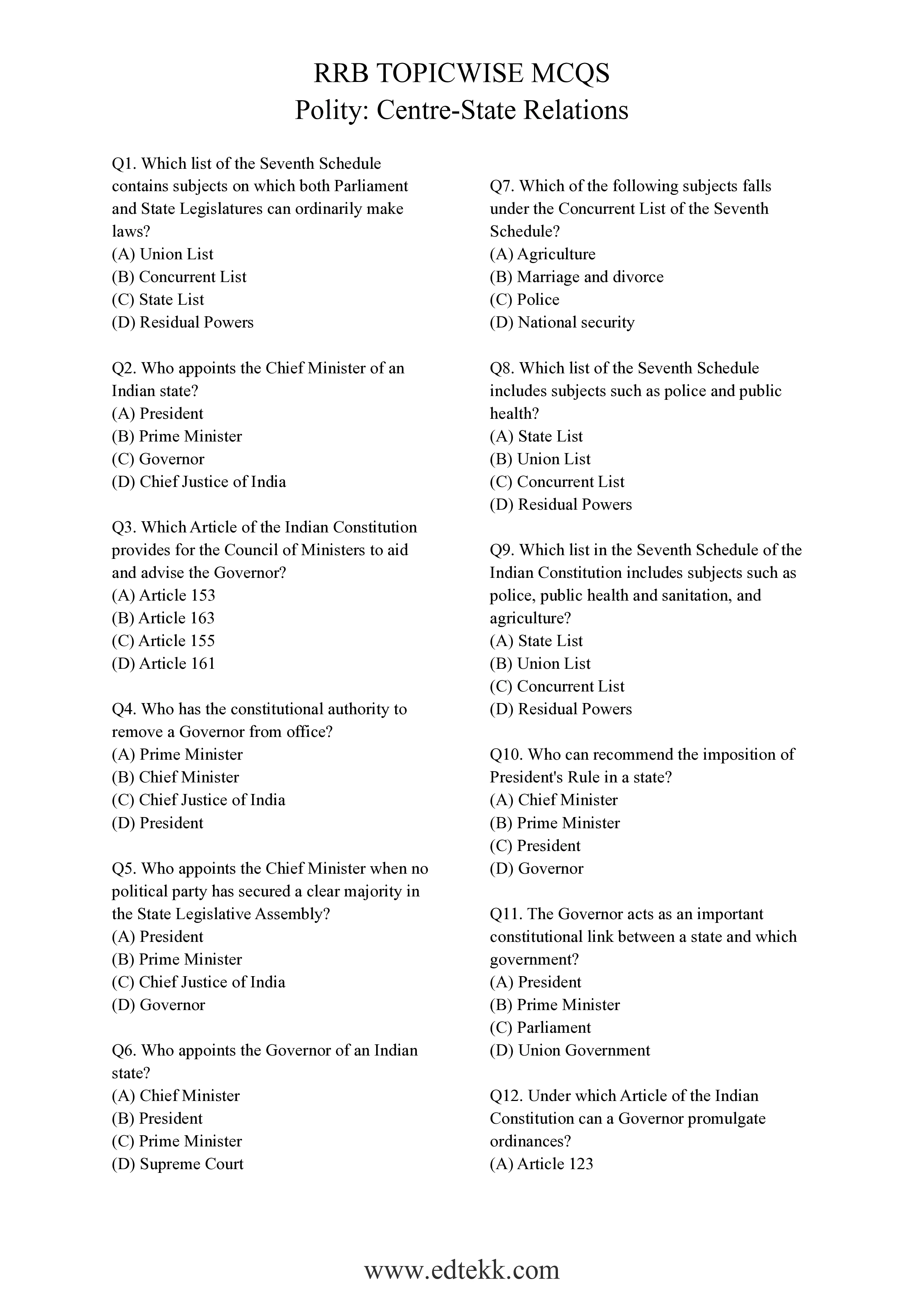
Prepare for RRB NTPC, Group D, ALP and Technician examinations with Centre–State Relations MCQs from Indian Polity. This question set covers legislative, administrative and financial relations between the Union and States, distribution of powers, constitutional provisions and federal features through practice questions, answers and explanations.
Test Details
Topic: Polity: Centre-State Relations
Total Questions: 20
Question Format: MCQs – Single Correct Answer
Suitable for: RRB NTPC, Group D, ALP, Technician
Download All Papers in This Series (PDF)
Questions and Answers
Q1. Which list of the Seventh Schedule contains subjects on which both Parliament and State Legislatures can ordinarily make laws?
(A) Union List
(B) Concurrent List
(C) State List
(D) Residual Powers
Explanation: The Concurrent List in the Seventh Schedule includes subjects on which both Parliament and State Legislatures can ordinarily legislate. Examples include education, forests, marriage, adoption, criminal law and criminal procedure. Under Article 254, Union legislation generally prevails in cases of conflict, subject to the constitutional exception for certain State laws receiving Presidential assent.
Q2. Who appoints the Chief Minister of an Indian state?
(A) President
(B) Prime Minister
(C) Governor
(D) Chief Justice of India
Explanation: Under Article 164, the Governor appoints the Chief Minister of the State. Normally, the leader of the party or coalition commanding a majority in the Legislative Assembly is appointed. If no party has a clear majority, the Governor invites the person most likely to demonstrate majority support, ordinarily verified through a floor test.
Q3. Which Article of the Indian Constitution provides for the Council of Ministers to aid and advise the Governor?
(A) Article 153
(B) Article 163
(C) Article 155
(D) Article 161
Explanation: Article 163 provides for a Council of Ministers headed by the Chief Minister to aid and advise the Governor, except where the Constitution requires the Governor to exercise discretion. This provision establishes the principle of responsible parliamentary government at the State level, subject to constitutionally recognised discretionary functions.
Q4. Who has the constitutional authority to remove a Governor from office?
(A) Prime Minister
(B) Chief Minister
(C) Chief Justice of India
(D) President
Explanation: The President can remove a Governor under Article 156, which provides that the Governor holds office during the President’s pleasure. Consequently, the Governor’s normal five-year term is not guaranteed, and removal may occur before the term expires.
Q5. Who appoints the Chief Minister when no political party has secured a clear majority in the State Legislative Assembly?
(A) President
(B) Prime Minister
(C) Chief Justice of India
(D) Governor
Explanation: The Governor appoints the Chief Minister under Article 164. When no party has secured a clear majority in the Legislative Assembly, the Governor invites the person most likely to command majority support. The Chief Minister may be required to establish that support through a floor test in the Assembly.
Q6. Who appoints the Governor of an Indian state?
(A) Chief Minister
(B) President
(C) Prime Minister
(D) Supreme Court
Explanation: Under Article 155, the Governor of a State is appointed by the President by warrant under the President’s hand and seal. Under Article 156, the Governor ordinarily holds office for five years, subject to the pleasure of the President, and may leave office earlier.
Q7. Which of the following subjects falls under the Concurrent List of the Seventh Schedule?
(A) Agriculture
(B) Marriage and divorce
(C) Police
(D) National security
Explanation: Marriage and divorce fall under Entry 5 of the Concurrent List in the Seventh Schedule of the Indian Constitution. Both Parliament and State Legislatures can legislate on these subjects. Under Article 254, where a valid central law and state law conflict, the central law generally prevails, subject to the constitutional exception for certain state laws receiving Presidential assent.
Q8. Which list of the Seventh Schedule includes subjects such as police and public health?
(A) State List
(B) Union List
(C) Concurrent List
(D) Residual Powers
Explanation: Police and public health are subjects included in the State List (List II) of the Seventh Schedule of the Indian Constitution. State legislatures have the primary authority to make laws on these subjects, subject to constitutional provisions that permit Parliament to legislate in specified circumstances.
Q9. Which list in the Seventh Schedule of the Indian Constitution includes subjects such as police, public health and sanitation, and agriculture?
(A) State List
(B) Union List
(C) Concurrent List
(D) Residual Powers
Explanation: The State List, contained in the Seventh Schedule of the Indian Constitution, includes subjects such as police, public health, sanitation and agriculture. State Legislatures generally have exclusive authority to legislate on these subjects, subject to constitutional provisions that permit Parliament to legislate on State List matters in specified circumstances.
Q10. Who can recommend the imposition of President’s Rule in a state?
(A) Chief Minister
(B) Prime Minister
(C) President
(D) Governor
Explanation: Under Article 356, the President may proclaim President’s Rule if satisfied that the government of a State cannot be carried on in accordance with the Constitution. The President may act on a report from the Governor or otherwise; a Governor’s recommendation is therefore not a mandatory prerequisite.
Q11. The Governor acts as an important constitutional link between a state and which government?
(A) President
(B) Prime Minister
(C) Parliament
(D) Union Government
Explanation: The Governor acts as an important constitutional link between the state and the Union Government. Appointed by the President, the Governor serves as the constitutional head of the state and functions within the framework of the Constitution, exercising prescribed powers and responsibilities.
Q12. Under which Article of the Indian Constitution can a Governor promulgate ordinances?
(A) Article 123
(B) Article 352
(C) Article 356
(D) Article 213
Explanation: Article 213 empowers the Governor to promulgate ordinances when the State Legislature is not in session, subject to constitutional conditions and the necessity for immediate action. An ordinance has the force of law but must be laid before the Legislature and ordinarily ceases to operate six weeks after its reassembly unless it expires earlier or is withdrawn.
Q13. Banking falls under which list of the Seventh Schedule of the Indian Constitution?
(A) Concurrent List
(B) State List
(C) Union List
(D) Residual Powers
Explanation: Banking falls under the Union List in the Seventh Schedule, specifically Entry 45. Parliament ordinarily has exclusive authority to legislate on banking, including banking companies and banking regulation. This Union-level legislative framework supports consistent regulation of banking throughout India.
Q14. Who appoints the Advocate General of a state?
(A) Governor
(B) Chief Minister
(C) President
(D) Prime Minister
Explanation: Under Article 165, the Governor appoints the Advocate General for the State, the State Government’s highest law officer. The appointee must be qualified to be appointed a High Court judge. The Advocate General advises the State Government on legal matters and performs other legal duties assigned by the Governor.
Q15. Which body determines the emoluments and allowances of a state Governor?
(A) President
(B) Parliament
(C) Prime Minister
(D) Finance Minister
Explanation: Parliament determines the Governor’s emoluments, allowances and privileges by law. Under Article 158(3), these cannot be diminished during the Governor’s term of office. The expenses relating to the Governor’s emoluments and allowances are charged on the Consolidated Fund of the State.
Q16. Who has the constitutional authority to remove the Governor of a state?
(A) Prime Minister
(B) Chief Minister
(C) Supreme Court
(D) President
Explanation: The President can remove a State Governor because Article 156 provides that the Governor holds office during the President’s pleasure. The Governor has no guaranteed five-year tenure and may be removed before completing the normal term. The removal is formally effected by the President under the constitutional framework.
Q17. Which list in the Seventh Schedule includes subjects such as education, forests, marriage and divorce?
(A) Union List
(B) Concurrent List
(C) State List
(D) Residual Powers
Explanation: The Concurrent List of the Seventh Schedule includes education, forests, marriage and divorce. Both Parliament and State Legislatures can ordinarily legislate on these subjects. In case of a conflict, Union legislation generally prevails under Article 254, subject to the exception for certain State laws receiving Presidential assent.
Q18. Which Article of the Indian Constitution provides for the appointment of the Governor?
(A) Article 155
(B) Article 153
(C) Article 356
(D) Article 360
Explanation: Article 155 of the Indian Constitution deals with the appointment of the Governor. It provides that the Governor of a state shall be appointed by the President by warrant under the President’s hand and seal.
Q19. Under which Article of the Indian Constitution is the Governor empowered to grant pardons and exercise other specified clemency powers?
(A) Article 161
(B) Article 163
(C) Article 356
(D) Article 360
Explanation: Article 161 empowers the Governor to grant pardons, reprieves, respites and remissions of punishment, and to suspend, remit or commute sentences for offences within the State’s executive power. This authority is subject to constitutional limitations and differs from the President’s clemency powers under Article 72.
Q20. Which of the following subjects falls under the exclusive legislative jurisdiction of Parliament?
(A) Agriculture
(B) Police
(C) Railways
(D) Public Health
Explanation: Railways fall under the Union List in the Seventh Schedule, specifically Entry 22. Parliament ordinarily has exclusive legislative authority over this subject. Union-level legislation supports coordinated railway administration, development and regulation across States.
Question Paper Images