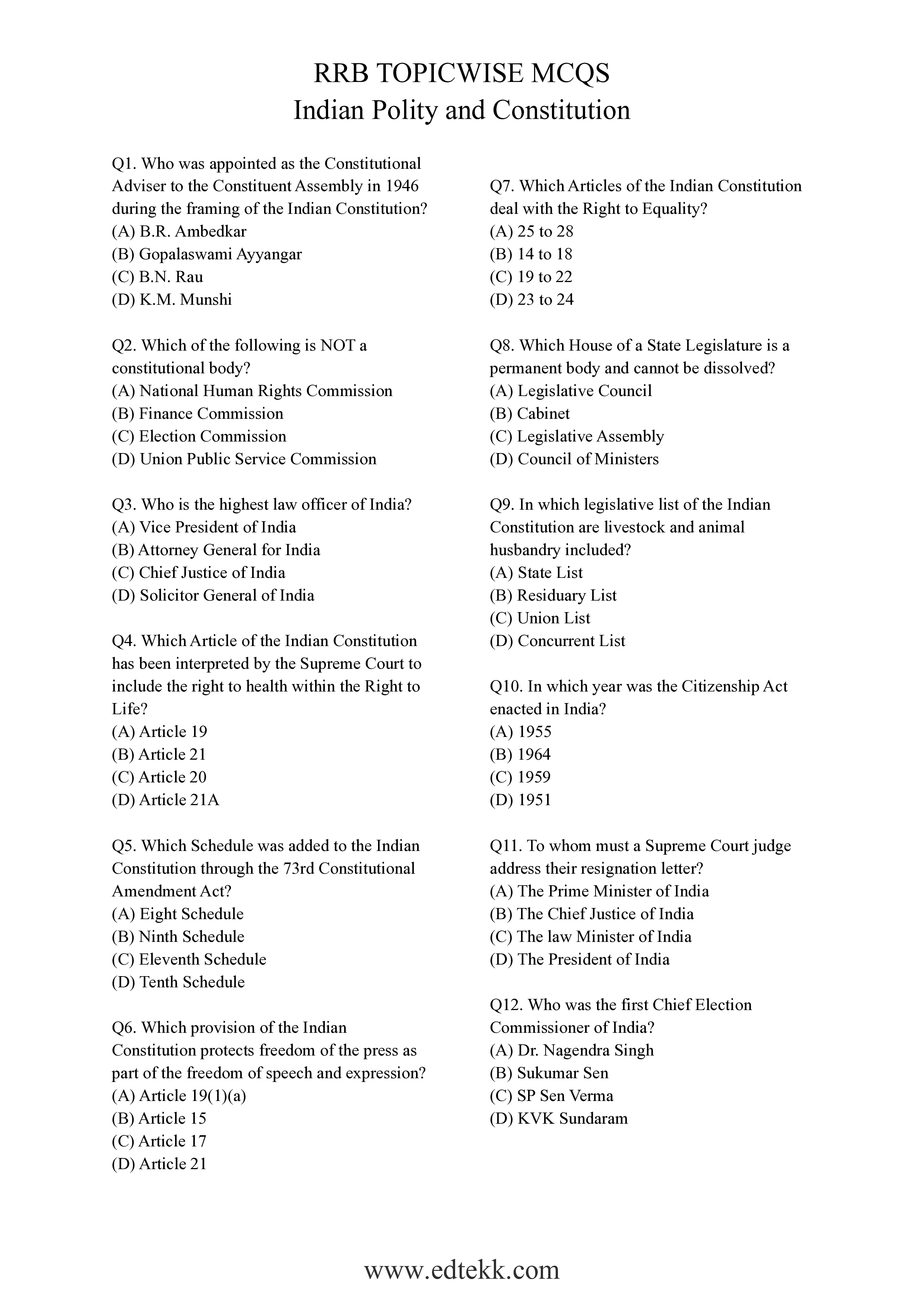
Strengthen your overall Indian Polity and Constitution preparation with comprehensive topicwise MCQs for RRB NTPC, Group D, ALP and Technician examinations. This practice set covers key constitutional provisions, government institutions, fundamental rights, duties, Parliament, judiciary and federalism through important questions, answers and explanations.
Test Details
Topic: Indian Polity and Constitution
Total Questions: 20
Question Format: MCQs – Single Correct Answer
Suitable for: RRB NTPC, Group D, ALP, Technician
Download All Papers in This Series (PDF)
Questions and Answers
Q1. Who was appointed as the Constitutional Adviser to the Constituent Assembly in 1946 during the framing of the Indian Constitution?
(A) B.R. Ambedkar
(B) Gopalaswami Ayyangar
(C) B.N. Rau
(D) K.M. Munshi
Explanation: B. N. Rau was appointed Constitutional Adviser to the Constituent Assembly in 1946. He prepared an initial constitutional draft and provided important legal and constitutional guidance during the framing process. He must be distinguished from Dr. B. R. Ambedkar, who chaired the Drafting Committee established in August 1947.
Q2. Which of the following is NOT a constitutional body?
(A) National Human Rights Commission
(B) Finance Commission
(C) Election Commission
(D) Union Public Service Commission
Explanation: The National Human Rights Commission is a statutory body established under the Protection of Human Rights Act, 1993. The Finance Commission, Election Commission of India and UPSC are constitutional bodies.
Q3. Who is the highest law officer of India?
(A) Vice President of India
(B) Attorney General for India
(C) Chief Justice of India
(D) Solicitor General of India
Explanation: The Attorney General for India is the highest law officer of the country under Article 76 of the Constitution. The President appoints the Attorney General, who advises the Union Government on legal matters. Under Article 88, the Attorney General has the right to participate in parliamentary proceedings but cannot vote.
Q4. Which Article of the Indian Constitution has been interpreted by the Supreme Court to include the right to health within the Right to Life?
(A) Article 19
(B) Article 21
(C) Article 20
(D) Article 21A
Explanation: Article 21 guarantees the Right to Life and Personal Liberty. The Supreme Court has interpreted this right to include the right to health and access to medical care. This interpretation recognises that the right to life extends beyond mere physical existence and includes conditions necessary for living with human dignity.
Q5. Which Schedule was added to the Indian Constitution through the 73rd Constitutional Amendment Act?
(A) Eight Schedule
(B) Ninth Schedule
(C) Eleventh Schedule
(D) Tenth Schedule
Explanation: The Eleventh Schedule was added to the Indian Constitution through the 73rd Constitutional Amendment Act, 1992. It contains 29 subjects that may be entrusted to Panchayati Raj institutions. These include agriculture, minor irrigation, rural development, education, health and sanitation. The amendment strengthened the constitutional framework for democratic decentralisation.
Q6. Which provision of the Indian Constitution protects freedom of the press as part of the freedom of speech and expression?
(A) Article 19(1)(a)
(B) Article 15
(C) Article 17
(D) Article 21
Explanation: Freedom of the press is protected under Article 19(1)(a) of the Indian Constitution as part of the fundamental right to freedom of speech and expression. Although the Constitution does not expressly mention freedom of the press, the Supreme Court has recognised it as an essential component of this fundamental right.
Q7. Which Articles of the Indian Constitution deal with the Right to Equality?
(A) 25 to 28
(B) 14 to 18
(C) 19 to 22
(D) 23 to 24
Explanation: The Right to Equality is covered by Articles 14 to 18 of the Indian Constitution. These provisions deal with equality before the law, prohibition of discrimination, equality of opportunity in public employment, abolition of untouchability and abolition of titles.
Q8. Which House of a State Legislature is a permanent body and cannot be dissolved?
(A) Legislative Council
(B) Cabinet
(C) Legislative Assembly
(D) Council of Ministers
Explanation: The Legislative Council is a permanent House in States having bicameral legislatures and is not subject to dissolution. Its members normally serve six-year terms, with one-third retiring every two years.
Q9. In which legislative list of the Indian Constitution are livestock and animal husbandry included?
(A) State List
(B) Residuary List
(C) Union List
(D) Concurrent List
Explanation: Livestock and animal husbandry fall under the State List in the Seventh Schedule of the Indian Constitution, particularly Entry 15. State legislatures have authority over the preservation, protection and improvement of livestock, prevention of animal diseases, and veterinary training and practice, subject to other applicable constitutional provisions.
Q10. In which year was the Citizenship Act enacted in India?
(A) 1955
(B) 1964
(C) 1959
(D) 1951
Explanation: The Citizenship Act was enacted in 1955 to regulate the acquisition and determination of Indian citizenship. It provides five methods of acquiring citizenship: birth, descent, registration, naturalisation and incorporation of territory. The Act has subsequently undergone several amendments.
Q11. To whom must a Supreme Court judge address their resignation letter?
(A) The Prime Minister of India
(B) The Chief Justice of India
(C) The law Minister of India
(D) The President of India
Explanation: Under Article 124(2) of the Constitution, a Supreme Court judge may resign by writing under their hand addressed to the President of India. The President is the designated constitutional authority to receive the resignation. The resignation becomes effective upon receipt by the President.
Q12. Who was the first Chief Election Commissioner of India?
(A) Dr. Nagendra Singh
(B) Sukumar Sen
(C) SP Sen Verma
(D) KVK Sundaram
Explanation: Sukumar Sen was the first Chief Election Commissioner of India. He served from 1950 to 1958 and supervised India’s first general elections held in 1951–52. His leadership was instrumental in establishing the country’s electoral machinery and conducting the first nationwide democratic elections after independence.
Q13. Who was the first Chairman of the Finance Commission of India?
(A) KC Neogy
(B) Ashok Kumar Chanda
(C) K Santhanam
(D) PV Rajamannar
Explanation: K.C. Neogy was the first Chairman of the Finance Commission of India. The First Finance Commission was constituted in 1951 under Article 280 of the Constitution. It was responsible for recommending the distribution of tax revenues between the Union and State Governments and the principles governing grants-in-aid to States.
Q14. Which type of Bill cannot be introduced in the Rajya Sabha?
(A) Both constitutional amendment and ordinary bills
(B) The money bill
(C) The constitutional amendment bill
(D) The ordinary bill
Explanation: A Money Bill can be introduced only in the Lok Sabha and not in the Rajya Sabha, as provided under Article 109 of the Constitution. The Rajya Sabha can make recommendations within 14 days, but the Lok Sabha may accept or reject them. Constitutional Amendment Bills and Ordinary Bills can be introduced in either House.
Q15. Which fund bears the expenditure relating to the President’s salary and allowances?
(A) Contingency fund
(B) Estimates fund
(C) Consolidated fund
(D) Public accounts fund
Explanation: Under Article 112(3)(a) of the Constitution of India, the emoluments and allowances of the President and other expenditure relating to the office are charged on the Consolidated Fund of India. Such expenditure is not submitted to the vote of Parliament, ensuring the financial independence of the constitutional office.
Q16. Which of the following is NOT a recognised category of the Directive Principles of State Policy?
(A) Liberal
(B) Socialist
(C) Nehruvian
(D) Gandhian
Explanation: Directive Principles of State Policy are conventionally classified into three categories: Socialist, Gandhian and Liberal-Intellectual principles. Nehruvian is not recognised as a standard category in this classification. These are academic classifications rather than constitutional headings.
Q17. In which year did the voting age in India become 18 years?
(A) In 2004
(B) In 1989
(C) In 1998
(D) In 1991
Explanation: The voting age was reduced from 21 to 18 years through the 61st Constitutional Amendment Act, 1988. The amendment came into force in 1989, enabling citizens aged 18 years and above to vote in elections to the Lok Sabha and State Legislative Assemblies.
Q18. Under which category of offences can the police arrest an accused without a warrant, subject to the law?
(A) Detention offences
(B) Non-Cognizable offences
(C) Cross offences
(D) Cognizable offences
Explanation: Cognizable offences are those in which the police may register a case and arrest an accused without a warrant, subject to the conditions prescribed by law. In non-cognizable offences, the police generally require a Magistrate’s order to investigate and cannot ordinarily make an arrest without a warrant.
Q19. From which country’s parliamentary tradition did India borrow certain features of bicameralism?
(A) France
(B) Germany
(C) South Africa
(D) Britain
Explanation: The Indian Constitution drew upon the British parliamentary tradition for its legislative institutions, including aspects of bicameralism. The Parliament of India consists of the Lok Sabha, the House of the People, and the Rajya Sabha, the Council of States. However, bicameralism has a broader historical background and should not be attributed exclusively to Britain.
Q20. Which Part of the Indian Constitution provides for the Union Public Service Commission?
(A) Part X
(B) Part VIII
(C) Part XVI
(D) Part XIV
Explanation: Part XIV of the Constitution deals with services under the Union and the States and contains provisions relating to Public Service Commissions. Articles 315–323 provide for the Union Public Service Commission and State Public Service Commissions.
Question Paper Images