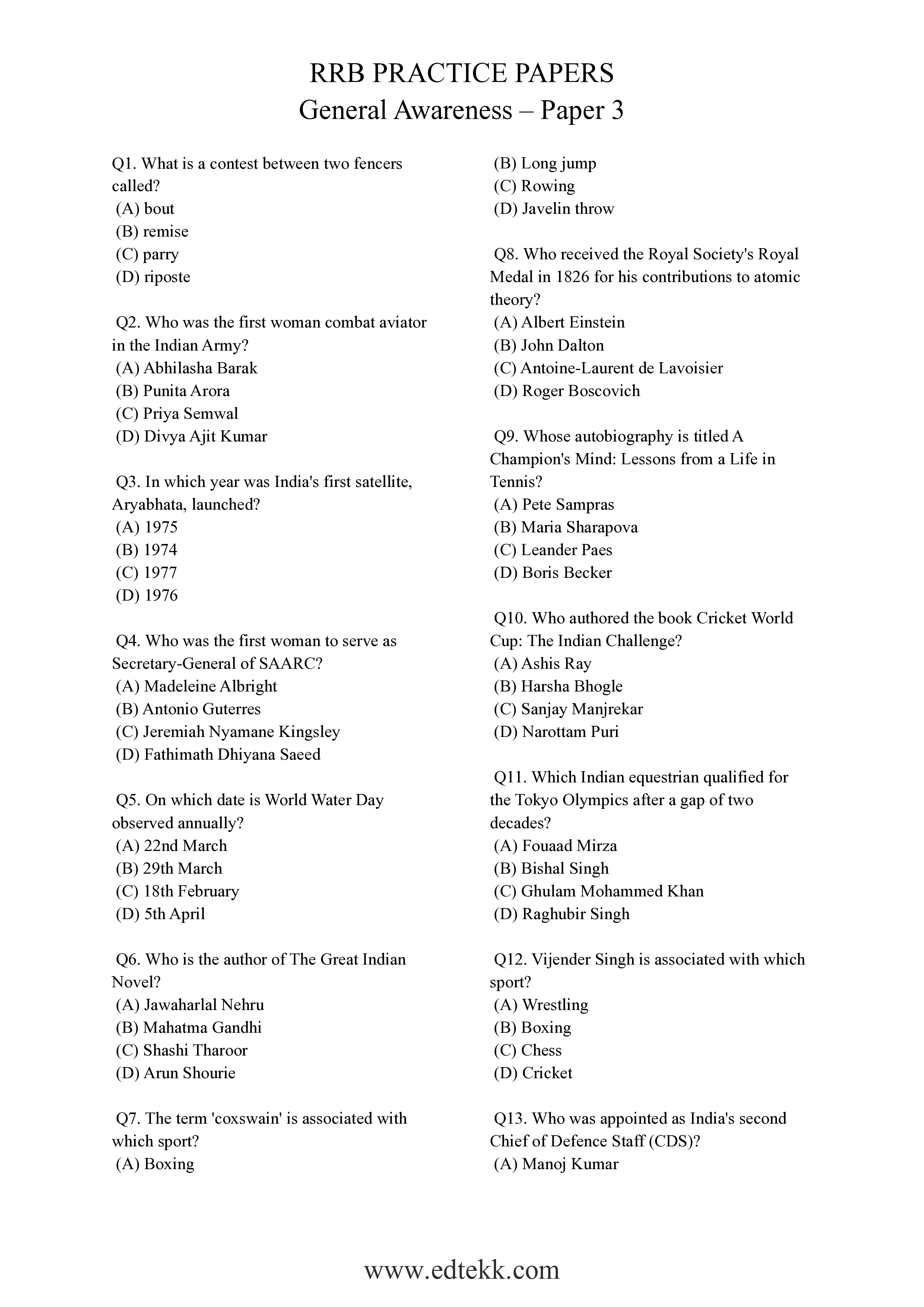
Improve your General Awareness preparation with RRB Practice Paper 3. This set includes 20 objective questions covering general awareness topics, along with answers and detailed explanations for better understanding. It supports candidates preparing for RRB NTPC, Group D, ALP and Technician recruitment examinations.
Test Details
Topic: General Awareness
Total Questions: 20
Question Format: MCQs – Single Correct Answer
Suitable for: RRB NTPC, Group D, ALP, Technician
Download All Papers in This Series (PDF)
Questions and Answers
Q1. What is a contest between two fencers called?
(A) bout
(B) remise
(C) parry
(D) riposte
Explanation: In fencing, a contest between two fencers is called a bout. A parry is a defensive action used to deflect an opponent’s attack, while a riposte is an offensive action following a successful parry. A remise is a renewed or continued attack after the initial action.
Q2. Who was the first woman combat aviator in the Indian Army?
(A) Abhilasha Barak
(B) Punita Arora
(C) Priya Semwal
(D) Divya Ajit Kumar
Explanation: Abhilasha Barak became the first woman officer of the Indian Army’s Army Aviation Corps to qualify as a combat aviator. She received her wings in May 2022, marking a significant milestone in the induction of women into Army aviation.
Q3. In which year was India’s first satellite, Aryabhata, launched?
(A) 1975
(B) 1974
(C) 1977
(D) 1976
Explanation: Aryabhata, India’s first artificial satellite, was launched on 19 April 1975 from the Soviet Union using a Kosmos-3M launch vehicle. Developed by ISRO, it was named after the ancient Indian mathematician and astronomer Aryabhata. Its launch marked a significant milestone in India’s space programme.
Q4. Who was the first woman to serve as Secretary-General of SAARC?
(A) Madeleine Albright
(B) Antonio Guterres
(C) Jeremiah Nyamane Kingsley
(D) Fathimath Dhiyana Saeed
Explanation: Fathimath Dhiyana Saeed of the Maldives became the first woman Secretary-General of the South Asian Association for Regional Cooperation (SAARC) in March 2011. She was also the first Maldivian to hold the position. SAARC was established in 1985 to promote regional cooperation among South Asian countries.
Q5. On which date is World Water Day observed annually?
(A) 22nd March
(B) 29th March
(C) 18th February
(D) 5th April
Explanation: World Water Day is observed annually on 22 March. The United Nations established this observance to highlight the importance of freshwater and raise awareness about the global water crisis. It promotes the sustainable management of freshwater resources and access to safe drinking water and sanitation.
Q6. Who is the author of The Great Indian Novel?
(A) Jawaharlal Nehru
(B) Mahatma Gandhi
(C) Shashi Tharoor
(D) Arun Shourie
Explanation: Shashi Tharoor wrote The Great Indian Novel, published in 1989. It is a satirical reinterpretation of India’s independence movement and post-independence politics, structured around characters and events inspired by the ancient Indian epic Mahabharata. The novel combines mythology, historical events and political satire.
Q7. The term ‘coxswain’ is associated with which sport?
(A) Boxing
(B) Long jump
(C) Rowing
(D) Javelin throw
Explanation: A coxswain is associated with rowing. The coxswain is responsible for steering the boat, coordinating the crew and providing tactical instructions during a race. The role is important in maintaining communication, rhythm and coordination among the rowers.
Q8. Who received the Royal Society’s Royal Medal in 1826 for his contributions to atomic theory?
(A) Albert Einstein
(B) John Dalton
(C) Antoine-Laurent de Lavoisier
(D) Roger Boscovich
Explanation: John Dalton received the Royal Society’s Royal Medal in 1826 in recognition of his contributions to atomic theory. He proposed that matter consists of indivisible atoms and that atoms of different elements combine in fixed proportions to form chemical compounds. His theory laid the foundation for modern atomic theory.
Q9. Whose autobiography is titled A Champion’s Mind: Lessons from a Life in Tennis?
(A) Pete Sampras
(B) Maria Sharapova
(C) Leander Paes
(D) Boris Becker
Explanation: A Champion’s Mind: Lessons from a Life in Tennis is the autobiography of former American tennis player Pete Sampras. The book discusses his professional career, competitive experiences, achievements and the mental approach that contributed to his success in tennis.
Q10. Who authored the book Cricket World Cup: The Indian Challenge?
(A) Ashis Ray
(B) Harsha Bhogle
(C) Sanjay Manjrekar
(D) Narottam Puri
Explanation: Cricket World Cup: The Indian Challenge was written by Ashis Ray, an Indian cricket journalist and commentator. The book documents India’s journey in Cricket World Cup tournaments, covering significant matches, performances and milestones in Indian cricket history.
Q11. Which Indian equestrian qualified for the Tokyo Olympics after a gap of two decades?
(A) Fouaad Mirza
(B) Bishal Singh
(C) Ghulam Mohammed Khan
(D) Raghubir Singh
Explanation: Fouaad Mirza qualified for the Tokyo 2020 Olympic Games in equestrian eventing. He became the first Indian rider in 20 years to qualify for the Olympic eventing competition. The Games were postponed to 2021 because of the COVID-19 pandemic.
Q12. Vijender Singh is associated with which sport?
(A) Wrestling
(B) Boxing
(C) Chess
(D) Cricket
Explanation: Vijender Singh is an Indian boxer from Haryana. He won a bronze medal in the middleweight category at the 2008 Beijing Olympics, becoming India’s first Olympic medal-winning boxer. He has also won medals at the Commonwealth Games and Asian Games.
Q13. Who was appointed as India’s second Chief of Defence Staff (CDS)?
(A) Manoj Kumar
(B) Anil Chauhan
(C) R. Dinesh
(D) Sanjay Agarwal
Explanation: General Anil Chauhan was appointed India’s second Chief of Defence Staff (CDS) on 28 September 2022, following the death of General Bipin Rawat in December 2021. The CDS serves as the principal military adviser to the government on tri-service matters and promotes coordination and integration among the Army, Navy and Air Force.
Q14. In which year did the Government of India institute the Arjuna Award to recognise outstanding achievements in sports?
(A) 1964
(B) 1963
(C) 1961
(D) 1962
Explanation: The Arjuna Awards were instituted in 1961 by the Government of India to recognise outstanding achievements in sports. They honour sportspersons for excellence and consistent performance in national and international competitions and are among India’s prominent sporting honours.
Q15. Which Indian author wrote the book Two Lives?
(A) Vikram Seth
(B) Amitava Ghosh
(C) Chetan Bhagat
(D) Amish Tripathi
Explanation: Two Lives was written by Vikram Seth and published in 2005. This work of non-fiction is based on the lives of his great-uncle Shanti Behari Seth and great-aunt Henny Caro. It explores their relationship, experiences during the Second World War and the historical circumstances surrounding their lives.
Q16. On which date is World Hypertension Day observed?
(A) 23rd January
(B) 17th May
(C) 16th February
(D) 14th April
Explanation: World Hypertension Day is observed annually on 17 May to raise awareness about high blood pressure, its prevention and management. Hypertension is a major risk factor for cardiovascular diseases, including heart attacks and strokes. Regular blood pressure monitoring and healthy lifestyle practices help reduce associated risks.
Q17. In which city is the National Dope Testing Laboratory located?
(A) Mumbai
(B) Bangalore
(C) New Delhi
(D) Indore
Explanation: The National Dope Testing Laboratory (NDTL) is located in New Delhi. It analyses doping-control samples collected from athletes to detect prohibited substances and methods. Its work supports anti-doping efforts and helps maintain fairness and integrity in competitive sports.
Q18. Whose autobiography is titled Waiting for a Visa?
(A) Dr. Bhimrao Ambedkar
(B) Dr. Ram Manohar Lohia
(C) Dr. Rajendra Prasad
(D) Dr. Kamal Ranadive
Explanation: Waiting for a Visa is an autobiographical work by Dr. Bhimrao Ramji Ambedkar. It recounts several experiences of caste-based discrimination and untouchability, highlighting the humiliation, exclusion and restrictions faced by people regarded as untouchable in Indian society.
Q19. Who authored The Free Voice: On Democracy, Culture and the Nation?
(A) Rahul Kanwal
(B) Arnab Goswami
(C) Barkha Dutt
(D) Ravish Kumar
Explanation: The Free Voice: On Democracy, Culture and the Nation was authored by Ravish Kumar and published in 2018. The book examines democracy, freedom of expression, media independence and contemporary Indian society. It highlights the relationship between journalism, political discourse and democratic values.
Q20. In which year were the first Commonwealth Games held?
(A) 1920
(B) 1922
(C) 1930
(D) 1926
Explanation: The first Commonwealth Games were held in Hamilton, Canada, in 1930. Originally known as the British Empire Games, the inaugural event featured athletes from 11 countries. The competition was subsequently renamed the British Empire and Commonwealth Games before adopting its present name, the Commonwealth Games.
Question Paper Images