Prepare for Railway recruitment examinations with 20 General Awareness MCQs on Awards and Honours – Paper 1. The practice set covers important national and international awards, award recipients and their achievements. Test your knowledge with relevant questions, answers and explanations for RRB NTPC, Group D, ALP and Technician exams.
Test Details
Topic: Awards and Honours
Total Questions: 20
Question Format: MCQs – Single Correct Answer
Suitable for: RRB NTPC, Group D, ALP, Technician
Download All Papers in This Series (PDF)
Questions and Answers
Q1. Who won the National Film Award for Best Male Playback Singer at the 67th National Film Awards?
(A) B Praak
(B) Mika Singh
(C) Arijit Singh
(D) K.J Yesudas
Explanation: B. Praak won the National Film Award for Best Male Playback Singer at the 67th National Film Awards for the song Teri Mitti from the Hindi film Kesari. His performance was recognised for its emotional expression and contribution to the film’s soundtrack. The award related to the 2019 film award year.
Q2. Uma Sharma received the Padma Bhushan for her contribution to which Indian classical dance form?
(A) Kathak
(B) Bharatanatyam
(C) Manipuri
(D) Odissi
Explanation: Uma Sharma is a distinguished Kathak dancer and choreographer known for her contribution to the preservation and development of this classical dance form. She received the Padma Bhushan in 2001. Through her performances, choreography and educational initiatives, she has helped promote Kathak in India and internationally.
Q3. Which of the following personalities, known for contributions to poetry and music, received the Nobel Prize?
(A) Dwijendralal Ray
(B) Rabindranath Tagore
(C) Bankim Chandra Chatterjee
(D) Purandar Das
Explanation: Rabindranath Tagore received the Nobel Prize in Literature in 1913 for his literary work, particularly the English translation of Gitanjali. He became the first Asian Nobel laureate. Besides being a celebrated poet, he was also a composer, playwright, novelist and philosopher who made lasting contributions to Indian literature and music.
Q4. Which state government instituted the Lata Mangeshkar Award in 1984?
(A) Maharashtra
(B) Uttar Pradesh
(C) Madhya Pradesh
(D) Gujarat
Explanation: The Government of Madhya Pradesh instituted the Lata Mangeshkar Award in 1984 to recognise outstanding contributions to music. Named after the legendary playback singer Lata Mangeshkar, the award honours distinguished achievements in the field of Indian music and celebrates excellence in musical performance and composition.
Q5. In which field is the Saraswati Samman awarded?
(A) Music
(B) Literature
(C) Journalism
(D) Dance
Explanation: The Saraswati Samman is a prestigious literary award established by the K. K. Birla Foundation in 1991. It recognises outstanding literary works written in any of the 22 languages listed in the Eighth Schedule of the Indian Constitution. The award is given for exceptional contributions to literature, not music, journalism or dance.
Q6. Who received the Royal Society’s Royal Medal in 1826 for his contributions to atomic theory?
(A) Albert Einstein
(B) Antoine-Laurent de Lavoisier
(C) Roger Boscovich
(D) John Dalton
Explanation: John Dalton received the Royal Society’s Royal Medal in 1826 in recognition of his contributions to atomic theory. He proposed that matter consists of indivisible atoms and that atoms of different elements combine in fixed proportions to form chemical compounds. His theory laid the foundation for modern atomic theory.
Q7. Who became the first non-European to receive the Nobel Prize in Literature in 1913?
(A) John Maxwell Coetzee
(B) Kenzaburo Oe
(C) Rabindranath Tagore
(D) Subrahmanyan Chandrasekhar
Explanation: Rabindranath Tagore received the Nobel Prize in Literature in 1913, becoming the first non-European to win this award. He was recognised primarily for his English translation of Gitanjali (Song Offerings). Tagore was a Bengali poet, philosopher, composer and educator whose literary contributions gained international recognition.
Q8. Who was the first Indian musician to win the Oscar for Best Original Score?
(A) Bhanu Athaiya
(B) Resul Pookutty
(C) Mehboob Khan
(D) A.R. Rahman
Explanation: A. R. Rahman became the first Indian to win the Academy Award for Best Original Score for Slumdog Millionaire in 2009. He also won the Academy Award for Best Original Song for Jai Ho, sharing the award with lyricist Gulzar. His achievements brought international recognition to Indian film music.
Q9. In which year was Albert Einstein awarded the Nobel Prize in Physics?
(A) 1934
(B) 1924
(C) 1920
(D) 1921
Explanation: Albert Einstein was awarded the 1921 Nobel Prize in Physics for his contributions to theoretical physics, particularly his explanation of the photoelectric effect. Although the prize was designated for 1921, it was formally presented to him in 1922.
Q10. Which civilian award was conferred on Ustad Bismillah Khan in 2001?
(A) Padma Vibhushan
(B) Padma Shri
(C) Bharat Ratna
(D) Padma Bhushan
Explanation: Ustad Bismillah Khan received the Bharat Ratna in 2001, India’s highest civilian honour. He was a legendary shehnai player who helped establish the instrument as a prominent concert instrument in Indian classical music. He had previously received the Padma Shri in 1961, the Padma Bhushan in 1968 and the Padma Vibhushan in 1980.
Q11. Which of the following singers has received the Bharat Ratna?
(A) Mohammed Rafi
(B) Lata Mangeshkar
(C) Mukesh
(D) Asha Bhonsle
Explanation: Lata Mangeshkar received the Bharat Ratna in 2001 for her exceptional contribution to Indian music. One of India’s most celebrated playback singers, she recorded thousands of songs across several decades and numerous Indian languages. The Bharat Ratna is the country’s highest civilian award.
Q12. Which state government presents the Kalidas Samman annually?
(A) Chhattisgarh
(B) Maharashtra
(C) Madhya Pradesh
(D) Andhra Pradesh
Explanation: The Kalidas Samman is an award instituted by the Government of Madhya Pradesh in 1980–81. It recognises outstanding contributions to classical music, classical dance, theatre and plastic arts. Named after the celebrated Sanskrit poet and playwright Kalidasa, the award honours excellence in Indian artistic traditions.
Q13. Which Padma award did Mrinalini Sarabhai receive in 1992?
(A) Padma Vibhushan
(B) Padma Bhushan
(C) Padma Shri
(D) Bharat Ratna
Explanation: Mrinalini Sarabhai received the Padma Bhushan in 1992 in recognition of her contributions to Indian classical dance. She was renowned for her mastery of Bharatanatyam and Kathakali and founded the Darpana Academy of Performing Arts in Ahmedabad. Her work significantly contributed to dance education, choreography and the promotion of Indian performing arts.
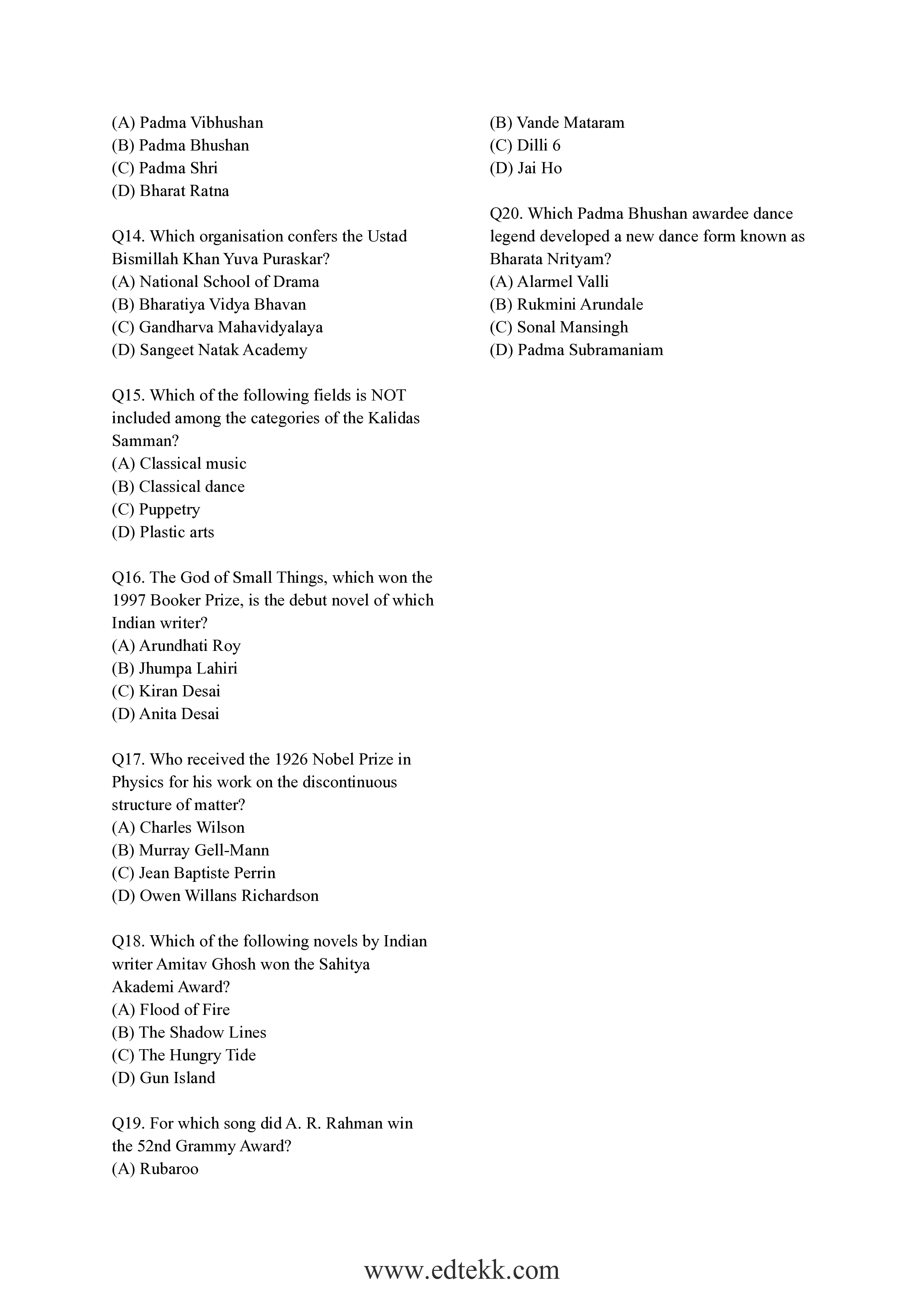
Q14. Which organisation confers the Ustad Bismillah Khan Yuva Puraskar?
(A) National School of Drama
(B) Bharatiya Vidya Bhavan
(C) Gandharva Mahavidyalaya
(D) Sangeet Natak Academy
Explanation: The Ustad Bismillah Khan Yuva Puraskar is conferred by the Sangeet Natak Akademi. It recognises outstanding young artists in music, dance, theatre and other performing arts. Named after the celebrated shehnai maestro Ustad Bismillah Khan, the award encourages emerging talent and supports the development of India’s performing arts traditions.
Q15. Which of the following fields is NOT included among the categories of the Kalidas Samman?
(A) Classical music
(B) Classical dance
(C) Puppetry
(D) Plastic arts
Explanation: The Kalidas Samman was instituted by the Government of Madhya Pradesh in 1980–81. It recognises outstanding contributions to classical music, classical dance, theatre and plastic arts. Puppetry is not a designated category among the four options listed, making it the correct answer.
Q16. The God of Small Things, which won the 1997 Booker Prize, is the debut novel of which Indian writer?
(A) Arundhati Roy
(B) Jhumpa Lahiri
(C) Kiran Desai
(D) Anita Desai
Explanation: The God of Small Things is the debut novel of Arundhati Roy and won the 1997 Booker Prize. Set in Kerala, the novel explores family relationships, caste discrimination, social inequalities and forbidden love. Its international success established Roy as a prominent contemporary Indian novelist.
Q17. Who received the 1926 Nobel Prize in Physics for his work on the discontinuous structure of matter?
(A) Charles Wilson
(B) Murray Gell-Mann
(C) Jean Baptiste Perrin
(D) Owen Willans Richardson
Explanation: Jean Baptiste Perrin received the 1926 Nobel Prize in Physics for his work on the discontinuous structure of matter, particularly his discovery of sedimentation equilibrium. His experiments provided important evidence supporting the physical existence of atoms and molecules.
Q18. Which of the following novels by Indian writer Amitav Ghosh won the Sahitya Akademi Award?
(A) Flood of Fire
(B) The Shadow Lines
(C) The Hungry Tide
(D) Gun Island
Explanation: The Shadow Lines, written by Amitav Ghosh and published in 1988, received the Sahitya Akademi Award in 1989 in the English language category. The novel explores nationalism, identity, memory and the complex relationships between individuals across geographical boundaries. It remains one of Ghosh’s most acclaimed literary works.
Q19. For which song did A. R. Rahman win the 52nd Grammy Award?
(A) Rubaroo
(B) Vande Mataram
(C) Dilli 6
(D) Jai Ho
Explanation: A. R. Rahman won the 52nd Annual Grammy Award in 2010 for Jai Ho, from the film Slumdog Millionaire. The song received the Grammy for Best Song Written for Motion Picture, Television or Other Visual Media. Rahman also won a separate Grammy for the film’s soundtrack album.
Q20. Which Padma Bhushan awardee dance legend developed a new dance form known as Bharata Nrityam?
(A) Alarmel Valli
(B) Rukmini Arundale
(C) Sonal Mansingh
(D) Padma Subramaniam
Explanation: Padma Subrahmanyam, an eminent Bharatanatyam dancer, choreographer and scholar, developed a distinctive dance style known as Bharata Nrityam. Her work draws upon extensive research into ancient Indian dance traditions, particularly the movement principles described in the Natya Shastra. She received the Padma Bhushan in 2003.
Question Paper Images