Improve your Indian History preparation with RRB Practice Paper 3, designed for candidates appearing in Railway Recruitment Board examinations. This practice set features objective-type questions covering important historical topics. Test your understanding and revise key concepts with answers and explanations relevant to RRB NTPC, Group D, ALP and Technician exams.
Test Details
Topic: Indian History
Total Questions: 20
Question Format: MCQs – Single Correct Answer
Suitable for: RRB NTPC, Group D, ALP, Technician
Download All Papers in This Series (PDF)
Questions and Answers
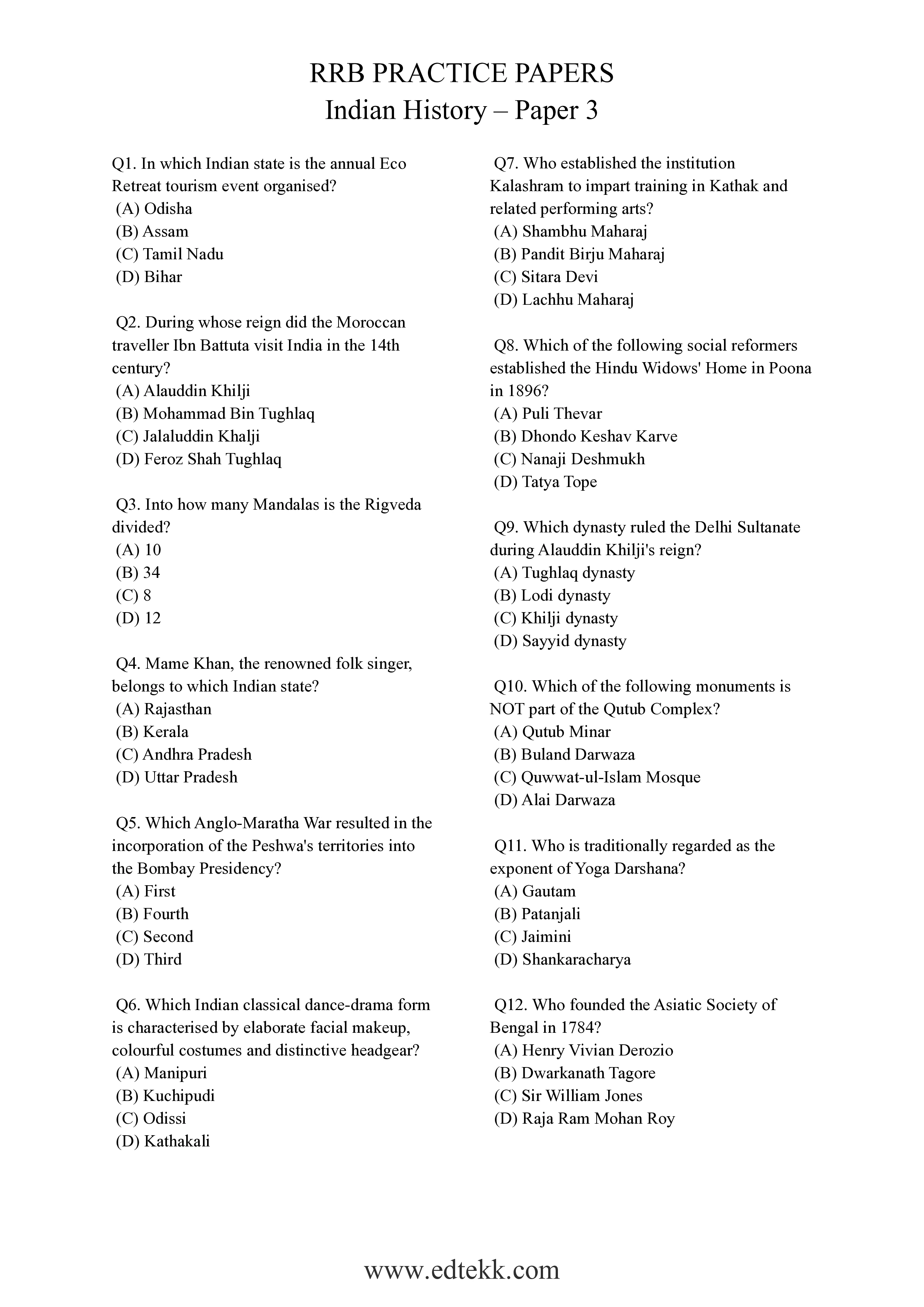
Q1. In which Indian state is the annual Eco Retreat tourism event organised?
(A) Odisha
(B) Assam
(C) Tamil Nadu
(D) Bihar
Explanation: Eco Retreat is a tourism initiative organised by the Odisha Government to promote experiential and sustainable tourism. It offers luxury tented accommodation, recreational activities and nature-based experiences at selected destinations across the state. It is organised seasonally and is a tourism event rather than a traditional religious festival.
Q2. During whose reign did the Moroccan traveller Ibn Battuta visit India in the 14th century?
(A) Alauddin Khilji
(B) Mohammad Bin Tughlaq
(C) Jalaluddin Khalji
(D) Feroz Shah Tughlaq
Explanation: Ibn Battuta, the Moroccan traveller and scholar, visited India during the reign of Muhammad bin Tughlaq (1325–1351 CE). He arrived in India around 1333 CE and was appointed Qazi of Delhi. His travel account, known as the Rihla, provides valuable information about the political, social and economic conditions of the Delhi Sultanate.
Q3. Into how many Mandalas is the Rigveda divided?
(A) 10
(B) 34
(C) 8
(D) 12
Explanation: The Rigveda consists of ten books, known as Mandalas, containing hymns dedicated to various deities. These hymns form the oldest surviving collection of Vedic Sanskrit literature. The second to seventh Mandalas are generally known as the family books, while the first and tenth Mandalas contain material from different periods of composition.
Q4. Mame Khan, the renowned folk singer, belongs to which Indian state?
(A) Rajasthan
(B) Kerala
(C) Andhra Pradesh
(D) Uttar Pradesh
Explanation: Mame Khan is a renowned Indian folk and playback singer from Rajasthan. He belongs to the Manganiyar community, which is known for its rich musical heritage. His singing is deeply rooted in traditional Rajasthani folk music, and he has also performed in Bollywood films and international musical collaborations.
Q5. Which Anglo-Maratha War resulted in the incorporation of the Peshwa’s territories into the Bombay Presidency?
(A) First
(B) Fourth
(C) Second
(D) Third
Explanation: The Third Anglo-Maratha War (1817–1818) resulted in the defeat of the Marathas and the abolition of the Peshwa’s office. The territories of the Peshwa were annexed by the British and incorporated into the Bombay Presidency. This marked the end of the Maratha Confederacy’s political supremacy.
Q6. Which Indian classical dance-drama form is characterised by elaborate facial makeup, colourful costumes and distinctive headgear?
(A) Manipuri
(B) Kuchipudi
(C) Odissi
(D) Kathakali
Explanation: Kathakali is a classical dance-drama tradition originating in Kerala. It is distinguished by elaborate facial makeup, colourful costumes, large headgear and expressive gestures. Its performances traditionally depict stories from Indian epics and mythology through stylised movements, facial expressions and hand gestures.
Q7. Who established the institution Kalashram to impart training in Kathak and related performing arts?
(A) Shambhu Maharaj
(B) Pandit Birju Maharaj
(C) Sitara Devi
(D) Lachhu Maharaj
Explanation: Pandit Birju Maharaj established Kalashram to teach and promote Kathak and related performing arts. A celebrated exponent of the Lucknow gharana, he made significant contributions to Kathak through performance, choreography and teaching, helping popularise the dance form nationally and internationally.
Q8. Which of the following social reformers established the Hindu Widows’ Home in Poona in 1896?
(A) Puli Thevar
(B) Dhondo Keshav Karve
(C) Nanaji Deshmukh
(D) Tatya Tope
Explanation: Dhondo Keshav Karve, popularly known as Maharshi Karve, established the Hindu Widows’ Home in Poona (now Pune) in 1896. He was a pioneering social reformer who worked for women’s education, widow remarriage, and the upliftment of widows in India.
Q9. Which dynasty ruled the Delhi Sultanate during Alauddin Khilji’s reign?
(A) Tughlaq dynasty
(B) Lodi dynasty
(C) Khilji dynasty
(D) Sayyid dynasty
Explanation: Alauddin Khilji belonged to the Khilji dynasty, which ruled the Delhi Sultanate from 1290 to 1320. He ruled from 1296 to 1316 and is particularly remembered for his administrative reforms, market regulations, military campaigns and territorial expansion. His reign marked a significant phase in the history of the Delhi Sultanate.
Q10. Which of the following monuments is NOT part of the Qutub Complex?
(A) Qutub Minar
(B) Buland Darwaza
(C) Quwwat-ul-Islam Mosque
(D) Alai Darwaza
Explanation: Buland Darwaza is not part of the Qutub Complex. It is a monumental gateway at Fatehpur Sikri, Uttar Pradesh, constructed by Mughal emperor Akbar to commemorate his victory over Gujarat in 1572 CE. The Qutub Complex in Delhi includes the Qutub Minar, Quwwat-ul-Islam Mosque and Alai Darwaza.
Q11. Who is traditionally regarded as the exponent of Yoga Darshana?
(A) Gautam
(B) Patanjali
(C) Jaimini
(D) Shankaracharya
Explanation: Patanjali is traditionally regarded as the exponent and systematiser of Yoga Darshana, one of the six orthodox schools of Indian philosophy. His Yoga Sutras describe the principles and practices of yoga, including ethical discipline, concentration, meditation and the attainment of spiritual liberation.
Q12. Who founded the Asiatic Society of Bengal in 1784?
(A) Henry Vivian Derozio
(B) Dwarkanath Tagore
(C) Sir William Jones
(D) Raja Ram Mohan Roy
Explanation: Sir William Jones founded the Asiatic Society of Bengal in Calcutta in 1784. The society promoted research into Asian history, languages, literature, culture and natural sciences. Jones’s studies of Sanskrit and comparative linguistics contributed significantly to the development of Oriental studies. The institution became an important centre of historical and scholarly research in colonial India.
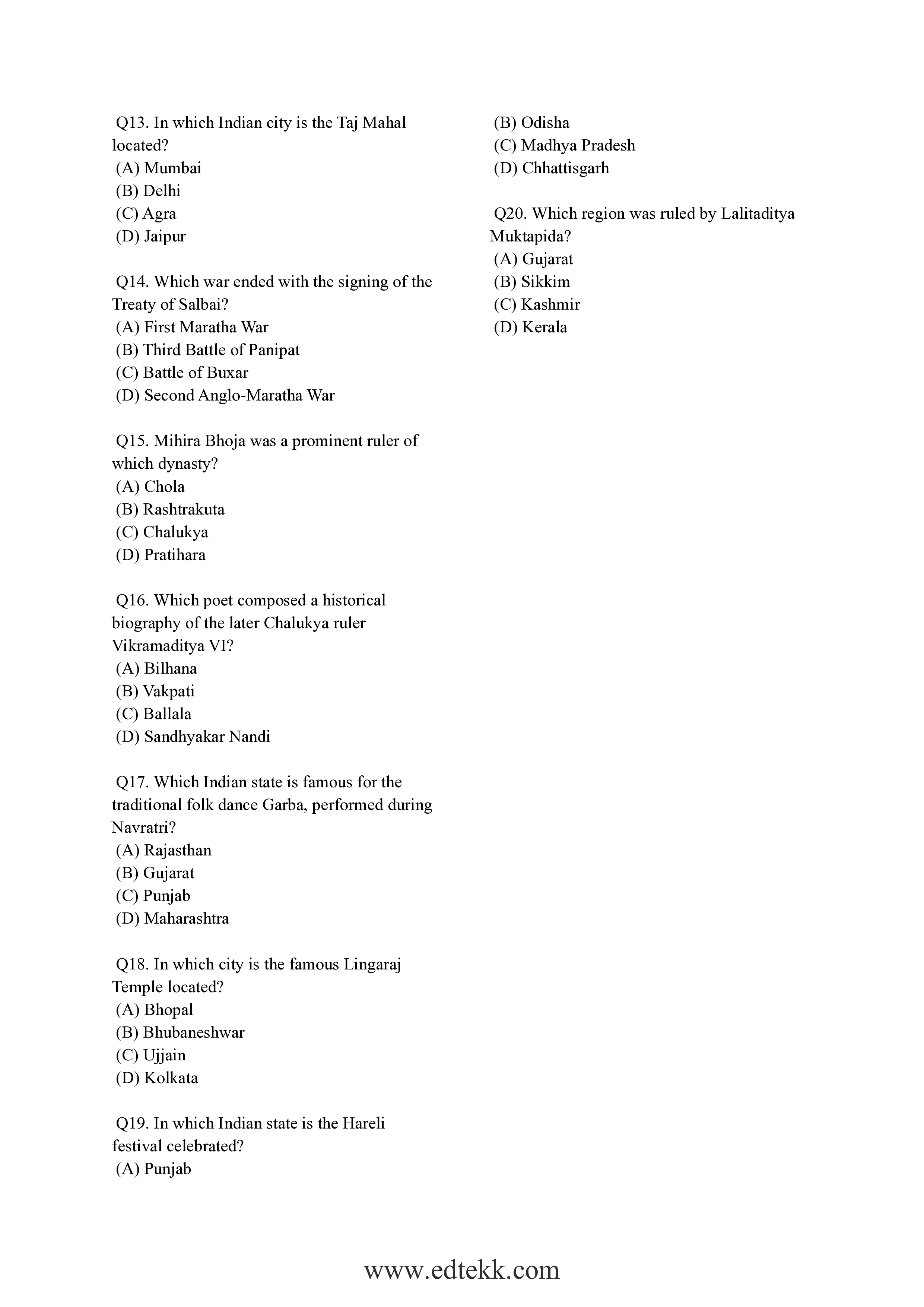
Q13. In which Indian city is the Taj Mahal located?
(A) Mumbai
(B) Delhi
(C) Agra
(D) Jaipur
Explanation: The Taj Mahal is located in Agra, Uttar Pradesh, on the southern bank of the Yamuna River. Mughal Emperor Shah Jahan commissioned it as a mausoleum in memory of his wife Mumtaz Mahal, who died in 1631. Renowned for its white marble architecture and intricate inlay work, it became a UNESCO World Heritage Site in 1983 and was named one of the New Seven Wonders of the World in 2007.
Q14. Which war ended with the signing of the Treaty of Salbai?
(A) First Maratha War
(B) Third Battle of Panipat
(C) Battle of Buxar
(D) Second Anglo-Maratha War
Explanation: The First Anglo-Maratha War (1775–1782) ended with the Treaty of Salbai, signed in 1782 between the British East India Company and the Maratha Confederacy. The treaty recognised Madhav Rao II as Peshwa and restored several territories to the Marathas, establishing peace between the two powers.
Q15. Mihira Bhoja was a prominent ruler of which dynasty?
(A) Chola
(B) Rashtrakuta
(C) Chalukya
(D) Pratihara
Explanation: Mihira Bhoja was a prominent ruler of the Gurjara-Pratihara dynasty during the ninth century CE. He strengthened the dynasty’s military and political influence in northern India. He assumed the title Adivaraha, which appears on his coins. The Pratiharas were major participants in the Tripartite Struggle for control of Kannauj, alongside the Palas and Rashtrakutas.
Q16. Which poet composed a historical biography of the later Chalukya ruler Vikramaditya VI?
(A) Bilhana
(B) Vakpati
(C) Ballala
(D) Sandhyakar Nandi
Explanation: Bilhana, a Kashmiri Sanskrit poet, composed Vikramankadevacharita, a historical poetic biography of the Western Chalukya ruler Vikramaditya VI. The work describes the king’s achievements, military campaigns and reign. It is an important literary source for understanding the political and cultural history of the Western Chalukya dynasty.
Q17. Which Indian state is famous for the traditional folk dance Garba, performed during Navratri?
(A) Rajasthan
(B) Gujarat
(C) Punjab
(D) Maharashtra
Explanation: Gujarat is particularly famous for Garba, a traditional folk dance performed during the Navratri festival. Participants dance in circular formations around a centrally placed lamp or an image of a goddess. The dance is associated with devotion to Goddess Amba and represents an important expression of Gujarati cultural heritage.
Q18. In which city is the famous Lingaraj Temple located?
(A) Bhopal
(B) Bhubaneshwar
(C) Ujjain
(D) Kolkata
Explanation: The Lingaraj Temple is situated in Bhubaneswar, Odisha. Dedicated primarily to Lord Shiva, it is an outstanding example of Kalinga-style temple architecture. Its principal structure dates to the eleventh century CE, although the sacred site and associated religious traditions are older. The temple is renowned for its towering curvilinear tower and elaborate stone carvings.
Q19. In which Indian state is the Hareli festival celebrated?
(A) Punjab
(B) Odisha
(C) Madhya Pradesh
(D) Chhattisgarh
Explanation: Hareli is a major agricultural festival of Chhattisgarh, celebrated during the Hindu month of Shravan. It marks the importance of agriculture, greenery and the monsoon season. Farmers traditionally worship agricultural implements and cattle and pray for good crops, prosperity and protection from diseases.
Q20. Which region was ruled by Lalitaditya Muktapida?
(A) Gujarat
(B) Sikkim
(C) Kashmir
(D) Kerala
Explanation: Lalitaditya Muktapida was a powerful ruler of the Karkota dynasty of Kashmir during the eighth century CE. He is particularly remembered for his military campaigns and expansion of Kashmiri political influence. He is also associated with significant architectural achievements, especially the construction of the Martand Sun Temple in Kashmir.
Question Paper Images