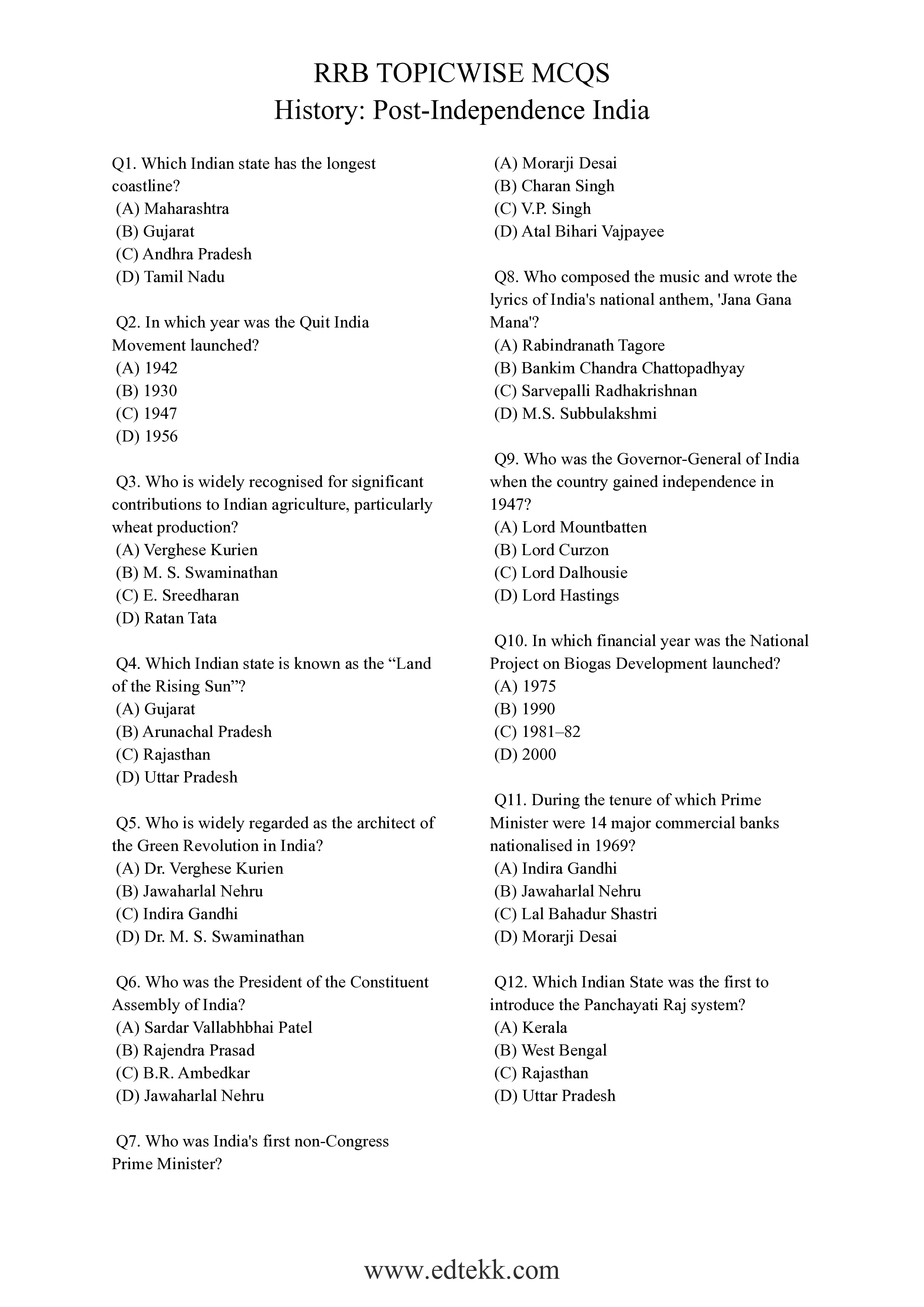
Strengthen your Indian History preparation with topicwise MCQs on post-independence India. This question set covers nation-building, integration of princely states, constitutional developments, economic planning, major policies and important historical events after 1947, with answers and explanations for RRB NTPC, Group D, ALP and Technician examinations.
Test Details
Topic: History: Post-Independence India
Total Questions: 20
Question Format: MCQs – Single Correct Answer
Suitable for: RRB NTPC, Group D, ALP, Technician
Download All Papers in This Series (PDF)
Questions and Answers
Q1. Which Indian state has the longest coastline?
(A) Maharashtra
(B) Gujarat
(C) Andhra Pradesh
(D) Tamil Nadu
Explanation: Gujarat has the longest coastline among Indian states. Its coastline lies along the Arabian Sea and includes the Kathiawar Peninsula and the Gulfs of Kutch and Khambhat. Its extensive coastal geography supports major ports, fisheries, maritime trade and industrial activities.
Q2. In which year was the Quit India Movement launched?
(A) 1942
(B) 1930
(C) 1947
(D) 1956
Explanation: The Quit India Movement was launched by Mahatma Gandhi and the Indian National Congress in August 1942. The Congress adopted the Quit India resolution on 8 August at Bombay (now Mumbai), and the movement began on 9 August following the arrest of major leaders. Gandhi gave the famous call of “Do or Die”.
Q3. Who is widely recognised for significant contributions to Indian agriculture, particularly wheat production?
(A) Verghese Kurien
(B) M. S. Swaminathan
(C) E. Sreedharan
(D) Ratan Tata
Explanation: M. S. Swaminathan played a pivotal role in India’s Green Revolution, particularly through the introduction and promotion of high-yielding wheat varieties and modern agricultural practices. His contributions, alongside international agricultural researchers and Indian agricultural institutions, helped significantly increase food-grain production and strengthen India’s food security. He is widely recognised as the Father of the Green Revolution in India.
Q4. Which Indian state is known as the “Land of the Rising Sun”?
(A) Gujarat
(B) Arunachal Pradesh
(C) Rajasthan
(D) Uttar Pradesh
Explanation: Arunachal Pradesh is known as the Land of the Rising Sun because it is India’s easternmost state and receives the country’s earliest sunrise. Its geographical position in northeastern India gives it this distinctive nickname. The state is also renowned for its mountainous landscapes, biodiversity and diverse indigenous cultures.
Q5. Who is widely regarded as the architect of the Green Revolution in India?
(A) Dr. Verghese Kurien
(B) Jawaharlal Nehru
(C) Indira Gandhi
(D) Dr. M. S. Swaminathan
Explanation: Dr. M. S. Swaminathan is widely regarded as the architect of India’s Green Revolution. He played a significant role in introducing and promoting high-yielding varieties of wheat and rice, along with modern agricultural practices. His contributions substantially increased India’s food-grain production and strengthened national food security.
Q6. Who was the President of the Constituent Assembly of India?
(A) Sardar Vallabhbhai Patel
(B) Rajendra Prasad
(C) B.R. Ambedkar
(D) Jawaharlal Nehru
Explanation: Dr. Rajendra Prasad was the President (Chairman) of the Constituent Assembly of India. He presided over its proceedings during the framing of the Constitution. He was subsequently elected as the first President of independent India in 1950.
Q7. Who was India’s first non-Congress Prime Minister?
(A) Morarji Desai
(B) Charan Singh
(C) V.P. Singh
(D) Atal Bihari Vajpayee
Explanation: Morarji Desai became India’s first non-Congress Prime Minister in March 1977 after the Janata Party won the general elections. He served until July 1979. His premiership marked the end of uninterrupted Congress rule at the national level since independence in 1947.
Q8. Who composed the music and wrote the lyrics of India’s national anthem, ‘Jana Gana Mana’?
(A) Rabindranath Tagore
(B) Bankim Chandra Chattopadhyay
(C) Sarvepalli Radhakrishnan
(D) M.S. Subbulakshmi
Explanation: Rabindranath Tagore composed the lyrics and music of India’s national anthem, Jana Gana Mana. It was first publicly sung at the Indian National Congress session in Calcutta in December 1911. Its first stanza was officially adopted as India’s national anthem by the Constituent Assembly on 24 January 1950.
Q9. Who was the Governor-General of India when the country gained independence in 1947?
(A) Lord Mountbatten
(B) Lord Curzon
(C) Lord Dalhousie
(D) Lord Hastings
Explanation: Lord Mountbatten was the last Viceroy of British India and became the first Governor-General of independent India on 15 August 1947. He held this position until June 1948, when C. Rajagopalachari succeeded him. Mountbatten played a central role in the transfer of power and the Partition of British India.
Q10. In which financial year was the National Project on Biogas Development launched?
(A) 1975
(B) 1990
(C) 1981–82
(D) 2000
Explanation: The National Project on Biogas Development was launched during the financial year 1981–82 to promote biogas technology, particularly household biogas plants. It encouraged the utilisation of organic waste, especially cattle dung, for renewable energy production. The programme also promoted the use of biogas slurry as organic manure, contributing to sustainable agriculture and rural energy development.
Q11. During the tenure of which Prime Minister were 14 major commercial banks nationalised in 1969?
(A) Indira Gandhi
(B) Jawaharlal Nehru
(C) Lal Bahadur Shastri
(D) Morarji Desai
Explanation: Indira Gandhi’s government nationalised 14 major commercial banks on 19 July 1969. The decision aimed to expand banking services, increase credit availability to agriculture and small industries, promote financial inclusion and reduce the concentration of economic power in private hands.
Q12. Which Indian State was the first to introduce the Panchayati Raj system?
(A) Kerala
(B) West Bengal
(C) Rajasthan
(D) Uttar Pradesh
Explanation: Rajasthan was the first Indian state to implement the Panchayati Raj System. It was inaugurated at Nagaur on 2 October 1959 by Prime Minister Jawaharlal Nehru. Andhra Pradesh was the second state to introduce the system. It aimed to promote democratic decentralisation through elected local self-government institutions.
Q13. Who was the Prime Minister of India when the Right to Information Act was enacted in 2005?
(A) Atal Bihari Vajpayee
(B) Manmohan Singh
(C) P.V. Narasimha Rao
(D) Indira Gandhi
Explanation: Manmohan Singh was Prime Minister when the Right to Information (RTI) Act was enacted in 2005. The Act empowered citizens to obtain information from public authorities, promoting transparency, accountability and public participation in governance. It came fully into force on 12 October 2005.
Q14. Which of the following leaders was not a member of the Indian Constituent Assembly?
(A) Sardar Vallabhbhai Patel
(B) Maulana Abul Kalam Azad
(C) Mahatma Gandhi
(D) Dr. Rajendra Prasad
Explanation: Mahatma Gandhi was not a member of the Constituent Assembly that drafted the Indian Constitution. Although he profoundly influenced India’s freedom movement and political philosophy, he did not participate as an Assembly member. Sardar Vallabhbhai Patel, Maulana Abul Kalam Azad and Dr. Rajendra Prasad were members of the Assembly.
Q15. Who was the Prime Minister of India during Operation Blue Star in 1984?
(A) Rajiv Gandhi
(B) Indira Gandhi
(C) Charan Singh
(D) Morarji Desai
Explanation: Indira Gandhi was Prime Minister during Operation Blue Star, conducted by the Indian Army in June 1984 at the Golden Temple complex in Amritsar. The operation aimed to remove armed militants occupying the complex. It had significant political, religious and social consequences and intensified tensions in Punjab.
Q16. Which princely state acceded to India following the conflict with Pakistan in 1947–1948?
(A) Jammu and Kashmir
(B) Hyderabad
(C) Junagadh
(D) Travancore
Explanation: Jammu and Kashmir acceded to India in October 1947 after Pakistani tribal forces invaded the princely state. Maharaja Hari Singh signed the Instrument of Accession in favour of India on 26 October 1947. This led to the First Indo-Pakistani War (1947–1948), which ended with a UN-mediated ceasefire on 1 January 1949.
Q17. Which Indian Prime Minister was assassinated on 31 October 1984?
(A) Jawaharlal Nehru
(B) Indira Gandhi
(C) Lal Bahadur Shastri
(D) Rajiv Gandhi
Explanation: Indira Gandhi was assassinated on 31 October 1984 by two of her bodyguards in New Delhi. Her assassination followed Operation Blue Star, conducted earlier that year at the Golden Temple in Amritsar. Following her death, her son Rajiv Gandhi became Prime Minister of India.
Q18. Which sector is primarily addressed by the Antyodaya Anna Yojana?
(A) Rural Employment
(B) Food Security
(C) Universal Basic Income
(D) Women Empowerment
Explanation: Antyodaya Anna Yojana (AAY) was launched in December 2000 to provide highly subsidised food grains to the poorest households in India. It operates through the Public Distribution System (PDS) and aims to improve food security among the most economically vulnerable sections of society.
Q19. What was the primary objective of the Rajiv Gandhi Grameen Vidyutikaran Yojana (RGGVY)?
(A) Urban households
(B) Rural households
(C) Industrial areas
(D) Educational institutions
Explanation: The Rajiv Gandhi Grameen Vidyutikaran Yojana (RGGVY) was launched in 2005 to accelerate rural electrification. Its primary objective was to provide electricity to rural households, particularly below-poverty-line (BPL) households, while strengthening rural electricity distribution infrastructure. The scheme was subsequently subsumed under the Deen Dayal Upadhyaya Gram Jyoti Yojana (DDUGJY).
Q20. What was the name of the document that outlined the fundamental principles of the Indian Constitution?
(A) Nehru Report
(B) Mountbatten Plan
(C) Objective Resolution
(D) Cabinet Mission Plan
Explanation: The Objective Resolution was introduced by Jawaharlal Nehru in the Constituent Assembly on 13 December 1946 and adopted on 22 January 1947. It outlined the fundamental principles and objectives of the proposed Constitution. Its ideals subsequently formed the philosophical foundation of the Preamble to the Indian Constitution.
Question Paper Images