Prepare effectively for Railway examinations with Indian Polity and Constitution Practice Paper 7. Created for RRB NTPC, Group D, ALP and Technician candidates, this practice set includes 20 multiple-choice questions with correct answers and explanations to improve subject knowledge and support focused revision.
Test Details
Topic: Indian Polity and Constitution
Total Questions: 20
Question Format: MCQs – Single Correct Answer
Suitable for: RRB NTPC, Group D, ALP, Technician
Download All Papers in This Series (PDF)
Questions and Answers
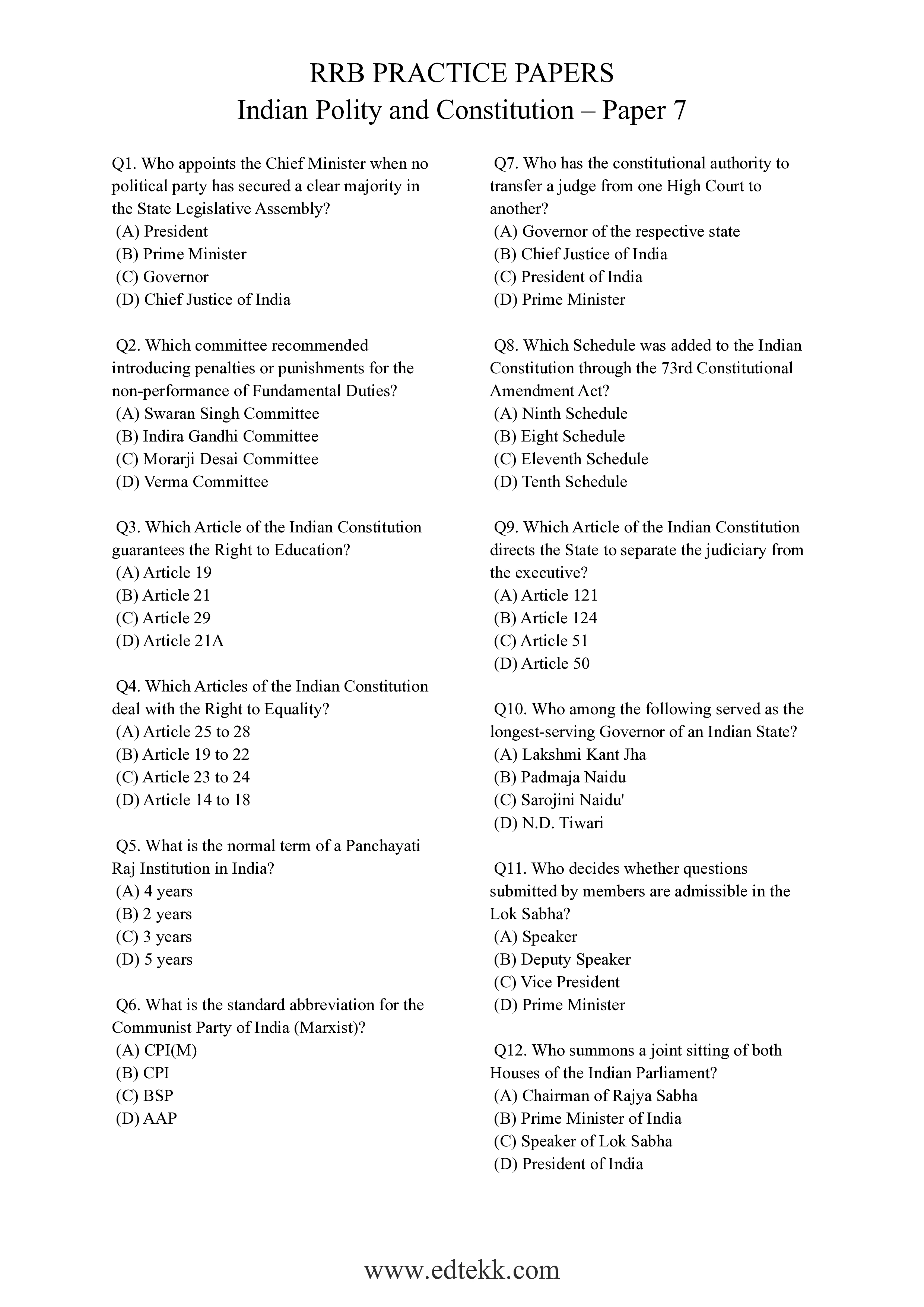
Q1. Who appoints the Chief Minister when no political party has secured a clear majority in the State Legislative Assembly?
(A) President
(B) Prime Minister
(C) Governor
(D) Chief Justice of India
Explanation: The Governor appoints the Chief Minister under Article 164. When no party has secured a clear majority in the Legislative Assembly, the Governor invites the person most likely to command majority support. The Chief Minister may be required to establish that support through a floor test in the Assembly.
Q2. Which committee recommended introducing penalties or punishments for the non-performance of Fundamental Duties?
(A) Swaran Singh Committee
(B) Indira Gandhi Committee
(C) Morarji Desai Committee
(D) Verma Committee
Explanation: The Sardar Swaran Singh Committee recommended that Parliament should provide penalties or punishments for non-performance of Fundamental Duties. However, this recommendation was not incorporated as a general constitutional punishment. Fundamental Duties are generally non-justiciable.
Q3. Which Article of the Indian Constitution guarantees the Right to Education?
(A) Article 19
(B) Article 21
(C) Article 29
(D) Article 21A
Explanation: Article 21A of the Indian Constitution guarantees the Fundamental Right to Education for children aged six to fourteen years. It directs the State to provide free and compulsory education to children in this age group in the manner prescribed by law. This provision was introduced through the 86th Constitutional Amendment Act, 2002.
Q4. Which Articles of the Indian Constitution deal with the Right to Equality?
(A) Article 25 to 28
(B) Article 19 to 22
(C) Article 23 to 24
(D) Article 14 to 18
Explanation: Articles 14–18 of the Indian Constitution deal with the Right to Equality. They provide for equality before the law, prohibit discrimination on specified grounds, ensure equality of opportunity in public employment, abolish untouchability and abolish titles, subject to the constitutional provisions.
Q5. What is the normal term of a Panchayati Raj Institution in India?
(A) 4 years
(B) 2 years
(C) 3 years
(D) 5 years
Explanation: Under Article 243E of the Constitution, every Panchayati Raj Institution has a five-year term from the date appointed for its first meeting, unless dissolved earlier. If dissolved prematurely, elections must generally be completed within six months. However, this requirement does not apply when the remaining term is less than six months.
Q6. What is the standard abbreviation for the Communist Party of India (Marxist)?
(A) CPI(M)
(B) CPI
(C) BSP
(D) AAP
Explanation: CPI(M) is the standard abbreviation for the Communist Party of India (Marxist), established in 1964 following a split within the Communist Party of India. It follows Marxist ideology and has historically maintained a significant political presence in states such as Kerala, West Bengal and Tripura.
Q7. Who has the constitutional authority to transfer a judge from one High Court to another?
(A) Governor of the respective state
(B) Chief Justice of India
(C) President of India
(D) Prime Minister
Explanation: Under Article 222 of the Indian Constitution, the President of India has the authority to transfer a judge from one High Court to another after consultation with the Chief Justice of India. The consultation process is an important safeguard for judicial independence. Neither the Prime Minister nor the Governor independently exercises this constitutional power.
Q8. Which Schedule was added to the Indian Constitution through the 73rd Constitutional Amendment Act?
(A) Ninth Schedule
(B) Eight Schedule
(C) Eleventh Schedule
(D) Tenth Schedule
Explanation: The Eleventh Schedule was added to the Indian Constitution through the 73rd Constitutional Amendment Act, 1992. It contains 29 subjects that may be entrusted to Panchayati Raj institutions. These include agriculture, minor irrigation, rural development, education, health and sanitation. The amendment strengthened the constitutional framework for democratic decentralisation.
Q9. Which Article of the Indian Constitution directs the State to separate the judiciary from the executive?
(A) Article 121
(B) Article 124
(C) Article 51
(D) Article 50
Explanation: Article 50 of the Indian Constitution directs the State to separate the judiciary from the executive in the public services of the State. This provision is included in the Directive Principles of State Policy (DPSP). Its objective is to strengthen judicial independence and minimise executive interference in judicial functions.
Q10. Who among the following served as the longest-serving Governor of an Indian State?
(A) Lakshmi Kant Jha
(B) Padmaja Naidu
(C) Sarojini Naidu’
(D) N.D. Tiwari
Explanation: Padmaja Naidu served as Governor of West Bengal from 1956 to 1967, for about 11 years, and is generally regarded as the longest-serving Governor of an Indian State. She was a freedom fighter and the daughter of Sarojini Naidu.
Q11. Who decides whether questions submitted by members are admissible in the Lok Sabha?
(A) Speaker
(B) Deputy Speaker
(C) Vice President
(D) Prime Minister
Explanation: The Speaker of the Lok Sabha decides the admissibility of questions submitted by members under the Rules of Procedure and Conduct of Business in Lok Sabha. The Speaker may disallow questions that do not satisfy prescribed procedural requirements or contain irrelevant or inadmissible material.
Q12. Who summons a joint sitting of both Houses of the Indian Parliament?
(A) Chairman of Rajya Sabha
(B) Prime Minister of India
(C) Speaker of Lok Sabha
(D) President of India
Explanation: The President of India summons a joint sitting of both Houses of Parliament under Article 108 to resolve a deadlock over an ordinary bill. This provision does not apply to Money Bills or Constitutional Amendment Bills. The Speaker of the Lok Sabha normally presides over the joint sitting.
Q13. In which year were two additional Election Commissioners appointed to the Election Commission of India for the first time?
(A) 1991
(B) 1998
(C) 1990
(D) 1989
Explanation: In 1989, two additional Election Commissioners were appointed for the first time, making the Election Commission of India a multi-member body. The arrangement was temporary; the Commission reverted to a single-member body in 1990 and became multi-member again in 1993.
Q14. How many Members of Parliament were elected from Punjab to the 17th Lok Sabha?
(A) 13
(B) 14
(C) 15
(D) 17
Explanation: Punjab has 13 elected seats in the Lok Sabha. The state elected 13 Members of Parliament to the 17th Lok Sabha following the 2019 general elections. These representatives were elected from the state’s 13 parliamentary constituencies.
Q15. Who administers the oath of office to the Governor of a state?
(A) Chief Minister
(B) Chief Justice of the High Court
(C) President
(D) Chief Justice of India
Explanation: The Chief Justice of the concerned High Court administers the oath of office to the Governor under Article 159 of the Constitution. In the absence of the Chief Justice, the senior-most available judge of that High Court administers the oath. This provision ensures the formal commencement of the Governor’s constitutional responsibilities.
Q16. Who is the administrative head of the Indian Audit and Accounts Department?
(A) Accountant General
(B) Principal Accountant General
(C) The Comptroller and Auditor General
(D) Director General
Explanation: The Comptroller and Auditor General of India (CAG) is the head of the Indian Audit and Accounts Department. The CAG audits the accounts of the Union and State Governments and performs the constitutional functions prescribed under the Constitution and the CAG’s statutory duties.
Q17. Which Constitutional Amendment Act added Konkani, Manipuri and Nepali to the Eighth Schedule of the Indian Constitution?
(A) The 71st Amendment
(B) The 42nd Amendment
(C) The 73rd Amendment
(D) The 92nd Amendment
Explanation: The 71st Constitutional Amendment Act, 1992, added Konkani, Manipuri and Nepali to the Eighth Schedule of the Indian Constitution, increasing the number of recognised scheduled languages from 18 to 21. Subsequently, the 92nd Amendment Act, 2003, added Bodo, Dogri, Maithili and Santhali.
Q18. Under which rule of the Lok Sabha can members raise matters that are not covered by regular parliamentary procedures?
(A) Rule 377
(B) Rule 302
(C) Rule 223
(D) Rule 214
Explanation: Rule 377 of the Lok Sabha’s Rules of Procedure allows members to raise matters that are not points of order and cannot conveniently be raised through other parliamentary procedures. It provides an opportunity to bring important matters of public interest to the attention of the House without initiating a formal discussion.
Q19. Which of the following has the authority to dissolve the Rajya Sabha?
(A) Council of Ministers
(B) The Rajya Sabha cannot be dissolved.
(C) President
(D) Chief Justice of India
Explanation: The Rajya Sabha is a permanent House of Parliament and cannot be dissolved (Article 83). Unlike the Lok Sabha, it maintains institutional continuity irrespective of general elections. Approximately one-third of its members retire every two years, with vacancies filled through elections or nominations, as applicable.
Q20. Which two States were associated with the initial introduction of the Panchayati Raj system in India in 1959?
(A) Rajasthan and Andhra Pradesh
(B) Assam and Bihar
(C) Arunachal Pradesh and Uttar Pradesh
(D) Punjab and Chandigarh
Explanation: Rajasthan was the first state to introduce the Panchayati Raj system in India on 2 October 1959 at Nagaur. Andhra Pradesh followed shortly afterwards as the second state to introduce the system in the same year. These developments marked the beginning of institutional democratic decentralisation through elected rural local self-government bodies.
Question Paper Images