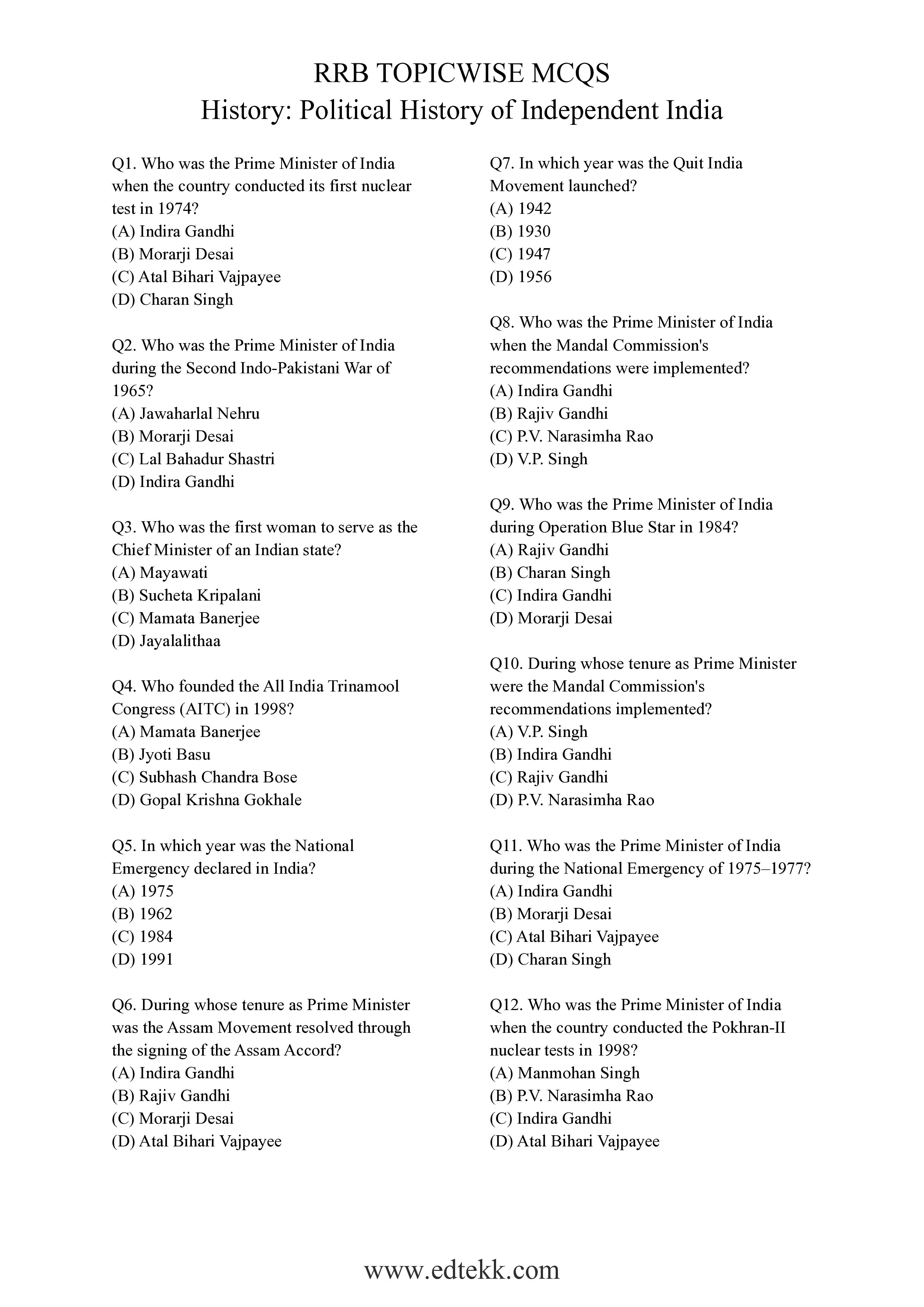
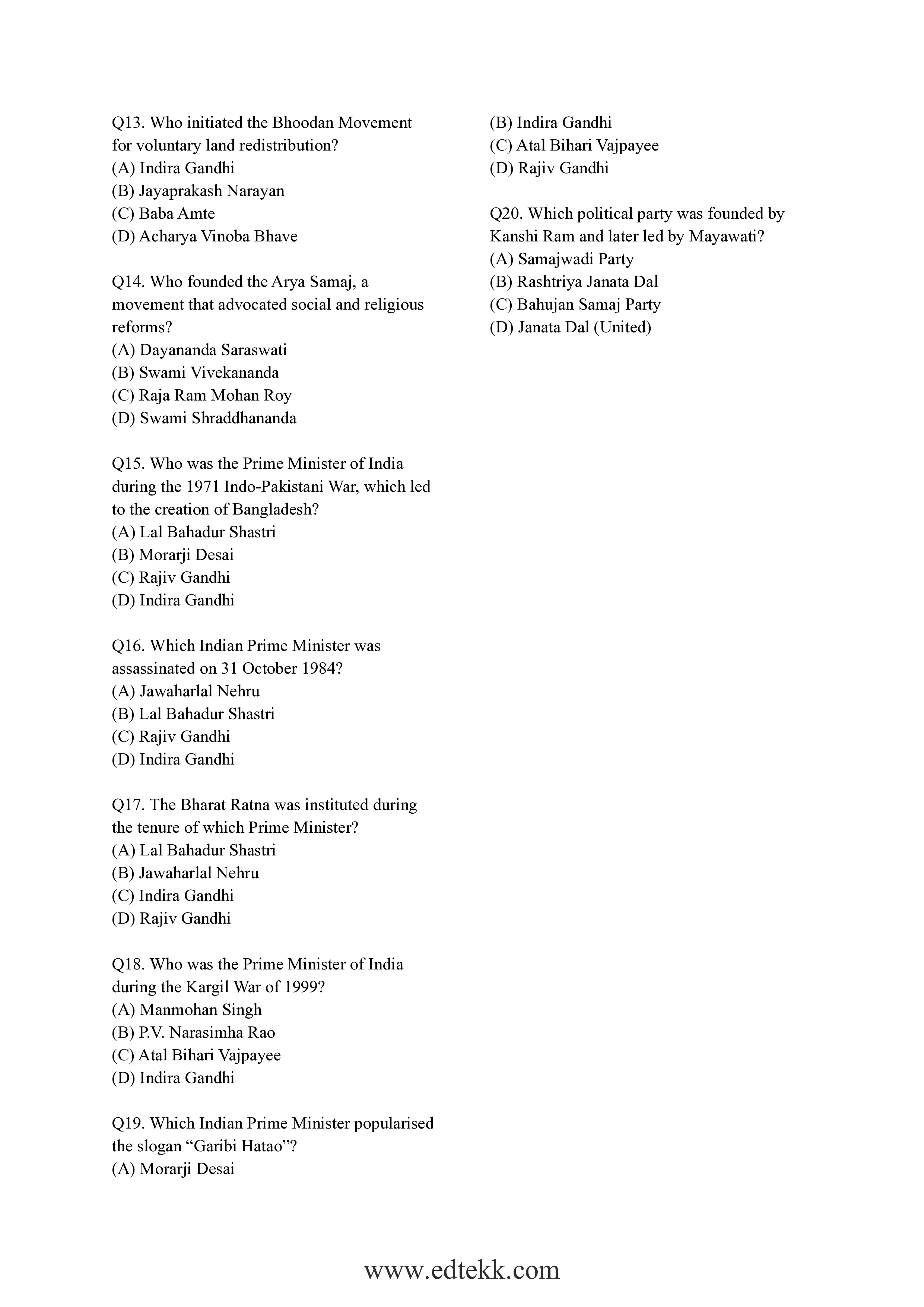
Test your knowledge of the political history of independent India through topicwise Indian History MCQs. This practice set covers political developments, elections, governments, constitutional milestones, leadership and major national events since independence, with answers and explanations for candidates preparing for RRB NTPC, Group D, ALP and Technician examinations.
Test Details
Topic: History: Political History of Independent India
Total Questions: 20
Question Format: MCQs – Single Correct Answer
Suitable for: RRB NTPC, Group D, ALP, Technician
Download All Papers in This Series (PDF)
Questions and Answers
Q1. Who was the Prime Minister of India when the country conducted its first nuclear test in 1974?
(A) Indira Gandhi
(B) Morarji Desai
(C) Atal Bihari Vajpayee
(D) Charan Singh
Explanation: Indira Gandhi was Prime Minister when India conducted its first successful nuclear test on 18 May 1974 at Pokhran in Rajasthan. Code-named Smiling Buddha, the test was officially described by India as a peaceful nuclear explosion and marked a significant milestone in the country’s nuclear programme.
Q2. Who was the Prime Minister of India during the Second Indo-Pakistani War of 1965?
(A) Jawaharlal Nehru
(B) Morarji Desai
(C) Lal Bahadur Shastri
(D) Indira Gandhi
Explanation: Lal Bahadur Shastri was the Prime Minister of India during the Second Indo-Pakistani War in 1965. His leadership during the conflict strengthened India’s national resolve. His famous slogan “Jai Jawan, Jai Kisan” highlighted the importance of soldiers and farmers in national development.
Q3. Who was the first woman to serve as the Chief Minister of an Indian state?
(A) Mayawati
(B) Sucheta Kripalani
(C) Mamata Banerjee
(D) Jayalalithaa
Explanation: Sucheta Kripalani became the first woman Chief Minister of an Indian state in 1963, when she assumed office in Uttar Pradesh. She served from 2 October 1963 to 13 March 1967. Her appointment marked a significant milestone in the political history of independent India.
Q4. Who founded the All India Trinamool Congress (AITC) in 1998?
(A) Mamata Banerjee
(B) Jyoti Basu
(C) Subhash Chandra Bose
(D) Gopal Krishna Gokhale
Explanation: Mamata Banerjee founded the All India Trinamool Congress (AITC) in January 1998 after separating from the Indian National Congress. The party emerged as a major political force in West Bengal and formed the state government in 2011 under her leadership.
Q5. In which year was the National Emergency declared in India?
(A) 1975
(B) 1962
(C) 1984
(D) 1991
Explanation: The National Emergency was declared in India on 25 June 1975 by President Fakhruddin Ali Ahmed on the advice of Prime Minister Indira Gandhi, under Article 352 of the Constitution. It remained in force until 21 March 1977 and was accompanied by restrictions on civil liberties, press freedom and political activities.
Q6. During whose tenure as Prime Minister was the Assam Movement resolved through the signing of the Assam Accord?
(A) Indira Gandhi
(B) Rajiv Gandhi
(C) Morarji Desai
(D) Atal Bihari Vajpayee
Explanation: The Assam Movement was resolved through the Assam Accord, signed on 15 August 1985 between the Government of India and leaders of the All Assam Students’ Union (AASU) and All Assam Gana Sangram Parishad (AAGSP). Rajiv Gandhi was the Prime Minister when the agreement was signed.
Q7. In which year was the Quit India Movement launched?
(A) 1942
(B) 1930
(C) 1947
(D) 1956
Explanation: The Quit India Movement was launched by Mahatma Gandhi and the Indian National Congress in August 1942. The Congress adopted the Quit India resolution on 8 August at Bombay (now Mumbai), and the movement began on 9 August following the arrest of major leaders. Gandhi gave the famous call of “Do or Die”.
Q8. Who was the Prime Minister of India when the Mandal Commission’s recommendations were implemented?
(A) Indira Gandhi
(B) Rajiv Gandhi
(C) P.V. Narasimha Rao
(D) V.P. Singh
Explanation: V. P. Singh was the Prime Minister when the Mandal Commission’s recommendations were implemented in 1990. His government announced 27% reservation in central government jobs for Socially and Educationally Backward Classes (OBCs), following the recommendations of the Second Backward Classes Commission headed by B. P. Mandal.
Q9. Who was the Prime Minister of India during Operation Blue Star in 1984?
(A) Rajiv Gandhi
(B) Charan Singh
(C) Indira Gandhi
(D) Morarji Desai
Explanation: Indira Gandhi was Prime Minister during Operation Blue Star, conducted by the Indian Army in June 1984 at the Golden Temple complex in Amritsar. The operation aimed to remove armed militants occupying the complex. It had significant political, religious and social consequences and intensified tensions in Punjab.
Q10. During whose tenure as Prime Minister were the Mandal Commission’s recommendations implemented?
(A) V.P. Singh
(B) Indira Gandhi
(C) Rajiv Gandhi
(D) P.V. Narasimha Rao
Explanation: V.P. Singh’s government implemented the Mandal Commission’s recommendation in 1990 by announcing 27% reservation for Other Backward Classes (OBCs) in central government services. This decision generated widespread political debate and protests and became a landmark development in India’s reservation policy.
Q11. Who was the Prime Minister of India during the National Emergency of 1975–1977?
(A) Indira Gandhi
(B) Morarji Desai
(C) Atal Bihari Vajpayee
(D) Charan Singh
Explanation: Indira Gandhi was Prime Minister during the National Emergency, which lasted from 25 June 1975 to 21 March 1977. During this period, civil liberties were curtailed, press censorship was imposed, political opponents were detained and democratic institutions faced significant restrictions.
Q12. Who was the Prime Minister of India when the country conducted the Pokhran-II nuclear tests in 1998?
(A) Manmohan Singh
(B) P.V. Narasimha Rao
(C) Indira Gandhi
(D) Atal Bihari Vajpayee
Explanation: Atal Bihari Vajpayee was Prime Minister when India conducted the Pokhran-II nuclear tests in May 1998. The series comprised five underground nuclear explosions conducted on 11 and 13 May. These tests demonstrated India’s nuclear weapons capability and marked a major turning point in its strategic and defence policy.
Q13. Who initiated the Bhoodan Movement for voluntary land redistribution?
(A) Indira Gandhi
(B) Jayaprakash Narayan
(C) Baba Amte
(D) Acharya Vinoba Bhave
Explanation: Acharya Vinoba Bhave initiated the Bhoodan Movement in April 1951 at Pochampally village in present-day Telangana. He encouraged wealthy landowners to voluntarily donate portions of their land to landless people. The movement promoted voluntary land redistribution and social justice through non-violent means.
Q14. Who founded the Arya Samaj, a movement that advocated social and religious reforms?
(A) Dayananda Saraswati
(B) Swami Vivekananda
(C) Raja Ram Mohan Roy
(D) Swami Shraddhananda
Explanation: Swami Dayananda Saraswati founded the Arya Samaj in Bombay in 1875. The movement advocated a return to the teachings of the Vedas and opposed idol worship and caste discrimination based on birth. It also promoted education, social equality and reforms against prevailing social evils.
Q15. Who was the Prime Minister of India during the 1971 Indo-Pakistani War, which led to the creation of Bangladesh?
(A) Lal Bahadur Shastri
(B) Morarji Desai
(C) Rajiv Gandhi
(D) Indira Gandhi
Explanation: Indira Gandhi was the Prime Minister during the Indo-Pakistani War of 1971. India’s military intervention supported the liberation of East Pakistan, resulting in the surrender of Pakistani forces on 16 December 1971 and the emergence of Bangladesh as an independent nation.
Q16. Which Indian Prime Minister was assassinated on 31 October 1984?
(A) Jawaharlal Nehru
(B) Lal Bahadur Shastri
(C) Rajiv Gandhi
(D) Indira Gandhi
Explanation: Indira Gandhi was assassinated on 31 October 1984 by two of her bodyguards in New Delhi. Her assassination followed Operation Blue Star, conducted earlier that year at the Golden Temple in Amritsar. Following her death, her son Rajiv Gandhi became Prime Minister of India.
Q17. The Bharat Ratna was instituted during the tenure of which Prime Minister?
(A) Lal Bahadur Shastri
(B) Jawaharlal Nehru
(C) Indira Gandhi
(D) Rajiv Gandhi
Explanation: The Bharat Ratna, India’s highest civilian award, was instituted in 1954 during the tenure of Prime Minister Jawaharlal Nehru. The first recipients in 1954 were C. Rajagopalachari, Dr. Sarvepalli Radhakrishnan and C. V. Raman, in recognition of their exceptional contributions.
Q18. Who was the Prime Minister of India during the Kargil War of 1999?
(A) Manmohan Singh
(B) P.V. Narasimha Rao
(C) Atal Bihari Vajpayee
(D) Indira Gandhi
Explanation: Atal Bihari Vajpayee was the Prime Minister of India during the Kargil War of 1999. The conflict involved Indian and Pakistani forces in the Kargil region of Jammu and Kashmir. India successfully recaptured the occupied positions through Operation Vijay, which concluded in July 1999.
Q19. Which Indian Prime Minister popularised the slogan “Garibi Hatao”?
(A) Morarji Desai
(B) Indira Gandhi
(C) Atal Bihari Vajpayee
(D) Rajiv Gandhi
Explanation: Indira Gandhi popularised the slogan “Garibi Hatao” (Remove Poverty) during the 1971 general election campaign. The slogan emphasised poverty alleviation, economic equality and social welfare. It became a central theme of her political programme and helped shape her electoral campaign.
Q20. Which political party was founded by Kanshi Ram and later led by Mayawati?
(A) Samajwadi Party
(B) Rashtriya Janata Dal
(C) Bahujan Samaj Party
(D) Janata Dal (United)
Explanation: Kanshi Ram founded the Bahujan Samaj Party (BSP) on 14 April 1984 to represent the political interests of Dalits, Adivasis, Other Backward Classes and other marginalised communities. Mayawati subsequently became its prominent leader and served multiple terms as Chief Minister of Uttar Pradesh.
Question Paper Images