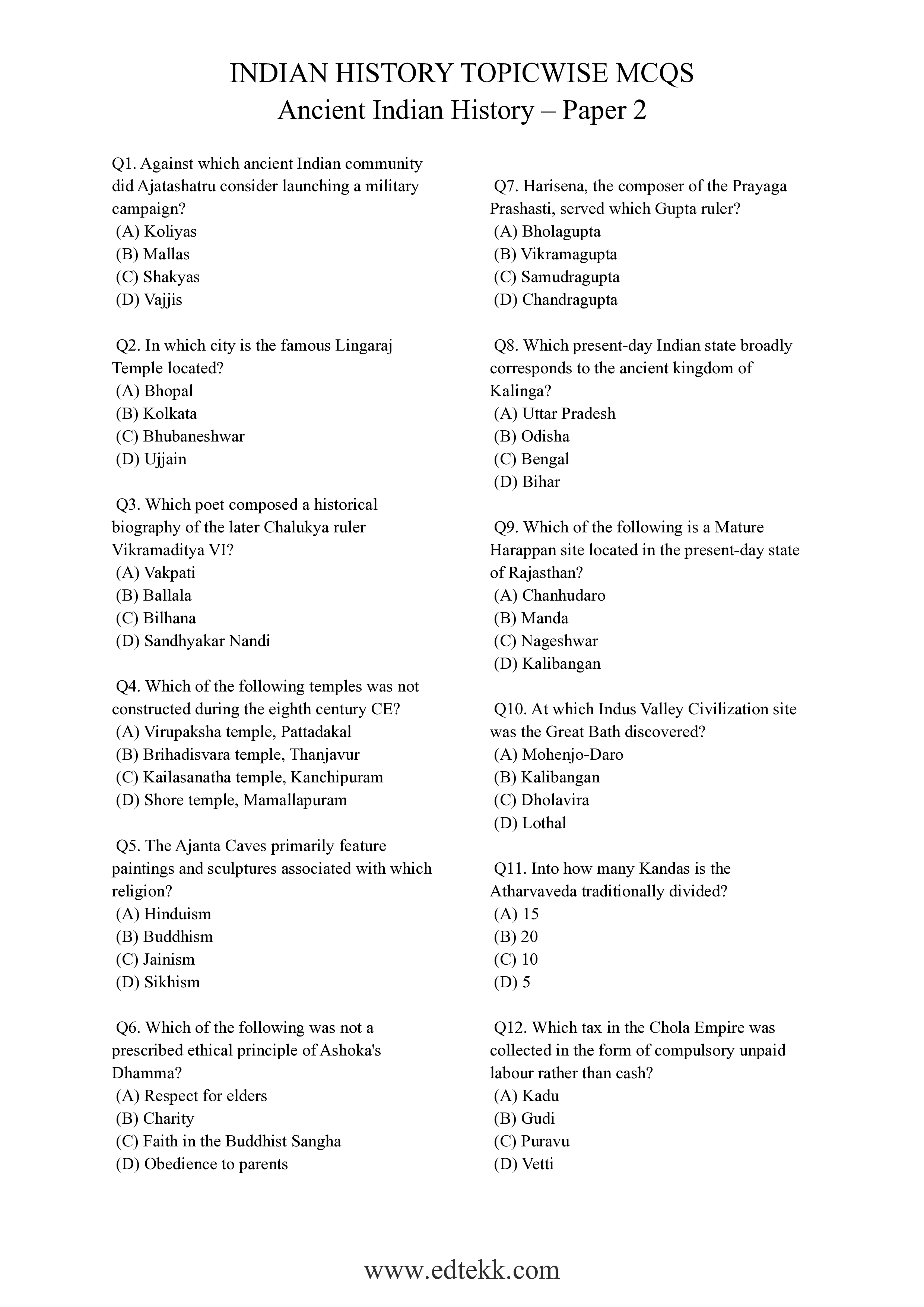
Prepare for competitive examinations with Ancient Indian History Topicwise MCQs – Paper 2. This question set covers important ancient dynasties, rulers, empires, administration, literature, science and historical developments. It helps candidates revise key concepts through objective questions with answers and explanations for SSC, RRB NTPC, RRB Group D, Police Constable and Police SI examinations.
Test Details
Topic: Ancient Indian History
Total Questions: 20
Question Format: MCQs – Single Correct Answer
Suitable for: SSC exams, RRB NTPC, RRB Group D, Police Constable, Police SI
Download All Papers in This Series (PDF)
Questions and Answers
Q1. Against which ancient Indian community did Ajatashatru consider launching a military campaign?
(A) Koliyas
(B) Mallas
(C) Shakyas
(D) Vajjis
Explanation: According to Buddhist tradition, Ajatashatru, the ruler of Magadha, sent his minister Vassakara to Gautama Buddha regarding his proposed campaign against the Vajjis. Buddha explained that the Vajjis would remain strong as long as they maintained unity, held regular assemblies, respected established customs and upheld mutual cooperation. The episode highlights the importance of political solidarity and collective governance.
Q2. In which city is the famous Lingaraj Temple located?
(A) Bhopal
(B) Kolkata
(C) Bhubaneshwar
(D) Ujjain
Explanation: The Lingaraj Temple is situated in Bhubaneswar, Odisha. Dedicated primarily to Lord Shiva, it is an outstanding example of Kalinga-style temple architecture. Its principal structure dates to the eleventh century CE, although the sacred site and associated religious traditions are older. The temple is renowned for its towering curvilinear tower and elaborate stone carvings.
Q3. Which poet composed a historical biography of the later Chalukya ruler Vikramaditya VI?
(A) Vakpati
(B) Ballala
(C) Bilhana
(D) Sandhyakar Nandi
Explanation: Bilhana, a Kashmiri Sanskrit poet, composed Vikramankadevacharita, a historical poetic biography of the Western Chalukya ruler Vikramaditya VI. The work describes the king’s achievements, military campaigns and reign. It is an important literary source for understanding the political and cultural history of the Western Chalukya dynasty.
Q4. Which of the following temples was not constructed during the eighth century CE?
(A) Virupaksha temple, Pattadakal
(B) Brihadisvara temple, Thanjavur
(C) Kailasanatha temple, Kanchipuram
(D) Shore temple, Mamallapuram
Explanation: The Brihadisvara Temple at Thanjavur was constructed under Rajaraja Chola I and completed around 1010 CE, during the early eleventh century. The Virupaksha Temple at Pattadakal, Shore Temple at Mamallapuram and Kailasanatha Temple at Kanchipuram are associated with the seventh or eighth centuries CE. Therefore, the Brihadisvara Temple was not built during the eighth century.
Q5. The Ajanta Caves primarily feature paintings and sculptures associated with which religion?
(A) Hinduism
(B) Buddhism
(C) Jainism
(D) Sikhism
Explanation: The Ajanta Caves in Maharashtra are primarily associated with Buddhism. They contain monasteries (viharas), prayer halls (chaityas), paintings, and sculptures depicting the Buddha, Jataka stories, and other Buddhist themes. Their artistic development occurred in distinct phases, principally from around the second century BCE to the fifth and sixth centuries CE.
Q6. Which of the following was not a prescribed ethical principle of Ashoka’s Dhamma?
(A) Respect for elders
(B) Charity
(C) Faith in the Buddhist Sangha
(D) Obedience to parents
Explanation: Ashoka’s Dhamma emphasised moral conduct, respect for parents and elders, kindness, charity, non-violence and tolerance towards different religious communities. It was a broad ethical and social philosophy intended to promote harmony and moral responsibility. Mandatory faith in the Buddhist Sangha was not a prescribed principle of Dhamma, which was intended to have wider social applicability beyond Buddhism.
Q7. Harisena, the composer of the Prayaga Prashasti, served which Gupta ruler?
(A) Bholagupta
(B) Vikramagupta
(C) Samudragupta
(D) Chandragupta
Explanation: Harisena was the court poet and minister of Samudragupta. He composed the Prayaga Prashasti, also known as the Allahabad Pillar Inscription, which records Samudragupta’s military campaigns, political achievements and relationships with other rulers. It is a major epigraphic source for reconstructing Gupta political history.
Q8. Which present-day Indian state broadly corresponds to the ancient kingdom of Kalinga?
(A) Uttar Pradesh
(B) Odisha
(C) Bengal
(D) Bihar
Explanation: Ancient Kalinga broadly corresponds to present-day Odisha, although its historical boundaries extended into neighbouring regions. Emperor Ashoka conquered Kalinga around 261 BCE. The devastation caused by the war deeply affected him and contributed to his subsequent emphasis on Dhamma, non-violence and moral governance.
Q9. Which of the following is a Mature Harappan site located in the present-day state of Rajasthan?
(A) Chanhudaro
(B) Manda
(C) Nageshwar
(D) Kalibangan
Explanation: Kalibangan is a Mature Harappan archaeological site situated in present-day Rajasthan, on the banks of the ancient Ghaggar River. It is particularly significant for its evidence of a ploughed agricultural field, fire altars and planned urban settlement. The site also contains remains belonging to the earlier pre-Harappan phase.
Q10. At which Indus Valley Civilization site was the Great Bath discovered?
(A) Mohenjo-Daro
(B) Kalibangan
(C) Dholavira
(D) Lothal
Explanation: The Great Bath was discovered at Mohenjo-Daro, a major urban centre of the Indus Valley Civilisation in present-day Sindh, Pakistan. It is a large, brick-lined tank constructed with waterproofing materials and surrounded by rooms. Archaeologists suggest that it may have been used for ritual bathing or other communal activities, although its precise function remains uncertain.
Q11. Into how many Kandas is the Atharvaveda traditionally divided?
(A) 15
(B) 20
(C) 10
(D) 5
Explanation: The Atharvaveda Samhita is traditionally divided into 20 Kandas (books). It contains hymns, spells, prayers and incantations addressing health, prosperity, protection, healing and social life. Compared with the other Vedas, it places considerable emphasis on everyday concerns, healing practices and domestic religious traditions.
Q12. Which tax in the Chola Empire was collected in the form of compulsory unpaid labour rather than cash?
(A) Kadu
(B) Gudi
(C) Puravu
(D) Vetti
Explanation: Vetti was a form of compulsory unpaid labour imposed during the Chola period. Instead of paying monetary revenue, individuals were required to provide labour or services to the state or local authorities. It was an important example of labour-based taxation in the Chola administrative and revenue system.
Q13. During whose reign was the Second Buddhist Council at Vaishali convened?
(A) Ajatashatru
(B) Ashoka
(C) Kalasoka
(D) Kanishka
Explanation: The Second Buddhist Council was held at Vaishali approximately 100 years after the Buddha’s death. According to Buddhist tradition, it was convened during the reign of Kalasoka to resolve disagreements concerning monastic discipline and practices. The council is traditionally associated with divisions within the Buddhist Sangha.
Q14. Kolathunadu, Valluvanad and Thekkumkoor were historical regional kingdoms located in which present-day Indian state?
(A) Gujarat
(B) Kerala
(C) Bihar
(D) Karnataka
Explanation: Kolathunadu, Valluvanad and Thekkumkoor were historical regional kingdoms or principalities located in present-day Kerala. They formed part of the region’s complex medieval political landscape, alongside several other ruling houses and local chieftaincies. Their histories reflect the fragmented political organisation of Kerala before the formation of modern administrative boundaries.
Q15. After which sacred texts is the Vedic Period named?
(A) Ramayana
(B) Vedas
(C) Mahabharata
(D) Upanishads
Explanation: The Vedic Period derives its name from the Vedas, the foundational sacred texts of the Vedic tradition. The four Vedas are the Rigveda, Samaveda, Yajurveda, and Atharvaveda. These texts provide valuable evidence about the religious beliefs, rituals, social organisation, and cultural practices of early Vedic society.
Q16. Which Mahajanapada emerged as a particularly powerful state due to its geographical advantages, natural resources and access to war elephants?
(A) Kosala
(B) Magadha
(C) Vatsa
(D) Avanti
Explanation: Magadha emerged as a powerful Mahajanapada because of its fertile agricultural land, access to iron resources, strategic location and availability of elephants for warfare. Its position along important river routes also facilitated trade and communication. Rulers such as Bimbisara and Ajatashatru strengthened Magadha through military campaigns, diplomacy and territorial expansion.
Q17. In which Indian state is the archaeological site of Inamgaon located?
(A) Kerala
(B) Punjab
(C) Maharashtra
(D) Madhya Pradesh
Explanation: Inamgaon is an important Chalcolithic archaeological site in Maharashtra, situated on the Ghod River in Pune district. Excavations have revealed evidence of agricultural practices, houses, pottery, burial customs and social organisation. The site is particularly significant for understanding the Malwa and Jorwe cultural phases of Chalcolithic Maharashtra.
Q18. Ravikirti was the court poet of which dynasty’s ruler?
(A) Chalukyas
(B) Cholas
(C) Cheras
(D) Pallavas
Explanation: Ravikirti was the court poet of the Chalukya ruler Pulakeshin II. He composed the famous Aihole inscription in Sanskrit in 634 CE. The inscription provides important information about Pulakeshin II’s military achievements, particularly his victory over the northern Indian emperor Harshavardhana. It is an important source for Chalukya history.
Q19. Which Mauryan emperor is prominently identified by the title ‘Devanampiya Piyadasi’ in his inscriptions?
(A) Kanishka
(B) Ashoka
(C) Amoghavarsha
(D) Kharavela
Explanation: Emperor Ashoka was prominently identified by the title Devanampiya Piyadasi in his inscriptions. Devanampiya means ‘Beloved of the Gods’, while Piyadasi means ‘of pleasing appearance’ or ‘of gracious mien’. The identification of Ashoka with Piyadasi is established through historical inscriptions, particularly the Maski inscription, which explicitly mentions Ashoka by name.
Q20. Which of the following was an important port city of the Indus Valley Civilization?
(A) Kalibangan
(B) Lothal
(C) Rakhigarhi
(D) Dholavira
Explanation: Lothal, situated in Gujarat, was an important Harappan trading centre with maritime connections. Its large basin has traditionally been identified as a dockyard, although its precise function remains debated. The site provides significant evidence of Harappan maritime activities and long-distance commercial connections.
Question Paper Images