Prepare for SSC, Railway, Banking, Police Constable and Police SI examinations with General Awareness Practice Paper 1. This practice set covers important general awareness topics through 20 MCQs, with correct answers and detailed explanations to strengthen knowledge, improve accuracy and support effective competitive-exam preparation.
Test Details
Topic: General Awareness
Total Questions: 20
Question Format: MCQs – Single Correct Answer
Suitable for: SSC exams, Railway exams, Banking exams, Police Constable, Police SI
Download All Papers in This Series (PDF)
Questions and Answers
Q1. Whose autobiography is titled Ace Against Odds?
(A) Sania Mirza
(B) Mary Kom
(C) Karnam Malleswari
(D) PT Usha
Explanation: Ace Against Odds is the autobiography of Indian tennis player Sania Mirza. Co-written with Shivani Gupta and published in 2016, the book recounts her journey in professional tennis, achievements, personal struggles and experiences in international sport.
Q2. On which date is Bihar Diwas celebrated annually?
(A) 27th March
(B) 17th March
(C) 22nd March
(D) 13th March
Explanation: Bihar Diwas is celebrated annually on 22 March to commemorate the formation of Bihar as a separate province in 1912. On this date, Bihar was separated from the Bengal Presidency during British rule. The day celebrates the state’s history, culture and heritage.
Q3. In which year was the first Janjatiya Khel Mahotsav held?
(A) 2021
(B) 2020
(C) 2023
(D) 2022
Explanation: The first Janjatiya Khel Mahotsav was held in 2023 in Bhubaneswar, Odisha. The event aimed to promote sports among tribal communities and provide a platform for tribal athletes to showcase their abilities. It brought together participants representing different states and Union Territories.
Q4. Which agreement did India and Pakistan sign in 1972 to promote the peaceful resolution of bilateral disputes?
(A) Calcutta Pact
(B) Simla Pact
(C) Lucknow Pact
(D) Agra Pact
Explanation: The Simla Agreement was signed between India and Pakistan on 2 July 1972 by Prime Minister Indira Gandhi and Pakistan’s President Zulfikar Ali Bhutto. Both countries agreed to resolve their differences through bilateral negotiations or other mutually agreed peaceful means.
Q5. Who authored the book I Witness: Partial Observation?
(A) Poonam Suri
(B) Mark Tully
(C) Rajmohan Gandhi
(D) Kapil Sibal
Explanation: I Witness: Partial Observation was written by Kapil Sibal, an Indian lawyer, politician and former Union Minister. The book presents his observations and reflections on Indian politics and public life and discusses contemporary political and social developments from his perspective.
Q6. What was Justice Sharad Arvind Bobde’s ordinal position among the Chief Justices of India?
(A) 50th
(B) 46th
(C) 47th
(D) 37th
Explanation: Justice Sharad Arvind Bobde was the 47th Chief Justice of India. He assumed office on 18 November 2019, succeeding Justice Ranjan Gogoi, and served until 23 April 2021.
Q7. Which organisation confers the Ustad Bismillah Khan Yuva Puraskar?
(A) National School of Drama
(B) Sangeet Natak Academy
(C) Bharatiya Vidya Bhavan
(D) Gandharva Mahavidyalaya
Explanation: The Ustad Bismillah Khan Yuva Puraskar is conferred by the Sangeet Natak Akademi. It recognises outstanding young artists in music, dance, theatre and other performing arts. Named after the celebrated shehnai maestro Ustad Bismillah Khan, the award encourages emerging talent and supports the development of India’s performing arts traditions.
Q8. Which sportsperson authored the autobiography Mind Master: Winning Lessons from a Champion’s Life?
(A) Rahul Dravid
(B) Leander Paes
(C) Baichung Bhutia
(D) Viswanathan Anand
Explanation: Mind Master: Winning Lessons from a Champion’s Life is the autobiography of Viswanathan Anand, India’s renowned chess grandmaster and former World Chess Champion. The book explores his chess career, strategic thinking, competitive experiences and lessons from his professional journey.
Q9. Who authored the book The Art of Living: A Guide to Contentment, Joy and Fulfillment?
(A) Kiran Bedi
(B) NR Narayana Murthy
(C) Dalai Lama
(D) Tenzin Geyche Tethong
Explanation: The 14th Dalai Lama, Tenzin Gyatso, is the author of The Art of Living: A Guide to Contentment, Joy and Fulfillment. The book presents his teachings on compassion, inner peace, happiness and overcoming negative emotions, drawing upon Buddhist philosophy and spiritual wisdom.
Q10. Which author wrote the book The Legend of Lakshmi Prasad?
(A) Arundhati Roy
(B) Jhumpa Lahiri
(C) Twinkle Khanna
(D) Shobha De
Explanation: The Legend of Lakshmi Prasad is a collection of short stories written by Twinkle Khanna and published in 2016. The collection addresses social issues, women’s empowerment and changing attitudes in Indian society. One of its stories, The Sanitary Man of Sacred Land, inspired the Hindi film Pad Man.
Q11. Which Indian author wrote the book The English Teacher?
(A) Vikram Seth
(B) Khushwant Singh
(C) R.K. Narayan
(D) Ruskin Bond
Explanation: The English Teacher was written by R. K. Narayan and published in 1945. The novel follows Krishna, a college teacher in Malgudi, as he experiences personal loss and seeks spiritual understanding. Narayan is renowned for portraying everyday Indian life through his fictional town of Malgudi.
Q12. The birthday of which Bharat Ratna recipient is celebrated as National Doctors’ Day in India?
(A) Abdul Kalam Azad
(B) C.N.R. Rao
(C) Purushottam Das Tandon
(D) Bidhan Chandra Roy
Explanation: Dr. Bidhan Chandra Roy was a renowned physician, freedom fighter and former Chief Minister of West Bengal. Born on 1 July 1882, his birth anniversary is observed as National Doctors’ Day in India. He received the Bharat Ratna in 1961 in recognition of his outstanding contributions to medicine and public service.
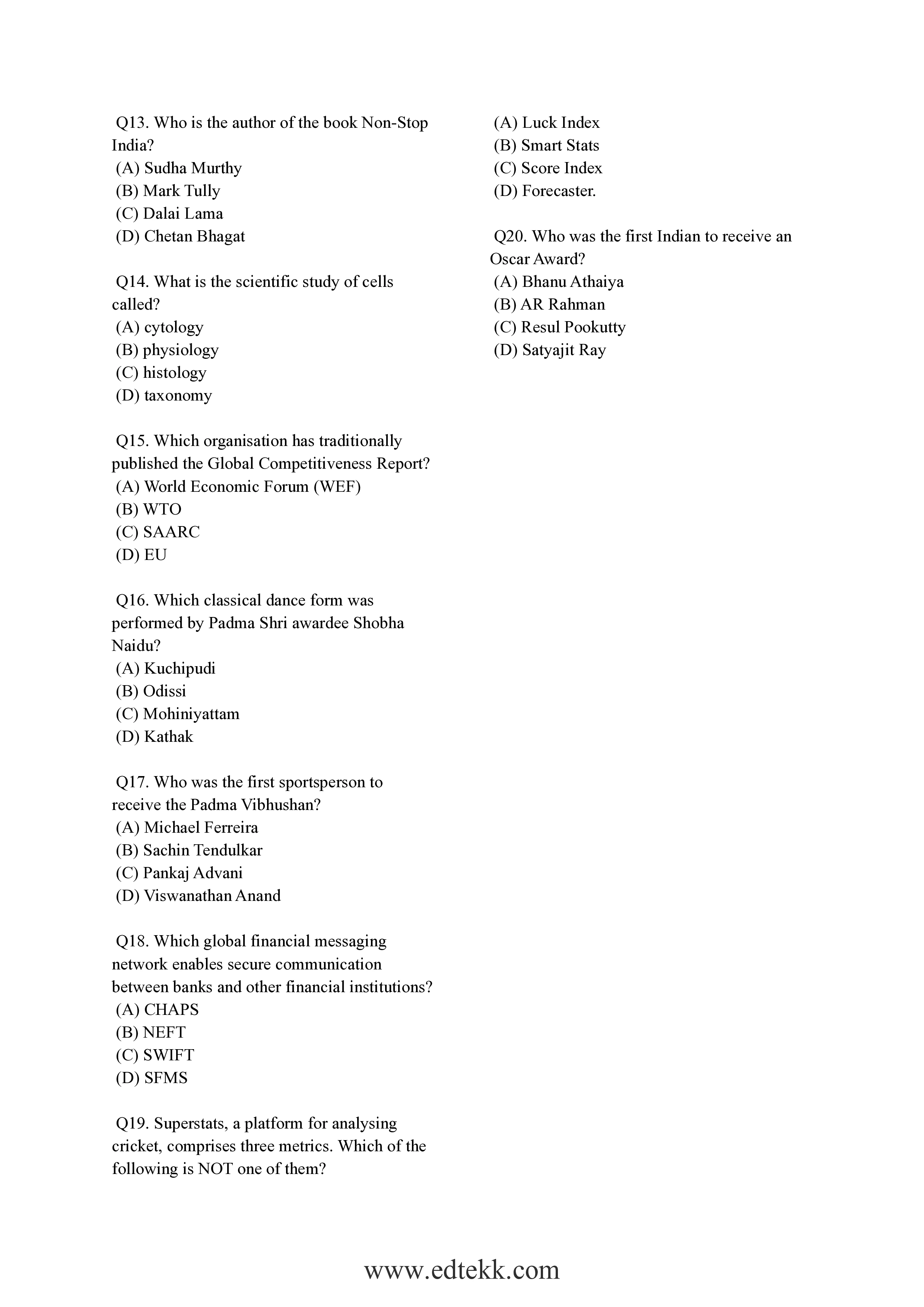
Q13. Who is the author of the book Non-Stop India?
(A) Sudha Murthy
(B) Mark Tully
(C) Dalai Lama
(D) Chetan Bhagat
Explanation: Non-Stop India was written by Mark Tully, a British journalist and former BBC correspondent in India. Published in 2011, the book explores India’s social, political and economic realities through reporting and personal observations. Tully is also known for No Full Stops in India and India in Slow Motion.
Q14. What is the scientific study of cells called?
(A) cytology
(B) physiology
(C) histology
(D) taxonomy
Explanation: Cytology is the branch of biology concerned with the study of cells, including their structure, composition, functions and reproduction. Cells are the fundamental structural and functional units of living organisms. Histology, by contrast, focuses on the microscopic study of tissues.
Q15. Which organisation has traditionally published the Global Competitiveness Report?
(A) World Economic Forum (WEF)
(B) WTO
(C) SAARC
(D) EU
Explanation: The World Economic Forum (WEF) has traditionally published the Global Competitiveness Report. The report evaluates the competitiveness of national economies by examining factors such as institutions, infrastructure, technological readiness, innovation and macroeconomic stability. It provides an international framework for comparing countries’ economic competitiveness.
Q16. Which classical dance form was performed by Padma Shri awardee Shobha Naidu?
(A) Kuchipudi
(B) Odissi
(C) Mohiniyattam
(D) Kathak
Explanation: Shobha Naidu was a celebrated Kuchipudi dancer and choreographer. She received the Padma Shri in 2001 in recognition of her contributions to Indian classical dance. She was particularly renowned for her expressive performances and portrayals of mythological characters and played an important role in promoting Kuchipudi through teaching and stage performances.
Q17. Who was the first sportsperson to receive the Padma Vibhushan?
(A) Michael Ferreira
(B) Sachin Tendulkar
(C) Pankaj Advani
(D) Viswanathan Anand
Explanation: Viswanathan Anand became the first sportsperson to receive the Padma Vibhushan, India’s second-highest civilian award. He received the honour in 2007 for his outstanding achievements in chess. A five-time World Chess Champion, Anand is one of India’s most celebrated chess players.
Q18. Which global financial messaging network enables secure communication between banks and other financial institutions?
(A) CHAPS
(B) NEFT
(C) SWIFT
(D) SFMS
Explanation: The Society for Worldwide Interbank Financial Telecommunication (SWIFT) operates a secure global messaging network used by banks and financial institutions to exchange financial instructions. Established in 1973 and headquartered in Belgium, SWIFT facilitates standardised financial communication but does not itself transfer or settle funds.
Q19. Superstats, a platform for analysing cricket, comprises three metrics. Which of the following is NOT one of them?
(A) Luck Index
(B) Smart Stats
(C) Score Index
(D) Forecaster.
Explanation: Superstats is a cricket analytics platform comprising three major components: Luck Index, Smart Stats and Forecaster. These provide insights into the influence of luck, contextual player and team performance, and predictions of match outcomes. Score Index is not one of these three components.
Q20. Who was the first Indian to receive an Oscar Award?
(A) Bhanu Athaiya
(B) AR Rahman
(C) Resul Pookutty
(D) Satyajit Ray
Explanation: Bhanu Athaiya became the first Indian to win an Academy Award in 1983 for Best Costume Design for the film Gandhi (1982), directed by Richard Attenborough. She shared the award with British costume designer John Mollo. Her achievement marked a significant milestone in the international recognition of Indian cinema.
Question Paper Images