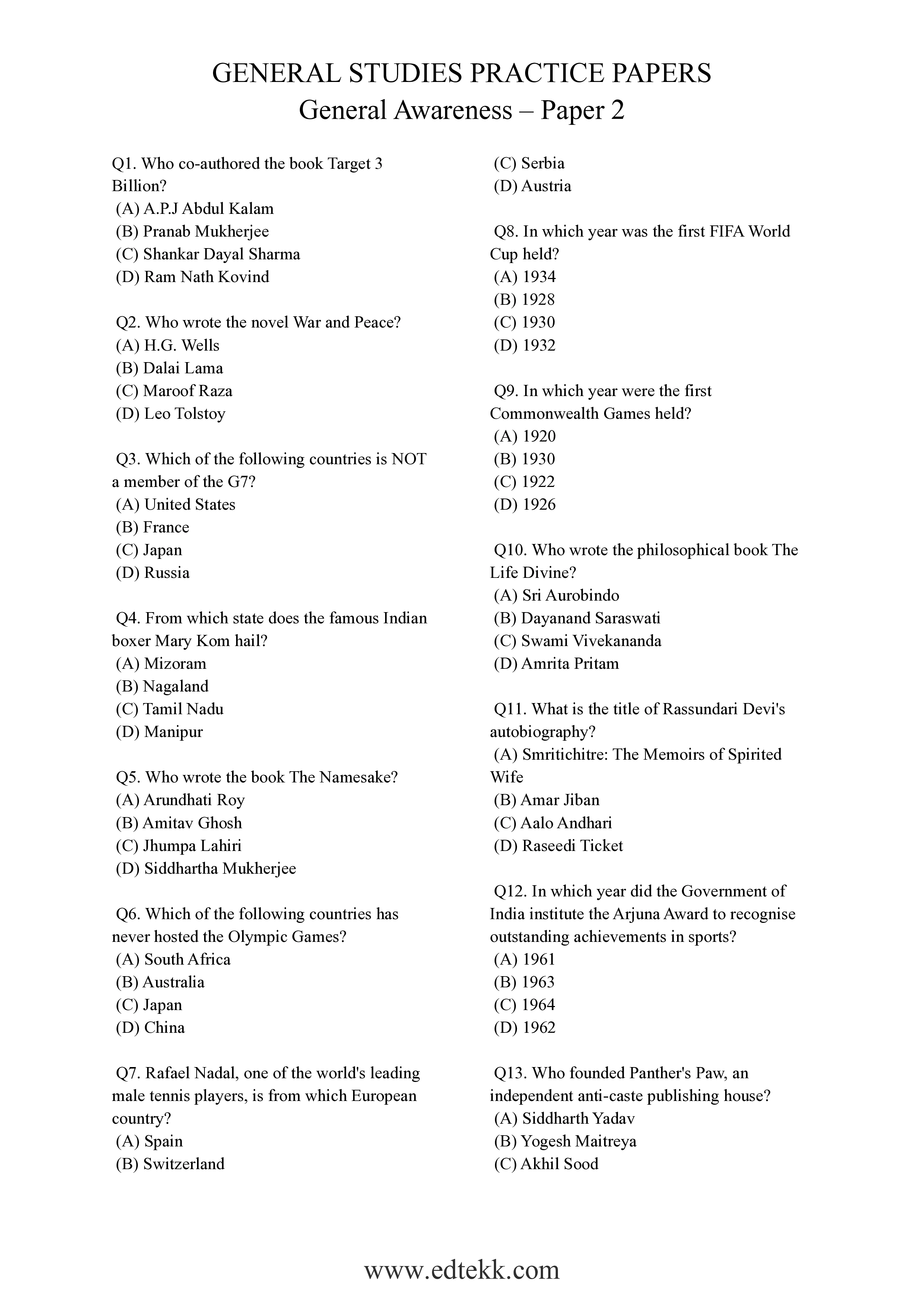
Improve your General Awareness preparation with General Studies Practice Paper 2, designed for Indian competitive examinations. This question set provides multiple-choice practice questions with answers and explanations to help candidates strengthen their general knowledge, improve accuracy and prepare effectively for SSC, Railway, Banking, Police Constable and Police SI exams.
Test Details
Topic: General Awareness
Total Questions: 20
Question Format: MCQs – Single Correct Answer
Suitable for: SSC exams, Railway exams, Banking exams, Police Constable, Police SI
Download All Papers in This Series (PDF)
Questions and Answers
Q1. Who co-authored the book Target 3 Billion?
(A) A.P.J Abdul Kalam
(B) Pranab Mukherjee
(C) Shankar Dayal Sharma
(D) Ram Nath Kovind
Explanation: Target 3 Billion was co-authored by A. P. J. Abdul Kalam and Srijan Pal Singh and published in 2011. The book presents the PURA (Providing Urban Amenities in Rural Areas) model, which promotes rural development through physical, electronic and knowledge connectivity. It emphasises sustainable development, employment generation and improved livelihood opportunities in rural India.
Q2. Who wrote the novel War and Peace?
(A) H.G. Wells
(B) Dalai Lama
(C) Maroof Raza
(D) Leo Tolstoy
Explanation: Leo Tolstoy wrote War and Peace, one of the greatest works of Russian literature, published in its complete book form in 1869. The novel depicts Russian aristocratic society during the Napoleonic Wars, particularly Napoleon’s invasion of Russia in 1812. It explores themes of war, family, love, morality and human destiny.
Q3. Which of the following countries is NOT a member of the G7?
(A) United States
(B) France
(C) Japan
(D) Russia
Explanation: Russia is not currently a member of the G7. The group consists of Canada, France, Germany, Italy, Japan, the United Kingdom and the United States. Russia was previously part of the G8 but its participation was suspended in 2014 following its annexation of Crimea. The European Union also participates in G7 meetings but is not counted as a member country.
Q4. From which state does the famous Indian boxer Mary Kom hail?
(A) Mizoram
(B) Nagaland
(C) Tamil Nadu
(D) Manipur
Explanation: Mary Kom, the renowned Indian boxer and six-time world champion in amateur boxing, hails from Manipur. She was born in Kangathei village in the state. At the 2012 London Olympics, she won a bronze medal in women’s flyweight boxing, becoming the first Indian woman boxer to win an Olympic medal.
Q5. Who wrote the book The Namesake?
(A) Arundhati Roy
(B) Amitav Ghosh
(C) Jhumpa Lahiri
(D) Siddhartha Mukherjee
Explanation: The Namesake was written by Jhumpa Lahiri and published in 2003. The novel follows the Ganguli family, Indian immigrants who settle in the United States. It explores cultural identity, immigration, family relationships and the experiences of second-generation immigrants, particularly their son, Gogol Ganguli.
Q6. Which of the following countries has never hosted the Olympic Games?
(A) South Africa
(B) Australia
(C) Japan
(D) China
Explanation: South Africa has never hosted the Summer or Winter Olympic Games. Australia hosted the Summer Olympics in 1956 and 2000, Japan in 1964 and 2021, and China in 2008. South Africa has participated in the Olympics but has never hosted the event.
Q7. Rafael Nadal, one of the world’s leading male tennis players, is from which European country?
(A) Spain
(B) Switzerland
(C) Serbia
(D) Austria
Explanation: Rafael Nadal hails from Spain. Born in Manacor, Mallorca, he became one of the most successful tennis players in history, particularly renowned for his achievements on clay courts. He won 22 Grand Slam singles titles, including a record 14 French Open men’s singles championships.
Q8. In which year was the first FIFA World Cup held?
(A) 1934
(B) 1928
(C) 1930
(D) 1932
Explanation: The first FIFA Men’s World Cup was held in Uruguay in 1930. Thirteen national teams participated in the inaugural tournament. Uruguay defeated Argentina 4–2 in the final to become the first FIFA Men’s World Cup champions.
Q9. In which year were the first Commonwealth Games held?
(A) 1920
(B) 1930
(C) 1922
(D) 1926
Explanation: The first Commonwealth Games were held in Hamilton, Canada, in 1930. Originally known as the British Empire Games, the inaugural event featured athletes from 11 countries. The competition was subsequently renamed the British Empire and Commonwealth Games before adopting its present name, the Commonwealth Games.
Q10. Who wrote the philosophical book The Life Divine?
(A) Sri Aurobindo
(B) Dayanand Saraswati
(C) Swami Vivekananda
(D) Amrita Pritam
Explanation: The Life Divine is a major philosophical and spiritual work by Sri Aurobindo. It was originally published serially in the journal Arya and later in book form. It develops his ideas on consciousness, human evolution, integral yoga and spiritual transformation.
Q11. What is the title of Rassundari Devi’s autobiography?
(A) Smritichitre: The Memoirs of Spirited Wife
(B) Amar Jiban
(C) Aalo Andhari
(D) Raseedi Ticket
Explanation: Amar Jiban (My Life) is the autobiography of Rassundari Devi, published in 1876. It is regarded as the first full-length autobiography written by an Indian woman in Bengali. The book describes her family life, personal struggles and journey towards literacy in nineteenth-century Bengal.
Q12. In which year did the Government of India institute the Arjuna Award to recognise outstanding achievements in sports?
(A) 1961
(B) 1963
(C) 1964
(D) 1962
Explanation: The Arjuna Awards were instituted in 1961 by the Government of India to recognise outstanding achievements in sports. They honour sportspersons for excellence and consistent performance in national and international competitions and are among India’s prominent sporting honours.
Q13. Who founded Panther’s Paw, an independent anti-caste publishing house?
(A) Siddharth Yadav
(B) Yogesh Maitreya
(C) Akhil Sood
(D) Gouri Dange
Explanation: Yogesh Maitreya is the founder of Panther’s Paw, an independent publishing house in India. It focuses on anti-caste literature, Dalit writing and marginalised voices, promoting literature that addresses caste discrimination, social inequality and resistance.
Q14. The term ‘coxswain’ is associated with which sport?
(A) Rowing
(B) Long jump
(C) Boxing
(D) Javelin throw
Explanation: A coxswain is associated with rowing. The coxswain is responsible for steering the boat, coordinating the crew and providing tactical instructions during a race. The role is important in maintaining communication, rhythm and coordination among the rowers.
Q15. Which of the following is the largest planetarium in Asia?
(A) Birla Planetarium, Kolkata
(B) Nehru Planetarium, New Delhi
(C) Nehru Planetarium, Mumbai
(D) Birla Planetarium, Hyderabad
Explanation: The Birla Planetarium in Kolkata, West Bengal, officially known as the M. P. Birla Planetarium, is widely recognised as Asia’s largest planetarium. It was inaugurated on 2 July 1963. It promotes astronomical education through planetarium shows, exhibitions and educational programmes.
Q16. The Wightman Cup was associated with which sport?
(A) Hockey
(B) Cricket
(C) Golf
(D) Tennis
Explanation: The Wightman Cup was an international women’s team tennis competition between the United States and Great Britain. Named after American tennis player Hazel Hotchkiss Wightman, it was first held in 1923, and its final edition took place in 1989.
Q17. Who was the first woman to receive the Nobel Prize in Physics, in 1903?
(A) Alva Myrdal
(B) Marie Curie
(C) Jody Williams
(D) Jane Addams
Explanation: Marie Curie became the first woman to receive the Nobel Prize in Physics in 1903. She shared the award with Pierre Curie and Henri Becquerel for their pioneering investigations into radiation phenomena. She subsequently received the Nobel Prize in Chemistry in 1911, becoming the first person to win Nobel Prizes in two different scientific fields.
Q18. Who became the first non-European to receive the Nobel Prize in Literature in 1913?
(A) Subrahmanyan Chandrasekhar
(B) John Maxwell Coetzee
(C) Kenzaburo Oe
(D) Rabindranath Tagore
Explanation: Rabindranath Tagore received the Nobel Prize in Literature in 1913, becoming the first non-European to win this award. He was recognised primarily for his English translation of Gitanjali (Song Offerings). Tagore was a Bengali poet, philosopher, composer and educator whose literary contributions gained international recognition.
Q19. Which of the following books was written by Jawaharlal Nehru?
(A) A Bunch of Old Letters
(B) Riddles in Hinduism
(C) Ranade, Gandhi and Jinnah
(D) Waiting For A Visa: Autobiographical Notes
Explanation: A Bunch of Old Letters is a collection of letters edited and published by Jawaharlal Nehru in 1958. The correspondence provides insights into India’s political and intellectual life and includes letters involving several prominent historical figures. The other options are works by B. R. Ambedkar.
Q20. Who was appointed as India’s second Chief of Defence Staff (CDS)?
(A) R. Dinesh
(B) Manoj Kumar
(C) Anil Chauhan
(D) Sanjay Agarwal
Explanation: General Anil Chauhan was appointed India’s second Chief of Defence Staff (CDS) on 28 September 2022, following the death of General Bipin Rawat in December 2021. The CDS serves as the principal military adviser to the government on tri-service matters and promotes coordination and integration among the Army, Navy and Air Force.
Question Paper Images