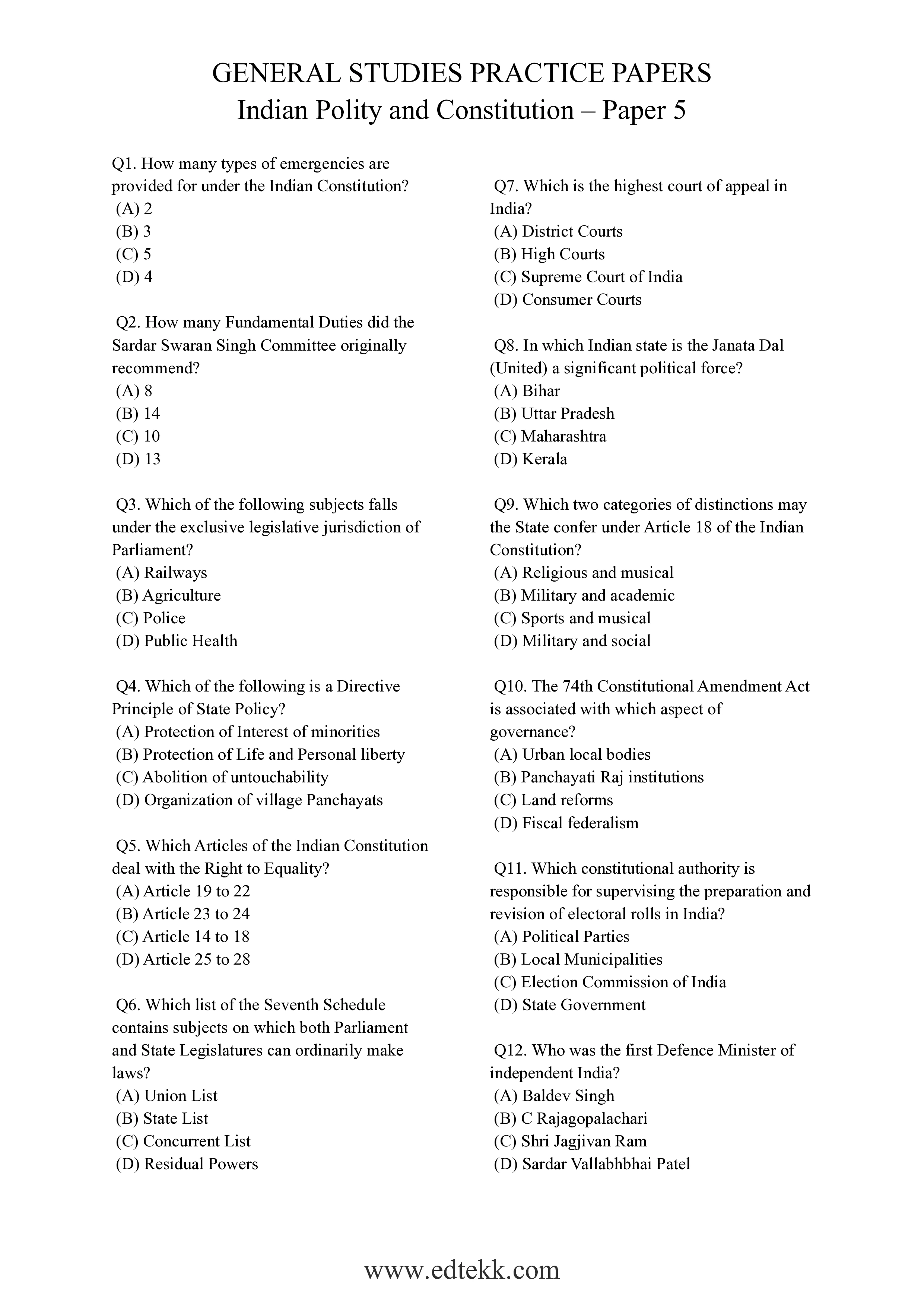
Enhance your General Studies preparation with Indian Polity and Constitution Practice Paper 5. Created for SSC, Railway, Police Constable and Police SI aspirants, this set provides 20 MCQs on key constitutional concepts, political institutions and governance, helping candidates assess their knowledge through answers and explanations.
Test Details
Topic: Indian Polity and Constitution
Total Questions: 20
Question Format: MCQs – Single Correct Answer
Suitable for: SSC exams, Railway exams, Police Constable, Police SI
Download All Papers in This Series (PDF)
Questions and Answers
Q1. How many types of emergencies are provided for under the Indian Constitution?
(A) 2
(B) 3
(C) 5
(D) 4
Explanation: The Indian Constitution provides for three types of emergencies: National Emergency under Article 352, President’s Rule (State Emergency) under Article 356, and Financial Emergency under Article 360. These provisions address threats to national security, failure of constitutional machinery in a State, and threats to India’s financial stability or credit, respectively.
Q2. How many Fundamental Duties did the Sardar Swaran Singh Committee originally recommend?
(A) 8
(B) 14
(C) 10
(D) 13
Explanation: The Sardar Swaran Singh Committee originally recommended eight Fundamental Duties. However, the 42nd Constitutional Amendment Act, 1976, incorporated ten Fundamental Duties under Article 51A. Therefore, eight is the correct answer when referring specifically to the committee’s recommendation.
Q3. Which of the following subjects falls under the exclusive legislative jurisdiction of Parliament?
(A) Railways
(B) Agriculture
(C) Police
(D) Public Health
Explanation: Railways fall under the Union List in the Seventh Schedule, specifically Entry 22. Parliament ordinarily has exclusive legislative authority over this subject. Union-level legislation supports coordinated railway administration, development and regulation across States.
Q4. Which of the following is a Directive Principle of State Policy?
(A) Protection of Interest of minorities
(B) Protection of Life and Personal liberty
(C) Abolition of untouchability
(D) Organization of village Panchayats
Explanation: The organisation of village panchayats is a Directive Principle of State Policy under Article 40 of the Indian Constitution. It directs the State to organise village panchayats and endow them with the necessary powers to function as units of self-government, promoting decentralisation and grassroots democracy.
Q5. Which Articles of the Indian Constitution deal with the Right to Equality?
(A) Article 19 to 22
(B) Article 23 to 24
(C) Article 14 to 18
(D) Article 25 to 28
Explanation: Articles 14–18 of the Indian Constitution deal with the Right to Equality. They provide for equality before the law, prohibit discrimination on specified grounds, ensure equality of opportunity in public employment, abolish untouchability and abolish titles, subject to the constitutional provisions.
Q6. Which list of the Seventh Schedule contains subjects on which both Parliament and State Legislatures can ordinarily make laws?
(A) Union List
(B) State List
(C) Concurrent List
(D) Residual Powers
Explanation: The Concurrent List in the Seventh Schedule includes subjects on which both Parliament and State Legislatures can ordinarily legislate. Examples include education, forests, marriage, adoption, criminal law and criminal procedure. Under Article 254, Union legislation generally prevails in cases of conflict, subject to the constitutional exception for certain State laws receiving Presidential assent.
Q7. Which is the highest court of appeal in India?
(A) District Courts
(B) High Courts
(C) Supreme Court of India
(D) Consumer Courts
Explanation: The Supreme Court of India is the highest court of appeal in the country. It stands at the apex of the Indian judicial system, above the High Courts and subordinate courts. It also interprets the Constitution, exercises judicial review and protects fundamental rights.
Q8. In which Indian state is the Janata Dal (United) a significant political force?
(A) Bihar
(B) Uttar Pradesh
(C) Maharashtra
(D) Kerala
Explanation: The Janata Dal (United), commonly known as JD(U), is a prominent regional political party in Bihar. It has played an important role in the state’s politics and government, particularly under the leadership of Nitish Kumar.
Q9. Which two categories of distinctions may the State confer under Article 18 of the Indian Constitution?
(A) Religious and musical
(B) Military and academic
(C) Sports and musical
(D) Military and social
Explanation: Article 18 of the Indian Constitution abolishes titles and prohibits the State from conferring titles, except military and academic distinctions. These exceptions allow recognition of military service and academic achievements without creating hereditary or artificial social privileges.
Q10. The 74th Constitutional Amendment Act is associated with which aspect of governance?
(A) Urban local bodies
(B) Panchayati Raj institutions
(C) Land reforms
(D) Fiscal federalism
Explanation: The 74th Constitutional Amendment Act, 1992, granted constitutional recognition to urban local bodies by introducing Part IXA of the Constitution. It established a framework for municipalities, including Municipal Corporations, Municipal Councils and Nagar Panchayats, strengthening urban local self-government.
Q11. Which constitutional authority is responsible for supervising the preparation and revision of electoral rolls in India?
(A) Political Parties
(B) Local Municipalities
(C) Election Commission of India
(D) State Government
Explanation: Article 324 vests the Election Commission of India with the superintendence, direction and control of the preparation and revision of electoral rolls and the conduct of elections to Parliament, State Legislatures, and the offices of the President and Vice-President. It is an independent constitutional authority responsible for administering these elections.
Q12. Who was the first Defence Minister of independent India?
(A) Baldev Singh
(B) C Rajagopalachari
(C) Shri Jagjivan Ram
(D) Sardar Vallabhbhai Patel
Explanation: Sardar Baldev Singh was independent India’s first Defence Minister. He served in Jawaharlal Nehru’s first Council of Ministers after independence in 1947 and played an important role in establishing India’s defence administration during the initial years of independence.
Q13. Which Article of the Indian Constitution provides for administrative tribunals?
(A) Article 271
(B) Article 290A
(C) Article 323A
(D) Article 307
Explanation: Article 323A of the Constitution of India deals with administrative tribunals. It empowers Parliament to establish tribunals for adjudicating disputes relating to the recruitment and conditions of service of persons appointed to public services and posts under the Union, states and other specified authorities. The Administrative Tribunals Act, 1985 was enacted under this provision.
Q14. Under which Article of the Indian Constitution can the President seek the advisory opinion of the Supreme Court?
(A) Article 143
(B) Article 121
(C) Article 123
(D) Article 156
Explanation: Article 143 empowers the President to refer questions of law or fact of public importance to the Supreme Court for its advisory opinion. Under Article 143(1), the Court may report its opinion after hearing the matter. Such opinions are advisory rather than judgments resolving an ordinary dispute.
Q15. To which House of Parliament is the Union Council of Ministers collectively responsible?
(A) Lok Sabha
(B) President
(C) Prime Minister
(D) Chief Justice of India
Explanation: Under Article 75(3) of the Constitution, the Union Council of Ministers is collectively responsible to the Lok Sabha. This means that the ministry functions as a team and must retain the confidence of the Lok Sabha. If it loses a confidence vote, the Council of Ministers must resign.
Q16. Under which Article of the Indian Constitution can the President proclaim a National Emergency?
(A) Article 356
(B) Article 360
(C) Article 352
(D) Article 370
Explanation: Article 352 empowers the President to proclaim a national emergency when the security of India or any part of its territory is threatened by war, external aggression or armed rebellion. Article 356 concerns President’s Rule in a state, while Article 360 deals with a financial emergency.
Q17. The Governor acts as an important constitutional link between a state and which government?
(A) Parliament
(B) President
(C) Prime Minister
(D) Union Government
Explanation: The Governor acts as an important constitutional link between the state and the Union Government. Appointed by the President, the Governor serves as the constitutional head of the state and functions within the framework of the Constitution, exercising prescribed powers and responsibilities.
Q18. Who has the final authority to decide whether a Bill is a Money Bill?
(A) Vice President
(B) Finance Minister
(C) Speaker
(D) Prime Minister
Explanation: The Speaker of the Lok Sabha has the final authority to decide whether a bill is a Money Bill under Article 110(3) of the Constitution. The Speaker’s decision is constitutionally treated as final, and the Speaker’s certificate is required when a Money Bill is transmitted to the Rajya Sabha.
Q19. Which Article of the Indian Constitution deals with Fundamental Duties?
(A) Article 51A
(B) Article 21
(C) Article 19
(D) Article 14
Explanation: Fundamental Duties are mentioned in Article 51A of the Indian Constitution. They outline citizens’ responsibilities, including respecting the Constitution, national flag and national anthem, protecting the environment and promoting harmony. They were introduced by the 42nd Constitutional Amendment Act, 1976, and one additional duty was incorporated by the 86th Amendment Act, 2002.
Q20. Who was appointed as the Constitutional Adviser to the Constituent Assembly in 1946 during the framing of the Indian Constitution?
(A) B.R. Ambedkar
(B) B.N. Rau
(C) Gopalaswami Ayyangar
(D) K.M. Munshi
Explanation: B. N. Rau was appointed Constitutional Adviser to the Constituent Assembly in 1946. He prepared an initial constitutional draft and provided important legal and constitutional guidance during the framing process. He must be distinguished from Dr. B. R. Ambedkar, who chaired the Drafting Committee established in August 1947.
Question Paper Images