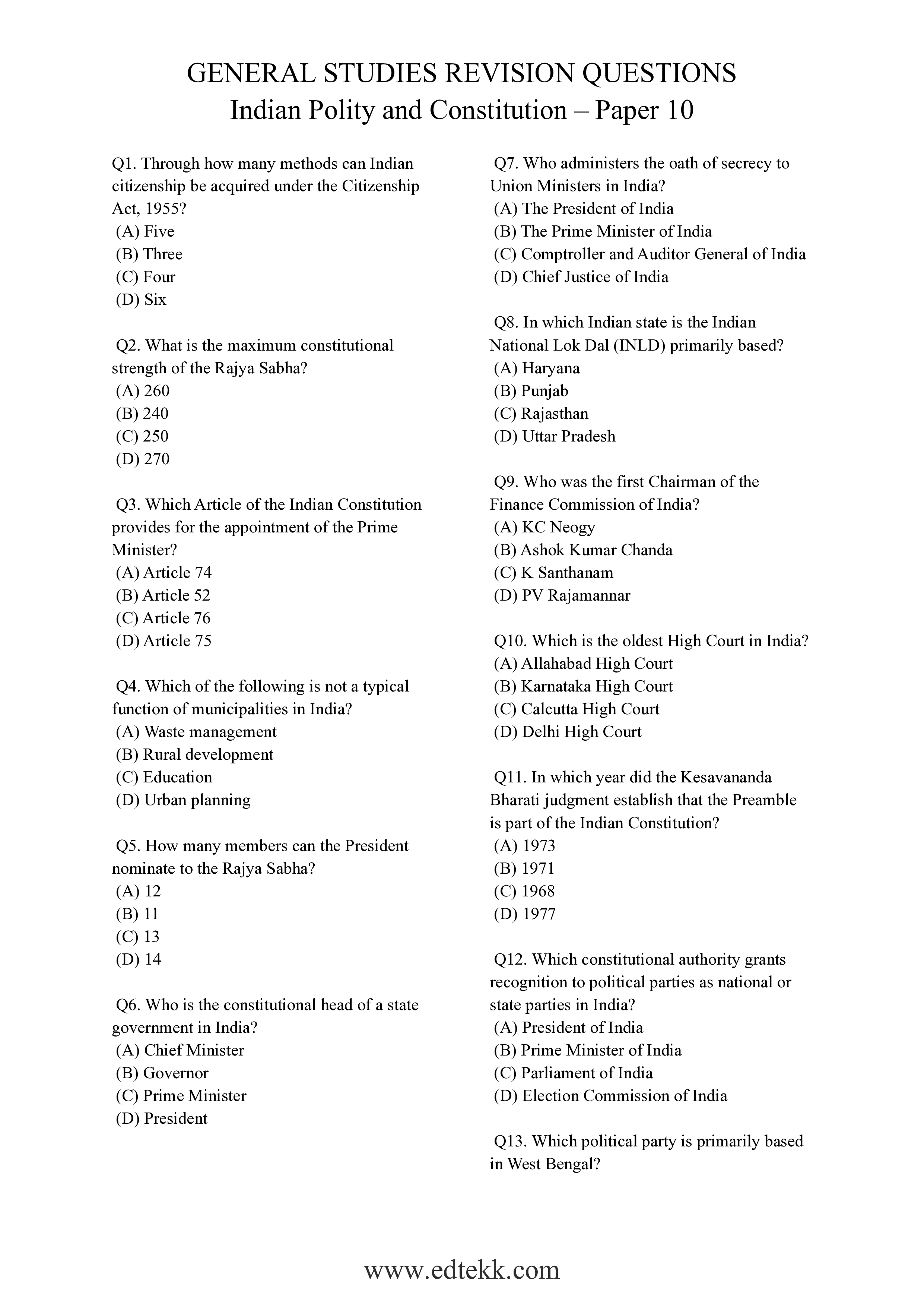
Complete another round of General Studies revision with Indian Polity and Constitution Revision Questions Paper 10. This set features 20 objective practice questions covering important subject concepts, along with answers and explanations to support exam preparation for SSC, Railway, Police Constable and Police SI examinations.
Test Details
Topic: Indian Polity and Constitution
Total Questions: 20
Question Format: MCQs – Single Correct Answer
Suitable for: SSC exams, Railway exams, Police Constable, Police SI
Download All Papers in This Series (PDF)
Questions and Answers
Q1. Which of the following is a non-statutory body in India?
(A) Election Commission
(B) Planning Commission
(C) NITI Aayog
(D) Finance Commission
Explanation: NITI Aayog is a non-statutory body established by an executive resolution of the Union Government in 2015, replacing the Planning Commission. The Election Commission of India and the Finance Commission are constitutional bodies. The Planning Commission was also non-statutory but has been abolished.
Q2. Who administers the oath of office to the Vice-President of India?
(A) President
(B) Prime Minister
(C) Speaker
(D) Chief Justice of India
Explanation: Under Article 69, the Vice President takes the oath or affirmation before the President of India or a person appointed by the President for that purpose. The oath requires the Vice President to bear true faith and allegiance to the Constitution and faithfully discharge the duties of office. The Vice President also serves as the ex officio Chairman of the Rajya Sabha.
Q3. In which Indian state does the All India Forward Bloc (AIFB) have its strongest historical political presence?
(A) Kerala
(B) Punjab
(C) West Bengal
(D) Gujarat
Explanation: The All India Forward Bloc (AIFB) has its strongest historical political presence in West Bengal. Founded in 1939 by Subhas Chandra Bose, the party emerged from the Indian independence movement and established its principal organisational base in the state.
Q4. Which Constitutional Amendment removed the Right to Property from the list of Fundamental Rights?
(A) 44th
(B) 41st
(C) 42nd
(D) 43rd
Explanation: The 44th Constitutional Amendment Act, 1978, removed the Right to Property from the list of Fundamental Rights by omitting Article 19(1)(f) and Article 31. It was subsequently retained as a constitutional right under Article 300A, which states that no person shall be deprived of property except by authority of law.
Q5. Who was the Prime Minister of India during the Emergency from 1975 to 1977?
(A) Rajiv Gandhi
(B) Morarji Desai
(C) Indira Gandhi
(D) Charan Singh
Explanation: Indira Gandhi was the Prime Minister of India throughout the National Emergency from 25 June 1975 to 21 March 1977. The Emergency was proclaimed under Article 352, and Morarji Desai became Prime Minister following the 1977 general election.
Q6. Which Article of the Indian Constitution deals with Fundamental Duties?
(A) Article 21
(B) Article 19
(C) Article 51A
(D) Article 14
Explanation: Fundamental Duties are mentioned in Article 51A of the Indian Constitution. They outline citizens’ responsibilities, including respecting the Constitution, national flag and national anthem, protecting the environment and promoting harmony. They were introduced by the 42nd Constitutional Amendment Act, 1976, and one additional duty was incorporated by the 86th Amendment Act, 2002.
Q7. In which Indian state is the Trinamool Congress a major political party?
(A) West Bengal
(B) Uttar Pradesh
(C) Maharashtra
(D) Tamil Nadu
Explanation: The All India Trinamool Congress (TMC), commonly known as the Trinamool Congress, is a major political party in West Bengal. Founded by Mamata Banerjee in 1998, it has been a dominant force in the state’s politics and has also expanded its activities to other parts of India.
Q8. Which list of the Seventh Schedule includes subjects such as police and public health?
(A) State List
(B) Union List
(C) Concurrent List
(D) Residual Powers
Explanation: Police and public health are subjects included in the State List (List II) of the Seventh Schedule of the Indian Constitution. State legislatures have the primary authority to make laws on these subjects, subject to constitutional provisions that permit Parliament to legislate in specified circumstances.
Q9. How many Rajya Sabha seats are allocated to Uttar Pradesh?
(A) 39
(B) 22
(C) 31
(D) 18
Explanation: Uttar Pradesh has 31 seats in the Rajya Sabha, making it the state with the highest representation in the Council of States. Its Rajya Sabha members are elected by elected members of the State Legislative Assembly through proportional representation using the single transferable vote system.
Q10. Under which Article of the Indian Constitution is the Right to Life and Personal Liberty guaranteed?
(A) Article 21
(B) Article 19
(C) Article 32
(D) Article 25
Explanation: Article 21 of the Indian Constitution guarantees the Fundamental Right to Life and Personal Liberty. It states that no person shall be deprived of life or personal liberty except according to a procedure established by law. Judicial interpretation has expanded its scope to include various rights essential for living with human dignity.
Q11. Which political party is historically associated with the clock election symbol?
(A) RJD
(B) NCP
(C) BJD
(D) TMC
Explanation: The Nationalist Congress Party (NCP) is historically associated with the clock (alarm clock) election symbol. Following the party split in 2023, the Election Commission of India recognised the Ajit Pawar-led faction as the NCP and allotted it the clock symbol in February 2024.
Q12. Who is widely known as the ‘Father of the Indian Constitution’?
(A) Jawaharlal Nehru
(B) Mahatma Gandhi
(C) Sardar Vallabhbhai Patel
(D) Dr. B.R. Ambedkar
Explanation: Dr. B. R. Ambedkar is widely known as the Father of the Indian Constitution because he chaired the Drafting Committee of the Constituent Assembly and played a leading role in preparing the constitutional text. The Constitution was ultimately adopted through the collective efforts of the Constituent Assembly.
Q13. Which Articles of the Indian Constitution deal with the Right against Exploitation?
(A) Article 23 to 24
(B) Article 25 to 28
(C) Article 29 to 30
(D) Article 31 to 32
Explanation: Articles 23 and 24 of the Indian Constitution deal with the Right against Exploitation. Article 23 prohibits human trafficking, begar and other forms of forced labour. Article 24 prohibits the employment of children below 14 years of age in factories, mines and other hazardous employment, thereby protecting human dignity and preventing exploitation.
Q14. Which Schedule was added to the Indian Constitution through the 73rd Constitutional Amendment Act?
(A) Eleventh Schedule
(B) Eight Schedule
(C) Ninth Schedule
(D) Tenth Schedule
Explanation: The Eleventh Schedule was added to the Indian Constitution through the 73rd Constitutional Amendment Act, 1992. It contains 29 subjects that may be entrusted to Panchayati Raj institutions. These include agriculture, minor irrigation, rural development, education, health and sanitation. The amendment strengthened the constitutional framework for democratic decentralisation.
Q15. Who has the constitutional authority to remove the Governor of a state?
(A) Prime Minister
(B) President
(C) Chief Minister
(D) Supreme Court
Explanation: The President can remove a State Governor because Article 156 provides that the Governor holds office during the President’s pleasure. The Governor has no guaranteed five-year tenure and may be removed before completing the normal term. The removal is formally effected by the President under the constitutional framework.
Q16. Which House of Parliament is popularly known as the ‘Popular Chamber’?
(A) State Assembly
(B) Rajya Sabha
(C) Lok Sabha
(D) Gram Sabha
Explanation: The Lok Sabha is known as the Popular Chamber or House of the People because its members are directly elected by the citizens of India through universal adult suffrage. It represents the people at the national level and plays a central role in legislation, financial matters and parliamentary accountability.
Q17. Which Part of the Indian Constitution deals with the States?
(A) Part VII
(B) Part VI
(C) Part VIII
(D) Part IX
Explanation: Part VI (Articles 152–237) of the Indian Constitution deals with the States. It contains provisions relating to the Governor, State Executive, State Legislature, High Courts and subordinate courts, establishing the constitutional framework for state governance.
Q18. Which Part of the Indian Constitution deals with the Directive Principles of State Policy?
(A) Part III
(B) Part IV
(C) Part V
(D) Part VI
Explanation: Part IV (Articles 36–51) of the Indian Constitution deals with the Directive Principles of State Policy (DPSP). These principles guide the State in establishing social and economic justice and promoting public welfare. They are not directly enforceable by courts under Article 37 but are fundamental to the governance of the country.
Q19. Who among the following was a member of the Constituent Assembly representing the Madras constituency in 1946?
(A) Hansa Jivraj Mehta
(B) Ammu Swaminathan
(C) Kamla Chaudhry
(D) Begum Aizaz Rasul
Explanation: Ammu Swaminathan was a member of the Constituent Assembly representing Madras. She participated in constitution-making as one of the Assembly’s women members and subsequently served in the provisional Parliament and the Lok Sabha. Her contribution formed part of the broader participation of women in India’s constitutional development.
Q20. Who appoints the Advocate General of a State?
(A) President of India
(B) Governor of the state
(C) Chief Justice of the high court
(D) Chief Minister of the state
Explanation: The Governor of a State appoints the Advocate General under Article 165. The Advocate General is the State’s highest law officer and must possess the qualifications required for appointment as a High Court judge.
Question Paper Images