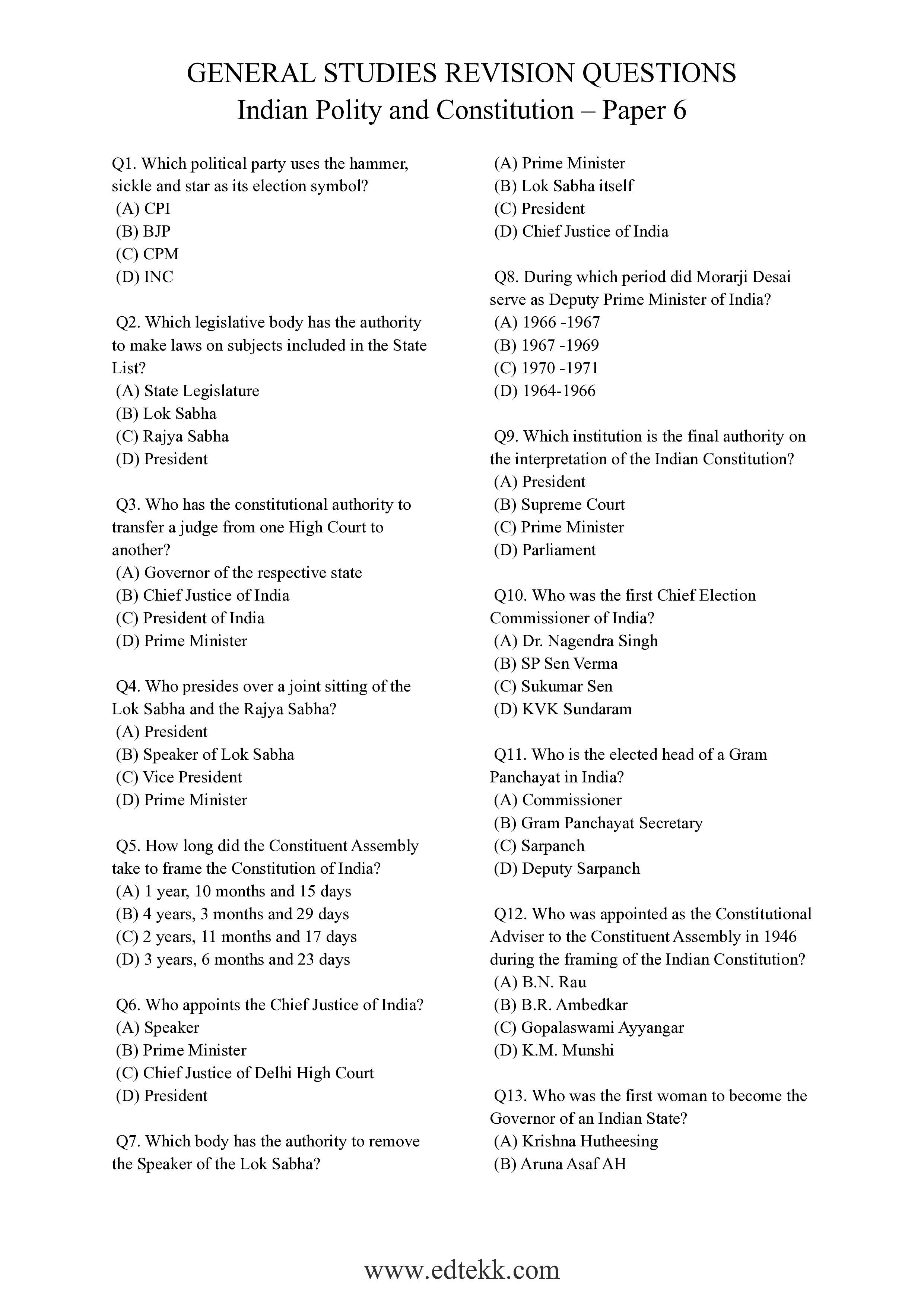
Revise essential Indian Polity and Constitution concepts with General Studies Revision Questions Paper 6. This practice set offers 20 objective questions to assess your understanding of the subject, supported by answers and explanations for effective preparation for SSC, Railway, Police Constable and Police SI examinations.
Test Details
Topic: Indian Polity and Constitution
Total Questions: 20
Question Format: MCQs – Single Correct Answer
Suitable for: SSC exams, Railway exams, Police Constable, Police SI
Download All Papers in This Series (PDF)
Questions and Answers
Q1. Which constitutional authority is responsible for supervising the preparation and revision of electoral rolls in India?
(A) State Government
(B) Election Commission of India
(C) Local Municipalities
(D) Political Parties
Explanation: Article 324 vests the Election Commission of India with the superintendence, direction and control of the preparation and revision of electoral rolls and the conduct of elections to Parliament, State Legislatures, and the offices of the President and Vice-President. It is an independent constitutional authority responsible for administering these elections.
Q2. Who presides over a joint sitting of both Houses of Parliament in India?
(A) President
(B) Prime Minister
(C) Speaker of Lok Sabha
(D) Vice President
Explanation: The Speaker of the Lok Sabha presides over a joint sitting of both Houses of Parliament under Article 118(4) of the Constitution. In the Speaker’s absence, the Deputy Speaker presides, followed by the Deputy Chairman of the Rajya Sabha. If all three are absent, another member may preside as determined by the rules of procedure.
Q3. Under which Article of the Indian Constitution is the District Planning Committee provided for?
(A) Article 243ZD
(B) Article 244ZD
(C) Article 242ZD
(D) Article 243ZE
Explanation: Article 243ZD of the Indian Constitution provides for the constitution of a District Planning Committee in every state at the district level. It consolidates plans prepared by Panchayats and Municipalities within the district and prepares a draft development plan for the district as a whole.
Q4. Who was the first woman Chief Justice of the Telangana High Court?
(A) JK Maheshwari
(B) Hima Kohli
(C) Ruma Pal
(D) R Banumathi
Explanation: Justice Hima Kohli became the first woman Chief Justice of the Telangana High Court in January 2021. She assumed office on 7 January 2021, following her tenure as a judge of the Delhi High Court. Her appointment marked an important milestone in women’s representation in India’s higher judiciary.
Q5. Which body determines the salaries and allowances of a state Governor?
(A) Parliament
(B) State Legislative Assembly
(C) President
(D) Chief Minister
Explanation: Parliament determines the Governor’s salaries, allowances and privileges by law. These financial entitlements are governed at the Union level, while the expenses relating to the Governor’s emoluments and allowances are charged on the Consolidated Fund of the State. Article 158(3) protects these entitlements against diminution during the Governor’s term.
Q6. In which House of the Indian Parliament can a Money Bill be introduced?
(A) Lok Sabha
(B) Rajya Sabha
(C) Both Lok Sabha and Rajya Sabha
(D) Neither Lok Sabha nor Rajya Sabha
Explanation: Under Article 109, a Money Bill can be introduced only in the Lok Sabha, with the President’s recommendation. The Rajya Sabha cannot amend it but may recommend changes within fourteen days. The Lok Sabha may accept or reject these recommendations. If the Rajya Sabha fails to return the Bill within fourteen days, it is deemed passed by both Houses.
Q7. In which Indian state is the All India Majlis-e-Ittehad-ul-Muslimeen (AIMIM) primarily based?
(A) Telangana
(B) Uttar Pradesh
(C) Bihar
(D) Maharashtra
Explanation: The All India Majlis-e-Ittehad-ul-Muslimeen (AIMIM) is primarily based in Telangana, particularly Hyderabad, where it has a longstanding political presence. The party has expanded into other states, including Maharashtra and Bihar. Asaduddin Owaisi is its prominent national leader.
Q8. Which is the oldest High Court in India?
(A) Calcutta High Court
(B) Madras High Court
(C) Delhi High Court
(D) Bombay High Court
Explanation: The Calcutta High Court is generally recognised as the oldest High Court in India. It commenced functioning on 1 July 1862 under the Indian High Courts Act, 1861. Although the Bombay and Madras High Courts were also established in 1862, the Calcutta High Court began functioning first.
Q9. Which of the following is not a function of the Legislature?
(A) Executive Oversight
(B) Lawmaking
(C) Budget Approval
(D) Implementation of Policies
Explanation: Implementation of government policies is primarily an executive function rather than a legislative function. The legislature is responsible for making laws, approving budgets and exercising oversight over the executive. The executive implements government policies, administers public programmes and ensures the enforcement of laws.
Q10. How many types of writs can the Supreme Court of India issue for the protection of Fundamental Rights?
(A) Five
(B) Four
(C) Seven
(D) Six
Explanation: The Supreme Court can issue five types of writs under Article 32 for the enforcement of Fundamental Rights: Habeas Corpus, Mandamus, Prohibition, Certiorari and Quo Warranto. These writs provide constitutional remedies against violations of Fundamental Rights and unlawful exercises of public authority.
Q11. What is the maximum term of office of an Election Commissioner of India under the applicable law, subject to the prescribed age limit?
(A) Six years
(B) Five years
(C) Seven years
(D) Eight years
Explanation: Under the 2023 legislation governing the appointment and service conditions of Election Commissioners, an Election Commissioner can hold office for six years or until attaining 65 years of age, whichever is earlier. An Election Commissioner is not eligible for reappointment, and the applicable law also regulates tenure when appointed as Chief Election Commissioner.
Q12. In which Indian state is the All India Anna Dravida Munnetra Kazhagam (AIADMK) a major regional political party?
(A) Tamil Nadu
(B) Kerala
(C) Karnataka
(D) Andhra Pradesh
Explanation: The All India Anna Dravida Munnetra Kazhagam (AIADMK) is a major regional political party in Tamil Nadu. Founded in 1972 by M. G. Ramachandran, it has historically been one of the two principal Dravidian political parties in the state.
Q13. In which Indian state is the Telugu Desam Party (TDP) a prominent political party?
(A) Karnataka
(B) Tamil Nadu
(C) Andhra Pradesh
(D) Telangana
Explanation: The Telugu Desam Party (TDP) is a prominent regional political party in Andhra Pradesh. Founded by N. T. Rama Rao in 1982, it has played a significant role in the state’s politics and also maintains a political presence in Telangana.
Q14. Who can recommend the imposition of President’s Rule in a state?
(A) Chief Minister
(B) Prime Minister
(C) Governor
(D) President
Explanation: Under Article 356, the President may proclaim President’s Rule if satisfied that the government of a State cannot be carried on in accordance with the Constitution. The President may act on a report from the Governor or otherwise; a Governor’s recommendation is therefore not a mandatory prerequisite.
Q15. How many Election Commissioners serve alongside the Chief Election Commissioner in the Election Commission of India?
(A) One
(B) Two
(C) Three
(D) Four
Explanation: The Election Commission of India is a three-member constitutional body comprising the Chief Election Commissioner and two Election Commissioners. All three participate in administering elections to Parliament, State Legislatures, and the offices of the President and Vice-President. Decisions are generally taken collectively, with the majority view prevailing in case of disagreement.
Q16. Who presided over the inaugural meeting of the Constituent Assembly of India?
(A) Sardar Patel
(B) Dr. Rajendra Prasad
(C) Dr. B. R. Ambedkar
(D) Dr. Sachchidanand Sinha
Explanation: Dr. Sachchidanand Sinha presided over the Constituent Assembly’s inaugural meeting on 9 December 1946 as its temporary chairman. Dr. Rajendra Prasad was subsequently elected President of the Constituent Assembly on 11 December 1946, while H. C. Mookherjee became its Vice-President.
Q17. What is the term of office of a member of the Rajya Sabha (Council of States)?
(A) 3 years
(B) 4 years
(C) 6 years
(D) 5 years
Explanation: A member of the Rajya Sabha serves a six-year term. Under Article 83(1), the Rajya Sabha is a permanent House and is not subject to dissolution. Approximately one-third of its members retire every two years, ensuring continuity in parliamentary functioning.
Q18. Which list of the Seventh Schedule contains subjects on which both Parliament and State Legislatures can ordinarily make laws?
(A) Union List
(B) State List
(C) Concurrent List
(D) Residual Powers
Explanation: The Concurrent List in the Seventh Schedule includes subjects on which both Parliament and State Legislatures can ordinarily legislate. Examples include education, forests, marriage, adoption, criminal law and criminal procedure. Under Article 254, Union legislation generally prevails in cases of conflict, subject to the constitutional exception for certain State laws receiving Presidential assent.
Q19. What is the normal constitutional term of office of the Governor of an Indian state?
(A) Five
(B) Four
(C) Six
(D) Seven
Explanation: Under Article 156, the Governor is appointed by the President and ordinarily holds office for five years from the date of entering office. However, the Governor holds office during the pleasure of the President and may resign by writing to the President. The five-year term does not guarantee tenure for the entire period.
Q20. Which of the following is not a function of the Indian Parliament?
(A) Lawmaking
(B) Budget Approval
(C) Judicial Review
(D) Oversight of Government
Explanation: Judicial review is primarily a function of the judiciary, not Parliament. It enables constitutional courts to examine whether legislation and executive actions conform to the Constitution. Parliament performs legislative, financial and executive oversight functions, including lawmaking, approving the Budget and holding the government accountable through parliamentary procedures.
Question Paper Images