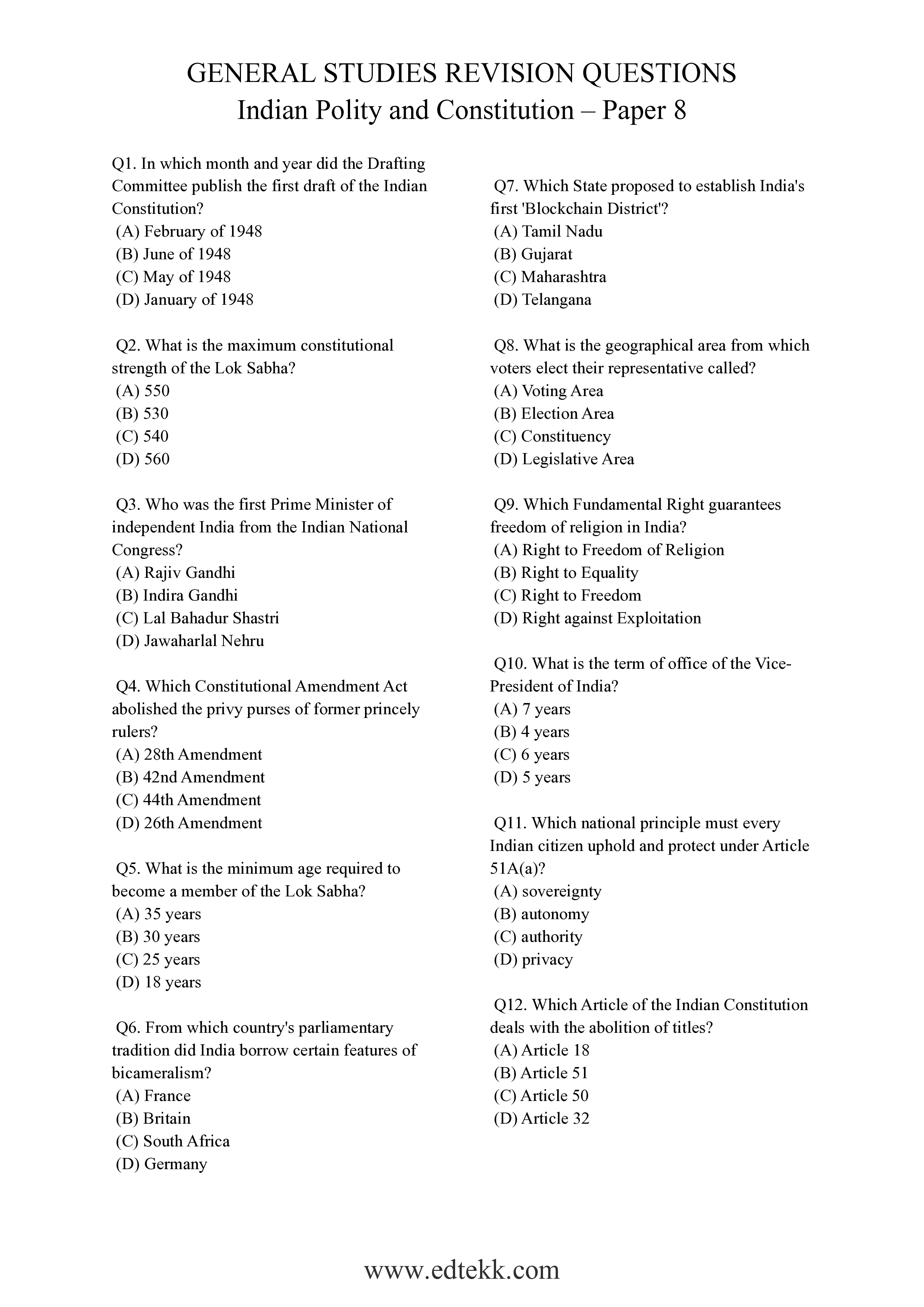
Strengthen your knowledge of Indian Polity and Constitution through General Studies Revision Questions Paper 8. This practice set features 20 MCQs for revising important political and constitutional concepts. Detailed answers and explanations make it useful for aspirants preparing for SSC, Railway, Police Constable and Police SI examinations.
Test Details
Topic: Indian Polity and Constitution
Total Questions: 20
Question Format: MCQs – Single Correct Answer
Suitable for: SSC exams, Railway exams, Police Constable, Police SI
Download All Papers in This Series (PDF)
Questions and Answers
Q1. How are the members of the Rajya Sabha elected?
(A) Direct Election
(B) Indirect Election
(C) Appointment by the President
(D) Nomination by the Prime Minister
Explanation: Rajya Sabha representatives of states are elected indirectly by elected members of the respective State Legislative Assemblies through proportional representation by means of the single transferable vote. Representatives of eligible Union Territories are elected through arrangements prescribed by Parliament. Additionally, the President nominates twelve members possessing special knowledge or practical experience in literature, science, art and social service.
Q2. On whose written recommendation can the President of India proclaim a National Emergency?
(A) Rajya Sabha
(B) Prime Minister
(C) Lok Sabha
(D) Union Cabinet
Explanation: Under Article 352(3), the President can proclaim a National Emergency only when the decision of the Union Cabinet has been communicated to the President in writing. The Union Cabinet comprises the Prime Minister and other ministers of Cabinet rank. This requirement, introduced by the 44th Constitutional Amendment, ensures collective Cabinet responsibility rather than reliance solely on the Prime Minister’s advice.
Q3. Who is the highest law officer of India?
(A) Vice President of India
(B) Attorney General for India
(C) Chief Justice of India
(D) Solicitor General of India
Explanation: The Attorney General for India is the highest law officer of the country under Article 76 of the Constitution. The President appoints the Attorney General, who advises the Union Government on legal matters. Under Article 88, the Attorney General has the right to participate in parliamentary proceedings but cannot vote.
Q4. Who is the presiding officer of the Lok Sabha?
(A) Chief Justice of India
(B) President
(C) Speaker
(D) Prime Minister
Explanation: The Speaker is the presiding officer of the Lok Sabha and is elected by its members under Article 93. The Speaker maintains order, regulates debates and ensures compliance with parliamentary procedures. In the Speaker’s absence, the Deputy Speaker or another authorised member may preside. The Speaker also certifies Money Bills under Article 110.
Q5. Who administers the oath of office to the Governor of a state?
(A) Chief Minister
(B) Chief Justice of the High Court
(C) Chief Justice of India
(D) President
Explanation: The Chief Justice of the concerned High Court administers the oath of office to the Governor under Article 159 of the Constitution. In the absence of the Chief Justice, the senior-most available judge of that High Court administers the oath. This provision ensures the formal commencement of the Governor’s constitutional responsibilities.
Q6. Who heads the Council of Ministers at the Union level in India?
(A) Chief Justice of India
(B) Vice President
(C) Prime Minister
(D) President
Explanation: The Prime Minister is the head of the Council of Ministers at the Union level. The Prime Minister leads the government, coordinates the functioning of various ministries and advises the President on ministerial appointments. Under Article 75(3) of the Constitution, the Council of Ministers is collectively responsible to the Lok Sabha.
Q7. How many times can a person be elected to represent the same constituency in Parliament?
(A) Thrice
(B) Twice
(C) Unlimited times
(D) Four times
Explanation: There is no constitutional limit on the number of times a person can be elected as a Member of Parliament from the same constituency. A person may contest and win elections repeatedly, provided they fulfil the prescribed eligibility requirements. However, under the Representation of the People Act, 1951, a candidate cannot contest from more than two constituencies in a single general election.
Q8. In which year were the first ten Fundamental Duties added to the Indian Constitution?
(A) 1955
(B) 1976
(C) 1947
(D) 1985
Explanation: The initial ten Fundamental Duties were added to the Indian Constitution in 1976 through the 42nd Constitutional Amendment Act. These duties emphasise citizens’ responsibilities towards the Constitution, the nation and society. An eleventh Fundamental Duty was subsequently added through the 86th Constitutional Amendment Act, 2002.
Q9. Which of the following is a type of election conducted by the Election Commission of India?
(A) Primary elections
(B) Bye-elections
(C) Opinion polls
(D) Referendums
Explanation: Bye-elections are conducted to fill vacant seats in Parliament or State Legislatures before the expiry of their normal terms. Vacancies may arise due to death, resignation or disqualification of elected representatives. The Election Commission of India conducts these elections in accordance with applicable constitutional and statutory provisions.
Q10. Which of the following is not a typical function of a Gram Panchayat in India?
(A) Agriculture extension services
(B) Urban planning
(C) Health care
(D) Primary education
Explanation: Urban planning is not a typical function of Gram Panchayats. Gram Panchayats primarily undertake rural development activities, including agricultural extension, primary education, sanitation, drinking water supply and local health-related services. Urban planning is generally the responsibility of urban local bodies and specialised planning authorities.
Q11. What is the normal duration of a Panchayat under the 73rd Constitutional Amendment Act?
(A) 5 years
(B) 4 years
(C) 3 years
(D) 6 years
Explanation: Under Article 243E, the normal duration of a Panchayat is five years from the date appointed for its first meeting. This provision was introduced through the 73rd Constitutional Amendment Act, 1992, to strengthen democratic decentralisation and ensure regular elections to rural local self-government institutions. A Panchayat may be dissolved earlier under applicable legal provisions.
Q12. Which constitutional body has the power to amend the Constitution of India?
(A) President
(B) Parliament
(C) Prime Minister
(D) Supreme Court
Explanation: Parliament has the power to amend the Indian Constitution under Article 368. Most constitutional amendments require a special majority in both Houses of Parliament, while amendments affecting specified federal provisions also require ratification by at least half of the State Legislatures. The President is constitutionally required to give assent to a duly passed Constitution Amendment Bill.
Q13. What is the minimum age required to contest elections to Panchayati Raj institutions in India?
(A) 21 years
(B) 18 years
(C) 25 years
(D) 30 years
Explanation: Under Article 243F of the Constitution, a person cannot be disqualified from Panchayat membership on the ground of being under 25 if they have attained 21 years of age. Other eligibility and disqualification conditions under applicable law also apply.
Q14. Who is the elected political head of a Municipal Corporation in India?
(A) Sarpanch
(B) Mayor
(C) President
(D) Municipal Commissioner
Explanation: The Mayor is generally the elected political head of a Municipal Corporation. The Mayor presides over corporation meetings and performs representative and civic functions. The Municipal Commissioner, usually appointed by the state government, generally manages executive administration and day-to-day municipal services.
Q15. Which of the following Presidents of India died while in office?
(A) Dr. Rajendra Prasad
(B) R. Venkataraman
(C) Fakhruddin Ali Ahmed
(D) V. V. Giri
Explanation: Fakhruddin Ali Ahmed was the fifth President of India and died in office on 11 February 1977. He was serving as President when he passed away. Dr. Rajendra Prasad, V. V. Giri and R. Venkataraman completed their respective presidential tenures and did not die while holding the office.
Q16. In which year was the Jammu and Kashmir Reorganisation Act passed?
(A) 2009
(B) 2019
(C) 2015
(D) 2017
Explanation: The Jammu and Kashmir Reorganisation Act was passed in 2019. It provided for the division of the former State of Jammu and Kashmir into two Union Territories: Jammu and Kashmir, with a legislature, and Ladakh, without a legislature. The reorganisation came into effect on 31 October 2019.
Q17. Which Article of the Indian Constitution deals with the establishment and constitution of the Supreme Court?
(A) Article 226
(B) Article 32
(C) Article 124
(D) Article 141
Explanation: Article 124 of the Indian Constitution deals with the establishment and constitution of the Supreme Court of India. It provides for the Court’s composition, appointment of judges, their qualifications, tenure and removal. Article 32 concerns constitutional remedies, Article 141 deals with binding judicial precedents, and Article 226 concerns the writ jurisdiction of High Courts.
Q18. Which Article of the Indian Constitution provides for the establishment of High Courts in the states?
(A) Article 216
(B) Article 214
(C) Article 222
(D) Article 226
Explanation: Article 214 of the Indian Constitution provides for a High Court for each state. However, under Article 231, Parliament may establish a common High Court for two or more states or for two or more states and Union Territories. Other constitutional provisions deal with the composition, appointment of judges and jurisdiction of High Courts.
Q19. Who is empowered to proclaim a Financial Emergency under Article 360 of the Indian Constitution?
(A) The Finance Minister of India
(B) The President of India
(C) The Governor of Reserve Bank of India
(D) Defence Minister of India
Explanation: Article 360 empowers the President of India to proclaim a Financial Emergency if the financial stability or credit of India, or any part of its territory, is threatened. The proclamation must be approved by both Houses of Parliament within two months. No Financial Emergency has been proclaimed in India so far.
Q20. What is the system of rural local self-government in India known as?
(A) Panchayati Raj
(B) Lok Sabha
(C) Gram Sabha
(D) Samiti Sabha
Explanation: Panchayati Raj is the system of rural local self-government in India. It generally provides elected institutions at village, intermediate and district levels. The Gram Sabha, comprising persons registered on the electoral rolls of a village within the Panchayat area, facilitates direct participation and local accountability.
Question Paper Images