Improve your Indian History preparation with topicwise MCQs on Medieval India. This practice set covers major dynasties, rulers, administration, battles, kingdoms, religious movements and cultural developments of the medieval period, along with answers and explanations for SSC, RRB NTPC, RRB Group D and police examinations.
Test Details
Topic: History: Medieval India
Total Questions: 20
Question Format: MCQs – Single Correct Answer
Suitable for: SSC exams, RRB NTPC, RRB Group D, Police Constable, Police SI
Download All Papers in This Series (PDF)
Questions and Answers
Q1. In which year was the Vijayanagara Empire founded?
(A) 1456
(B) 1229
(C) 1336
(D) 1412
Explanation: The Vijayanagara Empire was founded in 1336 CE by the brothers Harihara I and Bukka Raya I. They established their kingdom in southern India, with its capital at Vijayanagara, near present-day Hampi in Karnataka. The empire subsequently emerged as a major political, economic and cultural power in medieval South India.
Q2. Which department of the Delhi Sultanate was responsible for state correspondence?
(A) Diwan-i-arz
(B) Diwan-i-insha
(C) Diwan-i-risalat
(D) Diwan-i-khairat
Explanation: Diwan-i-Insha was the department responsible for state correspondence and the drafting of official royal communications under the Delhi Sultanate. It handled official letters, orders and diplomatic correspondence. Diwan-i-Arz dealt with military administration, while Diwan-i-Khairat was associated with charitable activities.
Q3. Which dynasty ruled the Delhi Sultanate during Alauddin Khilji’s reign?
(A) Tughlaq dynasty
(B) Khilji dynasty
(C) Lodi dynasty
(D) Sayyid dynasty
Explanation: Alauddin Khilji belonged to the Khilji dynasty, which ruled the Delhi Sultanate from 1290 to 1320. He ruled from 1296 to 1316 and is particularly remembered for his administrative reforms, market regulations, military campaigns and territorial expansion. His reign marked a significant phase in the history of the Delhi Sultanate.
Q4. Who founded the Bahmani Sultanate in the Deccan region?
(A) Hasan Gangu
(B) Muhammad Shah I
(C) Muhammad Shah II
(D) Mahmud Gawan
Explanation: Hasan Gangu, also known as Ala-ud-Din Bahman Shah, founded the Bahmani Sultanate in 1347 after rebelling against the Delhi Sultanate. Its establishment marked the emergence of an independent Muslim kingdom in the Deccan. Gulbarga, also known as Ahsanabad, initially served as its capital.
Q5. Which queen died fighting Mughal forces while defending Garha-Katanga in 1564 CE?
(A) Rani Rudrambara
(B) Rani Avantibai
(C) Rani Durgavati
(D) Rani Ahilyabai
Explanation: Rani Durgavati, the Gond queen of Garha-Katanga, fought against Mughal forces led by Asaf Khan in 1564 CE. After her forces suffered defeat and she was wounded, she chose to take her own life rather than surrender to the enemy. She is remembered for her courageous resistance against Mughal expansion in central India.
Q6. Which Mughal emperor died in 1605 and was buried at Sikandra near Agra?
(A) Jahangir
(B) Aurangzeb
(C) Shahjahan
(D) Akbar
Explanation: Akbar ruled the Mughal Empire from 1556 until his death in 1605, a reign of approximately 49 years. His tomb is located at Sikandra, near Agra, and was completed during the reign of his son Jahangir. His reign was marked by territorial expansion, administrative reforms and policies promoting religious accommodation.
Q7. In which year was the Battle of Tukaroi fought?
(A) 1532
(B) 1565
(C) 1575
(D) 1546
Explanation: The Battle of Tukaroi was fought on 3 March 1575 between Mughal forces commanded by Munim Khan and the Afghan forces of Daud Khan Karrani, ruler of Bengal. The Mughal victory led to the Treaty of Katak (Cuttack) in 1575 and strengthened Akbar’s position in eastern India.
Q8. In which year was Nahargarh Fort in Jaipur built by Maharaja Sawai Jai Singh II?
(A) 1805
(B) 1734
(C) 1800
(D) 1780
Explanation: Nahargarh Fort was built in 1734 by Maharaja Sawai Jai Singh II on the Aravalli Hills overlooking Jaipur. Originally named Sudarshangarh, it formed part of the region’s defensive network alongside the older Amer and Jaigarh forts. The fort was subsequently expanded and modified, particularly during the nineteenth century.
Q9. Who is widely regarded as the greatest ruler of the Vijayanagara Empire?
(A) Harihara I
(B) Krishnadevaraya
(C) Bukka Raya I
(D) Devaraya II
Explanation: Krishnadevaraya, who ruled the Vijayanagara Empire from 1509 to 1529, is widely regarded as its greatest ruler. Under his leadership, the empire achieved remarkable progress in military strength, territorial expansion, administration, literature, art and architecture. His reign is considered the golden age of the Vijayanagara Empire.
Q10. In which year did Timur invade India?
(A) 1398 AD
(B) 1210 AD
(C) 1492 AD
(D) 1526 AD
Explanation: Timur invaded India in 1398 CE during the reign of Sultan Nasir-ud-Din Mahmud Shah Tughlaq. He invaded Delhi, defeated the forces of the Delhi Sultanate and plundered the city. His invasion further weakened the already declining Tughlaq dynasty.
Q11. Whom did the Delhi Sultanate defeat in the Battle of Amroha in 1305 CE?
(A) Mongol army
(B) East India Company
(C) Bijapur Sultanate
(D) Portuguese empire
Explanation: The Delhi Sultanate defeated the Mongol army in the Battle of Amroha in 1305 CE during the reign of Alauddin Khilji. The Delhi forces were led by Malik Nayak, who successfully defeated the invading Mongols. This victory helped strengthen the Sultanate’s defence against repeated Mongol invasions.
Q12. Which kingdom was established by the Bahmani dynasty?
(A) Vijayanagara Kingdom
(B) Bahmani Sultanate
(C) Rajput Kingdom
(D) Maratha Kingdom
Explanation: Alauddin Bahman Shah, originally known as Hasan Gangu, founded the Bahmani Sultanate in 1347 after a revolt against the Delhi Sultanate. Gulbarga, also known as Ahsanabad, served as its initial capital. The sultanate emerged as a major political power in the Deccan.
Q13. Which Bhakti saint is known for promoting social equality and devotion to one God?
(A) Kabir
(B) Mirabai
(C) Ravidas
(D) Chaitanya Mahaprabhu
Explanation: Kabir was a prominent Bhakti saint who emphasised devotion to one formless God and challenged caste discrimination, religious exclusivity, and empty ritualism. His vernacular compositions conveyed spiritual teachings accessible to ordinary people and influenced devotional traditions across Hindu and Muslim communities.
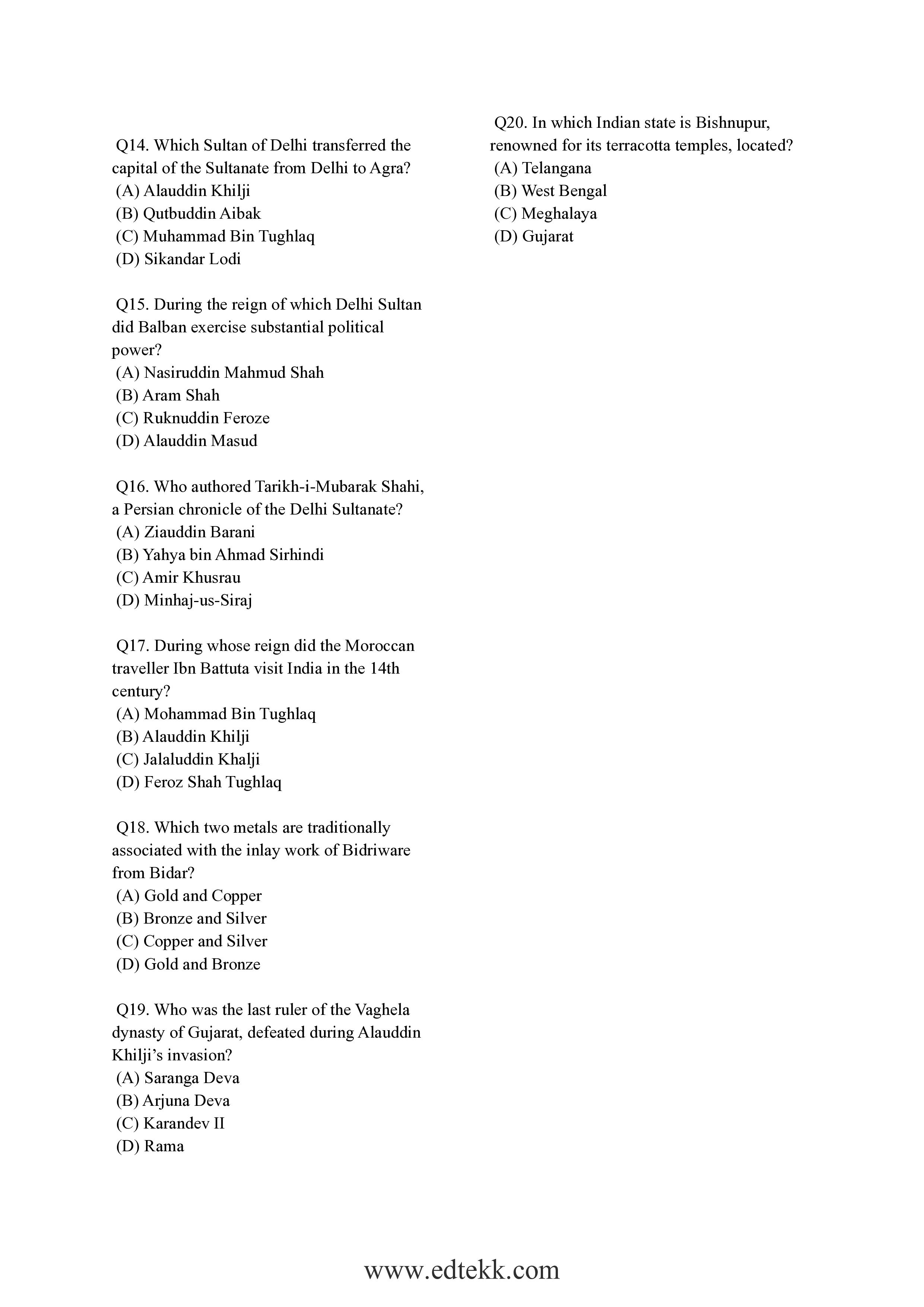
Q14. Which Sultan of Delhi transferred the capital of the Sultanate from Delhi to Agra?
(A) Alauddin Khilji
(B) Qutbuddin Aibak
(C) Muhammad Bin Tughlaq
(D) Sikandar Lodi
Explanation: Sikandar Lodi transferred the capital of the Delhi Sultanate from Delhi to Agra in 1504 CE. He developed Agra into an important administrative and military centre to strengthen his control over northern India. Agra subsequently became a major political centre under the Mughal Empire.
Q15. During the reign of which Delhi Sultan did Balban exercise substantial political power?
(A) Nasiruddin Mahmud Shah
(B) Aram Shah
(C) Ruknuddin Feroze
(D) Alauddin Masud
Explanation: Nasir-ud-Din Mahmud ruled the Delhi Sultanate from 1246 to 1266 CE, during which Balban exercised substantial political and administrative authority as a powerful noble and chief minister. Balban effectively controlled the administration before ascending the throne himself in 1266 CE.
Q16. Who authored Tarikh-i-Mubarak Shahi, a Persian chronicle of the Delhi Sultanate?
(A) Ziauddin Barani
(B) Yahya bin Ahmad Sirhindi
(C) Amir Khusrau
(D) Minhaj-us-Siraj
Explanation: Yahya bin Ahmad Sirhindi authored Tarikh-i-Mubarak Shahi, a Persian historical chronicle covering the Delhi Sultanate from its early establishment through the Sayyid period. It is particularly valuable for understanding the political history of the Sayyid dynasty and the reign of Mubarak Shah.
Q17. During whose reign did the Moroccan traveller Ibn Battuta visit India in the 14th century?
(A) Mohammad Bin Tughlaq
(B) Alauddin Khilji
(C) Jalaluddin Khalji
(D) Feroz Shah Tughlaq
Explanation: Ibn Battuta, the Moroccan traveller and scholar, visited India during the reign of Muhammad bin Tughlaq (1325–1351 CE). He arrived in India around 1333 CE and was appointed Qazi of Delhi. His travel account, known as the Rihla, provides valuable information about the political, social and economic conditions of the Delhi Sultanate.
Q18. Which two metals are traditionally associated with the inlay work of Bidriware from Bidar?
(A) Gold and Copper
(B) Bronze and Silver
(C) Copper and Silver
(D) Gold and Bronze
Explanation: Bidar in Karnataka is famous for Bidriware, a distinctive metalcraft involving intricate silver inlay. The craft traditionally uses a zinc-copper alloy as its base, with pure silver used for decorative inlay. Therefore, copper and silver are the intended materials in the given options, although zinc is the principal component of the alloy.
Q19. Who was the last ruler of the Vaghela dynasty of Gujarat, defeated during Alauddin Khilji’s invasion?
(A) Saranga Deva
(B) Arjuna Deva
(C) Karandev II
(D) Rama
Explanation: Karandev II, also known as Karna II, was the last ruler of the Vaghela dynasty of Gujarat. During Alauddin Khilji’s invasion in 1299 CE, his kingdom was attacked by the Delhi Sultanate’s forces under Ulugh Khan and Nusrat Khan. His defeat marked the end of Vaghela political dominance in Gujarat.
Q20. In which Indian state is Bishnupur, renowned for its terracotta temples, located?
(A) Telangana
(B) West Bengal
(C) Meghalaya
(D) Gujarat
Explanation: Bishnupur is located in the Bankura district of West Bengal and is renowned for its terracotta temples built under the patronage of the Malla rulers. Many of these temples date from the seventeenth and eighteenth centuries. Their distinctive architecture features curved roofs and intricate terracotta panels depicting episodes from Hindu mythology, particularly the Ramayana and Mahabharata.
Question Paper Images