Prepare for competitive examinations with this Indian Geography Topicwise MCQs Paper 1. This practice set covers important concepts and facts about India’s geographical features through 20 multiple-choice questions, with correct answers and detailed explanations for SSC exams, RRB NTPC, RRB Group D and Police Constable and SI examinations.
Test Details
Topic: Indian Geography
Total Questions: 20
Question Format: MCQs – Single Correct Answer
Suitable for: SSC exams, RRB NTPC, RRB Group D, Police Constable, Police SI
Download All Papers in This Series (PDF)
Questions and Answers
Q1. Which Indian city has the country’s busiest suburban railway network?
(A) Kolkata
(B) Mumbai
(C) Chennai
(D) Delhi
Explanation: Mumbai has India’s busiest and most extensive suburban railway network, serving millions of commuters daily. Its major corridors include the Western, Central and Harbour lines. The suburban railway system forms the backbone of public transportation in the Mumbai Metropolitan Region and connects the city with surrounding areas.
Q2. In which Indian city is Swami Vivekananda Airport located?
(A) Raipur
(B) Kanyakumari
(C) Ranchi
(D) Durgapur
Explanation: Swami Vivekananda Airport is located in Raipur, the capital of Chhattisgarh. Formerly known as Raipur Airport, it was renamed in honour of Swami Vivekananda. The airport is an important aviation facility serving Chhattisgarh and neighbouring regions.
Q3. Which Indian state is particularly famous for producing high-quality Mysore Silk?
(A) Karnataka
(B) West Bengal
(C) Kerala
(D) Tamil Nadu
Explanation: Mysore Silk is a renowned variety of mulberry silk associated with Karnataka. It is known for its quality, lustre and traditional gold zari work. The Karnataka Silk Industries Corporation (KSIC) plays an important role in its production and marketing. Mysore Silk is a prominent part of Karnataka’s textile heritage.
Q4. Which natural agents are primarily responsible for soil erosion?
(A) Planting trees
(B) Decreased water runoff
(C) Soil conservation measures
(D) Wind and water movement
Explanation: Wind and water are the principal natural agents of soil erosion. Running water removes soil particles through sheet, rill and gully erosion, while strong winds carry away loose and dry soil particles. Deforestation, overgrazing and improper agricultural practices accelerate these processes by reducing protective vegetation cover.
Q5. What is the term for establishing tree cover on land that was not previously forested?
(A) Reforestation
(B) Afforestation
(C) Desertification
(D) Deforestation
Explanation: Afforestation refers to establishing tree cover on land that was previously not classified as forest. Deliberately converting grasslands into forests through tree planting can therefore be described as afforestation. However, natural grasslands are valuable ecosystems in their own right, and converting them into forests may adversely affect native biodiversity and ecological balance.
Q6. India and which neighbouring country are involved in a territorial dispute over the Siachen Glacier region?
(A) China
(B) Nepal
(C) Pakistan
(D) Bhutan
Explanation: India and Pakistan are engaged in a longstanding dispute concerning the Siachen Glacier in the eastern Karakoram range. The dispute involves territorial control and the demarcation of military positions in this strategically important high-altitude region.
Q7. Which of the following is not classified as an oilseed crop?
(A) Oats
(B) Groundnut
(C) Soybean
(D) Sesame
Explanation: Oats are primarily cultivated as a cereal crop and are used for human consumption and animal fodder. Groundnut, soybean and sesame are important oilseed crops because their seeds contain substantial quantities of edible oil. Therefore, oats do not belong to the conventional oilseed category.
Q8. Who is known as the Father of the Green Revolution in India?
(A) Dr. Norman Borlaug
(B) Dr. Verghese Kurien
(C) M. S. Swaminathan
(D) Dr. A. P. J. Abdul Kalam
Explanation: M. S. Swaminathan is widely regarded as the Father of the Green Revolution in India for his role in promoting high-yielding crop varieties and modern agricultural practices. His contributions helped increase food-grain production and strengthen India’s food security during the 1960s and 1970s. Norman Borlaug is widely known as the Father of the Green Revolution globally.
Q9. Which Indian state is particularly well known for its jute industry?
(A) West Bengal
(B) Kerala
(C) Tamil Nadu
(D) Assam
Explanation: West Bengal is India’s leading traditional jute-producing state and has a well-developed jute textile industry. The Hooghly River basin is particularly important because of its favourable climatic conditions, availability of raw jute, water resources, transport facilities and established industrial infrastructure.
Q10. To which Indian state does the Nyishi tribe belong?
(A) Tamil Nadu
(B) Arunachal Pradesh
(C) Chhattisgarh
(D) Bihar
Explanation: The Nyishi are one of the major indigenous tribal communities of Arunachal Pradesh. They are concentrated mainly in districts such as Papum Pare, Lower Subansiri, Kurung Kumey and neighbouring areas. The community has distinctive cultural traditions, languages and customary practices.
Q11. In which Indian state is the Hirakud Captive Thermal Power Plant located?
(A) Tamil Nadu
(B) Gujarat
(C) Andhra Pradesh
(D) Odisha
Explanation: The Hirakud Captive Thermal Power Plant is located in Odisha, in the Hirakud industrial area near Sambalpur. It is associated with the aluminium industry and supplies electricity for industrial operations. Hirakud is also known for the Hirakud Dam, constructed across the Mahanadi River.
Q12. Which river is known as the “Lifeline of Kerala”?
(A) Pamba
(B) Periyar
(C) Chaliyar
(D) Bharathapuzha
Explanation: The Periyar River is often called the Lifeline of Kerala because it is the state’s longest river and provides water for drinking, irrigation, industrial activities and hydroelectric power generation. It also supports important ecosystems and reservoirs in the state.
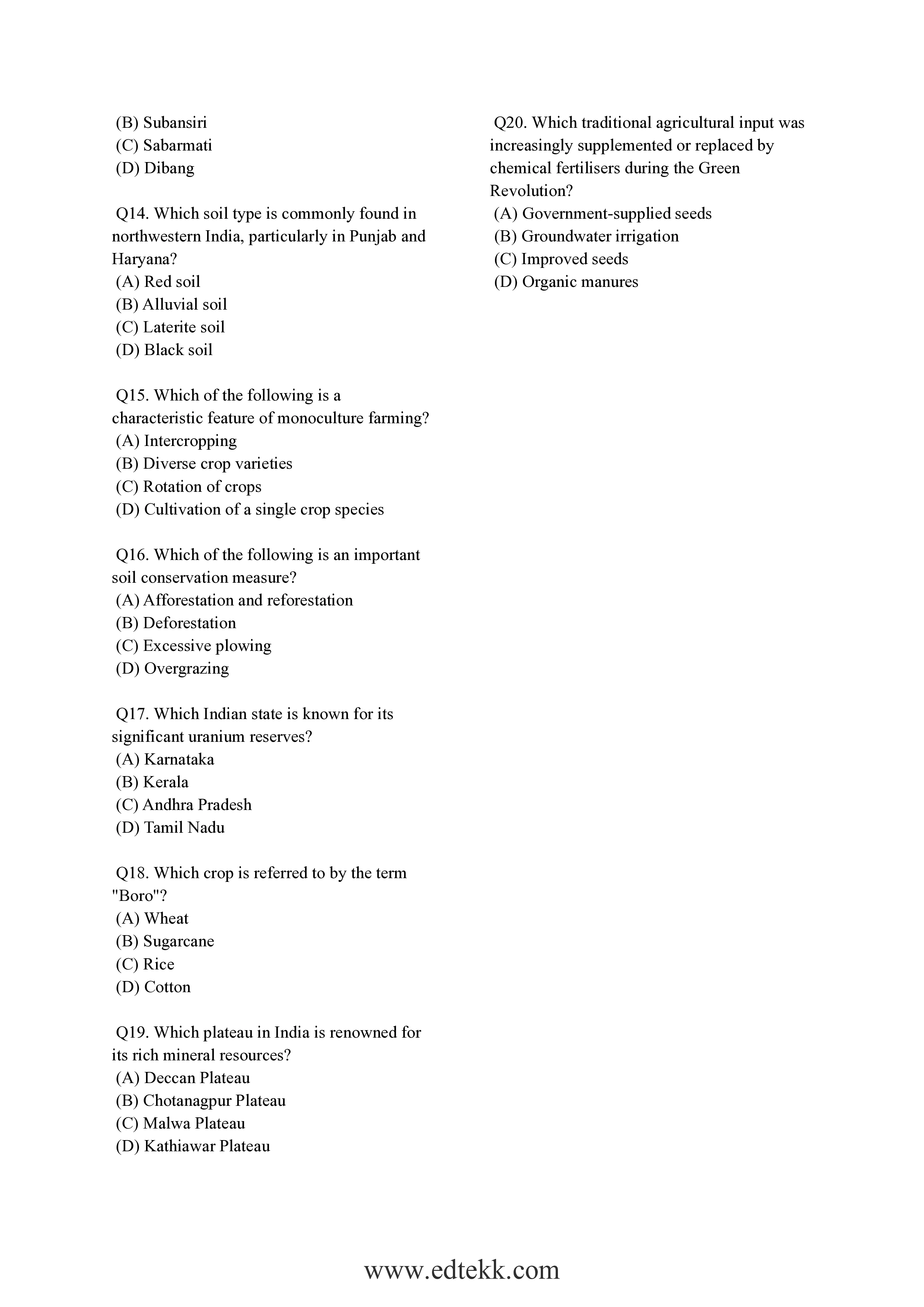
Q13. Which of the following rivers is not a tributary of the Brahmaputra?
(A) Teesta
(B) Subansiri
(C) Sabarmati
(D) Dibang
Explanation: The Sabarmati River is not a tributary of the Brahmaputra. It is an independent west-flowing river originating in the Aravalli Hills of Rajasthan and draining into the Gulf of Khambhat. In contrast, the Teesta, Subansiri and Dibang are tributaries of the Brahmaputra river system.
Q14. Which soil type is commonly found in northwestern India, particularly in Punjab and Haryana?
(A) Red soil
(B) Alluvial soil
(C) Laterite soil
(D) Black soil
Explanation: Alluvial soil is extensively distributed across the northwestern plains of India, particularly Punjab, Haryana and parts of Rajasthan and Uttar Pradesh. It develops through the deposition of sediments carried by rivers. Its generally high fertility makes it suitable for cultivating wheat, rice and other crops.
Q15. Which of the following is a characteristic feature of monoculture farming?
(A) Intercropping
(B) Diverse crop varieties
(C) Rotation of crops
(D) Cultivation of a single crop species
Explanation: Monoculture is an agricultural system in which a single crop species is cultivated on a given area of land during a growing season or repeatedly over successive seasons. It facilitates specialised farming and mechanisation but can increase vulnerability to pests, diseases and soil nutrient depletion compared with diversified cropping systems.
Q16. Which of the following is an important soil conservation measure?
(A) Afforestation and reforestation
(B) Deforestation
(C) Excessive plowing
(D) Overgrazing
Explanation: Afforestation and reforestation are important soil conservation measures. Plant roots bind soil particles, while vegetation reduces the impact of raindrops and slows surface runoff. These processes help prevent soil erosion, maintain soil structure and improve the long-term ecological stability of degraded land.
Q17. Which Indian state is known for its significant uranium reserves?
(A) Karnataka
(B) Kerala
(C) Andhra Pradesh
(D) Tamil Nadu
Explanation: Andhra Pradesh has significant uranium deposits, particularly at Tummalapalle in YSR Kadapa district. Tummalapalle is one of India’s major uranium deposits. Uranium is used as nuclear fuel in power reactors to generate electricity.
Q18. Which crop is referred to by the term “Boro”?
(A) Wheat
(B) Sugarcane
(C) Rice
(D) Cotton
Explanation: Boro refers to a dry-season rice crop cultivated mainly during winter and spring, particularly in eastern and northeastern India. It generally requires irrigation because rainfall is insufficient during its growing season. West Bengal and Assam are important Boro rice-producing states. It is distinct from the Aus and Aman rice seasons.
Q19. Which plateau in India is renowned for its rich mineral resources?
(A) Deccan Plateau
(B) Chotanagpur Plateau
(C) Malwa Plateau
(D) Kathiawar Plateau
Explanation: The Chotanagpur Plateau is renowned for its extensive mineral resources, including coal, iron ore, mica, bauxite and copper. Located primarily in Jharkhand and extending into neighbouring states, its mineral wealth has encouraged the development of major mining and industrial centres in eastern India.
Q20. Which traditional agricultural input was increasingly supplemented or replaced by chemical fertilisers during the Green Revolution?
(A) Government-supplied seeds
(B) Groundwater irrigation
(C) Improved seeds
(D) Organic manures
Explanation: Organic manures were traditionally used to maintain soil fertility and provide nutrients to crops. During the Green Revolution, chemical fertilisers increasingly supplemented and, in some cases, replaced organic manures. Nitrogen, phosphorus and potassium fertilisers helped increase agricultural productivity, particularly in the cultivation of high-yielding varieties of wheat and rice.
Question Paper Images