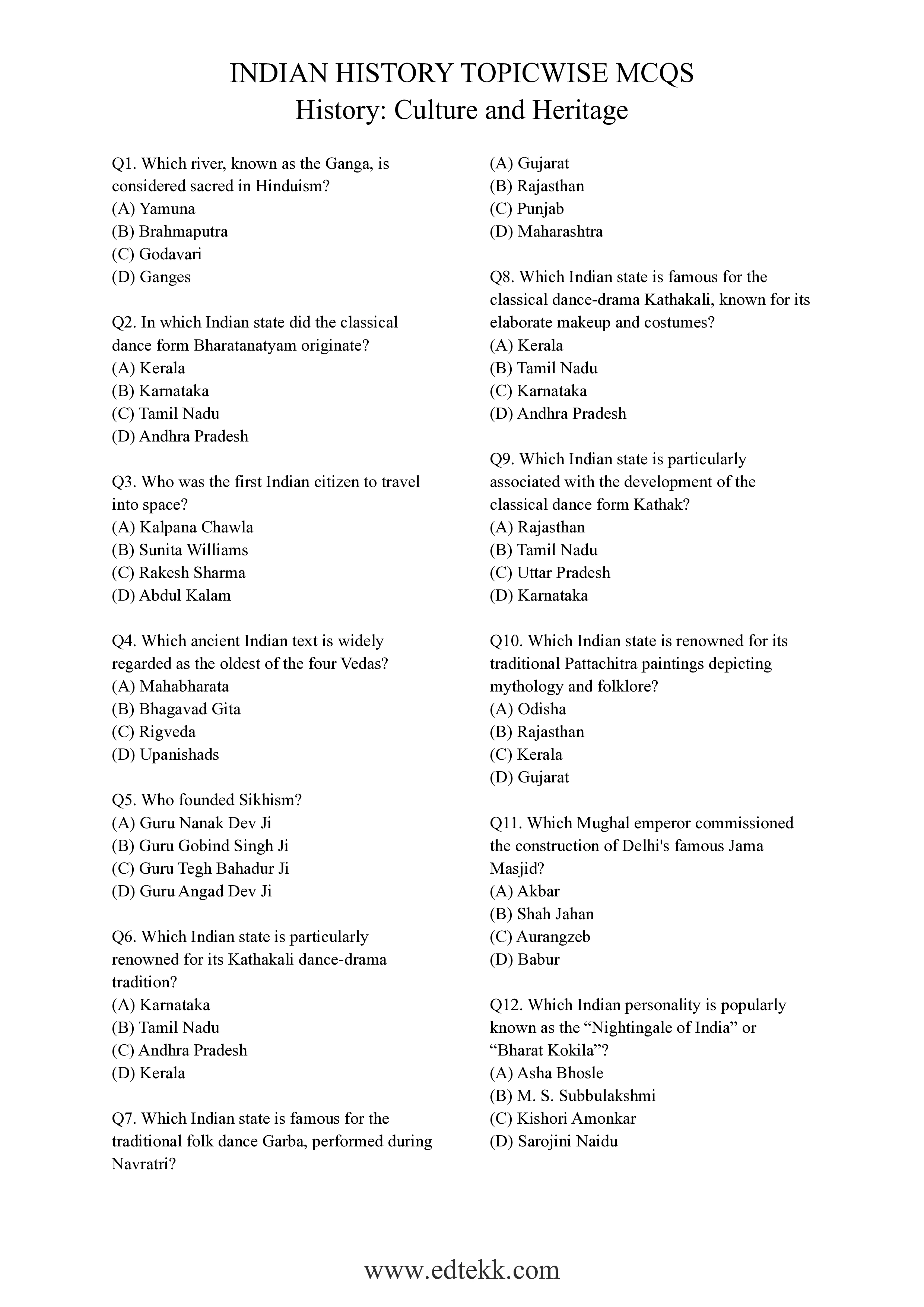
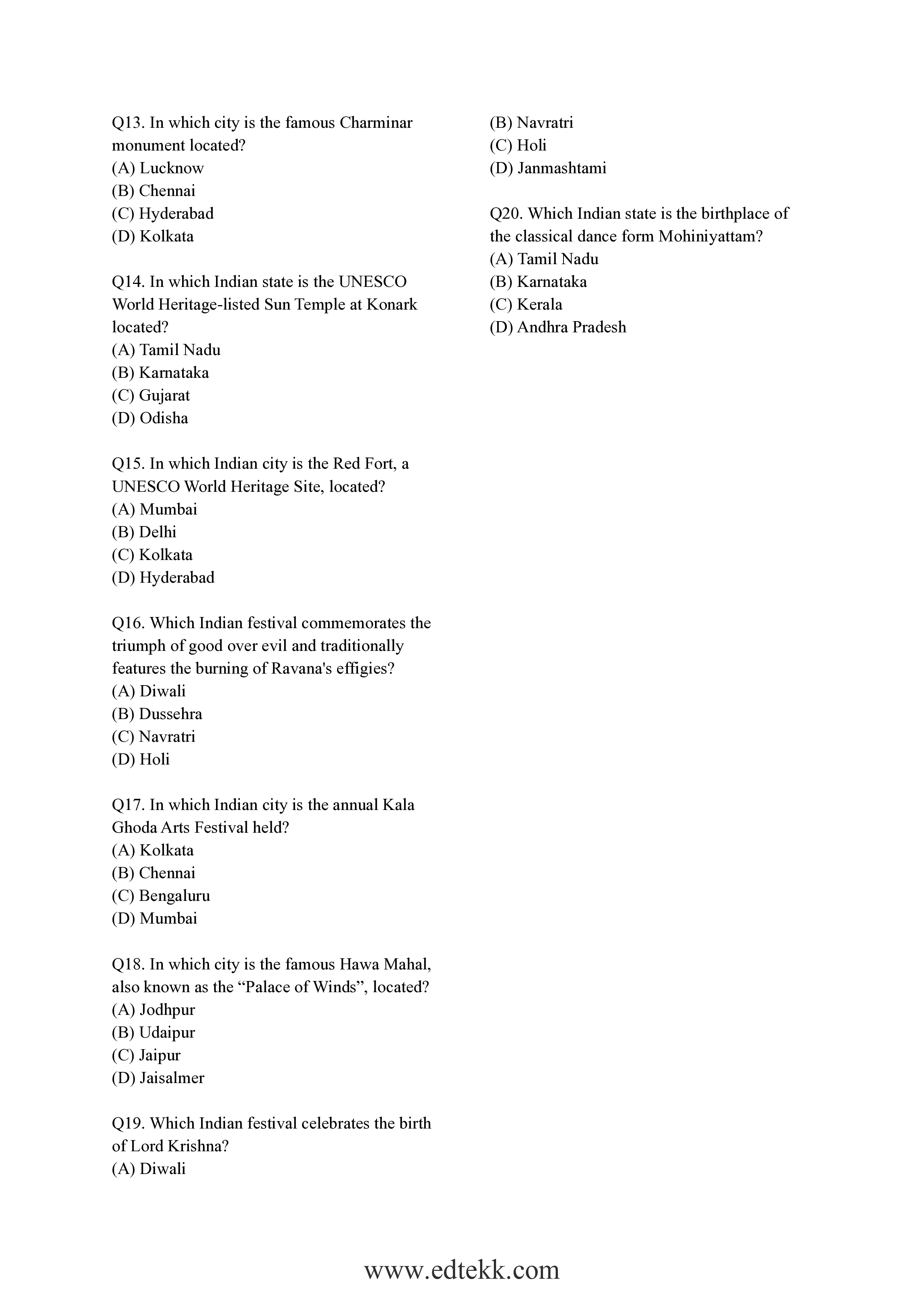
Improve your knowledge of Indian History through this Culture and Heritage MCQ practice set. It covers historical traditions, monuments, architecture, literature, religious developments, art forms and cultural heritage across different periods. Designed for competitive-exam preparation, the set provides objective questions, correct answers and explanations to help SSC, RRB NTPC, RRB Group D and Police aspirants revise important topics.
Test Details
Topic: History: Culture and Heritage
Total Questions: 20
Question Format: MCQs – Single Correct Answer
Suitable for: SSC exams, RRB NTPC, RRB Group D, Police Constable, Police SI
Download All Papers in This Series (PDF)
Questions and Answers
Q1. Which river, known as the Ganga, is considered sacred in Hinduism?
(A) Yamuna
(B) Brahmaputra
(C) Godavari
(D) Ganges
Explanation: The Ganga, known as the Ganges in English, is one of India’s most sacred rivers. It holds immense religious significance in Hinduism and is worshipped as a goddess. Millions of devotees visit its banks for ritual bathing, religious ceremonies and other spiritual practices.
Q2. In which Indian state did the classical dance form Bharatanatyam originate?
(A) Kerala
(B) Karnataka
(C) Tamil Nadu
(D) Andhra Pradesh
Explanation: Bharatanatyam originated in Tamil Nadu and developed from the temple dance traditions of the region. Historically associated with the Devadasi tradition, it combines expressive gestures, rhythmic footwork, facial expressions and intricate movements. It is one of India’s major classical dance forms and represents an important part of the country’s cultural heritage.
Q3. Who was the first Indian citizen to travel into space?
(A) Kalpana Chawla
(B) Sunita Williams
(C) Rakesh Sharma
(D) Abdul Kalam
Explanation: Rakesh Sharma became the first Indian citizen to travel into space on 3 April 1984 aboard the Soviet spacecraft Soyuz T-11. He spent approximately eight days aboard the Salyut 7 space station. When asked how India looked from space, he famously replied, “Saare Jahan Se Achha.”
Q4. Which ancient Indian text is widely regarded as the oldest of the four Vedas?
(A) Mahabharata
(B) Bhagavad Gita
(C) Rigveda
(D) Upanishads
Explanation: The Rigveda is the oldest of the four Vedas and is widely regarded as the oldest surviving sacred text of Hinduism. It consists of hymns composed in Vedic Sanskrit, primarily praising various deities. Its composition is generally dated to the second millennium BCE, making it a major source for understanding early Vedic civilisation.
Q5. Who founded Sikhism?
(A) Guru Nanak Dev Ji
(B) Guru Gobind Singh Ji
(C) Guru Tegh Bahadur Ji
(D) Guru Angad Dev Ji
Explanation: Guru Nanak Dev Ji founded Sikhism in the Punjab region during the late 15th century. Born in 1469 at Rai Bhoi di Talwandi, now Nankana Sahib in Pakistan, he taught devotion to one God, equality, honest work and service to humanity. His teachings challenged caste discrimination and empty ritualism. He was the first of the ten Sikh Gurus.
Q6. Which Indian state is particularly renowned for its Kathakali dance-drama tradition?
(A) Karnataka
(B) Tamil Nadu
(C) Andhra Pradesh
(D) Kerala
Explanation: Kathakali is a classical dance-drama tradition of Kerala. It combines elaborate costumes, distinctive facial makeup, expressive hand gestures and highly stylised movements to narrate stories from Hindu mythology. Its performances traditionally draw upon episodes from the Ramayana, Mahabharata and Puranas.
Q7. Which Indian state is famous for the traditional folk dance Garba, performed during Navratri?
(A) Gujarat
(B) Rajasthan
(C) Punjab
(D) Maharashtra
Explanation: Gujarat is particularly famous for Garba, a traditional folk dance performed during the Navratri festival. Participants dance in circular formations around a centrally placed lamp or an image of a goddess. The dance is associated with devotion to Goddess Amba and represents an important expression of Gujarati cultural heritage.
Q8. Which Indian state is famous for the classical dance-drama Kathakali, known for its elaborate makeup and costumes?
(A) Kerala
(B) Tamil Nadu
(C) Karnataka
(D) Andhra Pradesh
Explanation: Kathakali originated in Kerala and is renowned for its elaborate costumes, colourful makeup and dramatic facial expressions. This classical dance-drama combines dance, music, acting and storytelling to portray episodes from Hindu epics and mythology, particularly the Ramayana and Mahabharata.
Q9. Which Indian state is particularly associated with the development of the classical dance form Kathak?
(A) Rajasthan
(B) Tamil Nadu
(C) Uttar Pradesh
(D) Karnataka
Explanation: Kathak developed from the storytelling traditions of northern India, particularly those associated with itinerant storytellers known as Kathakars. Uttar Pradesh is strongly associated with its development, especially through the Lucknow and Banaras gharanas. It subsequently evolved through temple traditions and royal patronage into a major Indian classical dance form.
Q10. Which Indian state is renowned for its traditional Pattachitra paintings depicting mythology and folklore?
(A) Odisha
(B) Rajasthan
(C) Kerala
(D) Gujarat
Explanation: Odisha is particularly famous for its traditional Pattachitra painting. These intricate paintings commonly depict Hindu mythological narratives, especially stories associated with Lord Jagannath, Lord Krishna and other deities. Traditionally, artists create them on cloth prepared with a special coating. Pattachitra is an important part of Odisha’s cultural and artistic heritage.
Q11. Which Mughal emperor commissioned the construction of Delhi’s famous Jama Masjid?
(A) Akbar
(B) Shah Jahan
(C) Aurangzeb
(D) Babur
Explanation: Jama Masjid in Delhi was commissioned by Mughal emperor Shah Jahan and completed in 1656. Also known as Masjid-i-Jahan-Numa, it is one of India’s largest historic mosques. Constructed primarily from red sandstone and white marble, it represents the architectural achievements of the Mughal period.
Q12. Which Indian personality is popularly known as the “Nightingale of India” or “Bharat Kokila”?
(A) Asha Bhosle
(B) M. S. Subbulakshmi
(C) Kishori Amonkar
(D) Sarojini Naidu
Explanation: Sarojini Naidu is popularly known as the “Nightingale of India,” or Bharat Kokila, because of her lyrical poetry. She was also a prominent freedom fighter and political leader who participated in India’s independence movement. Her poetry explored themes including patriotism, Indian culture, nature and human emotions.
Q13. In which city is the famous Charminar monument located?
(A) Lucknow
(B) Chennai
(C) Hyderabad
(D) Kolkata
Explanation: The Charminar is located in Hyderabad, Telangana. Built in 1591 by Muhammad Quli Qutb Shah, it is one of the city’s most recognisable historical landmarks. Its name means “Four Minarets,” referring to the four prominent towers that characterise its architecture. It is an important example of the region’s historic Indo-Islamic architectural heritage.
Q14. In which Indian state is the UNESCO World Heritage-listed Sun Temple at Konark located?
(A) Tamil Nadu
(B) Karnataka
(C) Gujarat
(D) Odisha
Explanation: The Konark Sun Temple is located in Odisha, near the coastal town of Konark. Built in the thirteenth century by King Narasimhadeva I of the Eastern Ganga dynasty, it is dedicated to the Sun God. Its magnificent architecture represents a stone chariot featuring elaborately carved wheels and horses.
Q15. In which Indian city is the Red Fort, a UNESCO World Heritage Site, located?
(A) Mumbai
(B) Delhi
(C) Kolkata
(D) Hyderabad
Explanation: The Red Fort is located in Delhi and was constructed by Mughal emperor Shah Jahan in the seventeenth century. It served as the principal residence of Mughal emperors. The Red Fort Complex is a UNESCO World Heritage Site and is closely associated with India’s Independence Day celebrations.
Q16. Which Indian festival commemorates the triumph of good over evil and traditionally features the burning of Ravana’s effigies?
(A) Diwali
(B) Dussehra
(C) Navratri
(D) Holi
Explanation: Dussehra, also known as Vijayadashami, celebrates the victory of good over evil. In many parts of India, particularly northern India, it commemorates Lord Rama’s victory over the demon king Ravana. Burning Ravana’s effigies is a prominent tradition associated with these celebrations.
Q17. In which Indian city is the annual Kala Ghoda Arts Festival held?
(A) Kolkata
(B) Chennai
(C) Bengaluru
(D) Mumbai
Explanation: The Kala Ghoda Arts Festival is held annually in Mumbai, Maharashtra, particularly in the Kala Ghoda cultural district of South Mumbai. It celebrates diverse art forms, including visual arts, music, dance, theatre, literature, cinema and street performances. It is one of India’s prominent multidisciplinary cultural festivals.
Q18. In which city is the famous Hawa Mahal, also known as the “Palace of Winds”, located?
(A) Jodhpur
(B) Udaipur
(C) Jaipur
(D) Jaisalmer
Explanation: Hawa Mahal, popularly known as the Palace of Winds, is located in Jaipur, Rajasthan. Constructed in 1799 by Maharaja Sawai Pratap Singh, it is famous for its distinctive five-storey façade and numerous small windows. These windows enabled royal women to observe everyday street activities while maintaining privacy.
Q19. Which Indian festival celebrates the birth of Lord Krishna?
(A) Diwali
(B) Navratri
(C) Holi
(D) Janmashtami
Explanation: Janmashtami celebrates the birth of Lord Krishna, regarded as an incarnation of Lord Vishnu. It is observed on the eighth day (Ashtami) of the dark fortnight (Krishna Paksha) of Bhadrapada according to the commonly followed calendar. Celebrations include fasting, devotional singing, temple ceremonies and reenactments of Krishna’s childhood activities.
Q20. Which Indian state is the birthplace of the classical dance form Mohiniyattam?
(A) Tamil Nadu
(B) Karnataka
(C) Kerala
(D) Andhra Pradesh
Explanation: Mohiniyattam is a classical dance form originating in Kerala. Its name is derived from Mohini, the female incarnation of Lord Vishnu. Traditionally performed by women, it is characterised by graceful movements, gentle body swaying, expressive gestures and subtle facial expressions. Its musical accompaniment traditionally draws upon Carnatic music.
Question Paper Images