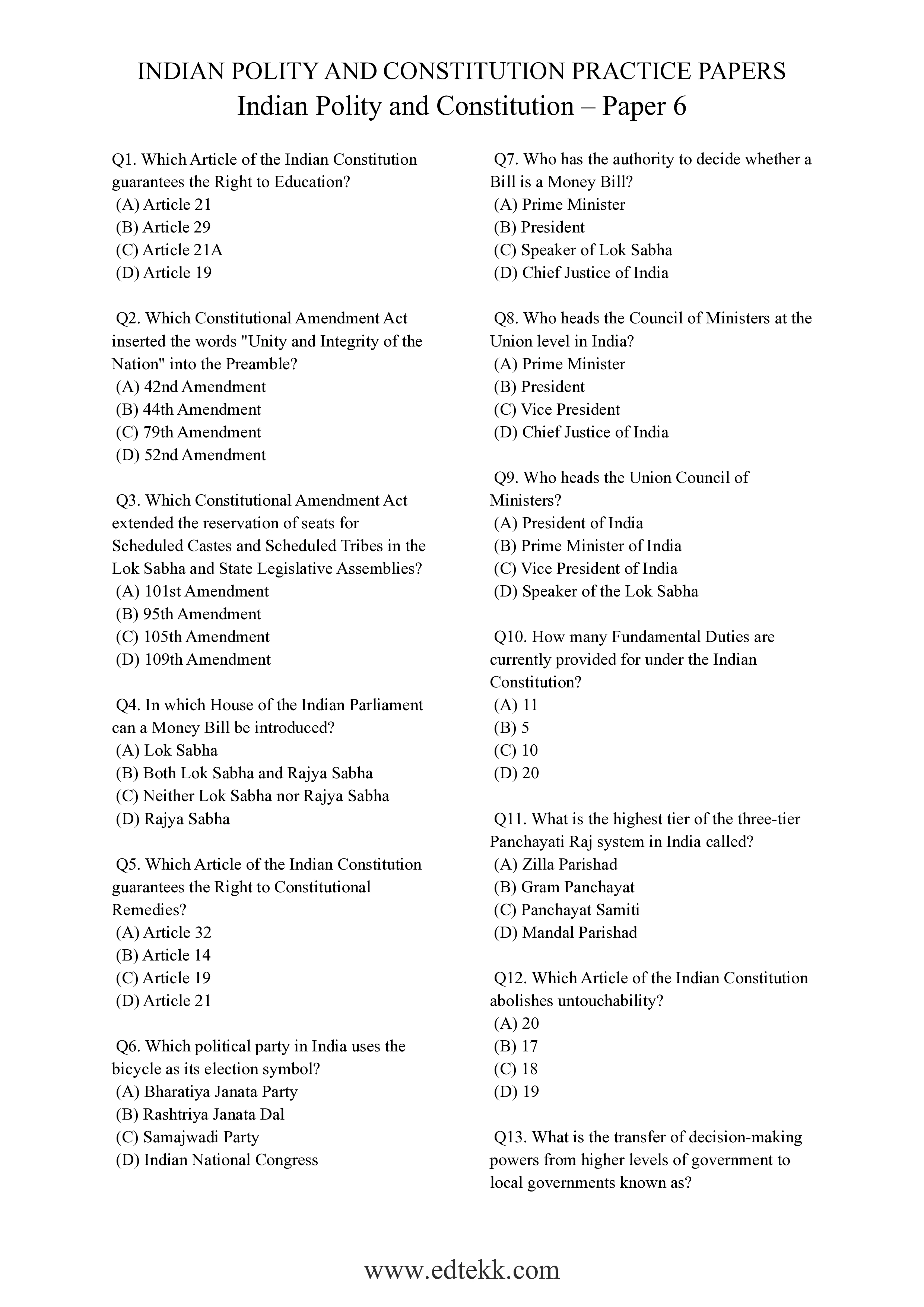
Test and improve your knowledge of Indian Polity and the Constitution with Practice Paper 6. Suitable for SSC, Railway, Police Constable and Police SI examinations, this set includes objective questions on important political and constitutional concepts, along with correct answers and explanations for focused revision and effective practice.
Test Details
Topic: Indian Polity and Constitution
Total Questions: 20
Question Format: MCQs – Single Correct Answer
Suitable for: SSC exams, Railway exams, Police Constable, Police SI
Download All Papers in This Series (PDF)
Questions and Answers
Q1. Which Article of the Indian Constitution guarantees the Right to Education?
(A) Article 21
(B) Article 29
(C) Article 21A
(D) Article 19
Explanation: Article 21A of the Indian Constitution guarantees the Fundamental Right to Education for children aged six to fourteen years. It directs the State to provide free and compulsory education to children in this age group in the manner prescribed by law. This provision was introduced through the 86th Constitutional Amendment Act, 2002.
Q2. Which Constitutional Amendment Act inserted the words “Unity and Integrity of the Nation” into the Preamble?
(A) 42nd Amendment
(B) 44th Amendment
(C) 79th Amendment
(D) 52nd Amendment
Explanation: The 42nd Constitutional Amendment Act, 1976, inserted the expression “Unity and Integrity of the Nation” into the Preamble. It modified the original expression “unity of the Nation” by adding the word “Integrity”, emphasising national unity and territorial integrity.
Q3. Which Constitutional Amendment Act extended the reservation of seats for Scheduled Castes and Scheduled Tribes in the Lok Sabha and State Legislative Assemblies?
(A) 101st Amendment
(B) 95th Amendment
(C) 105th Amendment
(D) 109th Amendment
Explanation: The 95th Constitutional Amendment Act, 2009, extended the reservation of seats for Scheduled Castes and Scheduled Tribes in the Lok Sabha and State Legislative Assemblies for ten years, until 2020. Subsequently, the 104th Constitutional Amendment Act, 2019, extended this reservation until 2030.
Q4. In which House of the Indian Parliament can a Money Bill be introduced?
(A) Lok Sabha
(B) Both Lok Sabha and Rajya Sabha
(C) Neither Lok Sabha nor Rajya Sabha
(D) Rajya Sabha
Explanation: Under Article 109, a Money Bill can be introduced only in the Lok Sabha, with the President’s recommendation. The Rajya Sabha cannot amend it but may recommend changes within fourteen days. The Lok Sabha may accept or reject these recommendations. If the Rajya Sabha fails to return the Bill within fourteen days, it is deemed passed by both Houses.
Q5. Which Article of the Indian Constitution guarantees the Right to Constitutional Remedies?
(A) Article 32
(B) Article 14
(C) Article 19
(D) Article 21
Explanation: Article 32 guarantees the Right to Constitutional Remedies, enabling individuals to approach the Supreme Court for the enforcement of Fundamental Rights. The Supreme Court can issue five types of writs: habeas corpus, mandamus, prohibition, certiorari and quo warranto. Dr B. R. Ambedkar described Article 32 as the heart and soul of the Constitution.
Q6. Which political party in India uses the bicycle as its election symbol?
(A) Bharatiya Janata Party
(B) Rashtriya Janata Dal
(C) Samajwadi Party
(D) Indian National Congress
Explanation: The bicycle is the reserved election symbol of the Samajwadi Party (SP). Founded in 1992, the party is primarily based in Uttar Pradesh and has a significant presence in the state’s political landscape.
Q7. Who has the authority to decide whether a Bill is a Money Bill?
(A) Prime Minister
(B) President
(C) Speaker of Lok Sabha
(D) Chief Justice of India
Explanation: Under Article 110(3), the Speaker of the Lok Sabha decides whether a Bill is a Money Bill. The Speaker’s certificate accompanies the Bill when transmitted to the Rajya Sabha and presented to the President. Although the Constitution describes the Speaker’s decision as final, it is not absolutely immune from judicial review, particularly where substantive constitutional violations are alleged.
Q8. Who heads the Council of Ministers at the Union level in India?
(A) Prime Minister
(B) President
(C) Vice President
(D) Chief Justice of India
Explanation: The Prime Minister is the head of the Council of Ministers at the Union level. The Prime Minister leads the government, coordinates the functioning of various ministries and advises the President on ministerial appointments. Under Article 75(3) of the Constitution, the Council of Ministers is collectively responsible to the Lok Sabha.
Q9. Who heads the Union Council of Ministers?
(A) President of India
(B) Prime Minister of India
(C) Vice President of India
(D) Speaker of the Lok Sabha
Explanation: The Prime Minister heads the Union Council of Ministers and coordinates the functioning of the government. Although executive power is formally vested in the President, the President ordinarily acts on the aid and advice of the Council of Ministers headed by the Prime Minister.
Q10. How many Fundamental Duties are currently provided for under the Indian Constitution?
(A) 11
(B) 5
(C) 10
(D) 20
Explanation: The Indian Constitution provides for 11 Fundamental Duties under Article 51A. Initially, ten duties were introduced through the 42nd Constitutional Amendment Act, 1976. The 86th Constitutional Amendment Act, 2002, added the eleventh duty, requiring parents or guardians to provide educational opportunities to children or wards aged 6–14 years.
Q11. What is the highest tier of the three-tier Panchayati Raj system in India called?
(A) Zilla Parishad
(B) Gram Panchayat
(C) Panchayat Samiti
(D) Mandal Parishad
Explanation: The Zilla Parishad is generally the highest tier of the three-tier Panchayati Raj system and operates at the district level. The Gram Panchayat functions at the village level, while the Panchayat Samiti generally operates at the intermediate or block level. The exact structure may vary by state.
Q12. Which Article of the Indian Constitution abolishes untouchability?
(A) 20
(B) 17
(C) 18
(D) 19
Explanation: Article 17 of the Indian Constitution abolishes untouchability and prohibits its practice in any form. It also declares the enforcement of any disability arising from untouchability to be an offence punishable by law. This provision promotes social equality and protects individuals against caste-based discrimination.
Q13. What is the transfer of decision-making powers from higher levels of government to local governments known as?
(A) Communism
(B) Unitarism
(C) Decentralization
(D) Autonomy
Explanation: Decentralization refers to the transfer of administrative, political and financial decision-making powers from higher levels of government to lower levels, particularly local governments. In India, the 73rd and 74th Constitutional Amendments strengthened democratic decentralisation by granting constitutional recognition to rural and urban local self-government institutions.
Q14. Who is the head of the Government of India?
(A) Speaker of the Lok Sabha
(B) Chief Justice of India
(C) President of India
(D) Prime Minister of India
Explanation: The Prime Minister is the head of the Union Government and leads the Council of Ministers. The President is the constitutional head of the Indian state, while executive functions are exercised in accordance with the Constitution, generally on the aid and advice of the Council of Ministers headed by the Prime Minister.
Q15. What is the minimum age required to be eligible for election as the President of India?
(A) 35 years
(B) 30 years
(C) 40 years
(D) 45 years
Explanation: A person must be at least 35 years old to be eligible for election as President of India under Article 58(1) of the Constitution. The candidate must also be an Indian citizen, be qualified for election as a member of the Lok Sabha and fulfil the other constitutional requirements for presidential eligibility.
Q16. Which Article of the Indian Constitution prohibits discrimination on grounds of religion, race, caste, sex and place of birth?
(A) Article19
(B) Article 23
(C) Article 25
(D) Article 15
Explanation: Article 15 prohibits the State from discriminating against any citizen on grounds only of religion, race, caste, sex or place of birth. It also enables the State to introduce special provisions for disadvantaged groups, including women, children, socially and educationally backward classes, Scheduled Castes and Scheduled Tribes.
Q17. Which Article of the Indian Constitution provides for the Council of Ministers to aid and advise the Governor?
(A) Article 153
(B) Article 163
(C) Article 155
(D) Article 161
Explanation: Article 163 provides for a Council of Ministers headed by the Chief Minister to aid and advise the Governor, except where the Constitution requires the Governor to exercise discretion. This provision establishes the principle of responsible parliamentary government at the State level, subject to constitutionally recognised discretionary functions.
Q18. Which of the following is a non-statutory body in India?
(A) Finance Commission
(B) Election Commission
(C) Planning Commission
(D) NITI Aayog
Explanation: NITI Aayog is a non-statutory body established by an executive resolution of the Union Government in 2015, replacing the Planning Commission. The Election Commission of India and the Finance Commission are constitutional bodies. The Planning Commission was also non-statutory but has been abolished.
Q19. Who is widely known as the ‘Father of the Indian Constitution’?
(A) Dr. B.R. Ambedkar
(B) Mahatma Gandhi
(C) Jawaharlal Nehru
(D) Sardar Vallabhbhai Patel
Explanation: Dr. B. R. Ambedkar is widely known as the Father of the Indian Constitution because he chaired the Drafting Committee of the Constituent Assembly and played a leading role in preparing the constitutional text. The Constitution was ultimately adopted through the collective efforts of the Constituent Assembly.
Q20. Which of the following is NOT a constitutional body?
(A) Election Commission
(B) Finance Commission
(C) National Human Rights Commission
(D) Union Public Service Commission
Explanation: The National Human Rights Commission is a statutory body established under the Protection of Human Rights Act, 1993. The Finance Commission, Election Commission of India and UPSC are constitutional bodies.
Question Paper Images