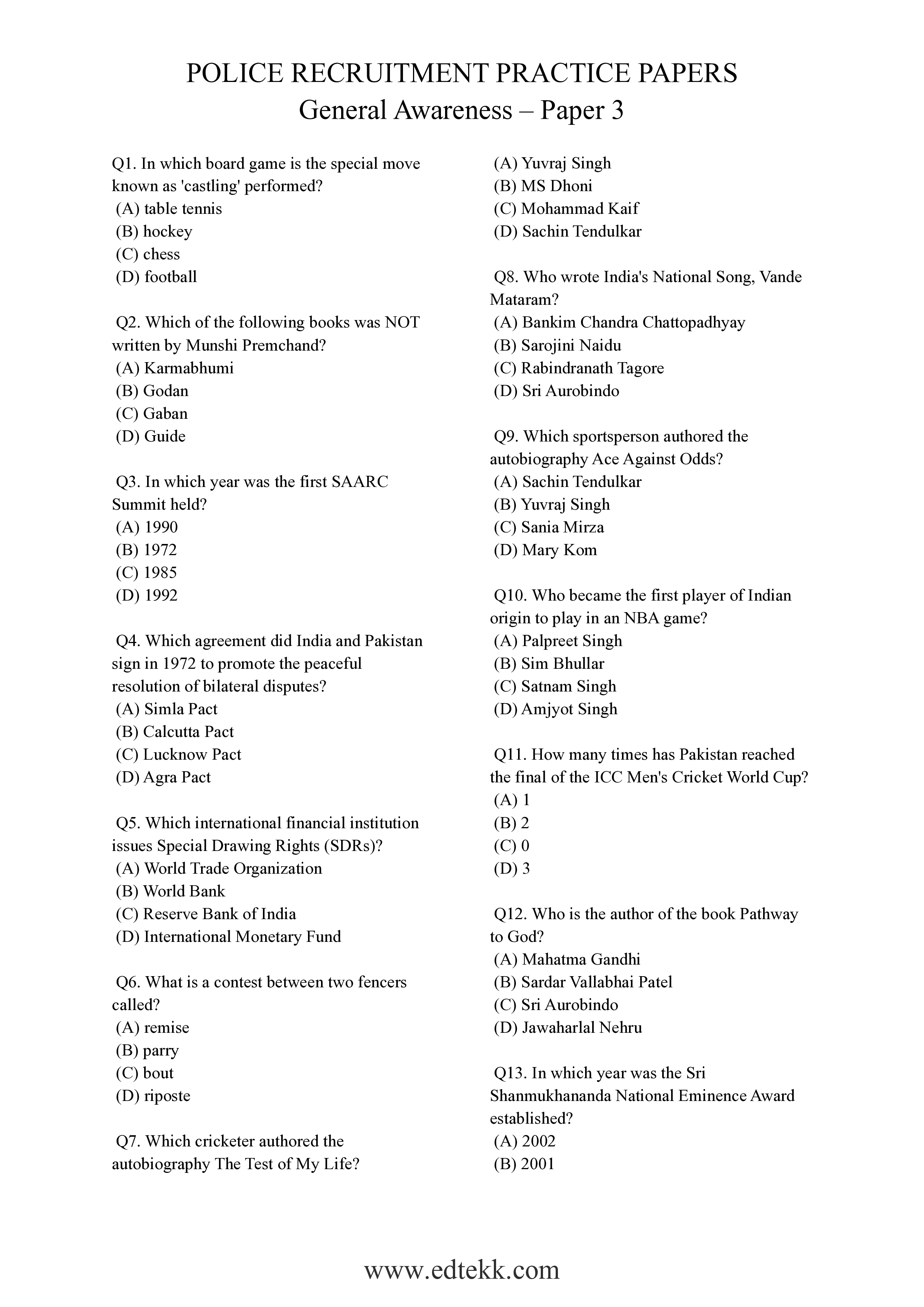
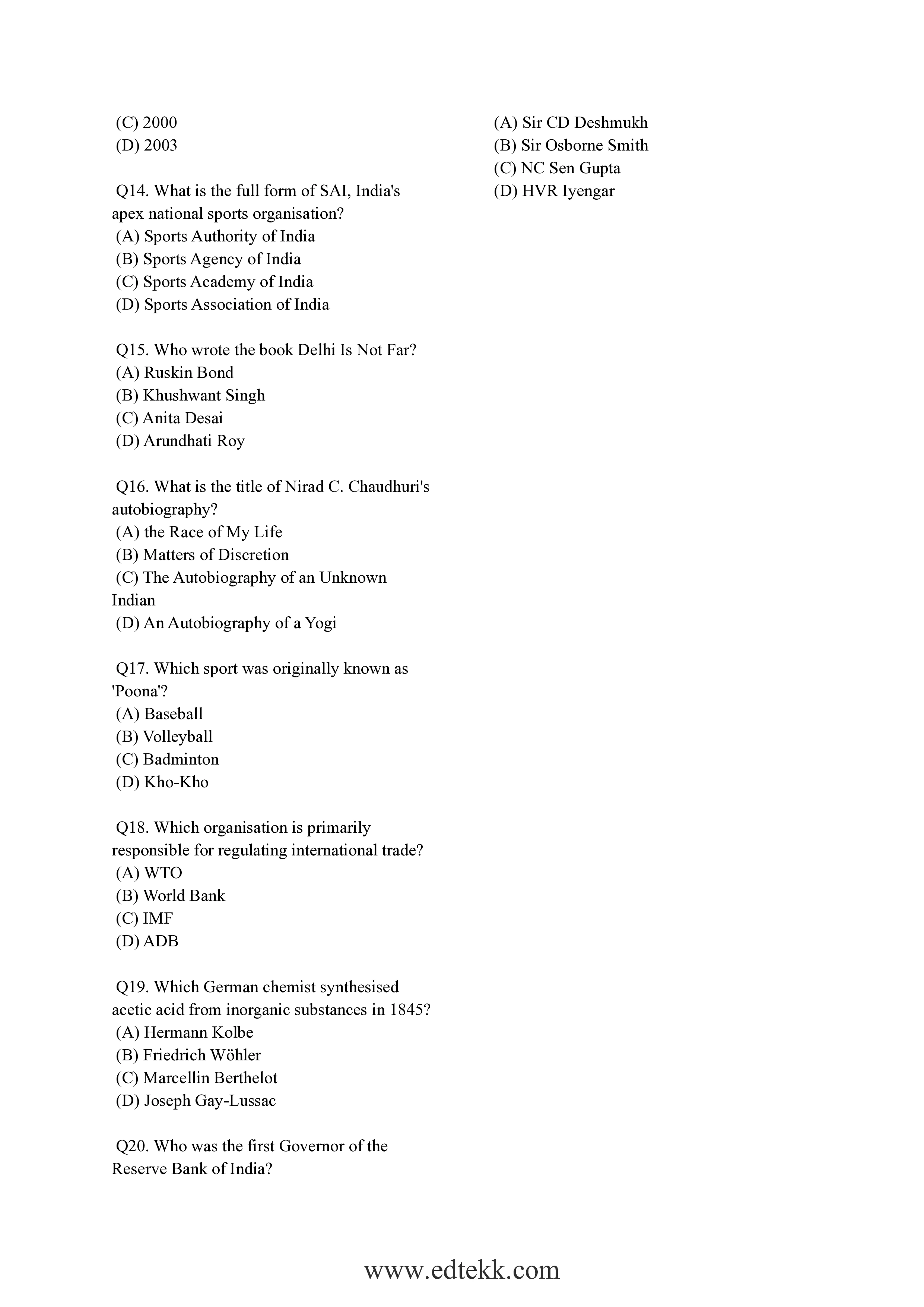
Get ready for Police Constable and Police Sub-Inspector recruitment examinations with General Awareness Practice Paper 3. This practice set features 20 MCQs to help candidates assess their subject knowledge and examination readiness. Practise objective questions, check accurate answers and understand explanations to improve preparation and build confidence for competitive police examinations.
Test Details
Topic: General Awareness
Total Questions: 20
Question Format: MCQs – Single Correct Answer
Suitable for: Police Constable, Police SI
Download All Papers in This Series (PDF)
Questions and Answers
Q1. In which board game is the special move known as ‘castling’ performed?
(A) table tennis
(B) hockey
(C) chess
(D) football
Explanation: Castling is a special move in chess involving the king and one rook. Both pieces move during the same turn, subject to specific conditions. Castling helps protect the king by moving it towards the side of the board while bringing the rook into a more active position.
Q2. Which of the following books was NOT written by Munshi Premchand?
(A) Karmabhumi
(B) Godan
(C) Gaban
(D) Guide
Explanation: The Guide is a novel written by R. K. Narayan and first published in 1958. It follows the story of Raju, a tourist guide who eventually becomes a spiritual figure. In contrast, Godan, Gaban and Karmabhumi were written by Munshi Premchand, a celebrated Hindi and Urdu literary figure.
Q3. In which year was the first SAARC Summit held?
(A) 1990
(B) 1972
(C) 1985
(D) 1992
Explanation: The first SAARC Summit was held in Dhaka, Bangladesh, on 7–8 December 1985. The leaders of the seven founding member countries adopted the SAARC Charter, formally establishing the organisation to promote regional cooperation in economic, social and cultural development.
Q4. Which agreement did India and Pakistan sign in 1972 to promote the peaceful resolution of bilateral disputes?
(A) Simla Pact
(B) Calcutta Pact
(C) Lucknow Pact
(D) Agra Pact
Explanation: The Simla Agreement was signed between India and Pakistan on 2 July 1972 by Prime Minister Indira Gandhi and Pakistan’s President Zulfikar Ali Bhutto. Both countries agreed to resolve their differences through bilateral negotiations or other mutually agreed peaceful means.
Q5. Which international financial institution issues Special Drawing Rights (SDRs)?
(A) World Trade Organization
(B) World Bank
(C) Reserve Bank of India
(D) International Monetary Fund
Explanation: Special Drawing Rights (SDRs) are international reserve assets created by the International Monetary Fund (IMF) in 1969 to supplement member countries’ official reserves. Their value is based on a basket of five currencies: the US dollar, euro, Chinese renminbi, Japanese yen and British pound sterling. SDRs are not currencies but represent potential claims on freely usable currencies.
Q6. What is a contest between two fencers called?
(A) remise
(B) parry
(C) bout
(D) riposte
Explanation: In fencing, a contest between two fencers is called a bout. A parry is a defensive action used to deflect an opponent’s attack, while a riposte is an offensive action following a successful parry. A remise is a renewed or continued attack after the initial action.
Q7. Which cricketer authored the autobiography The Test of My Life?
(A) Yuvraj Singh
(B) MS Dhoni
(C) Mohammad Kaif
(D) Sachin Tendulkar
Explanation: The Test of My Life: From Cricket to Cancer and Back is the autobiography of former Indian cricketer Yuvraj Singh. Published in 2013, the book describes his cricketing career, battle with cancer and return to professional cricket after treatment.
Q8. Who wrote India’s National Song, Vande Mataram?
(A) Bankim Chandra Chattopadhyay
(B) Sarojini Naidu
(C) Rabindranath Tagore
(D) Sri Aurobindo
Explanation: Bankim Chandra Chattopadhyay wrote Vande Mataram, which originally appeared in his Bengali novel Anandamath, published in 1882. The song became an important symbol of India’s freedom struggle. It was accorded the status of India’s National Song in 1950.
Q9. Which sportsperson authored the autobiography Ace Against Odds?
(A) Sachin Tendulkar
(B) Yuvraj Singh
(C) Sania Mirza
(D) Mary Kom
Explanation: Ace Against Odds is the autobiography of Indian tennis player Sania Mirza, published in 2016. It recounts her childhood, professional tennis career, achievements and challenges. Mirza became the first Indian woman to win a Grand Slam title in tennis.
Q10. Who became the first player of Indian origin to play in an NBA game?
(A) Palpreet Singh
(B) Sim Bhullar
(C) Satnam Singh
(D) Amjyot Singh
Explanation: Sim Bhullar became the first player of Indian origin to appear in an NBA regular-season game. The Canadian-born centre made his debut for the Sacramento Kings in April 2015. His appearance marked a milestone for people of Indian origin in professional basketball.
Q11. How many times has Pakistan reached the final of the ICC Men’s Cricket World Cup?
(A) 1
(B) 2
(C) 0
(D) 3
Explanation: Pakistan has reached the final of the ICC Men’s Cricket World Cup twice. It won its first title in 1992 under captain Imran Khan, defeating England in the final. Pakistan reached its second final in 1999 but lost to Australia.
Q12. Who is the author of the book Pathway to God?
(A) Mahatma Gandhi
(B) Sardar Vallabhai Patel
(C) Sri Aurobindo
(D) Jawaharlal Nehru
Explanation: Mahatma Gandhi is the author of Pathway to God, a compilation of his writings and speeches edited and compiled by M. S. Deshpande. First published in 1971 by Navajivan Publishing House, the book discusses Gandhi’s spiritual philosophy, truth, non-violence, selfless service and the pursuit of God.
Q13. In which year was the Sri Shanmukhananda National Eminence Award established?
(A) 2002
(B) 2001
(C) 2000
(D) 2003
Explanation: The Sri Shanmukhananda National Eminence Award was established in 2002 by the Sri Shanmukhananda Fine Arts and Sangeetha Sabha in Mumbai, according to the commonly cited account. The award recognises distinguished individuals for their achievements and contributions in their respective fields.
Q14. What is the full form of SAI, India’s apex national sports organisation?
(A) Sports Authority of India
(B) Sports Agency of India
(C) Sports Academy of India
(D) Sports Association of India
Explanation: SAI stands for Sports Authority of India. Established in 1984 under the Ministry of Youth Affairs and Sports, it is the country’s principal sports development organisation. It supports athlete training, coaching programmes, sports infrastructure and India’s preparation for international sporting competitions.
Q15. Who wrote the book Delhi Is Not Far?
(A) Ruskin Bond
(B) Khushwant Singh
(C) Anita Desai
(D) Arundhati Roy
Explanation: Delhi Is Not Far was written by Ruskin Bond and published in 1972. Set in a small North Indian town, the novel follows the lives and aspirations of ordinary people, particularly a young writer named Arun. Delhi symbolises hope and the possibility of a different future for the characters.
Q16. What is the title of Nirad C. Chaudhuri’s autobiography?
(A) the Race of My Life
(B) Matters of Discretion
(C) The Autobiography of an Unknown Indian
(D) An Autobiography of a Yogi
Explanation: The Autobiography of an Unknown Indian is the autobiography of Nirad C. Chaudhuri, an Indian writer and intellectual. Published in 1951, the book describes his childhood, upbringing and experiences in colonial India. It is widely regarded as an important work of Indian autobiographical literature.
Q17. Which sport was originally known as ‘Poona’?
(A) Baseball
(B) Volleyball
(C) Badminton
(D) Kho-Kho
Explanation: Badminton was initially known as Poona or Poonah, after the Indian city of Pune, where British military officers played an early form of the game during the nineteenth century. The sport subsequently developed in England and acquired the name badminton after Badminton House, the estate of the Duke of Beaufort.
Q18. Which organisation is primarily responsible for regulating international trade?
(A) WTO
(B) World Bank
(C) IMF
(D) ADB
Explanation: The World Trade Organization (WTO) is the principal international organization responsible for administering global trade agreements. It provides a forum for trade negotiations, facilitates dispute settlement between member countries and promotes the reduction of trade barriers. The IMF focuses on monetary stability, while the World Bank and Asian Development Bank primarily support economic development.
Q19. Which German chemist synthesised acetic acid from inorganic substances in 1845?
(A) Hermann Kolbe
(B) Friedrich Wöhler
(C) Marcellin Berthelot
(D) Joseph Gay-Lussac
Explanation: German chemist Hermann Kolbe synthesised acetic acid from inorganic starting materials in 1845. This achievement challenged the doctrine of vitalism, which held that organic compounds required a special life force for their formation. His work helped establish that organic compounds could be synthesised from inorganic substances.
Q20. Who was the first Governor of the Reserve Bank of India?
(A) Sir CD Deshmukh
(B) Sir Osborne Smith
(C) NC Sen Gupta
(D) HVR Iyengar
Explanation: Sir Osborne Smith was the first Governor of the Reserve Bank of India (RBI), assuming office on 1 April 1935, when the RBI commenced operations. He served until 30 June 1937. Sir C. D. Deshmukh subsequently became the first Indian Governor of the RBI.
Question Paper Images