Get comprehensive Indian Polity and Constitution practice for Police Constable and Police SI examinations through this topicwise MCQ set. It covers important constitutional provisions, government institutions, fundamental rights, duties, Parliament, judiciary, executive and federal relations. Strengthen your conceptual knowledge with exam-oriented questions, correct answers and detailed explanations for effective preparation.
Test Details
Topic: Indian Polity and Constitution
Total Questions: 20
Question Format: MCQs – Single Correct Answer
Suitable for: Police Constable, Police SI
Download All Papers in This Series (PDF)
Questions and Answers
Q1. How many regular sessions does the Indian Parliament traditionally hold each year?
(A) 7
(B) 3
(C) 5
(D) 2
Explanation: The Indian Parliament traditionally holds three regular sessions annually: the Budget Session, Monsoon Session and Winter Session. However, the Constitution does not prescribe a fixed number of sessions; Article 85 requires that no more than six months elapse between parliamentary sittings in successive sessions.
Q2. In which month and year did the Drafting Committee publish the first draft of the Indian Constitution?
(A) June of 1948
(B) May of 1948
(C) January of 1948
(D) February of 1948
Explanation: The Drafting Committee published the first draft of the Indian Constitution in February 1948. The draft was circulated for public discussion, allowing suggestions and criticisms to be submitted. The Drafting Committee considered these responses and made revisions before the Constituent Assembly debated and adopted the Constitution.
Q3. Which Part of the Indian Constitution is often referred to as the ‘Magna Carta of India’?
(A) Part II
(B) Part VI
(C) Part IV
(D) Part III
Explanation: Part III of the Indian Constitution, covering Articles 12–35, is often called the “Magna Carta of India” because it guarantees Fundamental Rights. These rights include equality, freedom, protection against exploitation, freedom of religion, cultural and educational rights, and constitutional remedies. They protect individuals against specified forms of state action.
Q4. Under which Article of the Indian Constitution are the Fundamental Duties listed?
(A) Article 49
(B) Article 50
(C) Article 44
(D) Article 51A
Explanation: The initial ten Fundamental Duties were incorporated into the Indian Constitution in 1976 through the 42nd Constitutional Amendment Act. Subsequently, the 86th Constitutional Amendment Act, 2002, added an eleventh duty concerning the provision of educational opportunities to children between six and fourteen years of age.
Q5. Who was the first Chairman of the Finance Commission of India?
(A) Ashok Kumar Chanda
(B) KC Neogy
(C) K Santhanam
(D) PV Rajamannar
Explanation: K.C. Neogy was the first Chairman of the Finance Commission of India. The First Finance Commission was constituted in 1951 under Article 280 of the Constitution. It was responsible for recommending the distribution of tax revenues between the Union and State Governments and the principles governing grants-in-aid to States.
Q6. Through which Constitutional Amendment Act was the framework for the Goods and Services Tax (GST) introduced in India?
(A) 101st Amendment Act
(B) 97th Amendment Act
(C) 99th Amendment Act
(D) 103rd Amendment Act
Explanation: The 101st Constitutional Amendment Act, 2016, introduced the constitutional framework for the Goods and Services Tax (GST) in India. It enabled the Union and State governments to levy GST through a coordinated indirect taxation system. GST was implemented nationwide on 1 July 2017, replacing several central and state indirect taxes.
Q7. Who presided over the inaugural meeting of the Constituent Assembly of India?
(A) Dr. Rajendra Prasad
(B) Dr. B. R. Ambedkar
(C) Dr. Sachchidanand Sinha
(D) Sardar Patel
Explanation: Dr. Sachchidanand Sinha presided over the Constituent Assembly’s inaugural meeting on 9 December 1946 as its temporary chairman. Dr. Rajendra Prasad was subsequently elected President of the Constituent Assembly on 11 December 1946, while H. C. Mookherjee became its Vice-President.
Q8. Under which constitutional category does respecting India’s National Flag and National Anthem fall?
(A) Directive Principles of State Policy
(B) Fundamental Right
(C) Fundamental Duty
(D) Legal Right
Explanation: Respecting the National Flag and the National Anthem is a Fundamental Duty under Article 51A(a) of the Indian Constitution. Every citizen is expected to respect the Constitution, its ideals and institutions, the National Flag and the National Anthem.
Q9. Which Schedule of the Indian Constitution lists the States and Union Territories of India?
(A) Second Schedule
(B) Third Schedule
(C) Fourth Schedule
(D) First Schedule
Explanation: The First Schedule of the Indian Constitution contains the names of the States and Union Territories of India and specifies their respective territorial jurisdictions. It is amended whenever changes occur in the organisation of states or Union Territories. It is an important reference for understanding India’s territorial and administrative structure.
Q10. Which Article of the Indian Constitution provides for joint sittings of both Houses of Parliament?
(A) Article 93
(B) Article 126
(C) Article 122
(D) Article 108
Explanation: Article 108 of the Indian Constitution provides for a joint sitting of both Houses of Parliament to resolve disagreements over ordinary legislation in specified circumstances. The President may summon such a sitting when the constitutional conditions are satisfied. However, joint sittings are not permitted for Money Bills or Constitutional Amendment Bills.
Q11. Which of the following Presidents of India died while in office?
(A) Fakhruddin Ali Ahmed
(B) Dr. Rajendra Prasad
(C) R. Venkataraman
(D) V. V. Giri
Explanation: Fakhruddin Ali Ahmed was the fifth President of India and died in office on 11 February 1977. He was serving as President when he passed away. Dr. Rajendra Prasad, V. V. Giri and R. Venkataraman completed their respective presidential tenures and did not die while holding the office.
Q12. Which House of Parliament is popularly known as the ‘Popular Chamber’?
(A) Lok Sabha
(B) State Assembly
(C) Rajya Sabha
(D) Gram Sabha
Explanation: The Lok Sabha is known as the Popular Chamber or House of the People because its members are directly elected by the citizens of India through universal adult suffrage. It represents the people at the national level and plays a central role in legislation, financial matters and parliamentary accountability.
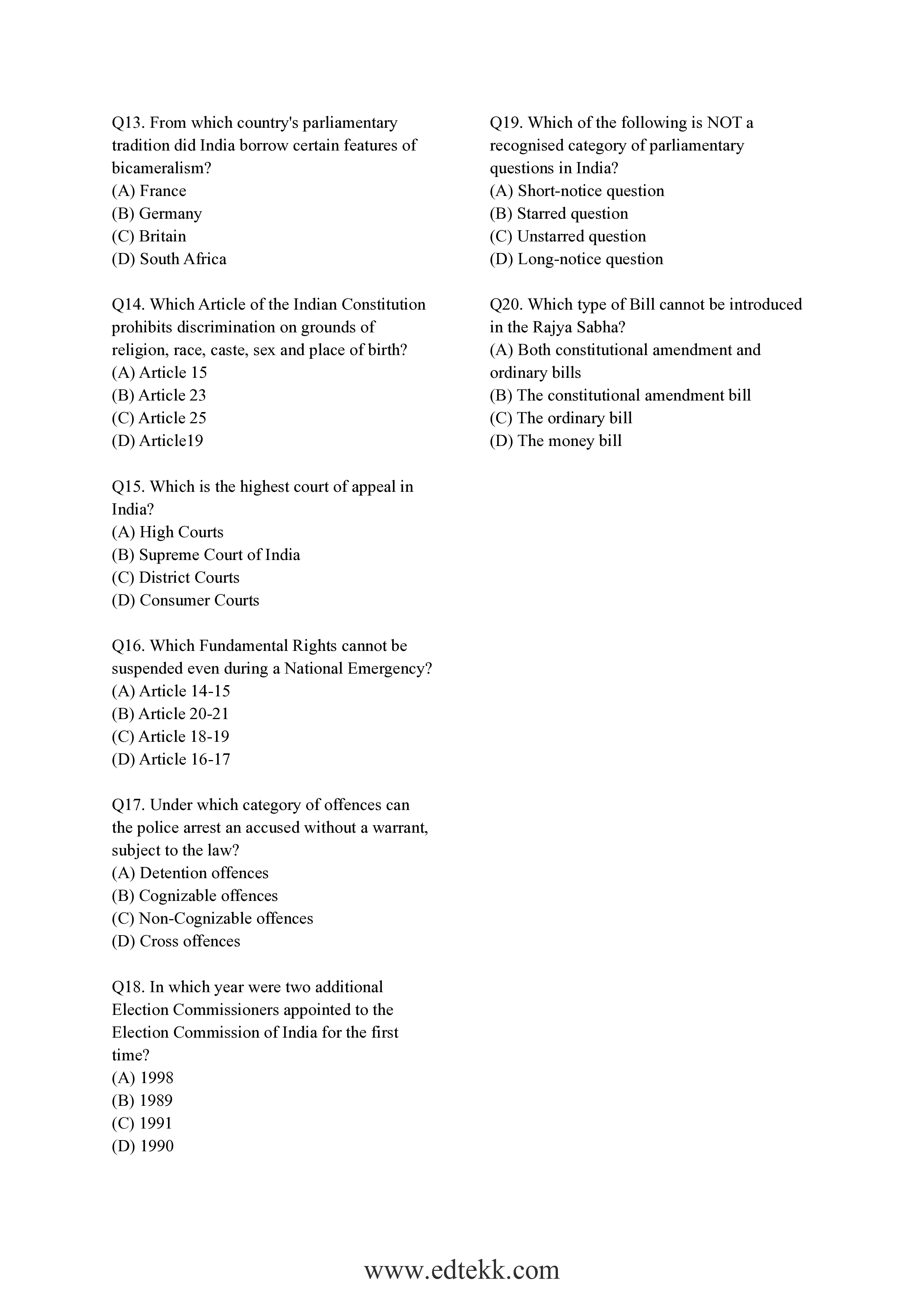
Q13. From which country’s parliamentary tradition did India borrow certain features of bicameralism?
(A) France
(B) Germany
(C) Britain
(D) South Africa
Explanation: The Indian Constitution drew upon the British parliamentary tradition for its legislative institutions, including aspects of bicameralism. The Parliament of India consists of the Lok Sabha, the House of the People, and the Rajya Sabha, the Council of States. However, bicameralism has a broader historical background and should not be attributed exclusively to Britain.
Q14. Which Article of the Indian Constitution prohibits discrimination on grounds of religion, race, caste, sex and place of birth?
(A) Article 15
(B) Article 23
(C) Article 25
(D) Article19
Explanation: Article 15 prohibits the State from discriminating against any citizen on grounds only of religion, race, caste, sex or place of birth. It also enables the State to introduce special provisions for disadvantaged groups, including women, children, socially and educationally backward classes, Scheduled Castes and Scheduled Tribes.
Q15. Which is the highest court of appeal in India?
(A) High Courts
(B) Supreme Court of India
(C) District Courts
(D) Consumer Courts
Explanation: The Supreme Court of India is the highest court of appeal in the country. It stands at the apex of the Indian judicial system, above the High Courts and subordinate courts. It also interprets the Constitution, exercises judicial review and protects fundamental rights.
Q16. Which Fundamental Rights cannot be suspended even during a National Emergency?
(A) Article 14-15
(B) Article 20-21
(C) Article 18-19
(D) Article 16-17
Explanation: Articles 20 and 21 of the Indian Constitution cannot be suspended even during a National Emergency. Article 20 provides protection in respect of conviction for offences, while Article 21 guarantees the protection of life and personal liberty. The 44th Constitutional Amendment Act, 1978, ensured that their enforcement cannot be suspended under Article 359.
Q17. Under which category of offences can the police arrest an accused without a warrant, subject to the law?
(A) Detention offences
(B) Cognizable offences
(C) Non-Cognizable offences
(D) Cross offences
Explanation: Cognizable offences are those in which the police may register a case and arrest an accused without a warrant, subject to the conditions prescribed by law. In non-cognizable offences, the police generally require a Magistrate’s order to investigate and cannot ordinarily make an arrest without a warrant.
Q18. In which year were two additional Election Commissioners appointed to the Election Commission of India for the first time?
(A) 1998
(B) 1989
(C) 1991
(D) 1990
Explanation: In 1989, two additional Election Commissioners were appointed for the first time, making the Election Commission of India a multi-member body. The arrangement was temporary; the Commission reverted to a single-member body in 1990 and became multi-member again in 1993.
Q19. Which of the following is NOT a recognised category of parliamentary questions in India?
(A) Short-notice question
(B) Starred question
(C) Unstarred question
(D) Long-notice question
Explanation: Parliamentary questions are classified into three recognised categories: starred questions, unstarred questions and short-notice questions. Starred questions require oral answers and may be followed by supplementary questions, whereas unstarred questions receive written answers. Short-notice questions concern urgent matters of public importance and are admitted with shorter notice.
Q20. Which type of Bill cannot be introduced in the Rajya Sabha?
(A) Both constitutional amendment and ordinary bills
(B) The constitutional amendment bill
(C) The ordinary bill
(D) The money bill
Explanation: A Money Bill can be introduced only in the Lok Sabha and not in the Rajya Sabha, as provided under Article 109 of the Constitution. The Rajya Sabha can make recommendations within 14 days, but the Lok Sabha may accept or reject them. Constitutional Amendment Bills and Ordinary Bills can be introduced in either House.
Question Paper Images