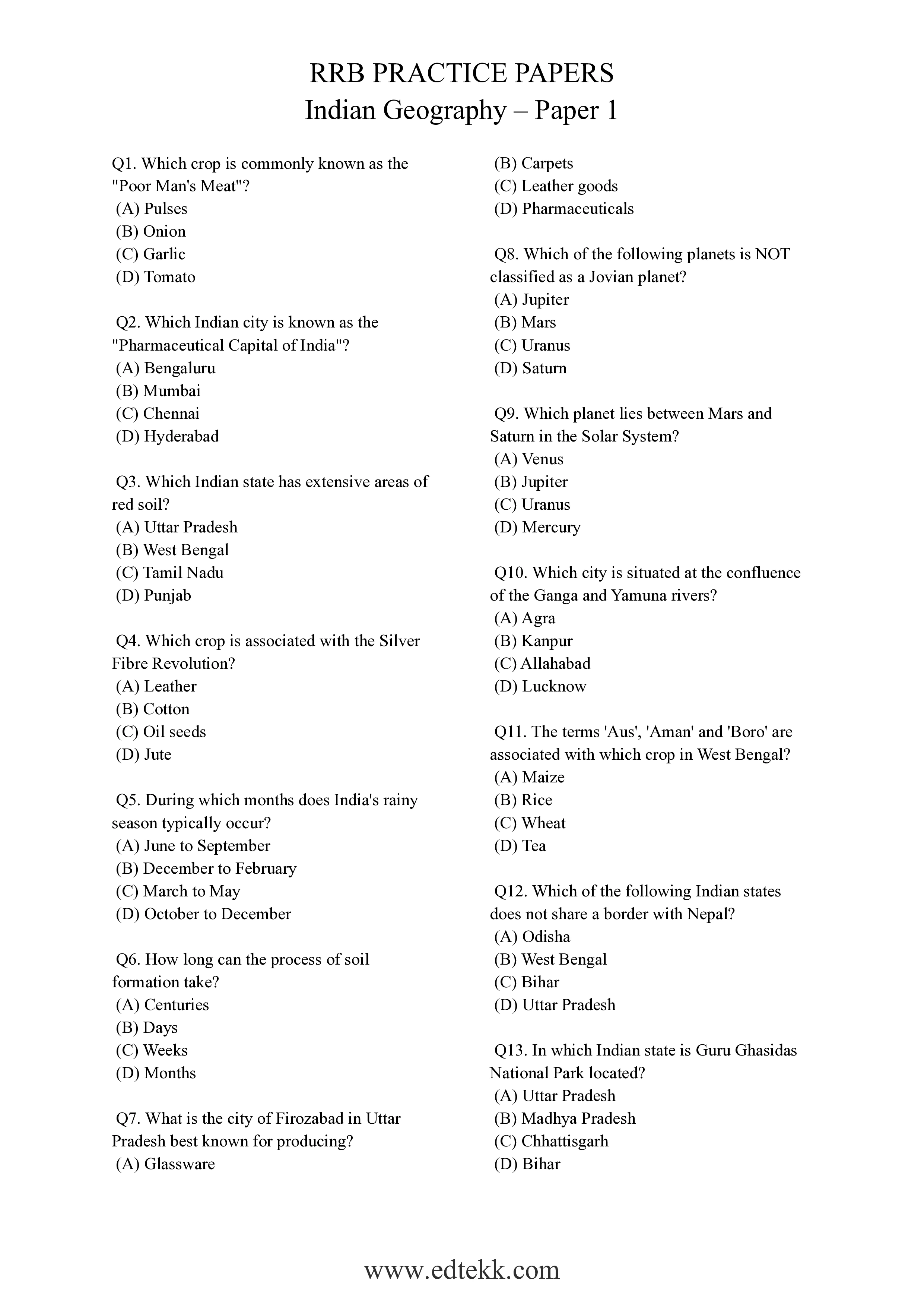
This Indian Geography practice paper contains 20 objective questions designed for RRB NTPC, Group D, ALP and Technician aspirants. It helps candidates revise key geographical concepts through exam-oriented MCQs, with answers and explanations to support understanding, accuracy and effective examination preparation.
Test Details
Topic: Geography
Total Questions: 20
Question Format: MCQs – Single Correct Answer
Suitable for: RRB NTPC, Group D, ALP, Technician
Download All Papers in This Series (PDF)
Questions and Answers
Q1. Which crop is commonly known as the “Poor Man’s Meat”?
(A) Pulses
(B) Onion
(C) Garlic
(D) Tomato
Explanation: Pulses are commonly called the poor man’s meat because they provide an affordable source of plant-based protein. They also supply dietary fibre, minerals and other nutrients. Chickpeas, lentils, pigeon peas, green gram and black gram are important pulses cultivated in India and contribute significantly to nutritional security.
Q2. Which Indian city is known as the “Pharmaceutical Capital of India”?
(A) Bengaluru
(B) Mumbai
(C) Chennai
(D) Hyderabad
Explanation: Hyderabad in Telangana is widely known as the Pharmaceutical Capital of India because of its concentration of pharmaceutical companies, research facilities and bulk drug manufacturers. It is also home to Genome Valley, a major biotechnology and life sciences cluster, making it an important pharmaceutical and research hub.
Q3. Which Indian state has extensive areas of red soil?
(A) Uttar Pradesh
(B) West Bengal
(C) Tamil Nadu
(D) Punjab
Explanation: Tamil Nadu has extensive areas of red soil, particularly in its interior regions. Red soils are also widespread across Karnataka, Andhra Pradesh, Telangana and parts of Odisha and Maharashtra. Their characteristic colour results from iron oxide compounds formed during the weathering of iron-bearing rocks.
Q4. Which crop is associated with the Silver Fibre Revolution?
(A) Leather
(B) Cotton
(C) Oil seeds
(D) Jute
Explanation: The Silver Fibre Revolution is associated with cotton production. Cotton is known as silver fibre because of its characteristic appearance and commercial importance as a textile raw material. The revolution refers to initiatives aimed at increasing cotton production and improving its productivity and quality in India.
Q5. During which months does India’s rainy season typically occur?
(A) June to September
(B) December to February
(C) March to May
(D) October to December
Explanation: The rainy season associated with the southwest monsoon generally extends from June to September in India. Moisture-laden southwesterly winds bring widespread rainfall during these months. This rainfall is essential for agriculture, groundwater replenishment and maintaining river flows.
Q6. How long can the process of soil formation take?
(A) Centuries
(B) Days
(C) Weeks
(D) Months
Explanation: Soil formation is an extremely slow natural process involving rock weathering and the accumulation and decomposition of organic matter. It is influenced by climate, parent material, organisms, relief and time. Developing a mature soil profile generally takes hundreds to thousands of years, depending on environmental conditions.
Q7. What is the city of Firozabad in Uttar Pradesh best known for producing?
(A) Glassware
(B) Carpets
(C) Leather goods
(D) Pharmaceuticals
Explanation: Firozabad in Uttar Pradesh is widely known as the Glass City of India because of its extensive glass manufacturing industry. The city is particularly famous for glass bangles, decorative glassware and other glass products. Its glass industry is an important contributor to the local economy.
Q8. Which of the following planets is NOT classified as a Jovian planet?
(A) Jupiter
(B) Mars
(C) Uranus
(D) Saturn
Explanation: Mars is not classified as a Jovian planet. The four Jovian planets are Jupiter, Saturn, Uranus and Neptune. Mars is a terrestrial planet with a rocky surface and is considerably smaller than these giant outer planets.
Q9. Which planet lies between Mars and Saturn in the Solar System?
(A) Venus
(B) Jupiter
(C) Uranus
(D) Mercury
Explanation: The correct sequence of planets from the Sun is Mercury, Venus, Earth, Mars, Jupiter, Saturn, Uranus and Neptune. Therefore, Jupiter lies between Mars and Saturn in order of increasing distance from the Sun.
Q10. Which city is situated at the confluence of the Ganga and Yamuna rivers?
(A) Agra
(B) Kanpur
(C) Allahabad
(D) Lucknow
Explanation: Prayagraj, formerly known as Allahabad, is located near the confluence of the Ganga and Yamuna rivers in Uttar Pradesh. This confluence is traditionally called the Triveni Sangam because of the religious belief that the mythical Saraswati also joins the two rivers there. The site is an important Hindu pilgrimage centre and hosts the Kumbh Mela.
Q11. The terms ‘Aus’, ‘Aman’ and ‘Boro’ are associated with which crop in West Bengal?
(A) Maize
(B) Rice
(C) Wheat
(D) Tea
Explanation: Aus, Aman and Boro are the three principal seasonal rice-growing seasons in West Bengal. Aus is generally cultivated during the pre-monsoon period, Aman during the monsoon season, and Boro during the dry winter season, usually with irrigation. These cropping seasons reflect the state’s diverse agricultural calendar.
Q12. Which of the following Indian states does not share a border with Nepal?
(A) Odisha
(B) West Bengal
(C) Bihar
(D) Uttar Pradesh
Explanation: Odisha does not share an international boundary with Nepal. Nepal shares its border with five Indian states: Uttarakhand, Uttar Pradesh, Bihar, West Bengal and Sikkim. Odisha is situated farther south and east and has no common boundary with Nepal.
Q13. In which Indian state is Guru Ghasidas National Park located?
(A) Uttar Pradesh
(B) Madhya Pradesh
(C) Chhattisgarh
(D) Bihar
Explanation: Guru Ghasidas National Park is located in northern Chhattisgarh. It protects extensive forest habitats and supports diverse wildlife characteristic of central India. The park was formerly known as Sanjay National Park when the region was part of undivided Madhya Pradesh. It was renamed following the formation of Chhattisgarh.
Q14. What is the city of Kanpur in Uttar Pradesh best known for producing?
(A) Electronics
(B) Leather goods
(C) Automobiles
(D) Pharmaceuticals
Explanation: Kanpur is a historic centre of India’s leather industry. It is known for leather tanning, footwear, saddlery and leather goods manufacturing. The industry has long contributed to the city’s industrial economy and export activities.
Q15. What is the process by which atmospheric water vapour changes into liquid water called?
(A) Condensation
(B) Decantation
(C) Precipitation
(D) Evaporation
Explanation: Condensation is the process by which water vapour changes into liquid water, generally when air cools to its dew point and becomes saturated. In the atmosphere, condensation contributes to the formation of clouds, fog and dew. Evaporation is the reverse process, in which liquid water changes into water vapour.
Q16. Which type of forest in India grows in coastal areas influenced by saline or brackish water?
(A) Evergreen Forests
(B) Mangrove Forests
(C) Deciduous Forests
(D) Coniferous Forests
Explanation: Mangrove forests grow along tropical and subtropical coastlines, particularly in intertidal regions influenced by saline or brackish water. Their trees possess specialised adaptations, including aerial roots and salt-tolerance mechanisms. In India, important mangrove regions include the Sundarbans, Mahanadi delta and Godavari delta.
Q17. What is the point on Earth’s surface directly above an earthquake’s focus called?
(A) semi centre
(B) hypocentre
(C) centrepiece
(D) epicentre
Explanation: The epicentre is the point on Earth’s surface directly above the earthquake’s focus, also called the hypocentre. The focus is the underground location where an earthquake originates and seismic energy is first released. Therefore, the epicentre is the surface point vertically above the focus, not necessarily the location of maximum damage.
Q18. What is the primary objective of the National Food Security Mission (NFSM)?
(A) Food grains
(B) Cash crops
(C) Horticultural crops
(D) Pulses
Explanation: The National Food Security Mission (NFSM) was launched in 2007–08 to increase the production of rice, wheat and pulses through improved agricultural practices, quality seeds and technological interventions. Its coverage was subsequently expanded to include additional crops, including coarse cereals and commercial crops.
Q19. In which city is the headquarters of the Western Railway zone of Indian Railways located?
(A) Delhi
(B) Kolkata
(C) Mumbai
(D) Chennai
Explanation: The headquarters of the Western Railway zone of Indian Railways is located in Mumbai, Maharashtra. The zone serves important regions, including Maharashtra, Gujarat and parts of Rajasthan and Madhya Pradesh. Its headquarters oversees railway administration, operations and infrastructure development across the zone.
Q20. Which organisation constructed the Atal Tunnel?
(A) Central Public Works Department
(B) Border Roads Organisation
(C) National Highways Authority of India
(D) Public Works Department
Explanation: The Atal Tunnel was constructed by the Border Roads Organisation (BRO), functioning under the Ministry of Defence. Located beneath the Rohtang Pass in Himachal Pradesh, it provides all-weather connectivity between the Manali region and Lahaul Valley. The strategically important tunnel was inaugurated in October 2020.
Question Paper Images