This Indian Geography practice paper concludes the practice series with 20 objective questions for RRB NTPC, Group D, ALP and Technician aspirants. Candidates can reinforce their geographical knowledge through exam-oriented MCQs and review detailed answers and explanations for effective revision and better examination preparation.
Test Details
Topic: Geography
Total Questions: 20
Question Format: MCQs – Single Correct Answer
Suitable for: RRB NTPC, Group D, ALP, Technician
Download All Papers in This Series (PDF)
Questions and Answers
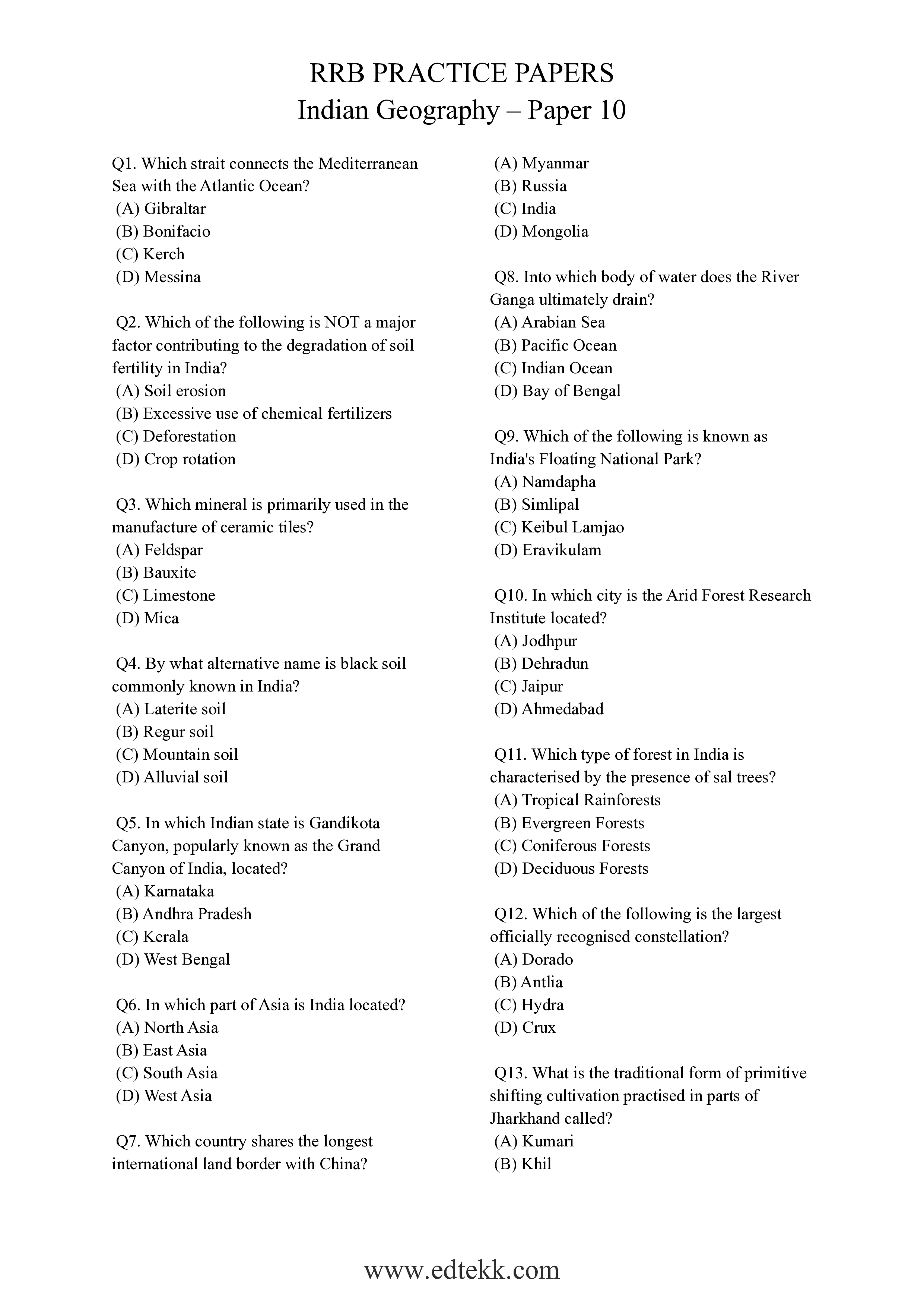
Q1. Which strait connects the Mediterranean Sea with the Atlantic Ocean?
(A) Gibraltar
(B) Bonifacio
(C) Kerch
(D) Messina
Explanation: The Strait of Gibraltar connects the Mediterranean Sea with the Atlantic Ocean. It separates southern Spain from northern Morocco and serves as an important maritime passage between the two water bodies. It is strategically significant for international shipping and the exchange of water between the Atlantic Ocean and Mediterranean Sea.
Q2. Which of the following is NOT a major factor contributing to the degradation of soil fertility in India?
(A) Soil erosion
(B) Excessive use of chemical fertilizers
(C) Deforestation
(D) Crop rotation
Explanation: Crop rotation generally helps maintain soil fertility by alternating crops with different nutrient requirements. Including legumes in a rotation improves nitrogen availability through biological nitrogen fixation. In contrast, excessive or imbalanced fertiliser use, deforestation and soil erosion contribute to soil degradation. Proper crop rotation also helps improve soil structure and manage pests and diseases.
Q3. Which mineral is primarily used in the manufacture of ceramic tiles?
(A) Feldspar
(B) Bauxite
(C) Limestone
(D) Mica
Explanation: Feldspar is an important raw material in ceramic tile manufacturing. It acts as a flux during firing, promoting vitrification and helping the ceramic body develop strength. Clay, quartz and kaolin are also commonly used in tile production.
Q4. By what alternative name is black soil commonly known in India?
(A) Laterite soil
(B) Regur soil
(C) Mountain soil
(D) Alluvial soil
Explanation: Black soil is commonly known as Regur soil or black cotton soil. It is widespread across the Deccan Plateau and is particularly suitable for cotton cultivation because of its high clay content and moisture-retention capacity. It develops mainly from the weathering of basaltic rocks.
Q5. In which Indian state is Gandikota Canyon, popularly known as the Grand Canyon of India, located?
(A) Karnataka
(B) Andhra Pradesh
(C) Kerala
(D) West Bengal
Explanation: Gandikota Canyon, popularly known as the Grand Canyon of India, is located in Andhra Pradesh’s Kadapa district. It was formed by the erosion of the Pennar River through the Erramala Hills. The spectacular gorge is famous for its steep rocky cliffs, distinctive geological formations and scenic landscape.
Q6. In which part of Asia is India located?
(A) North Asia
(B) East Asia
(C) South Asia
(D) West Asia
Explanation: India is located in South Asia and occupies a major part of the Indian subcontinent. It shares land borders with Pakistan, China, Nepal, Bhutan, Bangladesh and Myanmar. The Indian Ocean lies to its south, the Arabian Sea to its southwest and the Bay of Bengal to its southeast.
Q7. Which country shares the longest international land border with China?
(A) Myanmar
(B) Russia
(C) India
(D) Mongolia
Explanation: China shares its longest international land border with Mongolia, extending approximately 4,630 kilometres. The China-Russia border is also extensive but shorter. Mongolia is situated between China and Russia, making it an important neighbouring country in East Asian geography. Border-length figures may vary slightly depending on the measurement source.
Q8. Into which body of water does the River Ganga ultimately drain?
(A) Arabian Sea
(B) Pacific Ocean
(C) Indian Ocean
(D) Bay of Bengal
Explanation: The Ganga originates from the Gangotri Glacier system in Uttarakhand, where its headstream is known as the Bhagirathi. After meeting the Alaknanda at Devprayag, it is known as the Ganga. It flows across northern India, enters Bangladesh and ultimately drains into the Bay of Bengal through the Ganga–Brahmaputra delta.
Q9. Which of the following is known as India’s Floating National Park?
(A) Namdapha
(B) Simlipal
(C) Keibul Lamjao
(D) Eravikulam
Explanation: Keibul Lamjao National Park in Manipur is the world’s only floating national park. Located in Loktak Lake, it rests on floating masses of decomposing vegetation known as phumdis. The park is particularly important for conserving the endangered Sangai deer, also called the brow-antlered deer, which is endemic to Manipur.
Q10. In which city is the Arid Forest Research Institute located?
(A) Jodhpur
(B) Dehradun
(C) Jaipur
(D) Ahmedabad
Explanation: The Arid Forest Research Institute (AFRI) is located in Jodhpur, Rajasthan. Established in 1988, it conducts forestry research focusing on arid and semi-arid regions. Its work includes dryland ecology, desertification control, sustainable forest management and the rehabilitation of degraded lands.
Q11. Which type of forest in India is characterised by the presence of sal trees?
(A) Tropical Rainforests
(B) Evergreen Forests
(C) Coniferous Forests
(D) Deciduous Forests
Explanation: Sal (Shorea robusta) is an important deciduous tree species found in the tropical moist and dry deciduous forests of India, particularly in central and eastern regions. Major sal-growing areas include Jharkhand, Chhattisgarh, Odisha, West Bengal and Madhya Pradesh. Sal forests are economically and ecologically significant.
Q12. Which of the following is the largest officially recognised constellation?
(A) Dorado
(B) Antlia
(C) Hydra
(D) Crux
Explanation: Hydra is the largest officially recognised constellation by area. It covers approximately 1,303 square degrees of the celestial sphere and is one of the 88 constellations recognised by the International Astronomical Union.
Q13. What is the traditional form of primitive shifting cultivation practised in parts of Jharkhand called?
(A) Kumari
(B) Khil
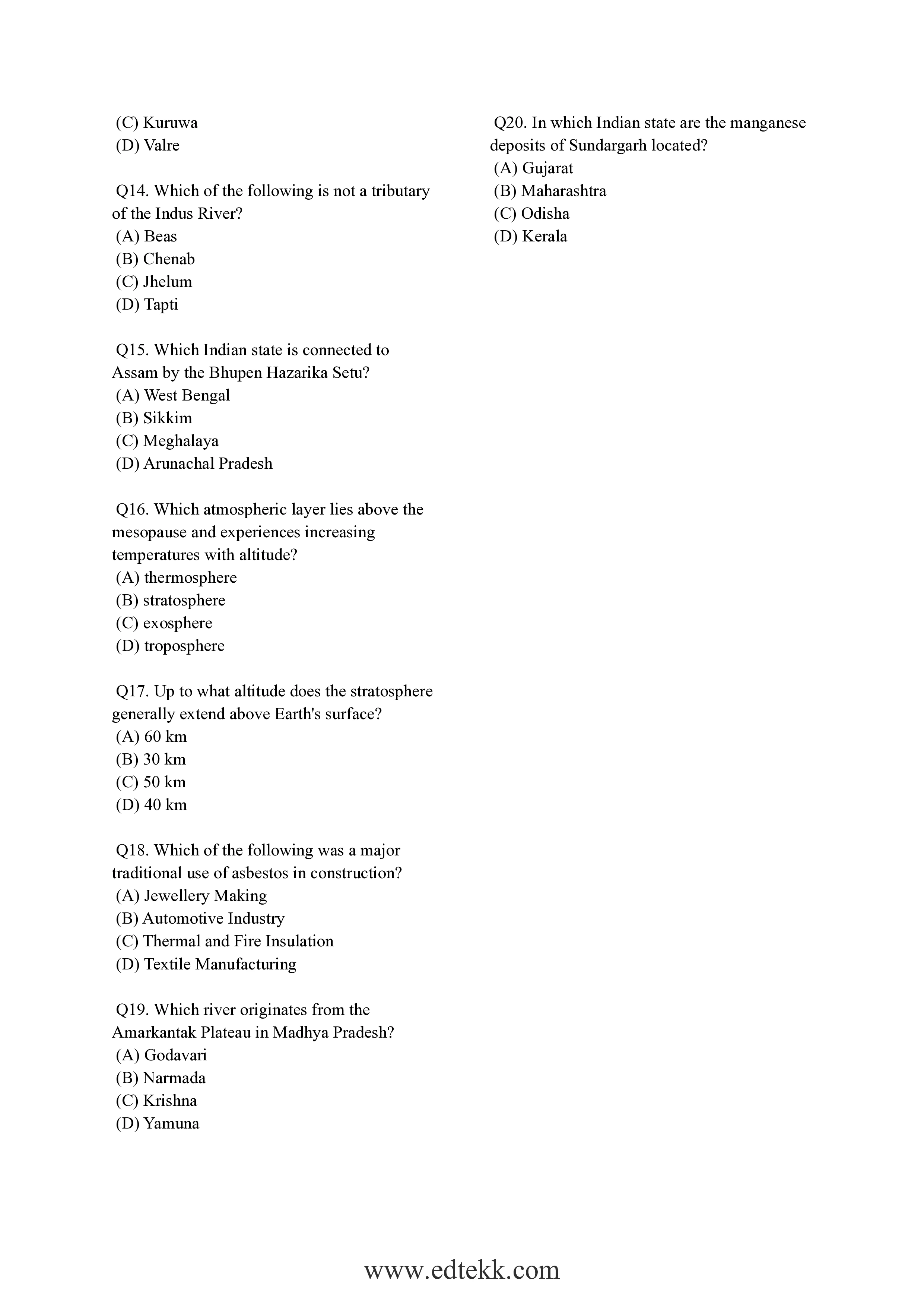
(C) Kuruwa
(D) Valre
Explanation: Kuruwa is a traditional form of shifting cultivation practised in parts of Jharkhand. It involves clearing and burning vegetation, cultivating crops for a limited period and subsequently leaving the land fallow to recover its fertility. This agricultural practice is associated with tribal communities in eastern India.
Q14. Which of the following is not a tributary of the Indus River?
(A) Beas
(B) Chenab
(C) Jhelum
(D) Tapti
Explanation: The Tapti (Tapi) River is not a tributary of the Indus River. It is an independent west-flowing peninsular river that drains into the Arabian Sea. The Chenab, Jhelum and Beas are important tributaries of the Indus river system and form part of its extensive drainage network.
Q15. Which Indian state is connected to Assam by the Bhupen Hazarika Setu?
(A) West Bengal
(B) Sikkim
(C) Meghalaya
(D) Arunachal Pradesh
Explanation: Bhupen Hazarika Setu, popularly known as the Dhola–Sadiya Bridge, connects Assam with Arunachal Pradesh across the Lohit River, a major tributary of the Brahmaputra. Located in northeastern India, this bridge improves regional connectivity and provides an important transport link for economic development and strategic mobility.
Q16. Which atmospheric layer lies above the mesopause and experiences increasing temperatures with altitude?
(A) thermosphere
(B) stratosphere
(C) exosphere
(D) troposphere
Explanation: The thermosphere lies above the mesopause and extends upward to several hundred kilometres. In this atmospheric layer, temperature generally increases with altitude because atmospheric gases absorb high-energy solar radiation, particularly ultraviolet and X-ray radiation. The mesopause marks the boundary between the mesosphere and thermosphere and is generally the coldest region of Earth’s atmosphere.
Q17. Up to what altitude does the stratosphere generally extend above Earth’s surface?
(A) 60 km
(B) 30 km
(C) 50 km
(D) 40 km
Explanation: The stratosphere extends from the tropopause to the stratopause, generally reaching an altitude of approximately 50 km above Earth’s surface. Its lower boundary varies with latitude and season. Temperature generally increases with altitude in this layer because ozone absorbs incoming ultraviolet radiation from the Sun.
Q18. Which of the following was a major traditional use of asbestos in construction?
(A) Jewellery Making
(B) Automotive Industry
(C) Thermal and Fire Insulation
(D) Textile Manufacturing
Explanation: Asbestos was traditionally used in building materials because of its excellent thermal insulation, fire resistance and durability. It was incorporated into roofing sheets, insulation boards, cement products and other construction materials. However, exposure to asbestos fibres can cause serious diseases, including lung cancer and mesothelioma, making it a significant health hazard.
Q19. Which river originates from the Amarkantak Plateau in Madhya Pradesh?
(A) Godavari
(B) Narmada
(C) Krishna
(D) Yamuna
Explanation: The Narmada River originates at Narmada Kund near Amarkantak on the Amarkantak Plateau in Madhya Pradesh. It flows westward through a rift valley between the Vindhya and Satpura ranges before draining into the Arabian Sea.
Q20. In which Indian state are the manganese deposits of Sundargarh located?
(A) Gujarat
(B) Maharashtra
(C) Odisha
(D) Kerala
Explanation: Sundargarh district in Odisha contains significant manganese deposits. Odisha is an important mineral-producing state, with deposits of iron ore, manganese, chromite, bauxite and coal. The Koida and Lahunipada areas of Sundargarh are particularly associated with iron ore and manganese mining.
Question Paper Images