Prepare for SSC examinations with General Awareness Practice Paper 1, designed for SSC CGL, CHSL, CPO, MTS, GD and Selection Post aspirants. This practice set contains 20 MCQs covering important General Awareness topics, with correct answers and detailed explanations to strengthen conceptual understanding and improve exam preparation.
Test Details
Topic: General Awareness
Total Questions: 20
Question Format: MCQs – Single Correct Answer
Suitable for: SSC CGL, CHSL, CPO, MTS, GD, Selection Post
Download All Papers in This Series (PDF)
Questions and Answers
Q1. Which of the following is the autobiography of former Indian Prime Minister I. K. Gujral?
(A) Matters of Discretion
(B) The Autobiography of an Unknown Indian
(C) Dream From My Father
(D) Filling the Gap
Explanation: Matters of Discretion: An Autobiography is the autobiography of Inder Kumar Gujral, former Prime Minister of India. Published in 2011, it recounts his personal experiences, political journey and diplomatic career. He served as India’s Prime Minister from 1997 to 1998.
Q2. Paan Singh Tomar, a seven-time national champion, was associated with which sport?
(A) Hockey
(B) Steeplechase
(C) Swimming
(D) Shot Put
Explanation: Paan Singh Tomar was an Indian athlete who specialised in the 3,000-metre steeplechase. He won the national championship in this event seven consecutive times. After retiring from athletics, he served in the Indian Army and later became widely known through the biographical film Paan Singh Tomar.
Q3. Who became the first Indian to win an individual Olympic gold medal?
(A) P. V. Sindhu
(B) Leander Paes
(C) Abhinav Bindra
(D) Karnam Malleswari
Explanation: Abhinav Bindra became the first Indian to win an individual Olympic gold medal by winning the men’s 10-metre air rifle event at the 2008 Beijing Olympics. India had previously won Olympic gold medals in field hockey, but none in an individual event.
Q4. In which year did Lata Mangeshkar receive the Bharat Ratna?
(A) 2003
(B) 2001
(C) 1997
(D) 1999
Explanation: Lata Mangeshkar received the Bharat Ratna in 2001 in recognition of her extraordinary contribution to Indian music. One of India’s most celebrated playback singers, she enjoyed a career spanning several decades and recorded songs in numerous Indian languages. The Bharat Ratna is India’s highest civilian honour.
Q5. Who coined the term “battery” to describe a group of interconnected capacitors?
(A) Lewis Urry
(B) Luigi Galvani
(C) John Frederic Daniell
(D) Benjamin Franklin
Explanation: Benjamin Franklin popularised the term battery in 1749 to describe an arrangement of interconnected Leyden jars used to store electrical charge. He borrowed the term from military usage, in which a battery referred to a group of weapons operating together. The term subsequently became established in electrical science.
Q6. Shambhu Maharaj received the Padma Shri for his contribution to which Indian classical dance form?
(A) Kathak
(B) Bharatanatyam
(C) Kuchipudi
(D) Manipuri
Explanation: Shambhu Maharaj was a renowned exponent of Kathak, one of India’s major classical dance forms. He belonged to the Lucknow gharana and was celebrated for his expressive facial movements, graceful gestures and mastery of rhythm. He received the Padma Shri in 1955 for his contribution to Indian classical dance.
Q7. Which Indian musician won two Grammy Awards in 2010 for his work on Danny Boyle’s film Slumdog Millionaire?
(A) AR Rahman
(B) Vishal Bharadwaj
(C) Bappi Lahiri
(D) Pritam Chakraborty
Explanation: A. R. Rahman won two Grammy Awards in 2010 for his work on Slumdog Millionaire. He received awards for Best Compilation Soundtrack Album for a Motion Picture, Television or Other Visual Media and Best Song Written for Motion Picture, Television or Other Visual Media for Jai Ho.
Q8. Who originally wrote the historical novel translated into English as Those Days?
(A) Sunil Gangopadhyay
(B) Bhartendu Harishchandra
(C) Nandita Das
(D) Sumitranandan Pant
Explanation: Those Days is the English translation of Sei Somoy, a Bengali historical novel by Sunil Gangopadhyay. The original won the Sahitya Akademi Award in Bengali in 1985. It depicts nineteenth-century Bengal and its major social, cultural and intellectual transformations.
Q9. Who is the author of the book The End of Imagination?
(A) Chetan Bhagat
(B) Shobha De
(C) Amitav Ghosh
(D) Arundhati Roy
Explanation: The End of Imagination was written by Arundhati Roy and originally published in 1998 as an essay. It strongly criticises India’s nuclear weapons tests conducted in May 1998. The essay questions nuclear nationalism, militarisation and the consequences of nuclear weapons for humanity and democratic society.
Q10. What is the name of India’s national space agency?
(A) NASA
(B) ESA
(C) ROSCOSMOS
(D) ISRO
Explanation: The Indian Space Research Organisation (ISRO) is India’s national space agency. Established in 1969, it conducts space research and develops satellites, launch vehicles and space-based applications. Its activities support communication, navigation, weather forecasting and Earth observation. ESA serves European countries, NASA is the United States’ space agency, and Roscosmos is Russia’s state space corporation.
Q11. Who among the following is an Indian Olympic archer and Padma Shri award recipient?
(A) Balbir Singh Dosanjh
(B) Kidambi Srikanth
(C) Bajrang Punia
(D) Limba Ram
Explanation: Limba Ram is a former Indian archer who represented India in international competitions, including the Olympic Games. He received the Padma Shri for his contribution to sport. The other options are associated with badminton, wrestling and hockey, respectively.
Q12. From which state does the famous Indian boxer Mary Kom hail?
(A) Nagaland
(B) Tamil Nadu
(C) Manipur
(D) Mizoram
Explanation: Mary Kom, the renowned Indian boxer and six-time world champion in amateur boxing, hails from Manipur. She was born in Kangathei village in the state. At the 2012 London Olympics, she won a bronze medal in women’s flyweight boxing, becoming the first Indian woman boxer to win an Olympic medal.
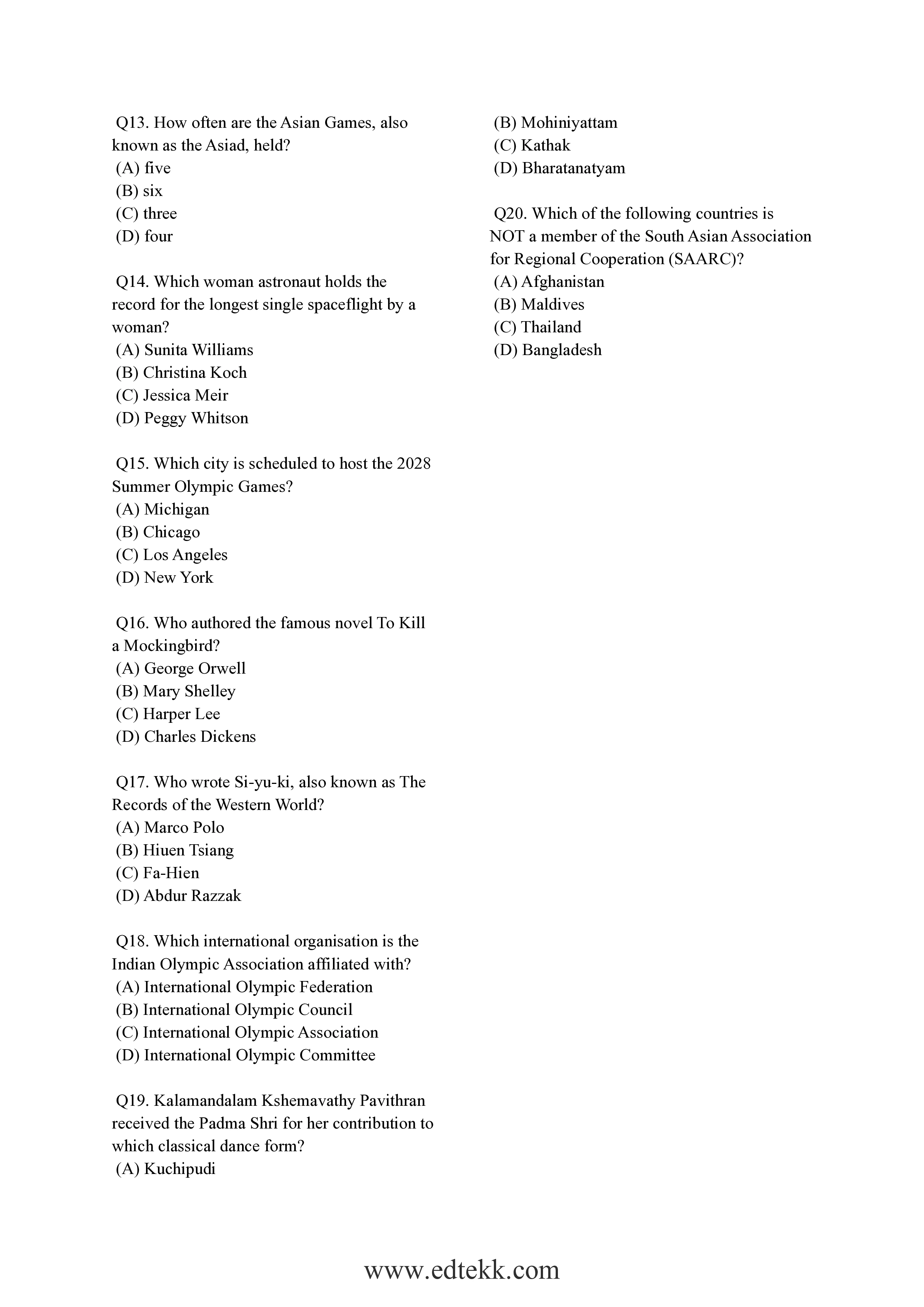
Q13. How often are the Asian Games, also known as the Asiad, held?
(A) five
(B) six
(C) three
(D) four
Explanation: The Asian Games, popularly known as the Asiad, are held once every four years. It is a major continental multi-sport event organised under the authority of the Olympic Council of Asia (OCA), featuring athletes representing Asian countries and territories.
Q14. Which woman astronaut holds the record for the longest single spaceflight by a woman?
(A) Sunita Williams
(B) Christina Koch
(C) Jessica Meir
(D) Peggy Whitson
Explanation: Christina Koch, an American NASA astronaut, completed a continuous spaceflight lasting 328 days, from March 2019 to February 2020. This established the record for the longest single spaceflight by a woman. She also participated in the first all-female spacewalk alongside Jessica Meir.
Q15. Which city is scheduled to host the 2028 Summer Olympic Games?
(A) Michigan
(B) Chicago
(C) Los Angeles
(D) New York
Explanation: Los Angeles, California, USA, is hosting the 2028 Summer Olympic Games, officially designated the Games of the XXXIV Olympiad. It will be the third time Los Angeles has hosted the Summer Olympics, following the 1932 and 1984 editions.
Q16. Who authored the famous novel To Kill a Mockingbird?
(A) George Orwell
(B) Mary Shelley
(C) Harper Lee
(D) Charles Dickens
Explanation: To Kill a Mockingbird was authored by Harper Lee and published in 1960. Set in the American South during the 1930s, the novel explores racial injustice, prejudice, morality and compassion through the experiences of Scout Finch and her father, Atticus Finch.
Q17. Who wrote Si-yu-ki, also known as The Records of the Western World?
(A) Marco Polo
(B) Hiuen Tsiang
(C) Fa-Hien
(D) Abdur Razzak
Explanation: Si-yu-ki, commonly known as the Records of the Western Regions, is associated with the Chinese Buddhist monk and traveller Xuanzang (Hiuen Tsang/Hiuen Tsiang). It records his seventh-century journey through Central Asia and India and provides valuable information on contemporary Indian society and Buddhism.
Q18. Which international organisation is the Indian Olympic Association affiliated with?
(A) International Olympic Federation
(B) International Olympic Council
(C) International Olympic Association
(D) International Olympic Committee
Explanation: The Indian Olympic Association (IOA) is India’s National Olympic Committee and is affiliated with the International Olympic Committee (IOC). The IOA coordinates India’s participation in the Olympic Games and other international multi-sport events and promotes the Olympic Movement in India.
Q19. Kalamandalam Kshemavathy Pavithran received the Padma Shri for her contribution to which classical dance form?
(A) Kuchipudi
(B) Mohiniyattam
(C) Kathak
(D) Bharatanatyam
Explanation: Kalamandalam Kshemavathy Pavithran is a renowned Mohiniyattam exponent and choreographer from Kerala. She received the Padma Shri in recognition of her contribution to Indian classical dance. Mohiniyattam originated in Kerala and is characterised by graceful movements, gentle swaying and expressive storytelling.
Q20. Which of the following countries is NOT a member of the South Asian Association for Regional Cooperation (SAARC)?
(A) Afghanistan
(B) Maldives
(C) Thailand
(D) Bangladesh
Explanation: Thailand is not a member of the South Asian Association for Regional Cooperation (SAARC). SAARC has eight member countries: Afghanistan, Bangladesh, Bhutan, India, Maldives, Nepal, Pakistan and Sri Lanka. Thailand belongs to Southeast Asia and is a member of the Association of Southeast Asian Nations (ASEAN).
Question Paper Images