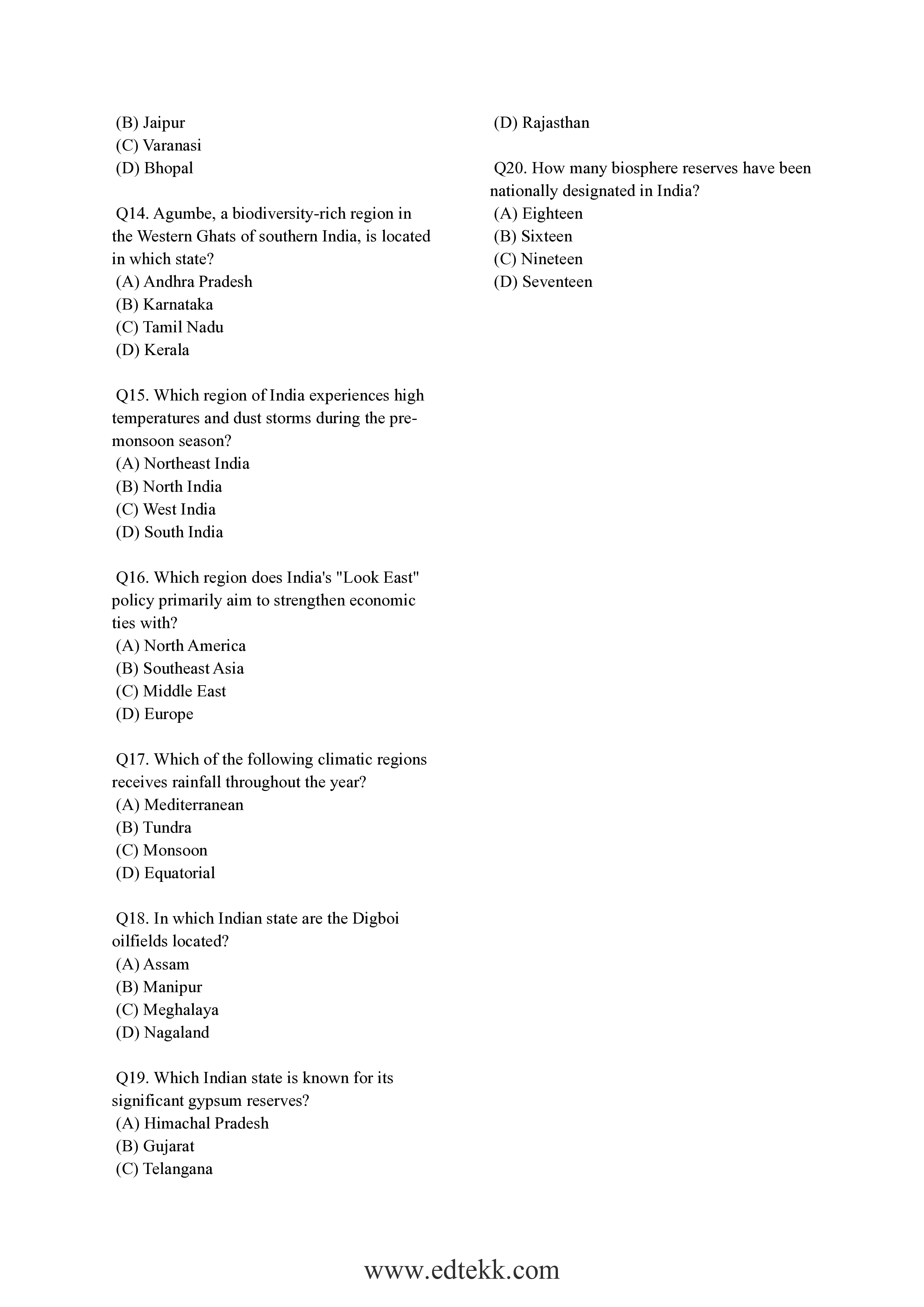
Build confidence in Indian Geography with Practice Paper 8, designed for candidates preparing for SSC CGL, CHSL, CPO, MTS, GD and Selection Post examinations. The set provides 20 objective-type questions for focused practice and revision, supported by correct answers and detailed explanations to improve conceptual clarity and exam performance.
Test Details
Topic: Geography
Total Questions: 20
Question Format: MCQs – Single Correct Answer
Suitable for: SSC CGL, CHSL, CPO, MTS, GD, Selection Post
Download All Papers in This Series (PDF)
Questions and Answers
Q1. Which type of grassland ecosystem is found in the Himalayan region of India?
(A) Downs
(B) Steppes
(C) Alpine Meadows
(D) Savannahs
Explanation: Alpine meadows are high-altitude grassland ecosystems found above the tree line in the Himalayan region. They support grasses, herbs and seasonal flowering plants adapted to cold temperatures and short growing seasons. These ecosystems are also known as alpine pastures and provide important seasonal grazing grounds.
Q2. Which industry is traditionally regarded as India’s second major metallurgical industry after iron and steel?
(A) Aluminium
(B) Iron
(C) Copper
(D) Zinc
Explanation: Aluminium is traditionally regarded as the second major metallurgical industry in India after the iron and steel industry. It is an important non-ferrous metal used in transportation, construction, electrical equipment, packaging and manufacturing. Aluminium production involves extracting alumina from bauxite and subsequently obtaining aluminium through electrolytic reduction.
Q3. Which river system is most closely associated with the Harappan Civilization?
(A) Ganga
(B) Brahmaputra
(C) Indus
(D) Yamuna
Explanation: The Harappan Civilization, also known as the Indus Valley Civilization, developed primarily in the Indus River system and its surrounding regions. Major settlements were established along the Indus and its tributaries, extending across present-day Pakistan and northwestern India. River systems supported agriculture, trade and urban development.
Q4. Which organisation was India’s first Internet Service Provider (ISP)?
(A) BSNL
(B) VSNL
(C) Airtel
(D) Reliance
Explanation: Videsh Sanchar Nigam Limited (VSNL), now known as Tata Communications, became India’s first Internet service provider when commercial Internet services were launched on 15 August 1995.
Q5. Which Indian state is referred to as the “Jute Bowl of India”?
(A) West Bengal
(B) Uttar Pradesh
(C) Bihar
(D) Assam
Explanation: West Bengal is widely associated with India’s jute industry because of its extensive jute cultivation and concentration of processing mills. The fertile alluvial soils and humid climate of the Ganga delta favour jute cultivation, while the Hooghly industrial region has historically been a major centre of jute manufacturing.
Q6. Which of the following stars is closest to the Sun?
(A) Deneb
(B) Proxima Centauri
(C) Betelgeuse
(D) Sirius
Explanation: Proxima Centauri is the nearest known star to the Sun, located approximately 4.24 light-years away. It is a red dwarf and belongs to the Alpha Centauri star system. Sirius, Deneb and Betelgeuse are considerably farther away.
Q7. In which Indian state is the Nellore mica belt located?
(A) Rajasthan
(B) Bihar
(C) Tamil Nadu
(D) Andhra Pradesh
Explanation: The Nellore mica belt is located in Andhra Pradesh, particularly in the Nellore region. Mica is valued for its electrical insulating properties, heat resistance and use in electrical and electronic applications.
Q8. The Hirakud Dam is constructed across which river?
(A) Mahanadi
(B) Damodar
(C) Tapti
(D) Sutlej
Explanation: The Hirakud Dam is constructed across the Mahanadi River near Sambalpur in Odisha. It is a major multipurpose project providing flood control, irrigation and hydroelectric power, and plays an important role in managing the water resources of the Mahanadi basin.
Q9. Which of the following represents a temperate marine climate with substantial rainfall throughout the year?
(A) Cfb
(B) Am
(C) BSh
(D) BSk
Explanation: The Cfb climate represents a temperate oceanic or marine west coast climate. It is characterised by mild summers, relatively mild winters and precipitation throughout the year. Rainfall is generally well distributed across all seasons, without a pronounced dry season. This climate occurs in parts of Western Europe, New Zealand and coastal regions of other continents.
Q10. What is the official legislative capital of Sri Lanka?
(A) Colombo
(B) Sri Jayawardenepura Kotte
(C) Ceylon
(D) Kandy
Explanation: Sri Jayawardenepura Kotte is the official legislative capital of Sri Lanka and the location of its Parliament. Colombo remains the country’s principal commercial centre and an important administrative and economic hub. The two cities perform distinct governmental and economic functions.
Q11. What type of production is associated with the White Revolution in India?
(A) Wheat
(B) Milk
(C) Cotton
(D) Sugarcane
Explanation: The White Revolution in India is associated with increased milk production and the development of the dairy sector. Led by Dr Verghese Kurien, it transformed India’s dairy industry through Operation Flood and the expansion of dairy cooperatives, making India one of the world’s largest milk producers.
Q12. The Almatti Dam project on the Krishna River has been a subject of dispute between which two states?
(A) Karnataka and Goa
(B) Karnataka and Andhra Pradesh
(C) Karnataka and Tamil Nadu
(D) Andhra Pradesh and Tamil nadu
Explanation: The Almatti Dam is constructed across the Krishna River in Karnataka. Its height and reservoir storage capacity have been associated with water-sharing disputes between Karnataka and the erstwhile state of Andhra Pradesh. The disagreement concerned the allocation and utilisation of Krishna River waters and the impact of upstream storage on downstream water availability.
Q13. Which Indian city is particularly well known for its leather industry?
(A) Kanpur
(B) Jaipur
(C) Varanasi
(D) Bhopal
Explanation: Kanpur in Uttar Pradesh is one of India’s major leather industry centres. The city has numerous leather tanneries and manufacturing units producing footwear, leather goods and finished leather. Its leather industry contributes significantly to employment and exports.
Q14. Agumbe, a biodiversity-rich region in the Western Ghats of southern India, is located in which state?
(A) Andhra Pradesh
(B) Karnataka
(C) Tamil Nadu
(D) Kerala
Explanation: Agumbe is a village in Shivamogga district of Karnataka, situated in the Western Ghats. It is renowned for heavy rainfall, rich biodiversity and tropical rainforest ecosystems. Often called the Cherrapunji of South India, Agumbe is also known for king cobra research and conservation.
Q15. Which region of India experiences high temperatures and dust storms during the pre-monsoon season?
(A) Northeast India
(B) North India
(C) West India
(D) South India
Explanation: North India, particularly the northwestern plains, experiences high temperatures, hot, dry winds and dust storms during the pre-monsoon season, especially in May. These conditions are common in Rajasthan, Punjab, Haryana, Uttar Pradesh and Delhi. The southwest monsoon generally begins reaching different parts of India from June onwards.
Q16. Which region does India’s “Look East” policy primarily aim to strengthen economic ties with?
(A) North America
(B) Southeast Asia
(C) Middle East
(D) Europe
Explanation: India’s Look East Policy, initiated in 1991, aimed to strengthen economic, political and strategic relations with Southeast Asian countries. In 2014, it evolved into the Act East Policy, broadening India’s engagement with Southeast Asia and the wider Indo-Pacific region.
Q17. Which of the following climatic regions receives rainfall throughout the year?
(A) Mediterranean
(B) Tundra
(C) Monsoon
(D) Equatorial
Explanation: Equatorial regions generally receive rainfall throughout the year because of intense solar heating, high humidity and persistent convection. Warm, moist air rises near the Intertropical Convergence Zone, cools and condenses, producing frequent rainfall. In contrast, tundra regions are very cold, while Mediterranean and monsoon climates have more distinct seasonal rainfall patterns.
Q18. In which Indian state are the Digboi oilfields located?
(A) Assam
(B) Manipur
(C) Meghalaya
(D) Nagaland
Explanation: Digboi Oil Fields are located in the Tinsukia district of Assam. Digboi is one of India’s oldest oil-producing centres, where commercial oil production began in 1889. The Digboi refinery, commissioned in 1901, is among the oldest operating oil refineries in the world.
Q19. Which Indian state is known for its significant gypsum reserves?
(A) Himachal Pradesh
(B) Gujarat
(C) Telangana
(D) Rajasthan
Explanation: Rajasthan has India’s largest gypsum resources and is a leading producer of gypsum. Important deposits occur in Bikaner, Jaisalmer, Barmer and Nagaur districts. Gypsum is widely used in cement manufacturing, plaster production and agriculture.
Q20. How many biosphere reserves have been nationally designated in India?
(A) Eighteen
(B) Sixteen
(C) Nineteen
(D) Seventeen
Explanation: India has 18 nationally notified biosphere reserves to conserve biodiversity, ecosystems and genetic resources while promoting sustainable development. These reserves represent diverse ecological regions, including forests, mountains, coastal ecosystems and islands. Of these, 13 are included in UNESCO’s World Network of Biosphere Reserves, according to 2025 government information.
Question Paper Images