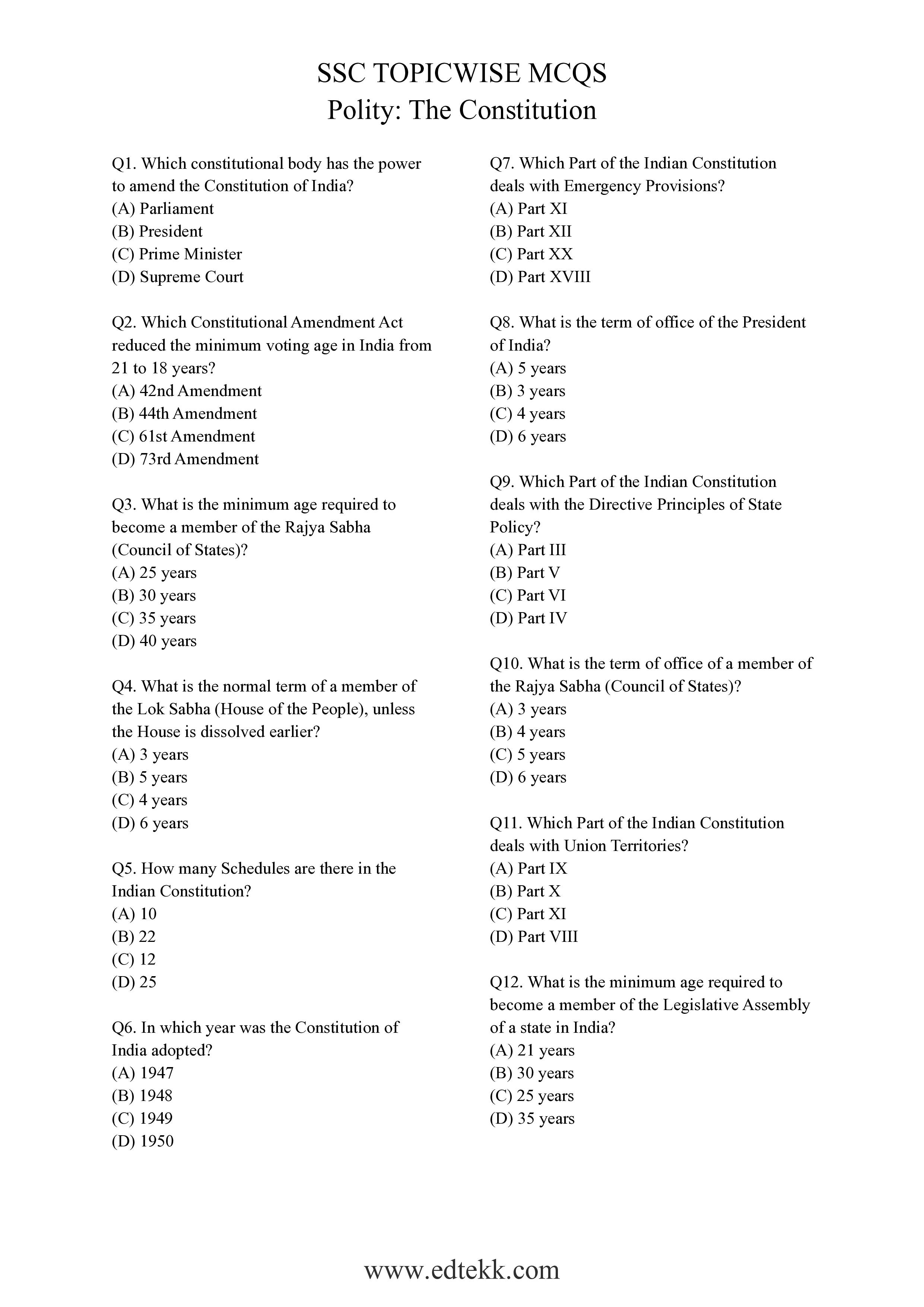
This question set covers the Indian Constitution topic with important MCQs on features, making, sources, amendments and constitutional framework. It helps SSC CGL, CHSL, CPO, MTS, GD and Selection Post aspirants revise key concepts through exam-oriented questions, answers and explanations for better preparation.
Test Details
Topic: Polity: The Constitution
Total Questions: 20
Question Format: MCQs – Single Correct Answer
Suitable for: SSC CGL, CHSL, CPO, MTS, GD, Selection Post
Download All Papers in This Series (PDF)
Questions and Answers
Q1. Which constitutional body has the power to amend the Constitution of India?
(A) Parliament
(B) President
(C) Prime Minister
(D) Supreme Court
Explanation: Parliament has the power to amend the Indian Constitution under Article 368. Most constitutional amendments require a special majority in both Houses of Parliament, while amendments affecting specified federal provisions also require ratification by at least half of the State Legislatures. The President is constitutionally required to give assent to a duly passed Constitution Amendment Bill.
Q2. Which Constitutional Amendment Act reduced the minimum voting age in India from 21 to 18 years?
(A) 42nd Amendment
(B) 44th Amendment
(C) 61st Amendment
(D) 73rd Amendment
Explanation: The 61st Constitutional Amendment Act, 1988, reduced the minimum voting age from 21 to 18 years for elections to the Lok Sabha and State Legislative Assemblies. It amended Article 326 of the Constitution, thereby expanding democratic participation by allowing younger citizens to exercise their voting rights.
Q3. What is the minimum age required to become a member of the Rajya Sabha (Council of States)?
(A) 25 years
(B) 30 years
(C) 35 years
(D) 40 years
Explanation: A person must be at least 30 years old to become a member of the Rajya Sabha under Article 84(b) of the Indian Constitution. This minimum age is higher than the 25-year requirement for membership of the Lok Sabha. Candidates must also satisfy the applicable citizenship and other statutory qualifications.
Q4. What is the normal term of a member of the Lok Sabha (House of the People), unless the House is dissolved earlier?
(A) 3 years
(B) 5 years
(C) 4 years
(D) 6 years
Explanation: The normal tenure of the Lok Sabha is five years from the date appointed for its first meeting, unless dissolved earlier. During a National Emergency, Parliament may extend its term by one year at a time, but such an extension cannot continue beyond six months after the Emergency ceases to operate.
Q5. How many Schedules are there in the Indian Constitution?
(A) 10
(B) 22
(C) 12
(D) 25
Explanation: The Indian Constitution originally contained eight Schedules. Following subsequent constitutional amendments, their number increased to 12. The Schedules deal with various subjects, including the allocation of Rajya Sabha seats, administration of tribal areas, official languages, anti-defection provisions and distribution of legislative powers.
Q6. In which year was the Constitution of India adopted?
(A) 1947
(B) 1948
(C) 1949
(D) 1950
Explanation: The Indian Constitution was adopted by the Constituent Assembly on 26 November 1949. It came into force on 26 January 1950, which is celebrated as Republic Day. The distinction between adoption and commencement is important for understanding the constitutional timeline.
Q7. Which Part of the Indian Constitution deals with Emergency Provisions?
(A) Part XI
(B) Part XII
(C) Part XX
(D) Part XVIII
Explanation: Part XVIII (Articles 352–360) of the Indian Constitution deals with Emergency Provisions. It covers National Emergency, President’s Rule in a state due to the failure of constitutional machinery, and Financial Emergency. These provisions are subject to constitutionally prescribed conditions and procedures.
Q8. What is the term of office of the President of India?
(A) 5 years
(B) 3 years
(C) 4 years
(D) 6 years
Explanation: The President of India holds office for a term of five years from the date of assuming office. The President may resign, be removed through impeachment for violation of the Constitution, or continue in office until the successor assumes office. The Constitution permits re-election without prescribing a maximum number of terms.
Q9. Which Part of the Indian Constitution deals with the Directive Principles of State Policy?
(A) Part III
(B) Part V
(C) Part VI
(D) Part IV
Explanation: Part IV (Articles 36–51) of the Indian Constitution deals with the Directive Principles of State Policy (DPSP). These principles guide the State in establishing social and economic justice and promoting public welfare. They are not directly enforceable by courts under Article 37 but are fundamental to the governance of the country.
Q10. What is the term of office of a member of the Rajya Sabha (Council of States)?
(A) 3 years
(B) 4 years
(C) 5 years
(D) 6 years
Explanation: A member of the Rajya Sabha serves a six-year term. Under Article 83(1), the Rajya Sabha is a permanent House and is not subject to dissolution. Approximately one-third of its members retire every two years, ensuring continuity in parliamentary functioning.
Q11. Which Part of the Indian Constitution deals with Union Territories?
(A) Part IX
(B) Part X
(C) Part XI
(D) Part VIII
Explanation: Part VIII of the Indian Constitution (Articles 239–242) deals with Union Territories. It provides for their administration by the President through appointed administrators and includes special constitutional arrangements for certain Union Territories having legislatures.
Q12. What is the minimum age required to become a member of the Legislative Assembly of a state in India?
(A) 21 years
(B) 30 years
(C) 25 years
(D) 35 years
Explanation: A person must be at least 25 years old to become a member of the Legislative Assembly of a State under Article 173(b) of the Constitution. The candidate must also be an Indian citizen and fulfil the prescribed electoral and other statutory qualifications under the Representation of the People Act, 1951.
Q13. Which Articles of the Indian Constitution deal with the Right against Exploitation?
(A) Article 25 to 28
(B) Article 29 to 30
(C) Article 31 to 32
(D) Article 23 to 24
Explanation: Articles 23 and 24 of the Indian Constitution deal with the Right against Exploitation. Article 23 prohibits human trafficking, begar and other forms of forced labour. Article 24 prohibits the employment of children below 14 years of age in factories, mines and other hazardous employment, thereby protecting human dignity and preventing exploitation.
Q14. Who presides over a joint sitting of both Houses of Parliament in India?
(A) President
(B) Speaker of Lok Sabha
(C) Prime Minister
(D) Vice President
Explanation: The Speaker of the Lok Sabha presides over a joint sitting of both Houses of Parliament under Article 118(4) of the Constitution. In the Speaker’s absence, the Deputy Speaker presides, followed by the Deputy Chairman of the Rajya Sabha. If all three are absent, another member may preside as determined by the rules of procedure.
Q15. Which Part of the Indian Constitution deals with citizenship?
(A) Part III
(B) Part IV
(C) Part IIIA
(D) Part II
Explanation: Part II (Articles 5–11) of the Indian Constitution deals with citizenship. It establishes provisions concerning citizenship at the commencement of the Constitution. Article 11 empowers Parliament to regulate citizenship through legislation. The Citizenship Act, 1955, was enacted under this constitutional authority.
Q16. Which Article of the Indian Constitution guarantees the Right to Freedom of Speech and Expression?
(A) Article 14 to 18
(B) Article 19
(C) Article 21 to 22
(D) Article 25 to 28
Explanation: Article 19(1)(a) of the Indian Constitution guarantees citizens the fundamental right to freedom of speech and expression. This includes expressing opinions through speech, writing, publications and other forms of communication. However, under Article 19(2), the State may impose reasonable restrictions on specified grounds, including public order, security of the State and defamation.
Q17. How many Fundamental Duties are currently enshrined in the Indian Constitution?
(A) 10
(B) 11
(C) 12
(D) 15
Explanation: The Indian Constitution contains 11 Fundamental Duties under Article 51A in Part IVA. Initially, ten duties were introduced through the 42nd Constitutional Amendment Act, 1976. The 86th Constitutional Amendment Act, 2002, added the eleventh duty concerning educational opportunities for children aged six to fourteen years.
Q18. How many types of writs can the Supreme Court issue for the enforcement of Fundamental Rights?
(A) 3
(B) 4
(C) 5
(D) 6
Explanation: The Supreme Court can issue five types of writs under Article 32 to enforce Fundamental Rights: Habeas Corpus, Mandamus, Prohibition, Certiorari and Quo Warranto. These writs protect individuals against unlawful detention, improper exercise of jurisdiction and other violations of legal or constitutional rights.
Q19. Which Part of the Indian Constitution deals with the Directive Principles of State Policy?
(A) Part III
(B) Part V
(C) Part IV
(D) Part VI
Explanation: Part IV (Articles 36–51) of the Indian Constitution deals with the Directive Principles of State Policy. These principles guide the State in promoting social and economic justice and public welfare. Although they are not directly enforceable by courts, Article 37 declares them fundamental to the governance of the country.
Q20. How many types of emergencies are provided for under the Indian Constitution?
(A) 2
(B) 4
(C) 5
(D) 3
Explanation: The Indian Constitution provides for three types of emergencies: National Emergency under Article 352, President’s Rule (State Emergency) under Article 356, and Financial Emergency under Article 360. These provisions address threats to national security, failure of constitutional machinery in a State, and threats to India’s financial stability or credit, respectively.
Question Paper Images