This comprehensive question set covers Indian Polity and Constitution topics including constitutional features, rights, institutions, governance and important provisions. Designed for SSC CGL, CHSL, CPO, MTS, GD and Selection Post exams, it provides topicwise MCQs with answers and explanations for complete exam preparation.
Test Details
Topic: Indian Polity and Constitution
Total Questions: 20
Question Format: MCQs – Single Correct Answer
Suitable for: SSC CGL, CHSL, CPO, MTS, GD, Selection Post
Download All Papers in This Series (PDF)
Questions and Answers
Q1. Which Article of the Indian Constitution prohibits discrimination on grounds of religion, race, caste, sex and place of birth?
(A) Article 23
(B) Article 25
(C) Article19
(D) Article 15
Explanation: Article 15 prohibits the State from discriminating against any citizen on grounds only of religion, race, caste, sex or place of birth. It also enables the State to introduce special provisions for disadvantaged groups, including women, children, socially and educationally backward classes, Scheduled Castes and Scheduled Tribes.
Q2. Who appoints the Advocate General of a State?
(A) President of India
(B) Chief Justice of the high court
(C) Governor of the state
(D) Chief Minister of the state
Explanation: The Governor of a State appoints the Advocate General under Article 165. The Advocate General is the State’s highest law officer and must possess the qualifications required for appointment as a High Court judge.
Q3. Under which constitutional category do the duties to safeguard public property and abjure violence fall?
(A) social ethic
(B) fundamental duty
(C) fundamental right
(D) directive principle of state policy
Explanation: Safeguarding public property and abjuring violence are Fundamental Duties under Article 51A(i) of the Indian Constitution. Citizens are expected to protect public resources, avoid destructive activities and contribute to maintaining peace and public order.
Q4. Which Part of the Indian Constitution deals with the administration of Union Territories?
(A) Part-VII
(B) Part – IX
(C) Part – IXB
(D) Part-VIII
Explanation: Part VIII of the Indian Constitution deals with Union Territories, covering their administration under Articles 239–242, although Article 242 has been repealed. Part VII, which formerly dealt with Part B states, was repealed by the Seventh Constitutional Amendment Act, 1956. Parts IX and IX-B concern Panchayats and cooperative societies, respectively.
Q5. Which Schedule of the Indian Constitution lists the States and Union Territories of India?
(A) Second Schedule
(B) Third Schedule
(C) First Schedule
(D) Fourth Schedule
Explanation: The First Schedule of the Indian Constitution contains the names of the States and Union Territories of India and specifies their respective territorial jurisdictions. It is amended whenever changes occur in the organisation of states or Union Territories. It is an important reference for understanding India’s territorial and administrative structure.
Q6. In which year did the Rajya Sabha hold its first sitting?
(A) 1947
(B) 1950
(C) 1954
(D) 1952
Explanation: The Rajya Sabha held its first sitting on 13 May 1952. It was first constituted on 3 April 1952 and is the Upper House of India’s Parliament. It is a permanent body that cannot be dissolved, with approximately one-third of its members retiring every two years.
Q7. Under which Article of the Indian Constitution is the District Planning Committee provided for?
(A) Article 243ZD
(B) Article 244ZD
(C) Article 242ZD
(D) Article 243ZE
Explanation: Article 243ZD of the Indian Constitution provides for the constitution of a District Planning Committee in every state at the district level. It consolidates plans prepared by Panchayats and Municipalities within the district and prepares a draft development plan for the district as a whole.
Q8. Who served as the Speaker of the 17th Lok Sabha?
(A) Om Birla
(B) Meira Kumar
(C) Somnath Chatterjee
(D) Sumitra Mahajan
Explanation: Om Birla was the Speaker of the 17th Lok Sabha. He was elected on 19 June 2019 and served until the conclusion of the 17th Lok Sabha in 2024. He was subsequently re-elected as Speaker of the 18th Lok Sabha in June 2024.
Q9. How many Articles were included in the original Constitution of India?
(A) 376
(B) 386
(C) 395
(D) 440
Explanation: The original Constitution of India contained 395 Articles, arranged into 22 Parts and 8 Schedules. Subsequent constitutional amendments have introduced new provisions, modified existing ones and repealed others. Therefore, 395 is the correct figure for the original Constitution, not a description of its current structure.
Q10. In which year was the Citizenship Act enacted in India?
(A) 1964
(B) 1959
(C) 1955
(D) 1951
Explanation: The Citizenship Act was enacted in 1955 to regulate the acquisition and determination of Indian citizenship. It provides five methods of acquiring citizenship: birth, descent, registration, naturalisation and incorporation of territory. The Act has subsequently undergone several amendments.
Q11. Who appoints the Advocate General of a State in India?
(A) Prime Minister of India
(B) President of India
(C) Governor of the State
(D) Chief Minister of the State
Explanation: The Governor of a State appoints the Advocate General under Article 165. The Advocate General is the highest law officer of the State and must possess the qualifications required for appointment as a High Court judge.
Q12. In which year was Article 21A, establishing the Right to Education as a Fundamental Right, inserted into the Indian Constitution?
(A) 2002
(B) 1997
(C) 1986
(D) 2004
Explanation: Article 21A was inserted into the Indian Constitution through the 86th Constitutional Amendment Act, 2002. It guarantees free and compulsory education to children between six and fourteen years of age. The provision came into effect on 1 April 2010, along with the implementation of the Right of Children to Free and Compulsory Education Act, 2009.
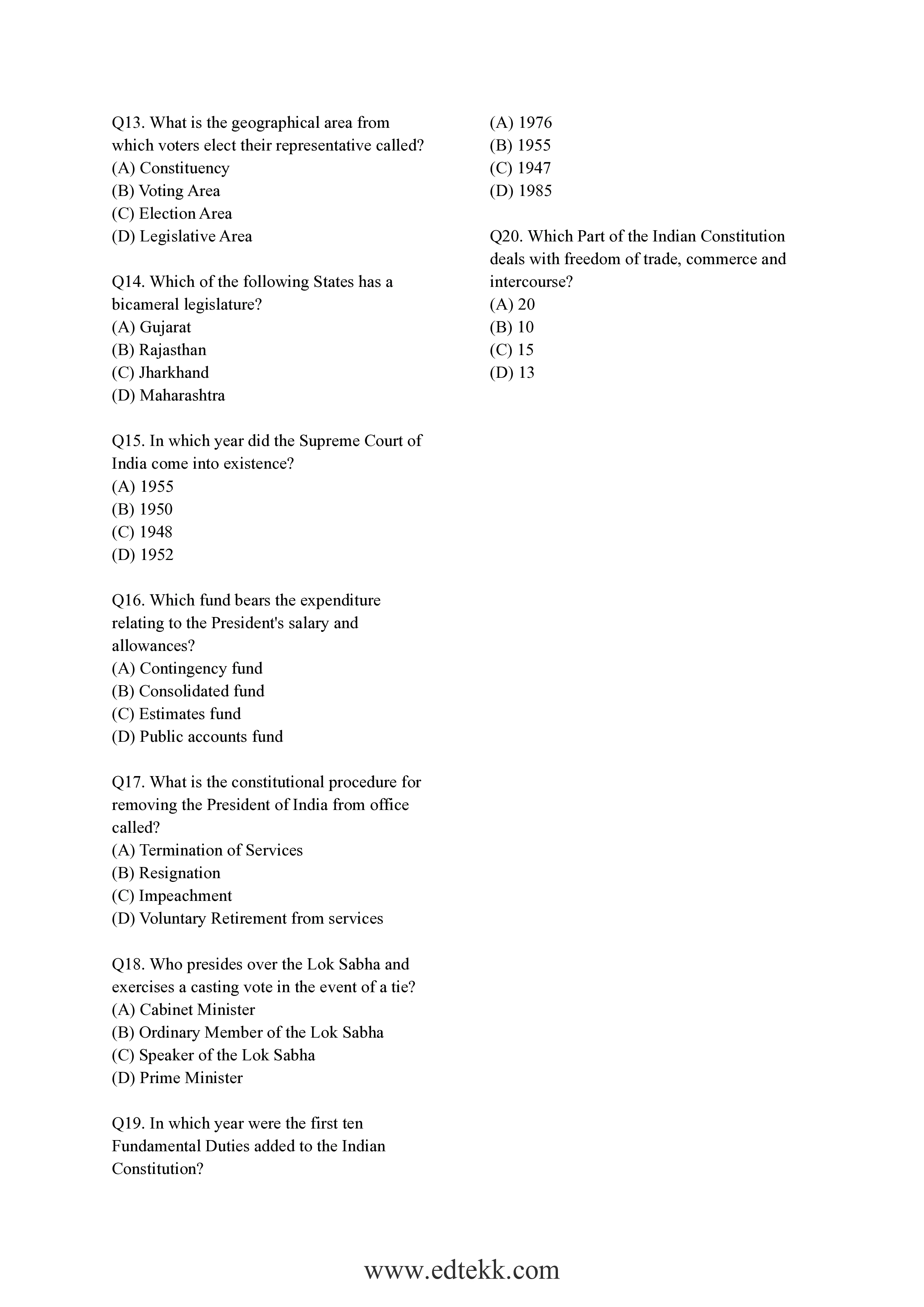
Q13. What is the geographical area from which voters elect their representative called?
(A) Constituency
(B) Voting Area
(C) Election Area
(D) Legislative Area
Explanation: A constituency is a defined geographical area from which voters elect a representative to a legislative body. Constituencies are established for elections to Parliament and State Legislatures, with eligible voters within each constituency participating in the election.
Q14. Which of the following States has a bicameral legislature?
(A) Gujarat
(B) Rajasthan
(C) Jharkhand
(D) Maharashtra
Explanation: Maharashtra has a bicameral State legislature consisting of the Legislative Assembly and Legislative Council. Gujarat, Rajasthan and Jharkhand have unicameral legislatures. The Legislative Council is the permanent Upper House.
Q15. In which year did the Supreme Court of India come into existence?
(A) 1955
(B) 1950
(C) 1948
(D) 1952
Explanation: The Supreme Court of India came into existence on 26 January 1950, when the Constitution of India came into force. It replaced the Federal Court of India, established in 1937. The Supreme Court formally commenced its proceedings on 28 January 1950.
Q16. Which fund bears the expenditure relating to the President’s salary and allowances?
(A) Contingency fund
(B) Consolidated fund
(C) Estimates fund
(D) Public accounts fund
Explanation: Under Article 112(3)(a) of the Constitution of India, the emoluments and allowances of the President and other expenditure relating to the office are charged on the Consolidated Fund of India. Such expenditure is not submitted to the vote of Parliament, ensuring the financial independence of the constitutional office.
Q17. What is the constitutional procedure for removing the President of India from office called?
(A) Termination of Services
(B) Resignation
(C) Impeachment
(D) Voluntary Retirement from services
Explanation: Impeachment is the constitutional procedure for removing the President of India from office for violation of the Constitution under Article 61. Either House of Parliament can initiate the process, and the other House investigates the charge. Removal requires a two-thirds majority of the total membership of each House.
Q18. Who presides over the Lok Sabha and exercises a casting vote in the event of a tie?
(A) Cabinet Minister
(B) Ordinary Member of the Lok Sabha
(C) Speaker of the Lok Sabha
(D) Prime Minister
Explanation: The Speaker of the Lok Sabha ordinarily does not vote in the first instance on a question put to the House. However, in the event of an equality of votes, the Speaker exercises a casting vote to resolve the tie, as provided under Article 100 of the Constitution.
Q19. In which year were the first ten Fundamental Duties added to the Indian Constitution?
(A) 1976
(B) 1955
(C) 1947
(D) 1985
Explanation: The initial ten Fundamental Duties were added to the Indian Constitution in 1976 through the 42nd Constitutional Amendment Act. These duties emphasise citizens’ responsibilities towards the Constitution, the nation and society. An eleventh Fundamental Duty was subsequently added through the 86th Constitutional Amendment Act, 2002.
Q20. Which Part of the Indian Constitution deals with freedom of trade, commerce and intercourse?
(A) 20
(B) 10
(C) 15
(D) 13
Explanation: Part XIII of the Indian Constitution, comprising Articles 301–307, deals with trade, commerce and intercourse within the territory of India. Article 301 establishes the general principle of freedom of trade, commerce and intercourse throughout India, subject to the constitutional restrictions and exceptions provided in subsequent articles.
Question Paper Images