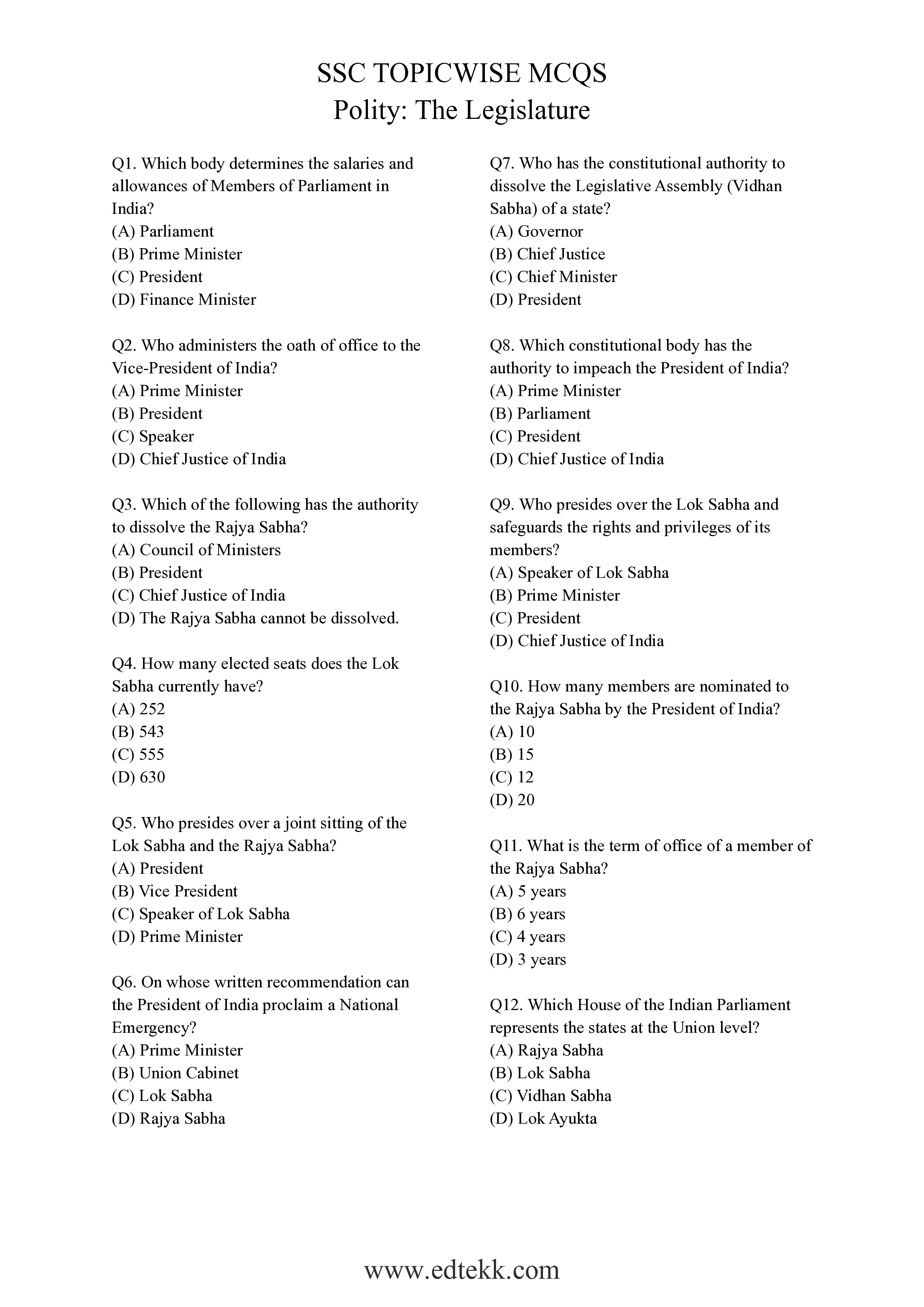
This practice set covers Indian Polity topic Legislature with important MCQs on Parliament, Lok Sabha, Rajya Sabha, legislative procedures and constitutional provisions. Designed for SSC CGL, CHSL, CPO, MTS, GD and Selection Post exams, it provides questions with answers and explanations for effective preparation.
Test Details
Topic: Polity: The Legislature
Total Questions: 20
Question Format: MCQs – Single Correct Answer
Suitable for: SSC CGL, CHSL, CPO, MTS, GD, Selection Post
Download All Papers in This Series (PDF)
Questions and Answers
Q1. Which body determines the salaries and allowances of Members of Parliament in India?
(A) Parliament
(B) Prime Minister
(C) President
(D) Finance Minister
Explanation: Parliament determines the salaries and allowances of its members through legislation under Article 106 of the Constitution. These payments are regulated by the Salary, Allowances and Pension of Members of Parliament Act, 1954, and subsequent amendments. Neither the Prime Minister nor the President independently determines MPs’ remuneration.
Q2. Who administers the oath of office to the Vice-President of India?
(A) Prime Minister
(B) President
(C) Speaker
(D) Chief Justice of India
Explanation: Under Article 69, the Vice President takes the oath or affirmation before the President of India or a person appointed by the President for that purpose. The oath requires the Vice President to bear true faith and allegiance to the Constitution and faithfully discharge the duties of office. The Vice President also serves as the ex officio Chairman of the Rajya Sabha.
Q3. Which of the following has the authority to dissolve the Rajya Sabha?
(A) Council of Ministers
(B) President
(C) Chief Justice of India
(D) The Rajya Sabha cannot be dissolved.
Explanation: The Rajya Sabha is a permanent House of Parliament and cannot be dissolved (Article 83). Unlike the Lok Sabha, it maintains institutional continuity irrespective of general elections. Approximately one-third of its members retire every two years, with vacancies filled through elections or nominations, as applicable.
Q4. How many elected seats does the Lok Sabha currently have?
(A) 252
(B) 543
(C) 555
(D) 630
Explanation: The Lok Sabha currently has 543 elected seats representing territorial constituencies across India’s states and Union Territories. Members are directly elected by eligible voters through general elections. This figure represents the sanctioned elected strength of the House, not the constitutional maximum of 550 members. Actual membership may temporarily be lower because of vacancies.
Q5. Who presides over a joint sitting of the Lok Sabha and the Rajya Sabha?
(A) President
(B) Vice President
(C) Speaker of Lok Sabha
(D) Prime Minister
Explanation: Under Article 118(4) and the relevant parliamentary rules, the Speaker of the Lok Sabha presides over a joint sitting of Parliament. In the Speaker’s absence, the Deputy Speaker presides. If both are absent, the Deputy Chairman of the Rajya Sabha presides. If all three are unavailable, another member presides according to the prescribed procedure.
Q6. On whose written recommendation can the President of India proclaim a National Emergency?
(A) Prime Minister
(B) Union Cabinet
(C) Lok Sabha
(D) Rajya Sabha
Explanation: Under Article 352(3), the President can proclaim a National Emergency only when the decision of the Union Cabinet has been communicated to the President in writing. The Union Cabinet comprises the Prime Minister and other ministers of Cabinet rank. This requirement, introduced by the 44th Constitutional Amendment, ensures collective Cabinet responsibility rather than reliance solely on the Prime Minister’s advice.
Q7. Who has the constitutional authority to dissolve the Legislative Assembly (Vidhan Sabha) of a state?
(A) Governor
(B) Chief Justice
(C) Chief Minister
(D) President
Explanation: Under Article 174(2)(b), the Governor has the constitutional authority to dissolve the State Legislative Assembly, ordinarily acting on the advice of the Council of Ministers headed by the Chief Minister. Limited discretionary questions may arise in exceptional constitutional circumstances. During President’s Rule, dissolution may also occur through the constitutional mechanism under Article 356.
Q8. Which constitutional body has the authority to impeach the President of India?
(A) Prime Minister
(B) Parliament
(C) President
(D) Chief Justice of India
Explanation: Parliament has the constitutional authority to impeach the President of India under Article 61. Either House can initiate the proceedings on grounds of violation of the Constitution. The resolution must secure a majority of the House’s total membership and at least two-thirds of members present and voting. The other House subsequently investigates the charges.
Q9. Who presides over the Lok Sabha and safeguards the rights and privileges of its members?
(A) Speaker of Lok Sabha
(B) Prime Minister
(C) President
(D) Chief Justice of India
Explanation: The Speaker is the presiding officer of the Lok Sabha, responsible for maintaining order, regulating debates, interpreting procedural rules and safeguarding members’ parliamentary rights and privileges. The Speaker also determines the admissibility of motions and exercises important procedural powers, ensuring the orderly conduct of parliamentary proceedings.
Q10. How many members are nominated to the Rajya Sabha by the President of India?
(A) 10
(B) 15
(C) 12
(D) 20
Explanation: The President of India nominates 12 members to the Rajya Sabha under Article 80 of the Constitution. These individuals are selected for their special knowledge or practical experience in literature, science, art and social service. Their nomination enables distinguished individuals to contribute their expertise to parliamentary discussions.
Q11. What is the term of office of a member of the Rajya Sabha?
(A) 5 years
(B) 6 years
(C) 4 years
(D) 3 years
Explanation: A Rajya Sabha member serves a six-year term. The Rajya Sabha is a permanent House and cannot be dissolved. Approximately one-third of its members retire every two years, ensuring continuity in parliamentary functioning. This arrangement provides institutional stability while allowing periodic renewal of membership.
Q12. Which House of the Indian Parliament represents the states at the Union level?
(A) Rajya Sabha
(B) Lok Sabha
(C) Vidhan Sabha
(D) Lok Ayukta
Explanation: The Rajya Sabha represents the states at the Union level in the Indian Parliament. Representatives of states are elected by elected members of their respective Legislative Assemblies through proportional representation using the single transferable vote. The House also includes representatives of eligible Union Territories and 12 nominated members.
Q13. Which House of Parliament at the Union level corresponds to the Legislative Assembly of a state?
(A) Rajya Sabha
(B) President
(C) Lok Sabha
(D) Prime Minister
Explanation: The Lok Sabha is the counterpart of a State Legislative Assembly at the Union level. Both are directly elected representative houses responsible for making laws within their respective jurisdictions. The Lok Sabha is the Lower House of Parliament, while the Legislative Assembly is the lower house of a state’s legislature.
Q14. Which House of the Indian Parliament is known as the Council of States?
(A) Rajya Sabha
(B) Lok Sabha
(C) Vidhan Sabha
(D) Lok Ayukta
Explanation: The Rajya Sabha is known as the Council of States and represents the states and eligible Union Territories in the Indian Parliament. It is the Upper House and a permanent body that cannot be dissolved. Its members are elected by the prescribed electoral colleges or nominated by the President according to constitutional provisions.
Q15. What is the minimum age required to become a member of the Lok Sabha?
(A) 30 years
(B) 35 years
(C) 18 years
(D) 25 years
Explanation: The minimum age prescribed for membership of the Lok Sabha is 25 years under Article 84 of the Constitution. A candidate must also satisfy the applicable citizenship and other electoral eligibility requirements. In comparison, the minimum age for membership of the Rajya Sabha is 30 years.
Q16. Who is the elected head of a Gram Panchayat in India?
(A) Sarpanch
(B) Commissioner
(C) Gram Panchayat Secretary
(D) Deputy Sarpanch
Explanation: The Sarpanch is the commonly used designation for the elected head of a Gram Panchayat, the village-level institution of rural local self-government. The Sarpanch generally presides over meetings and supervises Panchayat functioning. The official designation, method of election and specific powers may vary across states according to their respective Panchayati Raj legislation.
Q17. What is the minimum age required to become a member of a municipality in India?
(A) 18 years
(B) 25 years
(C) 30 years
(D) 21 years
Explanation: The minimum age for becoming a member of a municipality in India is 21 years, as provided under Article 243V of the Constitution. A candidate must also satisfy other eligibility conditions prescribed by the relevant state laws. This age requirement should not be confused with the minimum voting age of 18 years.
Q18. What is the maximum constitutional strength of the Lok Sabha?
(A) 530
(B) 540
(C) 560
(D) 550
Explanation: Under Article 81, the constitutional maximum strength of the Lok Sabha is 550 elected members: up to 530 representatives from states and up to 20 from Union Territories. The earlier provision for nominating two Anglo-Indian members ceased to operate following the 104th Constitutional Amendment. The present sanctioned elected strength is 543.
Q19. Who ordinarily presents the Union Budget in Parliament?
(A) Finance Minister
(B) Prime Minister
(C) President
(D) Chief Justice of India
Explanation: The Union Finance Minister ordinarily presents the annual Union Budget in the Lok Sabha, outlining the government’s estimated receipts, expenditure, taxation proposals and fiscal priorities. Under Article 112, the President causes the Annual Financial Statement to be laid before both Houses of Parliament. Another authorised minister may present the Budget in exceptional circumstances.
Q20. Who formally dissolves the Lok Sabha on the advice of the Council of Ministers?
(A) Attorney General
(B) Prime Minister
(C) President
(D) Chief Justice of India
Explanation: The President of India formally dissolves the Lok Sabha under Article 85(2)(b) of the Constitution, generally acting on the advice of the Council of Ministers headed by the Prime Minister. Dissolution brings the elected House to an end and normally necessitates general elections to constitute a new Lok Sabha.
Question Paper Images