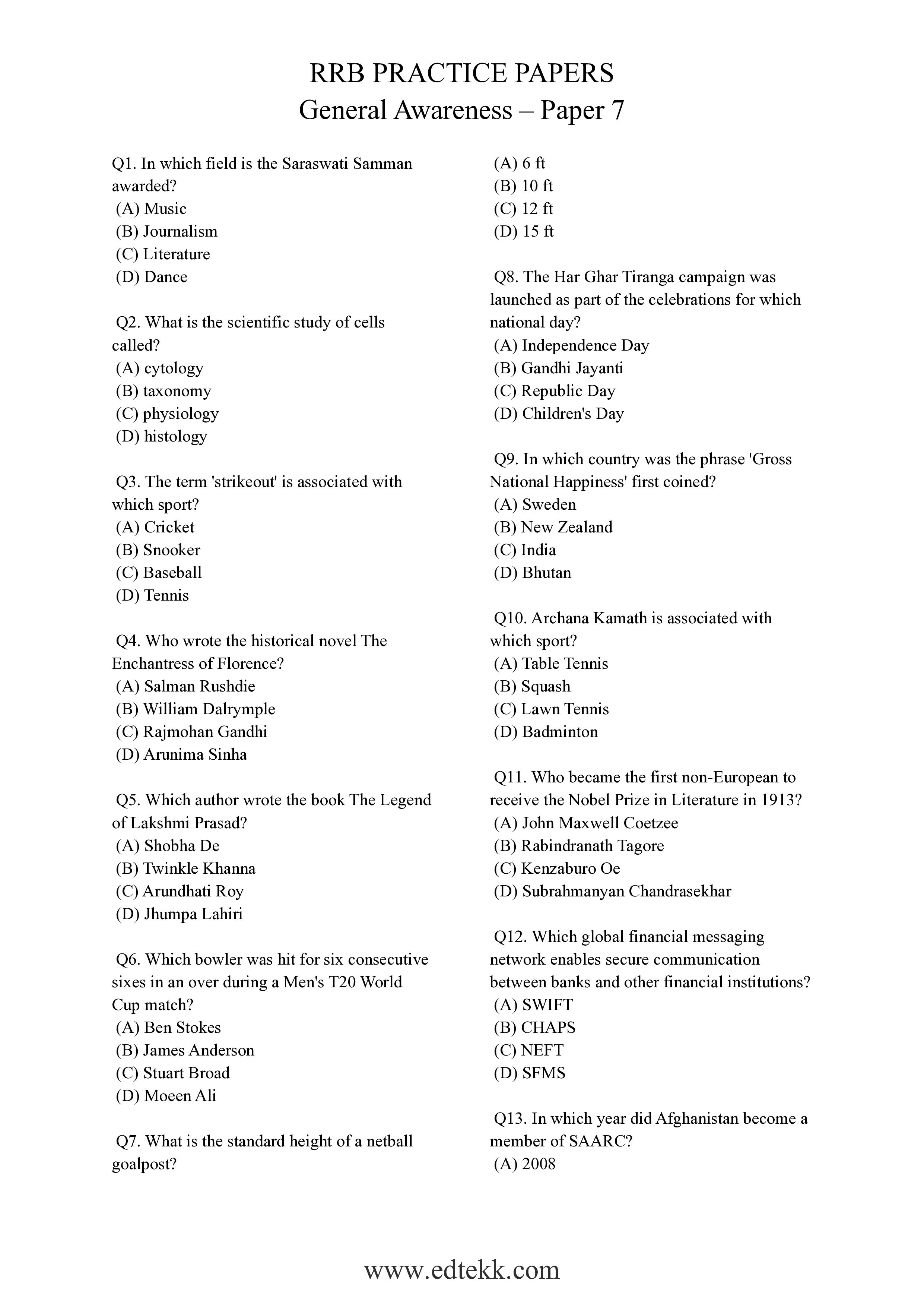
Test and improve your General Awareness knowledge with RRB Practice Paper 7. Featuring 20 objective questions with accurate answers and detailed explanations, this practice set supports focused preparation for Railway recruitment examinations, including RRB NTPC, Group D, ALP and Technician.
Test Details
Topic: General Awareness
Total Questions: 20
Question Format: MCQs – Single Correct Answer
Suitable for: RRB NTPC, Group D, ALP, Technician
Download All Papers in This Series (PDF)
Questions and Answers
Q1. In which field is the Saraswati Samman awarded?
(A) Music
(B) Journalism
(C) Literature
(D) Dance
Explanation: The Saraswati Samman is a prestigious literary award established by the K. K. Birla Foundation in 1991. It recognises outstanding literary works written in any of the 22 languages listed in the Eighth Schedule of the Indian Constitution. The award is given for exceptional contributions to literature, not music, journalism or dance.
Q2. What is the scientific study of cells called?
(A) cytology
(B) taxonomy
(C) physiology
(D) histology
Explanation: Cytology is the branch of biology concerned with the study of cells, including their structure, composition, functions and reproduction. Cells are the fundamental structural and functional units of living organisms. Histology, by contrast, focuses on the microscopic study of tissues.
Q3. The term ‘strikeout’ is associated with which sport?
(A) Cricket
(B) Snooker
(C) Baseball
(D) Tennis
Explanation: A strikeout is a fundamental term in baseball. It occurs when a batter accumulates three strikes during an at-bat. However, if the catcher fails to catch the third strike cleanly, the batter may be entitled to attempt to reach first base, provided first base is unoccupied or there are two outs.
Q4. Who wrote the historical novel The Enchantress of Florence?
(A) Salman Rushdie
(B) William Dalrymple
(C) Rajmohan Gandhi
(D) Arunima Sinha
Explanation: The Enchantress of Florence is a historical novel written by Salman Rushdie and published in 2008. It connects Mughal India under Emperor Akbar with Renaissance Florence through an imaginative narrative involving history, mythology, love and political intrigue. The novel explores storytelling, power and cultural exchange.
Q5. Which author wrote the book The Legend of Lakshmi Prasad?
(A) Shobha De
(B) Twinkle Khanna
(C) Arundhati Roy
(D) Jhumpa Lahiri
Explanation: The Legend of Lakshmi Prasad is a collection of short stories written by Twinkle Khanna and published in 2016. The collection addresses social issues, women’s empowerment and changing attitudes in Indian society. One of its stories, The Sanitary Man of Sacred Land, inspired the Hindi film Pad Man.
Q6. Which bowler was hit for six consecutive sixes in an over during a Men’s T20 World Cup match?
(A) Ben Stokes
(B) James Anderson
(C) Stuart Broad
(D) Moeen Ali
Explanation: Stuart Broad was hit for six consecutive sixes by India’s Yuvraj Singh during the inaugural ICC Men’s T20 World Cup in 2007. The feat occurred during a match between India and England in Durban, South Africa. Yuvraj became the first batter to hit six sixes in an over in international T20 cricket.
Q7. What is the standard height of a netball goalpost?
(A) 6 ft
(B) 10 ft
(C) 12 ft
(D) 15 ft
Explanation: A standard netball goalpost is 10 feet (3.05 metres) high. It consists of a vertical pole with a horizontal ring attached at the top. The ring has an internal diameter of 15 inches and is fitted with a net.
Q8. The Har Ghar Tiranga campaign was launched as part of the celebrations for which national day?
(A) Independence Day
(B) Gandhi Jayanti
(C) Republic Day
(D) Children’s Day
Explanation: The Har Ghar Tiranga campaign was launched in 2022 as part of the Azadi Ka Amrit Mahotsav celebrations marking India’s 75th year of independence. Its objective was to encourage citizens to hoist the national flag at their homes and strengthen patriotism and national unity.
Q9. In which country was the phrase ‘Gross National Happiness’ first coined?
(A) Sweden
(B) New Zealand
(C) India
(D) Bhutan
Explanation: The phrase Gross National Happiness (GNH) was coined by Bhutan’s fourth King, Jigme Singye Wangchuck, in 1972. It emphasises that national development should consider people’s overall well-being rather than relying solely on economic indicators such as Gross Domestic Product (GDP).
Q10. Archana Kamath is associated with which sport?
(A) Table Tennis
(B) Squash
(C) Lawn Tennis
(D) Badminton
Explanation: Archana Kamath is an Indian table tennis player who has represented India in international competitions. Table tennis is a racket sport played on a table divided by a net, with players using rackets to strike a lightweight ball. Therefore, table tennis is the correct answer.
Q11. Who became the first non-European to receive the Nobel Prize in Literature in 1913?
(A) John Maxwell Coetzee
(B) Rabindranath Tagore
(C) Kenzaburo Oe
(D) Subrahmanyan Chandrasekhar
Explanation: Rabindranath Tagore received the Nobel Prize in Literature in 1913, becoming the first non-European to win this award. He was recognised primarily for his English translation of Gitanjali (Song Offerings). Tagore was a Bengali poet, philosopher, composer and educator whose literary contributions gained international recognition.
Q12. Which global financial messaging network enables secure communication between banks and other financial institutions?
(A) SWIFT
(B) CHAPS
(C) NEFT
(D) SFMS
Explanation: The Society for Worldwide Interbank Financial Telecommunication (SWIFT) operates a secure global messaging network used by banks and financial institutions to exchange financial instructions. Established in 1973 and headquartered in Belgium, SWIFT facilitates standardised financial communication but does not itself transfer or settle funds.
Q13. In which year did Afghanistan become a member of SAARC?
(A) 2008
(B) 2007
(C) 2005
(D) 2006
Explanation: Afghanistan became the eighth member of SAARC in 2007 during the 14th SAARC Summit held in New Delhi, India. Its admission expanded the organisation beyond its seven founding members: Bangladesh, Bhutan, India, Maldives, Nepal, Pakistan and Sri Lanka.
Q14. Who wrote the book The Idea of Justice?
(A) Ravindra Singh
(B) Amartya Sen
(C) Mamta Banerjee
(D) Abhinav Bindra
Explanation: The Idea of Justice was written by Nobel Prize-winning economist Amartya Sen and published in 2009. It examines justice, inequality, freedom and social choice. Sen emphasises reducing actual injustices and improving people’s lives rather than relying solely on ideal institutional arrangements.
Q15. Who wrote India Wins Freedom?
(A) Jawaharlal Nehru
(B) Abul Kalam Azad
(C) Jaswant Singh
(D) Rajendra Prasad
Explanation: India Wins Freedom is the autobiographical memoir of Maulana Abul Kalam Azad. First published in 1959, it presents his account of India’s freedom struggle, the negotiations preceding independence and Partition, and major political developments involving prominent nationalist leaders.
Q16. Who authored the book I Witness: Partial Observation?
(A) Kapil Sibal
(B) Rajmohan Gandhi
(C) Poonam Suri
(D) Mark Tully
Explanation: I Witness: Partial Observation was written by Kapil Sibal, an Indian lawyer, politician and former Union Minister. The book presents his observations and reflections on Indian politics and public life and discusses contemporary political and social developments from his perspective.
Q17. To which Indian state did the noted Padma Shri awardee and Sufi saint Ibrahim Sutar belong?
(A) Telangana
(B) Karnataka
(C) Kerala
(D) Andhra Pradesh
Explanation: Ibrahim Sutar belonged to Karnataka. He was a renowned social worker, folk singer and spiritual speaker known for promoting communal harmony through his programmes and discourses. He received the Padma Shri in 2018 in recognition of his contributions to social work.
Q18. On which date is the International Day of Non-Violence observed?
(A) 15th August
(B) 2nd October
(C) 31st October
(D) 14th November
Explanation: The International Day of Non-Violence is observed annually on 2 October, marking the birth anniversary of Mahatma Gandhi. The United Nations established this observance to promote non-violence through education and public awareness and encourage a culture of peace, tolerance and understanding.
Q19. Who is the author of the book Pathway to God?
(A) Sardar Vallabhai Patel
(B) Mahatma Gandhi
(C) Jawaharlal Nehru
(D) Sri Aurobindo
Explanation: Mahatma Gandhi is the author of Pathway to God, a compilation of his writings and speeches edited and compiled by M. S. Deshpande. First published in 1971 by Navajivan Publishing House, the book discusses Gandhi’s spiritual philosophy, truth, non-violence, selfless service and the pursuit of God.
Q20. Who became the second Indian batsman, after Virender Sehwag, to score a triple century in Test cricket?
(A) Karun Nair
(B) Rohit Sharma
(C) Shikhar Dhawan
(D) Ajinkya Rahane
Explanation: Karun Nair became the second Indian batter, after Virender Sehwag, to score a triple century in men’s Test cricket. He scored 303 not out against England in Chennai in December 2016. Sehwag had previously scored Test triple centuries against Pakistan and South Africa.
Question Paper Images