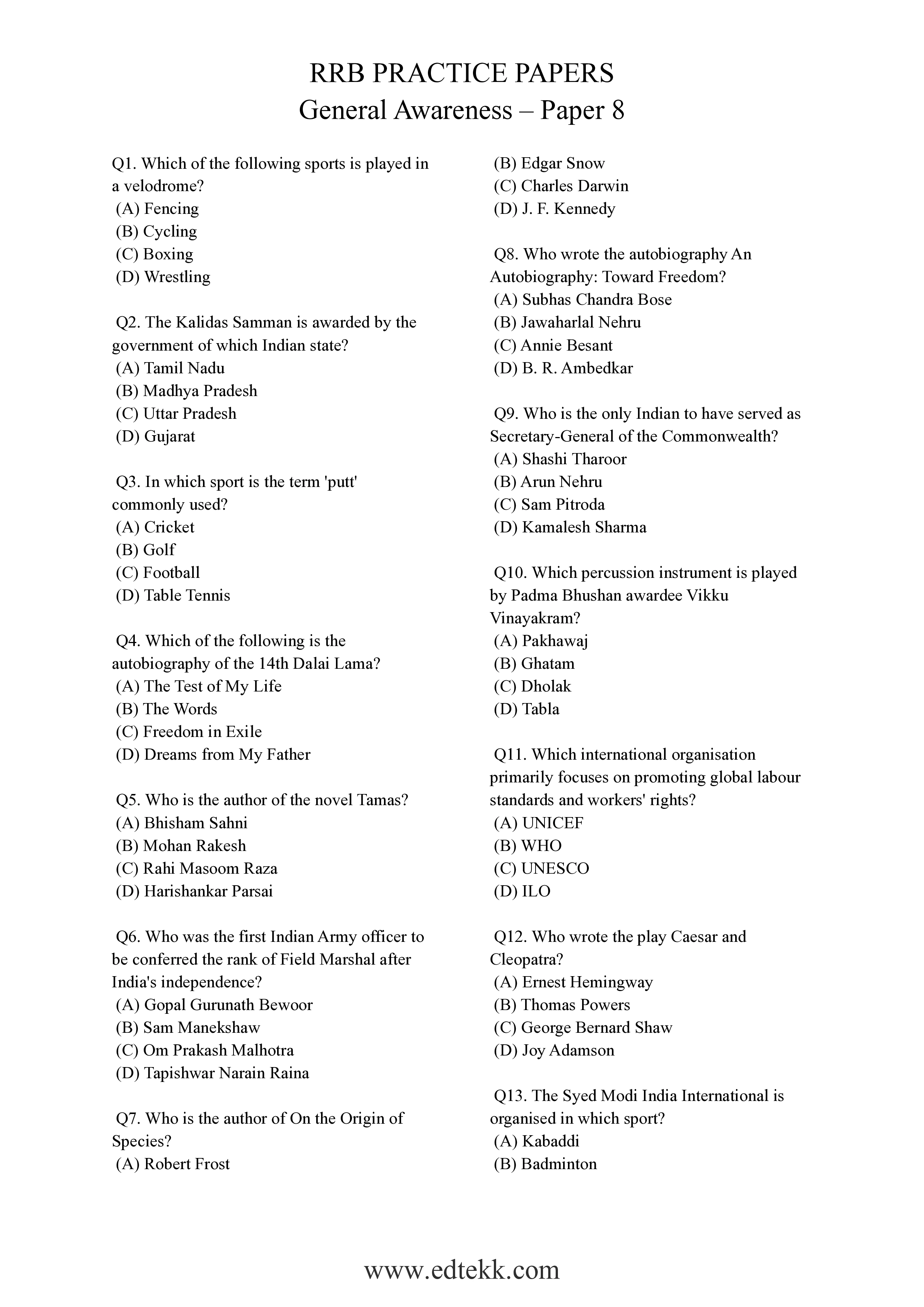
Strengthen your competitive-exam readiness with RRB General Awareness Practice Paper 8. This question set contains 20 MCQs covering general awareness topics, accompanied by answers and explanations. It is designed to help candidates revise and practise for RRB NTPC, Group D, ALP and Technician examinations.
Test Details
Topic: General Awareness
Total Questions: 20
Question Format: MCQs – Single Correct Answer
Suitable for: RRB NTPC, Group D, ALP, Technician
Download All Papers in This Series (PDF)
Questions and Answers
Q1. Which of the following sports is played in a velodrome?
(A) Fencing
(B) Cycling
(C) Boxing
(D) Wrestling
Explanation: Cycling, particularly track cycling, is performed in a specially designed oval-shaped arena called a velodrome. Its track generally features steeply banked curves that enable cyclists to maintain high speeds while negotiating turns. Velodromes host competitive track cycling events, including sprint and endurance races.
Q2. The Kalidas Samman is awarded by the government of which Indian state?
(A) Tamil Nadu
(B) Madhya Pradesh
(C) Uttar Pradesh
(D) Gujarat
Explanation: The Kalidas Samman is conferred by the Government of Madhya Pradesh. Instituted in 1980, it recognises distinguished contributions to classical music, classical dance, theatre and visual arts. The award is named after Kalidasa, the renowned classical Sanskrit poet and playwright, whose literary works are an important part of India’s cultural heritage.
Q3. In which sport is the term ‘putt’ commonly used?
(A) Cricket
(B) Golf
(C) Football
(D) Table Tennis
Explanation: Putt is a term used in golf. It refers to a stroke played on the putting green, generally using a putter, to roll the ball towards the hole. The objective is to control the ball’s direction and speed so that it enters the hole in as few strokes as possible.
Q4. Which of the following is the autobiography of the 14th Dalai Lama?
(A) The Test of My Life
(B) The Words
(C) Freedom in Exile
(D) Dreams from My Father
Explanation: Freedom in Exile is the autobiography of the 14th Dalai Lama, Tenzin Gyatso. Published in 1990, it recounts his childhood in Tibet, spiritual education, the Chinese invasion of Tibet and his subsequent exile in India in 1959.
Q5. Who is the author of the novel Tamas?
(A) Bhisham Sahni
(B) Mohan Rakesh
(C) Rahi Masoom Raza
(D) Harishankar Parsai
Explanation: Tamas is a Hindi novel by Bhisham Sahni, published in 1974. Set during the Partition of India, it portrays communal violence, religious tensions and the suffering of ordinary people. The novel received the Sahitya Akademi Award in 1975 and was later adapted for television.
Q6. Who was the first Indian Army officer to be conferred the rank of Field Marshal after India’s independence?
(A) Gopal Gurunath Bewoor
(B) Sam Manekshaw
(C) Om Prakash Malhotra
(D) Tapishwar Narain Raina
Explanation: Sam Hormusji Framji Jamshedji Manekshaw became the first Indian Army officer to attain the rank of Field Marshal on 1 January 1973. He served as Chief of the Army Staff during the 1971 Indo-Pakistani War, which resulted in the creation of Bangladesh. He was popularly known as “Sam Bahadur”.
Q7. Who is the author of On the Origin of Species?
(A) Robert Frost
(B) Edgar Snow
(C) Charles Darwin
(D) J. F. Kennedy
Explanation: Charles Darwin published On the Origin of Species in 1859. The book introduced his theory of evolution through natural selection, explaining how favourable inherited variations become more common over generations. Darwin’s work transformed biological science by providing a scientific explanation for the diversity and evolutionary relationships of living organisms.
Q8. Who wrote the autobiography An Autobiography: Toward Freedom?
(A) Subhas Chandra Bose
(B) Jawaharlal Nehru
(C) Annie Besant
(D) B. R. Ambedkar
Explanation: Jawaharlal Nehru wrote An Autobiography, also known as Toward Freedom. First published in 1936, it recounts his personal experiences, political activities, imprisonment and participation in India’s freedom struggle. Much of the work was written during his imprisonment under British rule.
Q9. Who is the only Indian to have served as Secretary-General of the Commonwealth?
(A) Shashi Tharoor
(B) Arun Nehru
(C) Sam Pitroda
(D) Kamalesh Sharma
Explanation: Kamalesh Sharma, an Indian diplomat, served as the Secretary-General of the Commonwealth from 2008 to 2016. He was the only Indian to hold this position. The Commonwealth is an association of independent countries that cooperate on democracy, development and other shared objectives.
Q10. Which percussion instrument is played by Padma Bhushan awardee Vikku Vinayakram?
(A) Pakhawaj
(B) Ghatam
(C) Dholak
(D) Tabla
Explanation: Vikku Vinayakram is a renowned Indian percussionist specialising in the ghatam, a traditional clay-pot percussion instrument used in Carnatic music. He is celebrated for his rhythmic precision and innovative performance style. He received the Padma Bhushan in 2014 in recognition of his outstanding contributions to Indian classical music.
Q11. Which international organisation primarily focuses on promoting global labour standards and workers’ rights?
(A) UNICEF
(B) WHO
(C) UNESCO
(D) ILO
Explanation: The International Labour Organization (ILO) promotes social justice, decent work and internationally recognized labour rights. It develops international labour standards addressing working conditions, freedom of association, forced labour, child labour and employment discrimination. The WHO focuses on public health, UNESCO on education, science and culture, and UNICEF primarily on children’s rights and welfare.
Q12. Who wrote the play Caesar and Cleopatra?
(A) Ernest Hemingway
(B) Thomas Powers
(C) George Bernard Shaw
(D) Joy Adamson
Explanation: George Bernard Shaw wrote the play Caesar and Cleopatra in 1898. It explores the relationship between Julius Caesar and the Egyptian queen Cleopatra, portraying Caesar as an experienced statesman and mentor. Shaw was an Irish playwright and critic who received the Nobel Prize in Literature in 1925.
Q13. The Syed Modi India International is organised in which sport?
(A) Kabaddi
(B) Badminton
(C) Volleyball
(D) Chess
Explanation: The Syed Modi India International is an international badminton tournament organised in India. It is named after Syed Modi, an accomplished Indian badminton player, and forms part of the international badminton competition calendar under the Badminton World Federation (BWF).
Q14. Who is the author of the book Freedom in Exile?
(A) Dalai Lama
(B) Ayub Khan
(C) Rajesh Pilot
(D) S. S. Gill
Explanation: Freedom in Exile is the autobiography of the 14th Dalai Lama, Tenzin Gyatso, published in 1990. It describes his childhood in Tibet, spiritual training, the Chinese occupation of Tibet and his subsequent exile in India.
Q15. Which of the following countries is NOT a member of the BRICS group?
(A) Brazil
(B) India
(C) China
(D) Japan
Explanation: Japan is not a member of BRICS. The grouping originally comprised Brazil, Russia, India, China and South Africa. It subsequently expanded to include additional full members. Japan, in contrast, is a member of the G7. BRICS membership has evolved in recent years, so its composition should be considered in relation to the relevant examination date.
Q16. Who was the first non-British person to become President of the Marylebone Cricket Club (MCC)?
(A) Mahela Jayawardene
(B) Wasim Akram
(C) Kumar Sangakkara
(D) Sunil Gavaskar
Explanation: Kumar Sangakkara, the former Sri Lankan captain and wicketkeeper-batter, became the first non-British president of the Marylebone Cricket Club (MCC). He assumed office in October 2019. The MCC is the custodian of the Laws of Cricket and plays an important role in the development of the game.
Q17. Which Marathi writer authored the autobiography Majya Jalmachi Chittarkatha?
(A) Kusumagraj
(B) Shantabai Krushnaji Kamble
(C) Sunita Deshpande
(D) Shivaji Sawant
Explanation: Shantabai Krushnaji Kamble, a Marathi Dalit writer, authored the autobiography Majya Jalmachi Chittarkatha. The work recounts her experiences of caste discrimination, poverty and social inequality, highlighting her struggle for education and dignity. It is an important contribution to Dalit autobiographical literature in Marathi.
Q18. What is the full form of SAI, India’s apex national sports organisation?
(A) Sports Association of India
(B) Sports Authority of India
(C) Sports Agency of India
(D) Sports Academy of India
Explanation: SAI stands for Sports Authority of India. Established in 1984 under the Ministry of Youth Affairs and Sports, it is the country’s principal sports development organisation. It supports athlete training, coaching programmes, sports infrastructure and India’s preparation for international sporting competitions.
Q19. Narendra Hirwani was associated with which sport?
(A) Cricket
(B) Hockey
(C) Football
(D) Boxing
Explanation: Narendra Hirwani is associated with cricket. He is a former Indian leg-spinner who made a remarkable Test debut against the West Indies in 1988, taking 16 wickets in the match. His bowling figures were 8/61 and 8/75, making him one of the most successful bowlers on Test debut.
Q20. Which of the following is an Indian research station in Antarctica?
(A) Orcadas
(B) Maitri
(C) Hope Bay
(D) Mawson
Explanation: Maitri is India’s second permanent research station in Antarctica, established in 1989 in the Schirmacher Oasis. India’s first Antarctic research station, Dakshin Gangotri, was established in 1983 and subsequently decommissioned as an operational research station. Maitri supports research in glaciology, meteorology, atmospheric sciences and other fields.
Question Paper Images