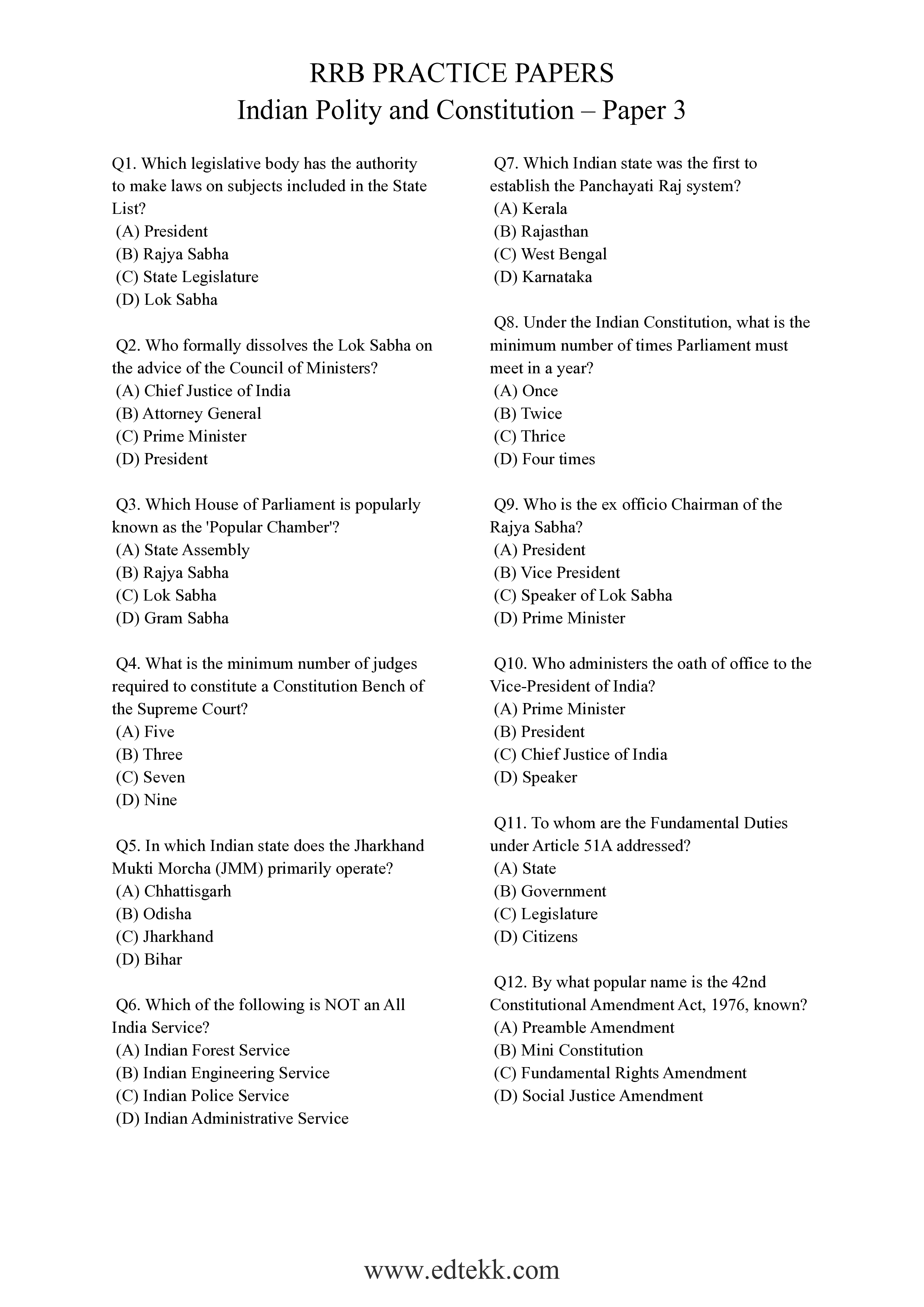
Strengthen your understanding of Indian Polity and the Constitution with Practice Paper 3 for Railway examinations. Suitable for RRB NTPC, Group D, ALP and Technician candidates, this practice set includes 20 MCQs with answers and explanations to support exam-oriented learning and improve preparation.
Test Details
Topic: Indian Polity and Constitution
Total Questions: 20
Question Format: MCQs – Single Correct Answer
Suitable for: RRB NTPC, Group D, ALP, Technician
Download All Papers in This Series (PDF)
Questions and Answers
Q1. Which legislative body has the authority to make laws on subjects included in the State List?
(A) President
(B) Rajya Sabha
(C) State Legislature
(D) Lok Sabha
Explanation: State Legislatures generally have the power to make laws on subjects included in the State List under the Seventh Schedule. These include public order, police, agriculture and public health. However, Parliament can also legislate on these subjects under specified circumstances, including a national emergency or a Rajya Sabha resolution under Article 249.
Q2. Who formally dissolves the Lok Sabha on the advice of the Council of Ministers?
(A) Chief Justice of India
(B) Attorney General
(C) Prime Minister
(D) President
Explanation: The President of India formally dissolves the Lok Sabha under Article 85(2)(b) of the Constitution, generally acting on the advice of the Council of Ministers headed by the Prime Minister. Dissolution brings the elected House to an end and normally necessitates general elections to constitute a new Lok Sabha.
Q3. Which House of Parliament is popularly known as the ‘Popular Chamber’?
(A) State Assembly
(B) Rajya Sabha
(C) Lok Sabha
(D) Gram Sabha
Explanation: The Lok Sabha is known as the Popular Chamber or House of the People because its members are directly elected by the citizens of India through universal adult suffrage. It represents the people at the national level and plays a central role in legislation, financial matters and parliamentary accountability.
Q4. What is the minimum number of judges required to constitute a Constitution Bench of the Supreme Court?
(A) Five
(B) Three
(C) Seven
(D) Nine
Explanation: Under Article 145(3) of the Indian Constitution, a minimum of five Supreme Court judges is required to constitute a Constitution Bench for deciding cases involving substantial questions of law concerning constitutional interpretation. Such benches may also consider matters referred under Article 143. Larger benches may consist of more than five judges.
Q5. In which Indian state does the Jharkhand Mukti Morcha (JMM) primarily operate?
(A) Chhattisgarh
(B) Odisha
(C) Jharkhand
(D) Bihar
Explanation: The Jharkhand Mukti Morcha (JMM) primarily operates in Jharkhand. Founded in 1972, the party played a significant role in the movement for a separate Jharkhand state and has remained an important political force in the region.
Q6. Which of the following is NOT an All India Service?
(A) Indian Forest Service
(B) Indian Engineering Service
(C) Indian Police Service
(D) Indian Administrative Service
Explanation: The Indian Engineering Service is not an All India Service. The three All India Services are the Indian Administrative Service (IAS), Indian Police Service (IPS) and Indian Forest Service (IFoS).
Q7. Which Indian state was the first to establish the Panchayati Raj system?
(A) Kerala
(B) Rajasthan
(C) West Bengal
(D) Karnataka
Explanation: Rajasthan was the first state to establish the Panchayati Raj system in India. It was inaugurated at Nagaur on 2 October 1959 by Prime Minister Jawaharlal Nehru. This marked an important milestone in the development of democratic decentralisation and rural self-government in independent India.
Q8. Under the Indian Constitution, what is the minimum number of times Parliament must meet in a year?
(A) Once
(B) Twice
(C) Thrice
(D) Four times
Explanation: Under Article 85 of the Indian Constitution, no more than six months can elapse between the last sitting of one session of Parliament and the first sitting of the next. Consequently, Parliament must hold at least two sessions annually.
Q9. Who is the ex officio Chairman of the Rajya Sabha?
(A) President
(B) Vice President
(C) Speaker of Lok Sabha
(D) Prime Minister
Explanation: Under Article 64 of the Constitution, the Vice-President of India is the ex-officio Chairman of the Rajya Sabha. The Vice-President presides over its proceedings and maintains order but is not a member of the Rajya Sabha. The Chairman ordinarily does not vote, except when exercising a casting vote in the event of a tie.
Q10. Who administers the oath of office to the Vice-President of India?
(A) Prime Minister
(B) President
(C) Chief Justice of India
(D) Speaker
Explanation: Under Article 69, the Vice President takes the oath or affirmation before the President of India or a person appointed by the President for that purpose. The oath requires the Vice President to bear true faith and allegiance to the Constitution and faithfully discharge the duties of office. The Vice President also serves as the ex officio Chairman of the Rajya Sabha.
Q11. To whom are the Fundamental Duties under Article 51A addressed?
(A) State
(B) Government
(C) Legislature
(D) Citizens
Explanation: Fundamental Duties are addressed to the citizens of India under Article 51A of the Constitution. They prescribe moral and civic responsibilities, including respecting the Constitution, protecting national unity, safeguarding public property and promoting harmony. They encourage responsible citizenship and contribute to national development.
Q12. By what popular name is the 42nd Constitutional Amendment Act, 1976, known?
(A) Preamble Amendment
(B) Mini Constitution
(C) Fundamental Rights Amendment
(D) Social Justice Amendment
Explanation: The 42nd Constitutional Amendment Act, 1976, is popularly known as the “Mini Constitution” because it introduced extensive changes to various provisions of the Indian Constitution. These included amendments relating to the Preamble, Fundamental Duties, Directive Principles of State Policy and Centre-State relations.
Q13. Which institution is the final authority on the interpretation of the Indian Constitution?
(A) Supreme Court
(B) President
(C) Prime Minister
(D) Parliament
Explanation: The Supreme Court of India is the highest judicial authority and the final interpreter of the Constitution within the Indian judicial system. It interprets constitutional provisions, adjudicates constitutional disputes and exercises judicial review to examine the constitutional validity of laws and government actions. Its judgments are binding on all courts in India under Article 141.
Q14. Who appoints the Advocate General of a state?
(A) Chief Minister
(B) Governor
(C) President
(D) Prime Minister
Explanation: Under Article 165, the Governor appoints the Advocate General for the State, the State Government’s highest law officer. The appointee must be qualified to be appointed a High Court judge. The Advocate General advises the State Government on legal matters and performs other legal duties assigned by the Governor.
Q15. Which Constitutional Amendment Act granted constitutional status to the Panchayati Raj system?
(A) 42nd Amendment
(B) 74th Amendment
(C) 73rd Amendment
(D) 79th Amendment
Explanation: The 73rd Constitutional Amendment Act, 1992, granted constitutional recognition to the Panchayati Raj system. It introduced a three-tier structure of rural local self-government comprising Gram Panchayats at the village level, Panchayat Samitis at the intermediate level and Zila Parishads at the district level, subject to constitutional provisions.
Q16. How many categories of Fundamental Rights were originally enshrined in the Indian Constitution?
(A) 8
(B) 5
(C) 7
(D) 6
Explanation: The original Constitution recognised seven categories of Fundamental Rights: Right to Equality, Right to Freedom, Right against Exploitation, Right to Freedom of Religion, Cultural and Educational Rights, Right to Property and Right to Constitutional Remedies. The Right to Property was subsequently removed from Part III by the 44th Constitutional Amendment Act, 1978, and incorporated under Article 300A.
Q17. Which of the following States has a bicameral legislature?
(A) Gujarat
(B) Maharashtra
(C) Rajasthan
(D) Jharkhand
Explanation: Maharashtra has a bicameral State legislature consisting of the Legislative Assembly and Legislative Council. Gujarat, Rajasthan and Jharkhand have unicameral legislatures. The Legislative Council is the permanent Upper House.
Q18. Who was appointed as the Constitutional Adviser to the Constituent Assembly in 1946 during the framing of the Indian Constitution?
(A) B.R. Ambedkar
(B) B.N. Rau
(C) K.M. Munshi
(D) Gopalaswami Ayyangar
Explanation: B. N. Rau was appointed Constitutional Adviser to the Constituent Assembly in 1946. He prepared an initial constitutional draft and provided important legal and constitutional guidance during the framing process. He must be distinguished from Dr. B. R. Ambedkar, who chaired the Drafting Committee established in August 1947.
Q19. In which Indian state is the Rashtriya Janata Dal (RJD) a prominent political party?
(A) Punjab
(B) Bihar
(C) Rajasthan
(D) Haryana
Explanation: The Rashtriya Janata Dal (RJD) is a prominent political party in Bihar. Founded by Lalu Prasad Yadav in 1997 following a split from the Janata Dal, the party has maintained a significant presence in Bihar politics and has participated in state and national coalition governments.
Q20. Who is empowered to proclaim a Financial Emergency under Article 360 of the Indian Constitution?
(A) Defence Minister of India
(B) The Finance Minister of India
(C) The Governor of Reserve Bank of India
(D) The President of India
Explanation: Article 360 empowers the President of India to proclaim a Financial Emergency if the financial stability or credit of India, or any part of its territory, is threatened. The proclamation must be approved by both Houses of Parliament within two months. No Financial Emergency has been proclaimed in India so far.
Question Paper Images