Improve your Railway exam preparation with Indian Polity and Constitution Practice Paper 2. Designed for RRB NTPC, Group D, ALP and Technician aspirants, this set features 20 objective-type practice questions covering important polity concepts, along with correct answers and explanations for effective revision.
Test Details
Topic: Indian Polity and Constitution
Total Questions: 20
Question Format: MCQs – Single Correct Answer
Suitable for: RRB NTPC, Group D, ALP, Technician
Download All Papers in This Series (PDF)
Questions and Answers
Q1. Which principle in the Preamble to the Indian Constitution promotes individual dignity and national unity?
(A) fraternity
(B) liberty
(C) equality
(D) Justice
Explanation: Fraternity in the Preamble seeks to assure the dignity of the individual and promote the unity and integrity of the nation. The Preamble separately identifies justice, liberty and equality as constitutional objectives. The word “integrity” was added to the Preamble by the 42nd Constitutional Amendment Act, 1976.
Q2. What is the minimum age required to vote in Lok Sabha elections in India?
(A) 16 years
(B) 18 years
(C) 21 years
(D) 25 years
Explanation: The minimum voting age for Lok Sabha elections in India is 18 years. The voting age was reduced from 21 to 18 years through the 61st Constitutional Amendment Act, 1988, which became effective in 1989. Citizens must also satisfy the applicable electoral registration requirements to exercise their voting rights.
Q3. How long did the Constituent Assembly take to frame the Constitution of India?
(A) 3 years, 6 months and 23 days
(B) 2 years, 11 months and 17 days
(C) 1 year, 10 months and 15 days
(D) 4 years, 3 months and 29 days
Explanation: The Constituent Assembly took 2 years, 11 months and 17 days to frame the Indian Constitution. Its first meeting was held on 9 December 1946, and the Constitution was adopted on 26 November 1949. It came into force on 26 January 1950, a date commemorated annually as Republic Day.
Q4. Which political party is primarily based in West Bengal?
(A) BJP
(B) CPI(M)
(C) TMC
(D) SP
Explanation: The All India Trinamool Congress (TMC) is primarily based in West Bengal. Founded by Mamata Banerjee in 1998 after her separation from the Indian National Congress, it became a major political force and formed the state government in 2011.
Q5. Which Constitutional Amendment Act granted constitutional status to Panchayati Raj institutions?
(A) 74th
(B) 73rd
(C) 72nd
(D) 75th
Explanation: The 73rd Constitutional Amendment Act, 1992, gave constitutional status to Panchayati Raj institutions by inserting Part IX into the Constitution. It established a framework for regular elections, reservation of seats, five-year terms and State Finance Commissions, strengthening rural local self-government.
Q6. Who was the first Chief Justice of India?
(A) H. J. Kania
(B) M. Patanjali Sastri
(C) D Y Chandrachud
(D) Y. V. Chandrachud
Explanation: Harilal Jekisundas Kania, popularly known as H. J. Kania, was the first Chief Justice of India. He assumed office on 26 January 1950, when the Supreme Court came into existence, and served until his death on 6 November 1951.
Q7. The Pattali Makkal Katchi (PMK) is a prominent regional political party in which Indian state?
(A) Tamil Nadu
(B) Kerala
(C) Andhra Pradesh
(D) Karnataka
Explanation: The Pattali Makkal Katchi (PMK) is a regional political party primarily based in Tamil Nadu. Founded by S. Ramadoss on 16 July 1989, the party has maintained a significant presence in Tamil Nadu politics.
Q8. In which year was the Estimates Committee first constituted in India?
(A) 1948
(B) 1947
(C) 1950
(D) 1949
Explanation: The Estimates Committee was constituted for the first time in 1950. It is a parliamentary financial committee consisting of 30 members elected exclusively from the Lok Sabha. Its functions include examining budget estimates, suggesting administrative improvements and recommending measures to achieve economy in public expenditure.
Q9. Which Fundamental Rights cannot be suspended even during a National Emergency?
(A) Article 14-15
(B) Article 18-19
(C) Article 20-21
(D) Article 16-17
Explanation: Articles 20 and 21 of the Indian Constitution cannot be suspended even during a National Emergency. Article 20 provides protection in respect of conviction for offences, while Article 21 guarantees the protection of life and personal liberty. The 44th Constitutional Amendment Act, 1978, ensured that their enforcement cannot be suspended under Article 359.
Q10. Which political party in India is associated with the bicycle election symbol?
(A) Shiv Sena
(B) TMC
(C) NCP
(D) Samajwadi Party
Explanation: The Samajwadi Party uses the bicycle as its election symbol. The party is particularly influential in Uttar Pradesh and was founded in 1992 by Mulayam Singh Yadav. The bicycle distinguishes it from the electoral symbols of the TMC, NCP and Shiv Sena.
Q11. What is the meaning of the writ of Mandamus?
(A) You May Have the Body
(B) By What Warrants
(C) To be Certified
(D) We Command
Explanation: Mandamus is a Latin term meaning “We command.” It is a judicial writ issued by a court directing a public authority to perform a legal or statutory duty that it has failed to discharge. It ensures compliance with legal obligations and prevents the neglect of public duties.
Q12. Under which Article of the Indian Constitution is the Governor empowered to grant pardons and exercise other specified clemency powers?
(A) Article 163
(B) Article 356
(C) Article 161
(D) Article 360
Explanation: Article 161 empowers the Governor to grant pardons, reprieves, respites and remissions of punishment, and to suspend, remit or commute sentences for offences within the State’s executive power. This authority is subject to constitutional limitations and differs from the President’s clemency powers under Article 72.
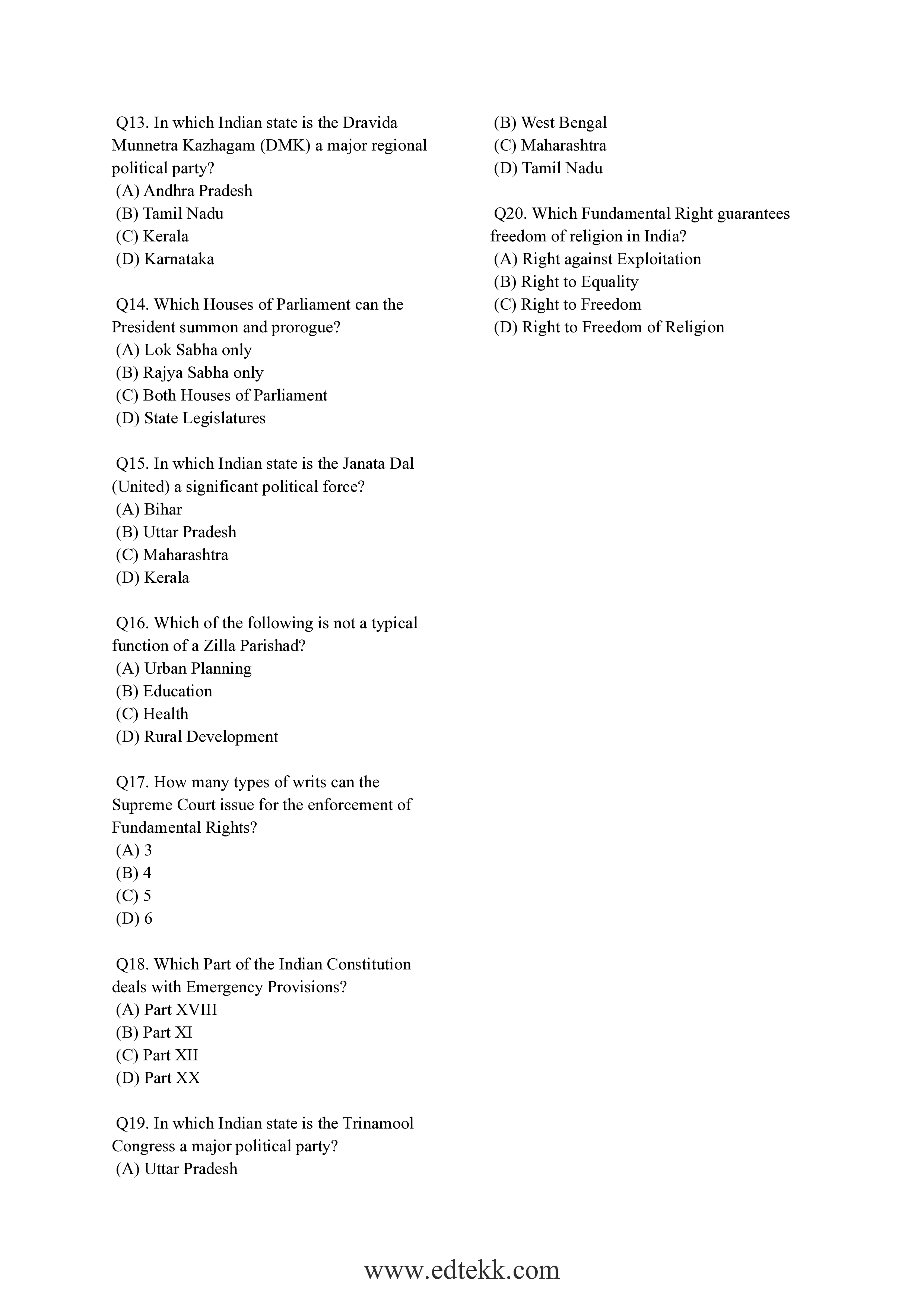
Q13. In which Indian state is the Dravida Munnetra Kazhagam (DMK) a major regional political party?
(A) Andhra Pradesh
(B) Tamil Nadu
(C) Kerala
(D) Karnataka
Explanation: The Dravida Munnetra Kazhagam (DMK) is a major regional political party in Tamil Nadu. Founded in 1949 by C. N. Annadurai, it emerged from the Dravidian political movement and has played a central role in the state’s government and politics.
Q14. Which Houses of Parliament can the President summon and prorogue?
(A) Lok Sabha only
(B) Rajya Sabha only
(C) Both Houses of Parliament
(D) State Legislatures
Explanation: Under Article 85, the President summons and prorogues both Houses of Parliament: the Lok Sabha and the Rajya Sabha. The President may also dissolve the Lok Sabha. The Rajya Sabha is a permanent House and is not subject to dissolution.
Q15. In which Indian state is the Janata Dal (United) a significant political force?
(A) Bihar
(B) Uttar Pradesh
(C) Maharashtra
(D) Kerala
Explanation: The Janata Dal (United), commonly known as JD(U), is a prominent regional political party in Bihar. It has played an important role in the state’s politics and government, particularly under the leadership of Nitish Kumar.
Q16. Which of the following is not a typical function of a Zilla Parishad?
(A) Urban Planning
(B) Education
(C) Health
(D) Rural Development
Explanation: Urban planning is primarily associated with urban local bodies and relevant planning authorities rather than being a typical core function of a Zilla Parishad. Zilla Parishads focus on rural development and may oversee or coordinate activities related to education, public health, sanitation and other rural services under state law.
Q17. How many types of writs can the Supreme Court issue for the enforcement of Fundamental Rights?
(A) 3
(B) 4
(C) 5
(D) 6
Explanation: The Supreme Court can issue five types of writs under Article 32 to enforce Fundamental Rights: Habeas Corpus, Mandamus, Prohibition, Certiorari and Quo Warranto. These writs protect individuals against unlawful detention, improper exercise of jurisdiction and other violations of legal or constitutional rights.
Q18. Which Part of the Indian Constitution deals with Emergency Provisions?
(A) Part XVIII
(B) Part XI
(C) Part XII
(D) Part XX
Explanation: Part XVIII (Articles 352–360) of the Indian Constitution deals with Emergency Provisions. It covers National Emergency, President’s Rule in a state due to the failure of constitutional machinery, and Financial Emergency. These provisions are subject to constitutionally prescribed conditions and procedures.
Q19. In which Indian state is the Trinamool Congress a major political party?
(A) Uttar Pradesh
(B) West Bengal
(C) Maharashtra
(D) Tamil Nadu
Explanation: The All India Trinamool Congress (TMC), commonly known as the Trinamool Congress, is a major political party in West Bengal. Founded by Mamata Banerjee in 1998, it has been a dominant force in the state’s politics and has also expanded its activities to other parts of India.
Q20. Which Fundamental Right guarantees freedom of religion in India?
(A) Right against Exploitation
(B) Right to Equality
(C) Right to Freedom
(D) Right to Freedom of Religion
Explanation: The Right to Freedom of Religion is one of the six categories of Fundamental Rights under Part III of the Constitution. Articles 25–28 protect freedom of conscience, the right to profess, practise and propagate religion, and certain related religious freedoms, subject to constitutional restrictions.
Question Paper Images