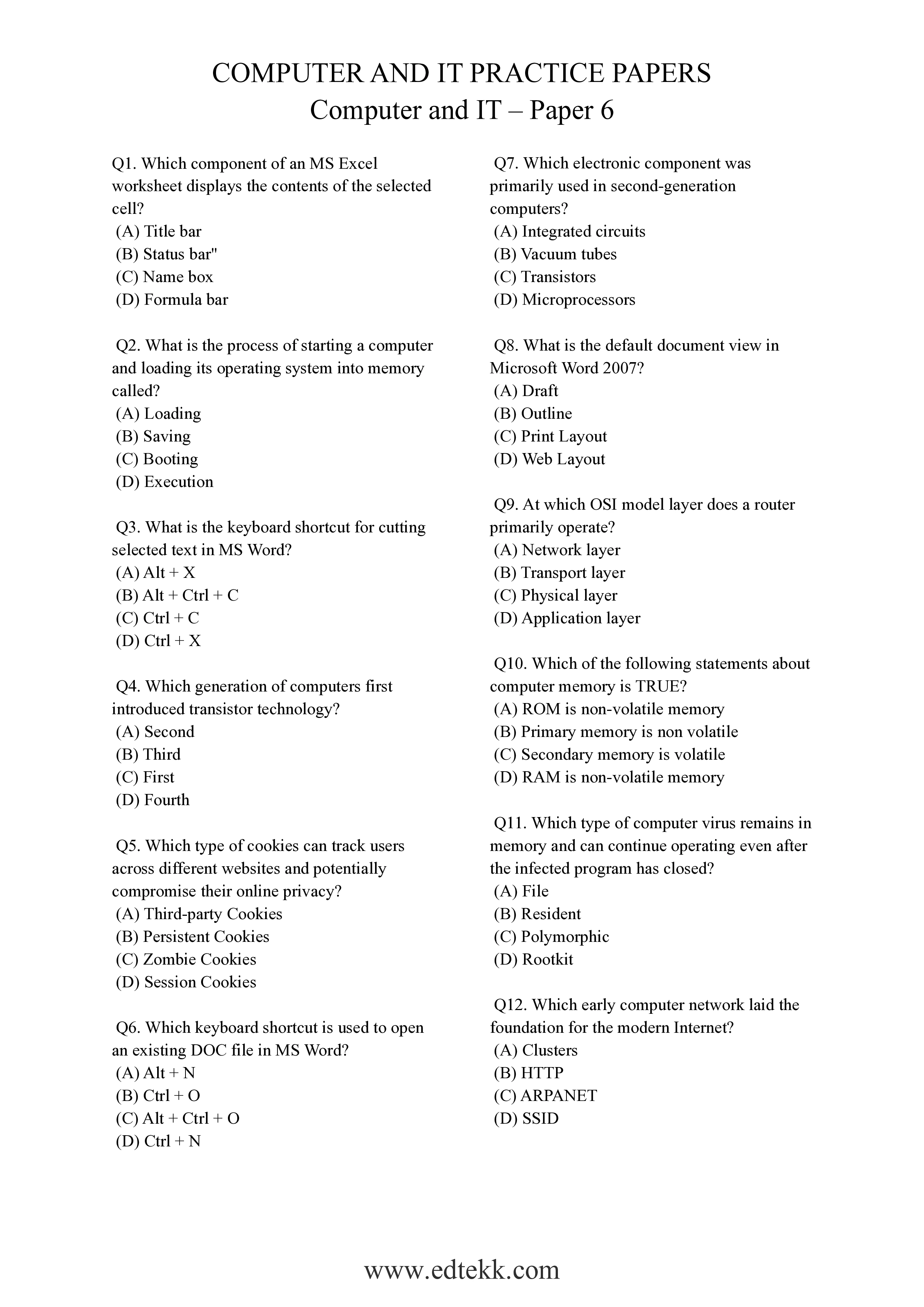
Test and improve your Computer and IT knowledge with Practice Paper 6, designed for Police Constable and Police SI examination preparation. This practice set features competitive-exam-oriented MCQs on computer and IT concepts, along with answers and explanations to strengthen understanding and support systematic revision.
Test Details
Topic: Computer and IT
Total Questions: 20
Question Format: MCQs – Single Correct Answer
Suitable for: Police Constable, Police SI
Download All Papers in This Series (PDF)
Questions and Answers
Q1. Which component of an MS Excel worksheet displays the contents of the selected cell?
(A) Title bar
(B) Status bar”
(C) Name box
(D) Formula bar
Explanation: The Formula Bar displays the contents of the active cell, including text, numbers, and formulas. When a formula is selected, the Formula Bar displays the formula, while the cell normally displays its calculated result.
Q2. What is the process of starting a computer and loading its operating system into memory called?
(A) Loading
(B) Saving
(C) Booting
(D) Execution
Explanation: Booting is the process of starting a computer and loading its operating system into memory (RAM) so that the system becomes ready for use. It generally involves hardware initialization, execution of firmware instructions, identification of a bootable device, and loading the operating system kernel. Booting may be classified as a cold boot or a warm boot.
Q3. What is the keyboard shortcut for cutting selected text in MS Word?
(A) Alt + X
(B) Alt + Ctrl + C
(C) Ctrl + C
(D) Ctrl + X
Explanation: Ctrl + X is the keyboard shortcut used to cut selected text in Microsoft Word. The cut content is removed from its original location and temporarily stored on the Clipboard. It can subsequently be inserted elsewhere using Ctrl + V.
Q4. Which generation of computers first introduced transistor technology?
(A) Second
(B) Third
(C) First
(D) Fourth
Explanation: Second-generation computers introduced transistors in place of vacuum tubes. Transistors were smaller, more reliable, consumed less electricity and generated less heat. First-generation computers primarily used vacuum tubes, while third-generation computers adopted integrated circuits.
Q5. Which type of cookies can track users across different websites and potentially compromise their online privacy?
(A) Third-party Cookies
(B) Persistent Cookies
(C) Zombie Cookies
(D) Session Cookies
Explanation: Third-party cookies are created by domains other than the website directly visited by a user. They can track browsing activity across multiple websites, enabling cross-site profiling and targeted advertising. Their use raises privacy concerns because they may collect information about users without their direct awareness. However, modern browsers increasingly restrict third-party cookies.
Q6. Which keyboard shortcut is used to open an existing DOC file in MS Word?
(A) Alt + N
(B) Ctrl + O
(C) Alt + Ctrl + O
(D) Ctrl + N
Explanation: Ctrl + O opens the Open dialogue or file-opening interface in Microsoft Word. It allows users to browse for and open existing documents, including files with the .doc extension. Ctrl + N creates a new document, whereas Ctrl + O is used to open an existing document.
Q7. Which electronic component was primarily used in second-generation computers?
(A) Integrated circuits
(B) Vacuum tubes
(C) Transistors
(D) Microprocessors
Explanation: Second-generation computers (approximately 1956–1963) primarily used transistors instead of vacuum tubes. Transistors made computers smaller, faster, more reliable and energy-efficient. Integrated circuits became the defining technology of third-generation computers, while microprocessors characterised fourth-generation computers.
Q8. What is the default document view in Microsoft Word 2007?
(A) Draft
(B) Outline
(C) Print Layout
(D) Web Layout
Explanation: Print Layout is the default document view in Microsoft Word 2007. It displays a document as it would appear when printed, including page boundaries, margins, headers, footers and page breaks. Other available views include Draft, Outline and Web Layout.
Q9. At which OSI model layer does a router primarily operate?
(A) Network layer
(B) Transport layer
(C) Physical layer
(D) Application layer
Explanation: A router primarily operates at the Network Layer (Layer 3) of the OSI model. It forwards packets between different networks using logical addressing, particularly IP addresses. Routers examine destination addresses and use routing tables and other routing information to determine the appropriate forwarding path.
Q10. Which of the following statements about computer memory is TRUE?
(A) ROM is non-volatile memory
(B) Primary memory is non volatile
(C) Secondary memory is volatile
(D) RAM is non-volatile memory
Explanation: Read-only memory (ROM) is non-volatile memory, meaning it retains stored information when power is switched off. RAM is generally volatile and loses its contents when power is removed. Primary memory can include both volatile and non-volatile memory, so it is incorrect to classify all primary memory as non-volatile.
Q11. Which type of computer virus remains in memory and can continue operating even after the infected program has closed?
(A) File
(B) Resident
(C) Polymorphic
(D) Rootkit
Explanation: Resident viruses load themselves into a computer’s memory (RAM) and remain active while the system is running. They can infect files or interfere with system operations even after the originally infected program has stopped executing. Removing the infected file alone may not eliminate an active memory-resident virus. Effective removal may require antivirus tools and a clean system restart.
Q12. Which early computer network laid the foundation for the modern Internet?
(A) Clusters
(B) HTTP
(C) ARPANET
(D) SSID
Explanation: ARPANET was an early packet-switching network that laid the foundation for the modern Internet. It facilitated communication between geographically separated computers and contributed to the development of networking technologies and protocols that enabled interconnected computer networks to evolve into the global Internet.
Q13. Which of the following is NOT an open-source operating system?
(A) Windows
(B) Ubuntu
(C) Debian
(D) Fedora
Explanation: Windows is a proprietary operating system developed by Microsoft, unlike Ubuntu, Debian, and Fedora, which are Linux distributions built primarily from open-source software. Their source code is available under applicable open-source licences, permitting modification and redistribution subject to licence conditions. Windows is distributed under Microsoft’s proprietary licensing terms and is therefore the correct answer.
Q14. Which keyboard shortcut opens a new Incognito window in Google Chrome?
(A) Ctrl + Shift + N
(B) Alt + Ctrl + N
(C) Ctrl + P
(D) Ctrl + N
Explanation: Google Chrome uses Ctrl + Shift + N on Windows and Linux to open a new Incognito window. Incognito mode does not save browsing history, cookies, or site data after all Incognito windows are closed. However, downloaded files and bookmarks are retained. It does not make users anonymous to websites, internet service providers, or network administrators.
Q15. Which of the following appears at the extreme right of a worksheet in MS Excel?
(A) Menu bar
(B) Vertical scroll bar.
(C) Horizontal scroll bar
(D) Status bar
Explanation: The vertical scroll bar is generally positioned along the extreme right side of the Excel worksheet area. It is used to move vertically through worksheet rows, whereas the horizontal scroll bar is used to move across columns.
Q16. Which of the following is NOT a part of an email address?
(A) Email service provider’s domain
(B) @ symbol
(C) Photo
(D) Username
Explanation: An email address generally consists of a local part (username), the @ symbol and a domain name identifying the mail system. For example, in student@example.com, “student” is the local part and “example.com” is the domain. A photograph is not a component of an email address.
Q17. In Gmail, which function allows you to send a received message to someone who was not included in the original To or Cc fields?
(A) Print
(B) Report Spam
(C) Forward
(D) Show original
Explanation: Forward is the Gmail function used to send an email received from someone else to another recipient. It allows the original message and its conversation content to be shared with someone who was not included in the original To or Cc fields.
Q18. Which of the following is NOT an Internet service?
(A) E-mail
(B) Ethernet
(C) FTP
(D) World Wide web
Explanation: Ethernet is a networking technology commonly used to connect devices within local area networks (LANs). It is not itself an Internet service. Email, the World Wide Web, and FTP are services or applications that can operate over Internet-connected networks.
Q19. Which Microsoft Word view displays a document as it would appear when printed?
(A) Web Layout
(B) Print Layout
(C) Normal Layout
(D) Reading Layout
Explanation: Print Layout view in Microsoft Word displays a document approximately as it will appear when printed. It shows page boundaries, margins, headers, footers and other page-layout elements, helping users review the document before printing.
Q20. Which number system is used by digital computers to represent and process data?
(A) Octal
(B) Hexadecimal
(C) Binary
(D) Ternary
Explanation: Binary is the number system used internally by digital computers to represent and process information. It uses only two digits, 0 and 1, corresponding to two distinct electronic states. Text, images, instructions and numerical values are represented through combinations of binary digits, each of which is called a bit.
Question Paper Images