Strengthen your Economics preparation with Economics Practice Papers – Paper 2, designed for Banking Exams. This set features 20 objective questions covering important economic concepts, knowledge-based topics and fundamentals, along with correct answers and explanations for effective practice and competitive exam preparation.
Test Details
Topic: Economics
Total Questions: 20
Question Format: MCQs – Single Correct Answer
Suitable for: Banking Exams
Download All Papers in This Series (PDF)
Questions and Answers
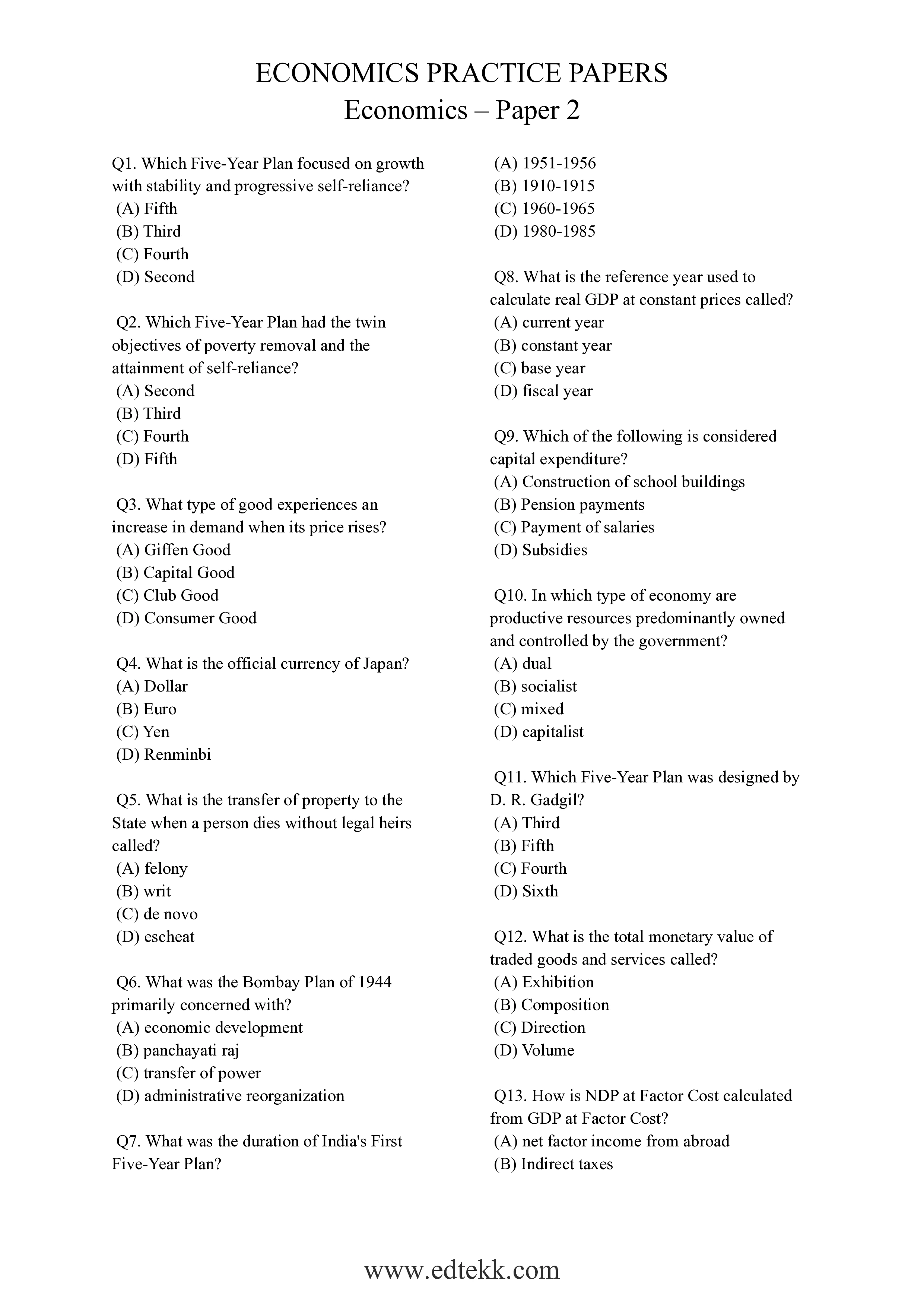
Q1. Which Five-Year Plan focused on growth with stability and progressive self-reliance?
(A) Fifth
(B) Third
(C) Fourth
(D) Second
Explanation: The Fourth Five-Year Plan (1969–1974) adopted the objectives of growth with stability and progressive achievement of self-reliance. It aimed to promote economic growth, maintain price stability, reduce economic inequalities and strengthen domestic resources to finance development. These objectives reflected India’s efforts to achieve greater economic independence and sustainable development.
Q2. Which Five-Year Plan had the twin objectives of poverty removal and the attainment of self-reliance?
(A) Second
(B) Third
(C) Fourth
(D) Fifth
Explanation: The Fifth Five-Year Plan (1974–1979) had the twin objectives of removal of poverty (Garibi Hatao) and attainment of self-reliance. It emphasised employment generation, poverty alleviation, economic development and reducing dependence on foreign assistance. The plan was terminated prematurely in 1978 by the Janata Government.
Q3. What type of good experiences an increase in demand when its price rises?
(A) Giffen Good
(B) Capital Good
(C) Club Good
(D) Consumer Good
Explanation: A Giffen good is an inferior good for which quantity demanded increases when its price rises, other things remaining constant. This unusual response occurs when the negative income effect of a price increase outweighs the substitution effect. Giffen goods are rare and generally associated with essential, inferior goods that account for a substantial share of consumers’ budgets.
Q4. What is the official currency of Japan?
(A) Dollar
(B) Euro
(C) Yen
(D) Renminbi
Explanation: Japan’s official currency is the Japanese yen, represented by the symbol ¥ and the currency code JPY. The renminbi is China’s currency, while the euro is used by many European countries. The dollar is the official currency of several countries, including the United States.
Q5. What is the transfer of property to the State when a person dies without legal heirs called?
(A) felony
(B) writ
(C) de novo
(D) escheat
Explanation: Escheat refers to the transfer of property to the State when a person dies without leaving any legally recognised heirs or other entitled successors. The property then devolves upon the government under applicable succession laws. The term is distinct from writ, de novo and felony, which have different legal meanings.
Q6. What was the Bombay Plan of 1944 primarily concerned with?
(A) economic development
(B) panchayati raj
(C) transfer of power
(D) administrative reorganization
Explanation: The Bombay Plan of 1944 was a proposal for India’s post-independence economic development prepared by eight prominent Indian industrialists. It advocated planned economic development, substantial public investment, state intervention and industrialisation alongside private enterprise. It was an economic development proposal rather than a plan concerning the transfer of power or administrative reorganisation.
Q7. What was the duration of India’s First Five-Year Plan?
(A) 1951-1956
(B) 1910-1915
(C) 1960-1965
(D) 1980-1985
Explanation: India’s First Five-Year Plan covered the period 1951–1956. Based broadly on the Harrod–Domar model, it prioritised agricultural development, irrigation, power generation and price stability. The plan achieved an average annual growth rate of approximately 3.6%, exceeding its original target of 2.1%, partly due to favourable agricultural performance.
Q8. What is the reference year used to calculate real GDP at constant prices called?
(A) current year
(B) constant year
(C) base year
(D) fiscal year
Explanation: The base year is the reference year whose prices are used to calculate real GDP in a fixed-base-year method. Valuing output at base-year prices removes the effect of price changes and helps measure changes in the volume of production. Some statistical systems instead use chain-linked volume measures.
Q9. Which of the following is considered capital expenditure?
(A) Construction of school buildings
(B) Pension payments
(C) Payment of salaries
(D) Subsidies
Explanation: Capital expenditure refers to government spending that creates physical assets or increases the productive capacity of the economy. Constructing school buildings creates public infrastructure and provides long-term benefits. In contrast, pension payments, salaries and subsidies are generally classified as revenue expenditure.
Q10. In which type of economy are productive resources predominantly owned and controlled by the government?
(A) dual
(B) socialist
(C) mixed
(D) capitalist
Explanation: In a socialist economy, productive resources are predominantly owned or controlled by the state or collective institutions. Production and resource allocation are generally guided by social objectives and planning rather than exclusively by private ownership and market forces. The extent of government ownership and planning varies across socialist economic systems.
Q11. Which Five-Year Plan was designed by D. R. Gadgil?
(A) Third
(B) Fifth
(C) Fourth
(D) Sixth
Explanation: The Third Five-Year Plan (1961–1966) is associated with the Gadgil Yojana, named after economist D. R. Gadgil. The plan aimed to establish a self-reliant and self-generating economy. Its priorities included agricultural development, expansion of basic and heavy industries, and reducing dependence on foreign assistance.
Q12. What is the total monetary value of traded goods and services called?
(A) Exhibition
(B) Composition
(C) Direction
(D) Volume
Explanation: Volume of trade refers to the total amount of goods and services exchanged through trade during a specified period. It may be measured in terms of physical quantity or monetary value. In this question, the intended meaning is the aggregate value of traded goods and services.
Q13. How is NDP at Factor Cost calculated from GDP at Factor Cost?
(A) net factor income from abroad
(B) Indirect taxes
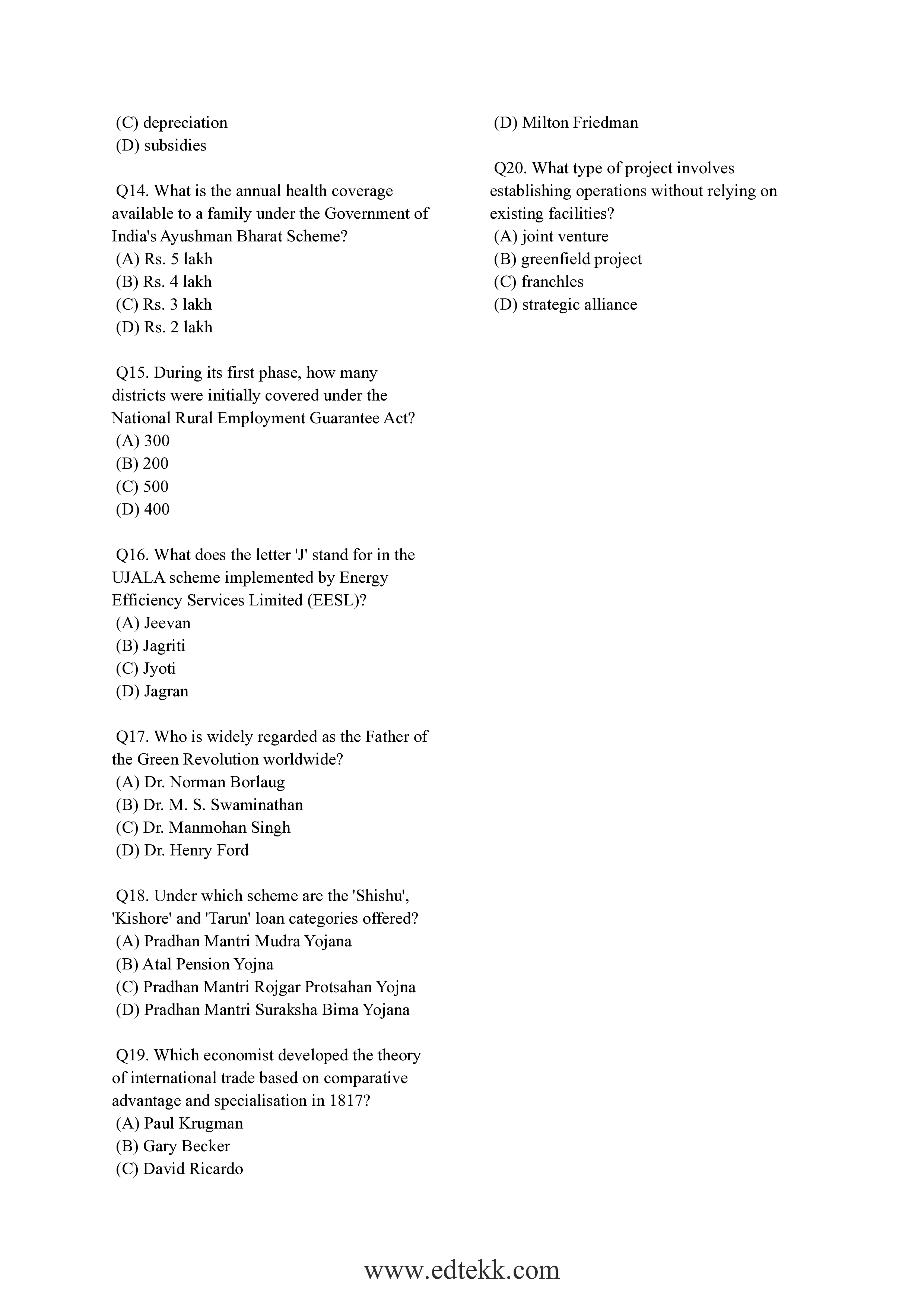
(C) depreciation
(D) subsidies
Explanation: Net Domestic Product at Factor Cost (NDP at FC) is calculated by subtracting depreciation from Gross Domestic Product at Factor Cost (GDP at FC). Depreciation represents the consumption of fixed capital during production, including losses in the value of capital assets due to wear and tear and obsolescence.
Q14. What is the annual health coverage available to a family under the Government of India’s Ayushman Bharat Scheme?
(A) Rs. 5 lakh
(B) Rs. 4 lakh
(C) Rs. 3 lakh
(D) Rs. 2 lakh
Explanation: Under Ayushman Bharat–Pradhan Mantri Jan Arogya Yojana (AB-PMJAY), eligible beneficiary families receive health coverage of up to ₹5 lakh per family per year for specified secondary and tertiary hospitalisation expenses. The scheme provides cashless treatment at empanelled hospitals. Coverage was extended to all senior citizens aged 70 years and above in 2024, irrespective of income.
Q15. During its first phase, how many districts were initially covered under the National Rural Employment Guarantee Act?
(A) 300
(B) 200
(C) 500
(D) 400
Explanation: The National Rural Employment Guarantee Act (NREGA) was initially implemented on 2 February 2006 in 200 districts across India. It was subsequently extended to additional districts in phases, achieving nationwide coverage in 2008. The programme was later renamed the Mahatma Gandhi National Rural Employment Guarantee Scheme (MGNREGS).
Q16. What does the letter ‘J’ stand for in the UJALA scheme implemented by Energy Efficiency Services Limited (EESL)?
(A) Jeevan
(B) Jagriti
(C) Jyoti
(D) Jagran
Explanation: UJALA stands for Unnat Jyoti by Affordable LEDs for All. The letter ‘J’ represents ‘Jyoti’. Launched in 2015, the scheme is implemented by Energy Efficiency Services Limited (EESL) to promote energy efficiency through the distribution of affordable LED bulbs, reducing electricity consumption and household expenditure.
Q17. Who is widely regarded as the Father of the Green Revolution worldwide?
(A) Dr. Norman Borlaug
(B) Dr. M. S. Swaminathan
(C) Dr. Manmohan Singh
(D) Dr. Henry Ford
Explanation: Norman Borlaug is widely regarded as the father of the Green Revolution worldwide for his pioneering work in developing high-yielding, disease-resistant wheat varieties. His research contributed significantly to increased food production in developing countries. He received the Nobel Peace Prize in 1970. M. S. Swaminathan is widely recognised as the father of India’s Green Revolution.
Q18. Under which scheme are the ‘Shishu’, ‘Kishore’ and ‘Tarun’ loan categories offered?
(A) Pradhan Mantri Mudra Yojana
(B) Atal Pension Yojna
(C) Pradhan Mantri Rojgar Protsahan Yojna
(D) Pradhan Mantri Suraksha Bima Yojana
Explanation: Shishu, Kishore and Tarun are the original loan categories under the Pradhan Mantri Mudra Yojana (PMMY). They traditionally covered loans up to ₹50,000, above ₹50,000 up to ₹5 lakh, and above ₹5 lakh up to ₹10 lakh, respectively. In 2024, Tarun Plus was introduced for eligible repeat borrowers, offering loans up to ₹20 lakh.
Q19. Which economist developed the theory of international trade based on comparative advantage and specialisation in 1817?
(A) Paul Krugman
(B) Gary Becker
(C) David Ricardo
(D) Milton Friedman
Explanation: David Ricardo developed the theory of comparative advantage, explaining how countries can benefit from international trade by specialising in goods they produce at a lower opportunity cost. His influential work, On the Principles of Political Economy and Taxation, was published in 1817 and remains foundational to classical international trade theory.
Q20. What type of project involves establishing operations without relying on existing facilities?
(A) joint venture
(B) greenfield project
(C) franchles
(D) strategic alliance
Explanation: A greenfield project involves establishing a new business facility or operation from the ground up, without relying on existing facilities or operations. It allows investors to design infrastructure and organisational arrangements according to their requirements. The term is commonly used in investment and international business.
Question Paper Images