Economics Practice Papers – Paper 3 provides focused practice for candidates preparing for Banking Exams. Covering important Economics concepts through 20 multiple-choice questions, this practice set includes answers and explanations to help aspirants strengthen subject knowledge, improve problem-solving skills and prepare effectively for competitive examinations.
Test Details
Topic: Economics
Total Questions: 20
Question Format: MCQs – Single Correct Answer
Suitable for: Banking Exams
Download All Papers in This Series (PDF)
Questions and Answers
Q1. What is the minimum monthly pension available under the Atal Pension Yojana?
(A) Rs. 2000
(B) Rs. 3000
(C) Rs. 4000
(D) Rs. 1000
Explanation: Under the Atal Pension Yojana (APY), subscribers can choose a guaranteed minimum monthly pension of ₹1,000, ₹2,000, ₹3,000, ₹4,000 or ₹5,000 after attaining 60 years of age. The minimum permissible pension is ₹1,000 per month, subject to the subscriber’s contribution and eligibility conditions.
Q2. In which city is the headquarters of Union Bank of India located?
(A) Mumbai
(B) Lucknow
(C) Mangaluru
(D) Kolkata
Explanation: Union Bank of India has its headquarters in Mumbai, Maharashtra. Established on 11 November 1919, it was inaugurated by Mahatma Gandhi. The bank was nationalised in 1969 and subsequently expanded its banking operations across India.
Q3. In which year was India’s First Five-Year Plan launched?
(A) 1952
(B) 1951
(C) 1961
(D) 1960
Explanation: India’s First Five-Year Plan was launched in 1951 and covered the period 1951–1956. It primarily focused on agricultural development, irrigation, power generation and economic rehabilitation following independence and Partition. Influenced by the Harrod–Domar growth model, the plan prioritised agricultural recovery and investment in essential infrastructure to strengthen the Indian economy.
Q4. What economic term refers to the quantity of goods and services that consumers are willing and able to purchase?
(A) income
(B) supply
(C) price
(D) demand
Explanation: In economics, demand refers to the quantity of a good or service that consumers are willing and able to purchase at different prices during a specified period, other things remaining constant. Mere desire to purchase is insufficient; consumers must also possess the purchasing power to buy the product.
Q5. What is another economic term for the consumption of fixed capital?
(A) net investment
(B) depreciation
(C) appreciation
(D) gross investment
Explanation: Consumption of fixed capital is also known as depreciation. It represents the decline in the value of fixed assets due to normal wear and tear, ageing and obsolescence. Depreciation is deducted from gross investment to calculate net investment, reflecting the replacement of capital lost during production.
Q6. What is unemployment caused by a mismatch between available jobs and workers’ skills called?
(A) Seasonal
(B) Structural
(C) Frictional
(D) Economical
Explanation: Structural unemployment occurs when workers’ skills, qualifications or locations do not match available job opportunities. It may result from technological change, industrial restructuring or geographical mismatches between workers and vacancies. Frictional unemployment, by contrast, occurs when people are temporarily between jobs or entering the labour market.
Q7. In which city is the headquarters of the Insurance Regulatory and Development Authority of India (IRDAI) located?
(A) Hyderabad
(B) Kolkata
(C) New Delhi
(D) Mumbai
Explanation: The headquarters of the Insurance Regulatory and Development Authority of India (IRDAI) is located in Hyderabad, Telangana. IRDAI is a statutory regulatory body established under the IRDA Act, 1999. It regulates the insurance industry, promotes its orderly development and protects the interests of policyholders in India.
Q8. Which major social problem was the Antyodaya Anna Yojana introduced to address?
(A) poverty
(B) unemployment
(C) environmental degradation
(D) population growth
Explanation: Antyodaya Anna Yojana (AAY) was launched in December 2000 to address extreme poverty and food insecurity among the poorest households. Under this scheme, eligible families receive highly subsidised food grains through the Public Distribution System (PDS).
Q9. Which economist is associated with the concept of Functional Finance?
(A) Abba P. Lerner
(B) Adams
(C) Adam Smith
(D) Adolph Wagner
Explanation: Functional Finance is associated with economist Abba P. Lerner. According to this approach, government fiscal policies should be evaluated based on their effects on employment, inflation and economic stability rather than the achievement of a balanced government budget.
Q10. Which Indian state introduced the Camel Protection and Development Policy?
(A) Ladakh
(B) Punjab
(C) Gujarat
(D) Rajasthan
Explanation: The Government of Rajasthan announced the Camel Protection and Development Policy to address the declining camel population and promote camel conservation. The policy focuses on protecting camels, improving breeding practices and encouraging camel rearing. Rajasthan is particularly significant for camel conservation because it accounts for a major share of India’s camel population.
Q11. How many languages, excluding Hindi and English, are displayed on the language panel of Indian banknotes?
(A) 12
(B) 15
(C) 17
(D) 10
Explanation: Indian banknotes display 17 languages in total on their language panels: Hindi and English, along with 15 other Indian languages. Therefore, excluding Hindi and English, the number of languages displayed is 15.
Q12. What is meant by a balanced budget?
(A) Expenditure is more than revenue
(B) Expenditure is greater than revenue
(C) Expenditure is equal to revenue
(D) Expenditure is less than revenue
Explanation: A balanced budget is one in which total government expenditure equals total government receipts during a specified financial period. Under the conventional definition using revenue and expenditure, it indicates neither a budget deficit nor a budget surplus. The precise classification depends on which receipts and expenditures are included.
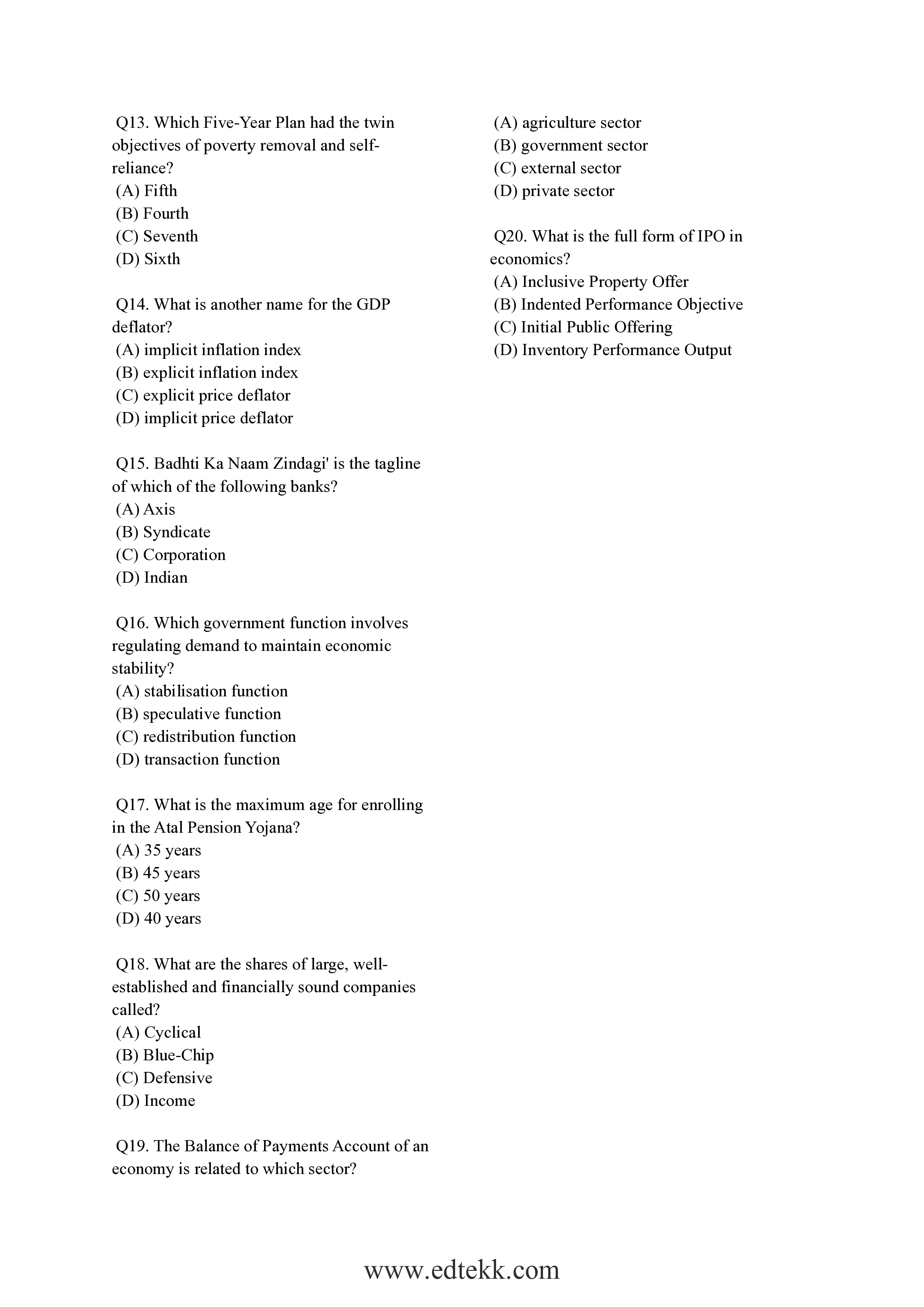
Q13. Which Five-Year Plan had the twin objectives of poverty removal and self-reliance?
(A) Fifth
(B) Fourth
(C) Seventh
(D) Sixth
Explanation: The Fifth Five-Year Plan (1974–1979) had the twin objectives of removal of poverty (Garibi Hatao) and attainment of self-reliance. It emphasised employment generation, poverty alleviation, agricultural development and reducing economic inequalities. The plan was terminated in 1978, one year before its originally scheduled completion.
Q14. What is another name for the GDP deflator?
(A) implicit inflation index
(B) explicit inflation index
(C) explicit price deflator
(D) implicit price deflator
Explanation: The GDP deflator is also called the implicit price deflator. It is calculated as (Nominal GDP ÷ Real GDP) × 100 and measures the price level of domestically produced final goods and services included in GDP. Unlike the Consumer Price Index, it covers a broader range of domestically produced final output.
Q15. Badhti Ka Naam Zindagi’ is the tagline of which of the following banks?
(A) Axis
(B) Syndicate
(C) Corporation
(D) Indian
Explanation: Badhti Ka Naam Zindagi is the advertising tagline associated with Axis Bank. The bank was originally established as UTI Bank and subsequently adopted the name Axis Bank in 2007.
Q16. Which government function involves regulating demand to maintain economic stability?
(A) stabilisation function
(B) speculative function
(C) redistribution function
(D) transaction function
Explanation: The stabilisation function of government involves influencing aggregate demand to maintain economic stability. Expansionary fiscal policy can increase demand during recessions, while contractionary fiscal policy can reduce excessive demand during inflation. Monetary policy, administered by the RBI in India, also contributes to macroeconomic stabilisation.
Q17. What is the maximum age for enrolling in the Atal Pension Yojana?
(A) 35 years
(B) 45 years
(C) 50 years
(D) 40 years
Explanation: The maximum age for joining the Atal Pension Yojana (APY) is 40 years. Eligible Indian citizens having a savings bank account or post office savings account can generally enrol between 18 and 40 years of age. Subscribers become eligible for the guaranteed minimum monthly pension after attaining 60 years.
Q18. What are the shares of large, well-established and financially sound companies called?
(A) Cyclical
(B) Blue-Chip
(C) Defensive
(D) Income
Explanation: Blue-chip stocks represent shares of large, well-established and financially sound companies with a long operating history. Such companies generally have established market positions and relatively stable financial performance. However, blue-chip stocks are not entirely free from investment risks.
Q19. The Balance of Payments Account of an economy is related to which sector?
(A) agriculture sector
(B) government sector
(C) external sector
(D) private sector
Explanation: The Balance of Payments (BoP) records economic transactions between residents of a country and non-residents during a specified period. It covers transactions involving goods, services, primary and secondary income, capital transfers and financial assets and liabilities. Therefore, it reflects the economy’s economic relations with the external sector.
Q20. What is the full form of IPO in economics?
(A) Inclusive Property Offer
(B) Indented Performance Objective
(C) Initial Public Offering
(D) Inventory Performance Output
Explanation: IPO stands for Initial Public Offering. It is the first public offering of a company’s shares to investors. An IPO may involve newly issued shares, enabling the company to raise capital, existing shareholders selling their shares, or both. The company may subsequently seek a stock exchange listing, subject to applicable requirements.
Question Paper Images