Assess your general awareness and improve your competitive-exam readiness with Practice Paper 6. Designed for SSC, Railway, Banking, Police Constable and Police SI aspirants, this set offers 20 MCQs with correct answers and explanations to reinforce knowledge and provide structured examination practice.
Test Details
Topic: General Awareness
Total Questions: 20
Question Format: MCQs – Single Correct Answer
Suitable for: SSC exams, Railway exams, Banking exams, Police Constable, Police SI
Download All Papers in This Series (PDF)
Questions and Answers
Q1. In which year did India host the Asian Games for the second time?
(A) 1976
(B) 1982
(C) 1984
(D) 1951
Explanation: India hosted the Asian Games for the second time in 1982 in New Delhi. It had previously hosted the inaugural Asian Games in 1951, also in New Delhi. The 1982 edition was the ninth Asian Games and brought together athletes from across Asia to compete in multiple sporting disciplines.
Q2. Who was the first Indian Army officer to be conferred the rank of Field Marshal after India’s independence?
(A) Tapishwar Narain Raina
(B) Gopal Gurunath Bewoor
(C) Om Prakash Malhotra
(D) Sam Manekshaw
Explanation: Sam Hormusji Framji Jamshedji Manekshaw became the first Indian Army officer to attain the rank of Field Marshal on 1 January 1973. He served as Chief of the Army Staff during the 1971 Indo-Pakistani War, which resulted in the creation of Bangladesh. He was popularly known as “Sam Bahadur”.
Q3. What was the name of India’s first lunar probe?
(A) Bhaskara-1
(B) Surya-1
(C) Chandrayaan-1
(D) Chandragupta-1
Explanation: Chandrayaan-1 was India’s first lunar exploration mission, launched by ISRO on 22 October 2008 aboard a PSLV-C11 rocket. It entered lunar orbit on 8 November 2008. Its scientific observations, including data from an instrument carried by the mission, provided important evidence of water molecules on the Moon.
Q4. Which bowler was hit for six consecutive sixes in an over during a Men’s T20 World Cup match?
(A) James Anderson
(B) Ben Stokes
(C) Stuart Broad
(D) Moeen Ali
Explanation: Stuart Broad was hit for six consecutive sixes by India’s Yuvraj Singh during the inaugural ICC Men’s T20 World Cup in 2007. The feat occurred during a match between India and England in Durban, South Africa. Yuvraj became the first batter to hit six sixes in an over in international T20 cricket.
Q5. The Kalidas Samman is awarded by the government of which Indian state?
(A) Uttar Pradesh
(B) Tamil Nadu
(C) Gujarat
(D) Madhya Pradesh
Explanation: The Kalidas Samman is conferred by the Government of Madhya Pradesh. Instituted in 1980, it recognises distinguished contributions to classical music, classical dance, theatre and visual arts. The award is named after Kalidasa, the renowned classical Sanskrit poet and playwright, whose literary works are an important part of India’s cultural heritage.
Q6. Who wrote the book The Namesake?
(A) Arundhati Roy
(B) Jhumpa Lahiri
(C) Amitav Ghosh
(D) Siddhartha Mukherjee
Explanation: The Namesake was written by Jhumpa Lahiri and published in 2003. The novel follows the Ganguli family, Indian immigrants who settle in the United States. It explores cultural identity, immigration, family relationships and the experiences of second-generation immigrants, particularly their son, Gogol Ganguli.
Q7. Who was the first Governor of the Reserve Bank of India?
(A) Sir CD Deshmukh
(B) NC Sen Gupta
(C) Sir Osborne Smith
(D) HVR Iyengar
Explanation: Sir Osborne Smith was the first Governor of the Reserve Bank of India (RBI), assuming office on 1 April 1935, when the RBI commenced operations. He served until 30 June 1937. Sir C. D. Deshmukh subsequently became the first Indian Governor of the RBI.
Q8. Who authored the book Every Vote Counts: The Story of India’s Elections?
(A) JM Lyngdoh
(B) Hamid Ansari
(C) Navin Chawla
(D) SY Qureshi
Explanation: Every Vote Counts: The Story of India’s Elections was written by Navin Chawla, a former Chief Election Commissioner of India. Published in 2019, the book examines India’s electoral system, the organisation of elections and the challenges involved in conducting democratic exercises on such a large scale.
Q9. Who wrote India Wins Freedom?
(A) Jawaharlal Nehru
(B) Abul Kalam Azad
(C) Jaswant Singh
(D) Rajendra Prasad
Explanation: India Wins Freedom is the autobiographical memoir of Maulana Abul Kalam Azad. First published in 1959, it presents his account of India’s freedom struggle, the negotiations preceding independence and Partition, and major political developments involving prominent nationalist leaders.
Q10. Who authored the autobiography In the Afternoon of Time?
(A) Harivansh Rai Bachchan
(B) Ruskin Bond
(C) RK Lakshman An
(D) R K Narayan
Explanation: In the Afternoon of Time: An Autobiography is an English-language abridgement of the four-volume autobiography of renowned Hindi poet Harivansh Rai Bachchan. It reflects on his family background, personal experiences, relationships and literary journey, offering insights into modern Hindi literature.
Q11. How many players from each team are on the court at a time in an indoor volleyball match?
(A) 5
(B) 6
(C) 8
(D) 7
Explanation: Indoor volleyball is played by two teams, each with six players on the court at a time. Thus, twelve players are on the court during regular play. Each team normally has three front-row and three back-row players, with substitutions governed by the rules.
Q12. Who wrote the book Gulamgiri?
(A) Ramabai Shinde
(B) Haridas Thakur
(C) Narayana Guru
(D) Jyotirao Phule
Explanation: Jyotirao Phule wrote Gulamgiri (Slavery), published in 1873. The book criticised caste-based oppression and the exploitation of marginalised communities in Indian society. Phule was a pioneering social reformer who advocated women’s education and equality. He also founded the Satyashodhak Samaj in 1873 to challenge caste discrimination.
Q13. In which year was Albert Einstein awarded the Nobel Prize in Physics?
(A) 1934
(B) 1924
(C) 1921
(D) 1920
Explanation: Albert Einstein was awarded the 1921 Nobel Prize in Physics for his contributions to theoretical physics, particularly his explanation of the photoelectric effect. Although the prize was designated for 1921, it was formally presented to him in 1922.
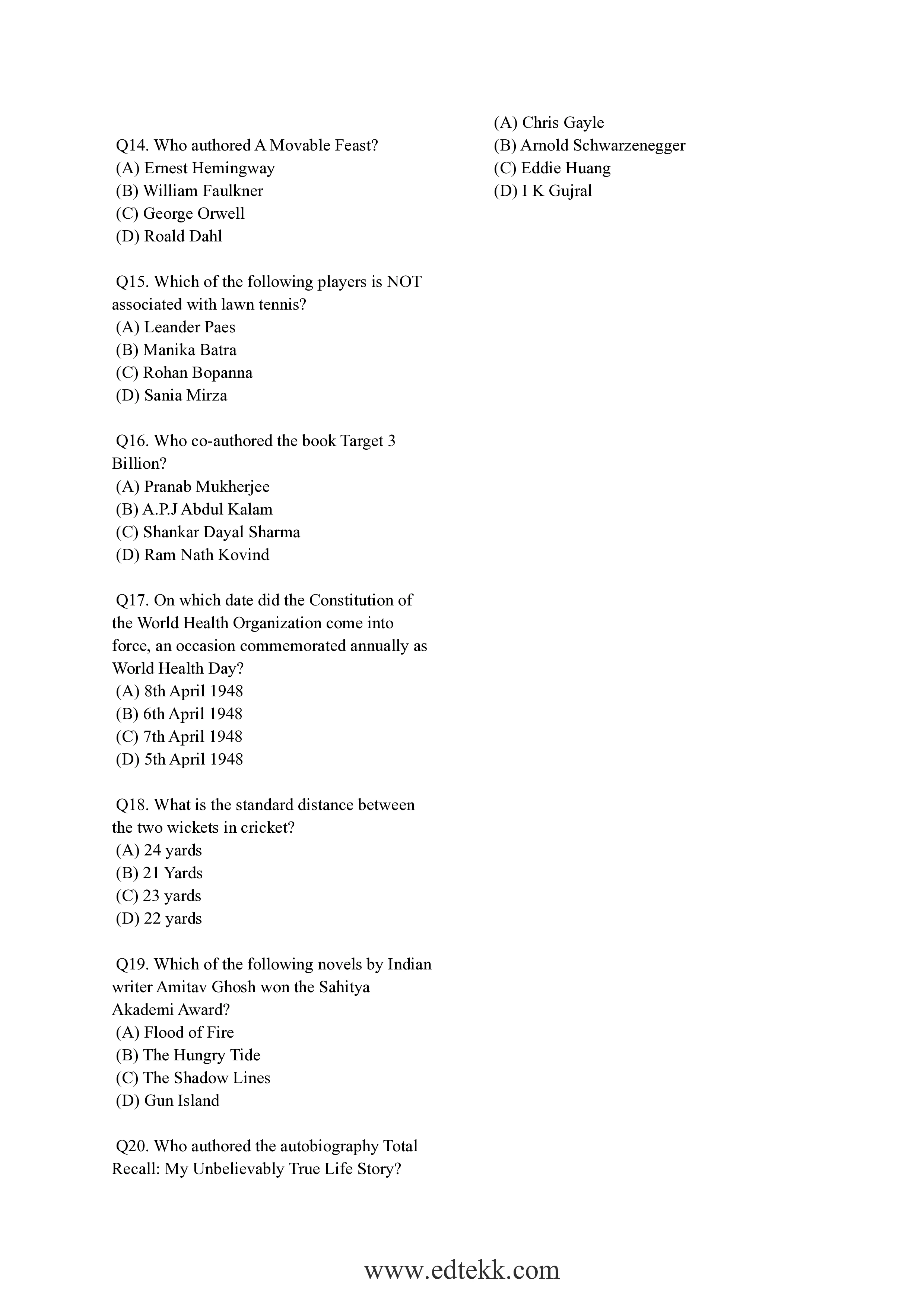
Q14. Who authored A Movable Feast?
(A) Ernest Hemingway
(B) William Faulkner
(C) George Orwell
(D) Roald Dahl
Explanation: A Movable Feast was written by Ernest Hemingway and published posthumously in 1964. This memoir recounts his experiences as a young writer living in Paris during the 1920s. It describes his literary development and encounters with prominent writers and artists of that period.
Q15. Which of the following players is NOT associated with lawn tennis?
(A) Leander Paes
(B) Manika Batra
(C) Rohan Bopanna
(D) Sania Mirza
Explanation: Manika Batra is associated with table tennis, not lawn tennis. She is an Indian table tennis player who has represented India at international competitions, including the Olympic Games. Leander Paes, Rohan Bopanna and Sania Mirza are associated with lawn tennis.
Q16. Who co-authored the book Target 3 Billion?
(A) Pranab Mukherjee
(B) A.P.J Abdul Kalam
(C) Shankar Dayal Sharma
(D) Ram Nath Kovind
Explanation: Target 3 Billion was co-authored by A. P. J. Abdul Kalam and Srijan Pal Singh and published in 2011. The book presents the PURA (Providing Urban Amenities in Rural Areas) model, which promotes rural development through physical, electronic and knowledge connectivity. It emphasises sustainable development, employment generation and improved livelihood opportunities in rural India.
Q17. On which date did the Constitution of the World Health Organization come into force, an occasion commemorated annually as World Health Day?
(A) 8th April 1948
(B) 6th April 1948
(C) 7th April 1948
(D) 5th April 1948
Explanation: The Constitution of the World Health Organization (WHO) came into force on 7 April 1948, marking its formal establishment. World Health Day is observed annually on 7 April to commemorate this occasion and promote awareness of global public health issues.
Q18. What is the standard distance between the two wickets in cricket?
(A) 24 yards
(B) 21 Yards
(C) 23 yards
(D) 22 yards
Explanation: The distance between the two sets of stumps in cricket is 22 yards, equivalent to 20.12 metres. This is the standard length of a cricket pitch, measured between the two wickets. According to the Laws of Cricket, the pitch is 10 feet (3.05 metres) wide.
Q19. Which of the following novels by Indian writer Amitav Ghosh won the Sahitya Akademi Award?
(A) Flood of Fire
(B) The Hungry Tide
(C) The Shadow Lines
(D) Gun Island
Explanation: The Shadow Lines, written by Amitav Ghosh and published in 1988, received the Sahitya Akademi Award in 1989 in the English language category. The novel explores nationalism, identity, memory and the complex relationships between individuals across geographical boundaries. It remains one of Ghosh’s most acclaimed literary works.
Q20. Who authored the autobiography Total Recall: My Unbelievably True Life Story?
(A) Chris Gayle
(B) Arnold Schwarzenegger
(C) Eddie Huang
(D) I K Gujral
Explanation: Total Recall: My Unbelievably True Life Story is the autobiography of Arnold Schwarzenegger, co-written with Peter Petre and published in 2012. It chronicles his journey from bodybuilding success to Hollywood stardom and his political career as Governor of California.
Question Paper Images