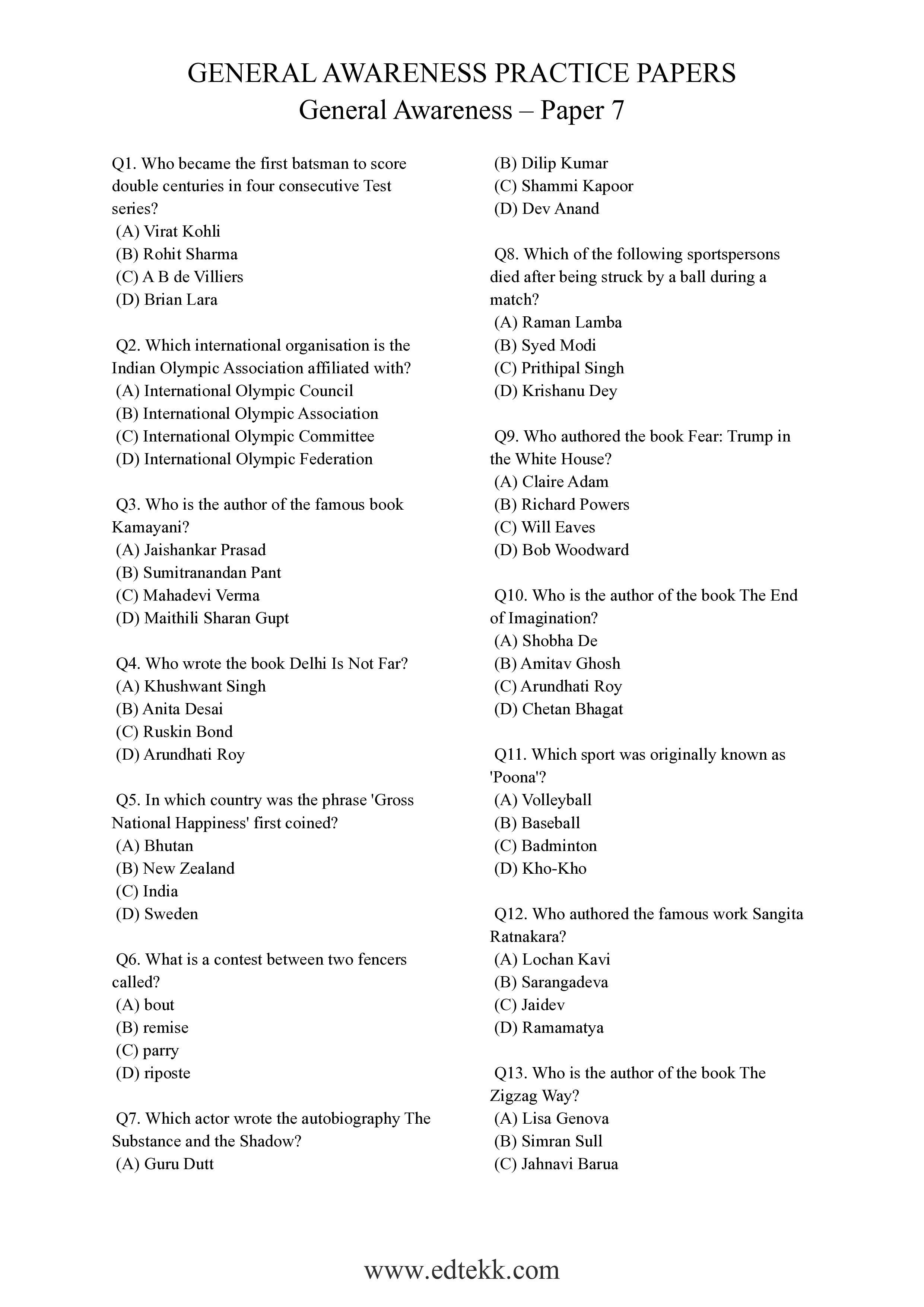
Prepare systematically for SSC, Railway, Banking, Police Constable and Police SI examinations with General Awareness Practice Paper 7. This paper contains 20 MCQs designed to test general awareness, accompanied by correct answers and explanations for effective revision, improved accuracy and better examination preparation.
Test Details
Topic: General Awareness
Total Questions: 20
Question Format: MCQs – Single Correct Answer
Suitable for: SSC exams, Railway exams, Banking exams, Police Constable, Police SI
Download All Papers in This Series (PDF)
Questions and Answers
Q1. Who became the first batsman to score double centuries in four consecutive Test series?
(A) Virat Kohli
(B) Rohit Sharma
(C) A B de Villiers
(D) Brian Lara
Explanation: Virat Kohli became the first batter to score double centuries in four consecutive Test series during 2016–2017. He achieved this feat against the West Indies, New Zealand, England and Bangladesh. His achievement established a notable record in Test cricket, demonstrating exceptional consistency in scoring large individual totals across successive series.
Q2. Which international organisation is the Indian Olympic Association affiliated with?
(A) International Olympic Council
(B) International Olympic Association
(C) International Olympic Committee
(D) International Olympic Federation
Explanation: The Indian Olympic Association (IOA) is India’s National Olympic Committee and is affiliated with the International Olympic Committee (IOC). The IOA coordinates India’s participation in the Olympic Games and other international multi-sport events and promotes the Olympic Movement in India.
Q3. Who is the author of the famous book Kamayani?
(A) Jaishankar Prasad
(B) Sumitranandan Pant
(C) Mahadevi Verma
(D) Maithili Sharan Gupt
Explanation: Jaishankar Prasad wrote Kamayani, a celebrated Hindi epic poem published in 1936. It is regarded as a major work of the Chhayavad movement in Hindi literature. The poem features mythological characters such as Manu, Shraddha and Ida to explore human emotions, intellect, faith and the relationship between human consciousness and civilisation.
Q4. Who wrote the book Delhi Is Not Far?
(A) Khushwant Singh
(B) Anita Desai
(C) Ruskin Bond
(D) Arundhati Roy
Explanation: Delhi Is Not Far was written by Ruskin Bond and published in 1972. Set in a small North Indian town, the novel follows the lives and aspirations of ordinary people, particularly a young writer named Arun. Delhi symbolises hope and the possibility of a different future for the characters.
Q5. In which country was the phrase ‘Gross National Happiness’ first coined?
(A) Bhutan
(B) New Zealand
(C) India
(D) Sweden
Explanation: The phrase Gross National Happiness (GNH) was coined by Bhutan’s fourth King, Jigme Singye Wangchuck, in 1972. It emphasises that national development should consider people’s overall well-being rather than relying solely on economic indicators such as Gross Domestic Product (GDP).
Q6. What is a contest between two fencers called?
(A) bout
(B) remise
(C) parry
(D) riposte
Explanation: In fencing, a contest between two fencers is called a bout. A parry is a defensive action used to deflect an opponent’s attack, while a riposte is an offensive action following a successful parry. A remise is a renewed or continued attack after the initial action.
Q7. Which actor wrote the autobiography The Substance and the Shadow?
(A) Guru Dutt
(B) Dilip Kumar
(C) Shammi Kapoor
(D) Dev Anand
Explanation: The Substance and the Shadow: An Autobiography was written by Dilip Kumar, whose birth name was Muhammad Yusuf Khan. Published in 2014, it recounts his personal life and long career in Indian cinema, making it an important autobiographical work by the celebrated actor.
Q8. Which of the following sportspersons died after being struck by a ball during a match?
(A) Raman Lamba
(B) Syed Modi
(C) Prithipal Singh
(D) Krishanu Dey
Explanation: Raman Lamba, a former Indian international cricketer, died in 1998 after being struck on the head by a cricket ball while fielding close to the batter during a club match in Bangladesh. He sustained a severe head injury and died three days later.
Q9. Who authored the book Fear: Trump in the White House?
(A) Claire Adam
(B) Richard Powers
(C) Will Eaves
(D) Bob Woodward
Explanation: Fear: Trump in the White House was authored by Bob Woodward and published in 2018. The book examines Donald Trump’s administration, drawing on interviews with individuals close to the administration. It describes internal decision-making, political developments and the functioning of the White House during Trump’s presidency.
Q10. Who is the author of the book The End of Imagination?
(A) Shobha De
(B) Amitav Ghosh
(C) Arundhati Roy
(D) Chetan Bhagat
Explanation: The End of Imagination was written by Arundhati Roy and originally published in 1998 as an essay. It strongly criticises India’s nuclear weapons tests conducted in May 1998. The essay questions nuclear nationalism, militarisation and the consequences of nuclear weapons for humanity and democratic society.
Q11. Which sport was originally known as ‘Poona’?
(A) Volleyball
(B) Baseball
(C) Badminton
(D) Kho-Kho
Explanation: Badminton was initially known as Poona or Poonah, after the Indian city of Pune, where British military officers played an early form of the game during the nineteenth century. The sport subsequently developed in England and acquired the name badminton after Badminton House, the estate of the Duke of Beaufort.
Q12. Who authored the famous work Sangita Ratnakara?
(A) Lochan Kavi
(B) Sarangadeva
(C) Jaidev
(D) Ramamatya
Explanation: Sarangadeva, a thirteenth-century Indian musicologist, authored Sangita Ratnakara, an influential Sanskrit treatise on Indian classical music and dance. It discusses musical theory, ragas, talas and performance practices. The work is particularly significant as an important link in the historical development of Hindustani and Carnatic musical traditions.
Q13. Who is the author of the book The Zigzag Way?
(A) Lisa Genova
(B) Simran Sull
(C) Jahnavi Barua
(D) Anita Desai
Explanation: The Zigzag Way is a novel by Anita Desai. Set largely in Mexico, it follows an American academic and explores themes of identity, cultural displacement, family history and personal discovery. Desai is also known for Clear Light of Day and In Custody.
Q14. In which year did India become a full member of the Shanghai Cooperation Organisation (SCO)?
(A) 2015
(B) 2018
(C) 2017
(D) 2016
Explanation: India became a full member of the Shanghai Cooperation Organisation (SCO) in June 2017 at the Astana Summit in Kazakhstan, alongside Pakistan. India had previously held observer status since 2005. The SCO promotes regional security, counterterrorism, economic cooperation and political dialogue.
Q15. The Scissor Cup is associated with which sport?
(A) Hockey
(B) Badminton
(C) Cricket
(D) Football
Explanation: The Scissor Cup is associated with football. It is listed among the football trophies and competitions associated with India. Other prominent Indian football competitions and trophies include the Durand Cup, Rovers Cup, Santosh Trophy and Subroto Cup.
Q16. What is the standard height of a netball goalpost?
(A) 6 ft
(B) 10 ft
(C) 15 ft
(D) 12 ft
Explanation: A standard netball goalpost is 10 feet (3.05 metres) high. It consists of a vertical pole with a horizontal ring attached at the top. The ring has an internal diameter of 15 inches and is fitted with a net.
Q17. Who co-authored the autobiography Wings of Fire?
(A) A. P. J. Abdul Kalam and Arun Tiwari
(B) Ram Nath Kovind and A. P. J. Abdul Kalam
(C) Pranab Mukherjee and Arun Tiwari
(D) K. R. Narayanan and A. P. J. Abdul Kalam
Explanation: Wings of Fire is the autobiography of former Indian President Dr. A. P. J. Abdul Kalam, co-authored with Arun Tiwari and published in 1999. It recounts Kalam’s childhood, education, scientific career and contributions to India’s missile development programmes.
Q18. The term ‘twiddle’ is associated with which sport?
(A) Table Tennis
(B) Cricket
(C) Rugby
(D) Hockey
Explanation: Twiddle is a technique associated with table tennis. It involves rotating the racket during a rally to use the different playing characteristics of the rubber surfaces on either side. Players employ this technique to vary spin and shot characteristics, making it difficult for opponents to anticipate the ball’s behaviour.
Q19. Which equestrian discipline combines gymnastics and dance-like movements performed on horseback?
(A) Jousting
(B) Equestrian Vaulting
(C) Barrel Racing
(D) Steeplechase
Explanation: Equestrian vaulting combines gymnastics and dance-like movements performed on a moving horse. The horse generally moves in a controlled circle while athletes perform individual or team routines requiring balance, strength, flexibility and coordination.
Q20. Where is the headquarters of the National Institute of Oceanography (NIO) located?
(A) New Delhi
(B) Goa
(C) Hyderabad
(D) Kanyakumari
Explanation: The National Institute of Oceanography (NIO) is headquartered at Dona Paula, Goa. Established in 1966, it operates under the Council of Scientific and Industrial Research (CSIR). Its research areas include marine biology, oceanography, marine geology, ocean engineering and coastal processes.
Question Paper Images