Enhance your competitive-exam preparation with General Studies Practice Paper 5, focused on General Awareness. This MCQ practice set helps candidates assess their general knowledge through relevant objective questions, answers and explanations. It supports preparation and revision for SSC, Railway, Banking, Police Constable and Police SI examinations.
Test Details
Topic: General Awareness
Total Questions: 20
Question Format: MCQs – Single Correct Answer
Suitable for: SSC exams, Railway exams, Banking exams, Police Constable, Police SI
Download All Papers in This Series (PDF)
Questions and Answers
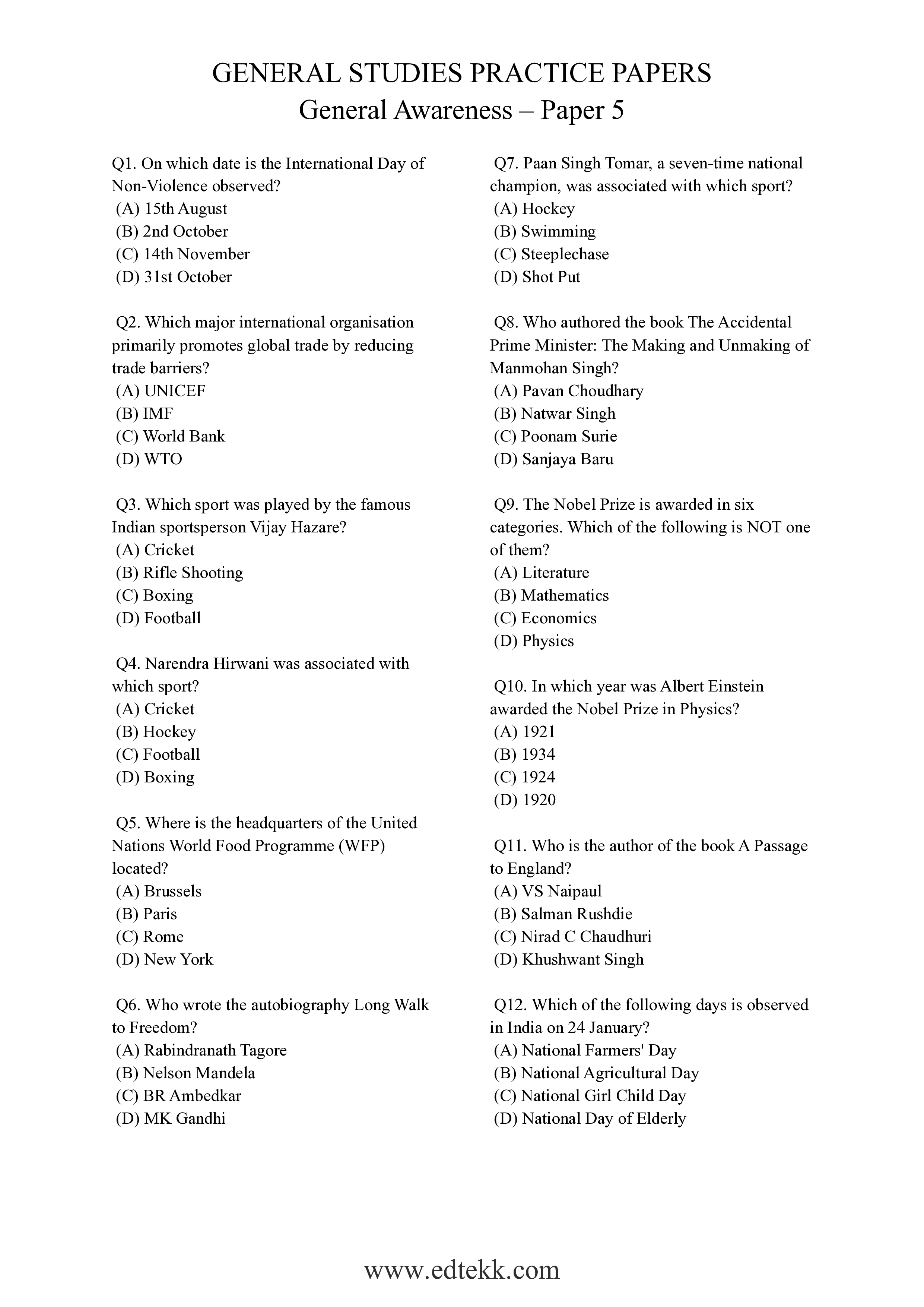
Q1. On which date is the International Day of Non-Violence observed?
(A) 15th August
(B) 2nd October
(C) 14th November
(D) 31st October
Explanation: The International Day of Non-Violence is observed annually on 2 October, marking the birth anniversary of Mahatma Gandhi. The United Nations established this observance to promote non-violence through education and public awareness and encourage a culture of peace, tolerance and understanding.
Q2. Which major international organisation primarily promotes global trade by reducing trade barriers?
(A) UNICEF
(B) IMF
(C) World Bank
(D) WTO
Explanation: The World Trade Organization (WTO) promotes rules-based international trade and works towards reducing trade barriers among member countries. It provides a forum for trade negotiations, monitors trade policies and facilitates the settlement of trade disputes. The IMF focuses on international monetary and financial stability, the World Bank supports development, and UNICEF works primarily for children’s rights and welfare.
Q3. Which sport was played by the famous Indian sportsperson Vijay Hazare?
(A) Cricket
(B) Rifle Shooting
(C) Boxing
(D) Football
Explanation: Vijay Hazare was a renowned Indian cricketer who represented India in Test cricket from 1946 to 1953. He was a right-handed batsman and occasional medium-pace bowler. He also captained the Indian team and became the first Indian to score a Test century against Australia.
Q4. Narendra Hirwani was associated with which sport?
(A) Cricket
(B) Hockey
(C) Football
(D) Boxing
Explanation: Narendra Hirwani is associated with cricket. He is a former Indian leg-spinner who made a remarkable Test debut against the West Indies in 1988, taking 16 wickets in the match. His bowling figures were 8/61 and 8/75, making him one of the most successful bowlers on Test debut.
Q5. Where is the headquarters of the United Nations World Food Programme (WFP) located?
(A) Brussels
(B) Paris
(C) Rome
(D) New York
Explanation: The World Food Programme (WFP) is headquartered in Rome, Italy. Established in 1961, it is the United Nations’ principal humanitarian organisation providing food assistance during emergencies and supporting nutrition and food security. It received the Nobel Peace Prize in 2020 for its efforts to combat hunger and prevent the use of hunger as a weapon of conflict.
Q6. Who wrote the autobiography Long Walk to Freedom?
(A) Rabindranath Tagore
(B) Nelson Mandela
(C) BR Ambedkar
(D) MK Gandhi
Explanation: Long Walk to Freedom is the autobiography of Nelson Mandela, published in 1994. It describes his childhood, struggle against apartheid, 27 years of imprisonment and eventual emergence as South Africa’s first Black president in 1994.
Q7. Paan Singh Tomar, a seven-time national champion, was associated with which sport?
(A) Hockey
(B) Swimming
(C) Steeplechase
(D) Shot Put
Explanation: Paan Singh Tomar was an Indian athlete who specialised in the 3,000-metre steeplechase. He won the national championship in this event seven consecutive times. After retiring from athletics, he served in the Indian Army and later became widely known through the biographical film Paan Singh Tomar.
Q8. Who authored the book The Accidental Prime Minister: The Making and Unmaking of Manmohan Singh?
(A) Pavan Choudhary
(B) Natwar Singh
(C) Poonam Surie
(D) Sanjaya Baru
Explanation: The Accidental Prime Minister: The Making and Unmaking of Manmohan Singh was written by Sanjaya Baru and published in 2014. Baru, who served as Manmohan Singh’s media adviser, provides an account of his experiences in the Prime Minister’s Office and discusses political decision-making during Singh’s premiership.
Q9. The Nobel Prize is awarded in six categories. Which of the following is NOT one of them?
(A) Literature
(B) Mathematics
(C) Economics
(D) Physics
Explanation: Mathematics is not among the six Nobel Prize categories. The six recognised categories are Physics, Chemistry, Physiology or Medicine, Literature, Peace and Economic Sciences. The Sveriges Riksbank Prize in Economic Sciences in Memory of Alfred Nobel was instituted separately in 1968. There is no Nobel Prize category for Mathematics.
Q10. In which year was Albert Einstein awarded the Nobel Prize in Physics?
(A) 1921
(B) 1934
(C) 1924
(D) 1920
Explanation: Albert Einstein was awarded the 1921 Nobel Prize in Physics for his contributions to theoretical physics, particularly his explanation of the photoelectric effect. Although the prize was designated for 1921, it was formally presented to him in 1922.
Q11. Who is the author of the book A Passage to England?
(A) VS Naipaul
(B) Salman Rushdie
(C) Nirad C Chaudhuri
(D) Khushwant Singh
Explanation: A Passage to England was written by Nirad C. Chaudhuri and published in 1959. The book records his observations and impressions of England and British society, reflecting on cultural differences, historical relationships and his experiences during his visit.
Q12. Which of the following days is observed in India on 24 January?
(A) National Farmers’ Day
(B) National Agricultural Day
(C) National Girl Child Day
(D) National Day of Elderly
Explanation: National Girl Child Day is observed in India every year on 24 January. It was initiated by the Government of India in 2008 to raise awareness about girls’ rights, education, health and empowerment and to address gender discrimination and inequalities.
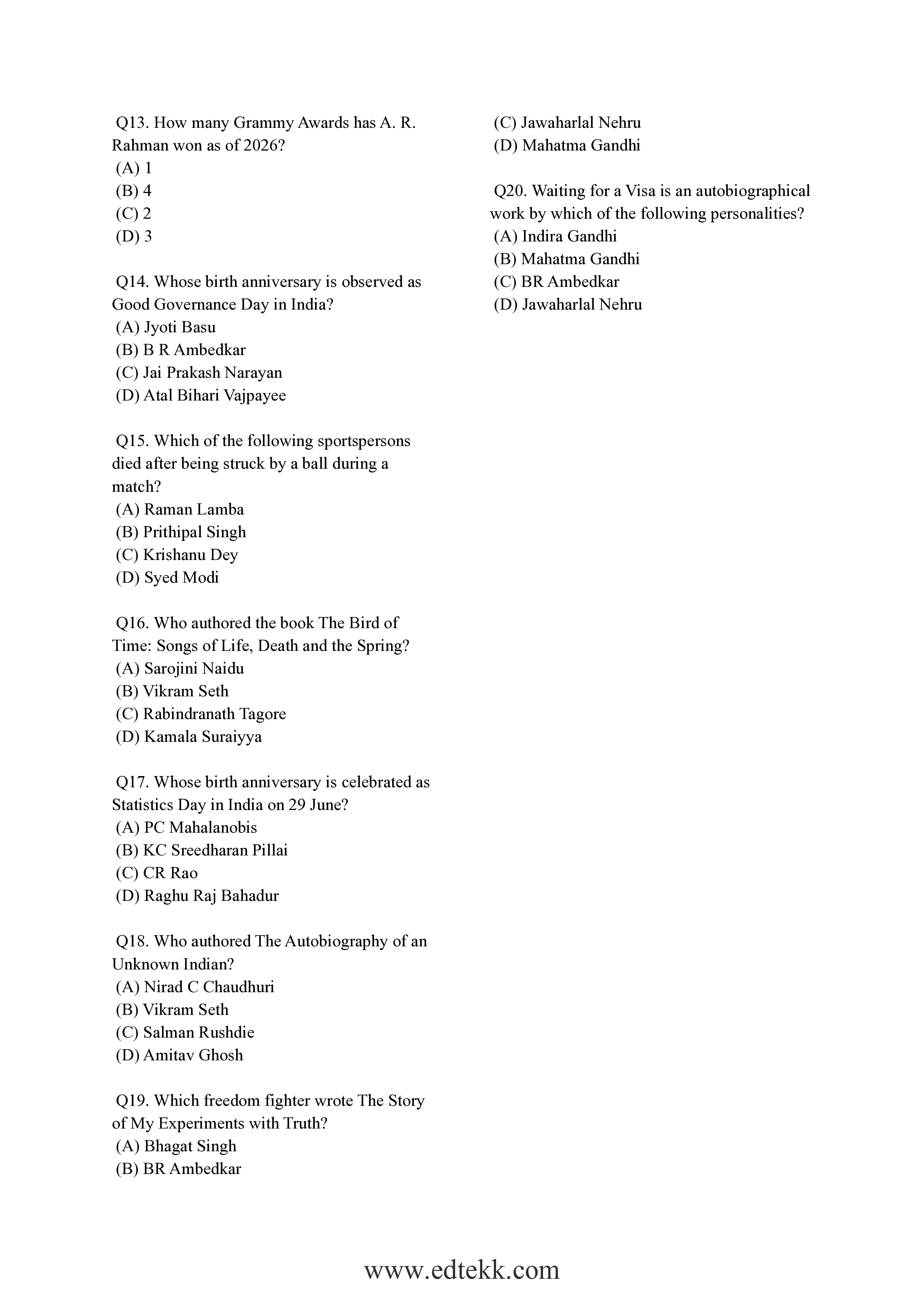
Q13. How many Grammy Awards has A. R. Rahman won as of 2026?
(A) 1
(B) 4
(C) 2
(D) 3
Explanation: A. R. Rahman has won two Grammy Awards. Both awards were received in 2010 for his work on the film Slumdog Millionaire. He received awards for Best Compilation Soundtrack Album for Motion Picture, Television or Other Visual Media and Best Song Written for Motion Picture, Television or Other Visual Media for Jai Ho.
Q14. Whose birth anniversary is observed as Good Governance Day in India?
(A) Jyoti Basu
(B) B R Ambedkar
(C) Jai Prakash Narayan
(D) Atal Bihari Vajpayee
Explanation: Good Governance Day is observed in India on 25 December, the birth anniversary of former Prime Minister Atal Bihari Vajpayee. Introduced in 2014, the observance honours his contributions and promotes transparency, accountability, efficiency and citizen-oriented administration in government functioning.
Q15. Which of the following sportspersons died after being struck by a ball during a match?
(A) Raman Lamba
(B) Prithipal Singh
(C) Krishanu Dey
(D) Syed Modi
Explanation: Raman Lamba, a former Indian international cricketer, died in 1998 after being struck on the head by a cricket ball while fielding close to the batter during a club match in Bangladesh. He sustained a severe head injury and died three days later.
Q16. Who authored the book The Bird of Time: Songs of Life, Death and the Spring?
(A) Sarojini Naidu
(B) Vikram Seth
(C) Rabindranath Tagore
(D) Kamala Suraiyya
Explanation: The Bird of Time: Songs of Life, Death and the Spring is a collection of poems by Sarojini Naidu, first published in 1912. The collection explores themes of love, nature, Indian culture, mortality and the passage of time. Sarojini Naidu is popularly known as the Nightingale of India.
Q17. Whose birth anniversary is celebrated as Statistics Day in India on 29 June?
(A) PC Mahalanobis
(B) KC Sreedharan Pillai
(C) CR Rao
(D) Raghu Raj Bahadur
Explanation: Statistics Day is celebrated in India on 29 June, the birth anniversary of Professor Prasanta Chandra Mahalanobis. He made significant contributions to statistical science and founded the Indian Statistical Institute. The observance highlights the importance of statistics in national planning, policymaking and economic development.
Q18. Who authored The Autobiography of an Unknown Indian?
(A) Nirad C Chaudhuri
(B) Vikram Seth
(C) Salman Rushdie
(D) Amitav Ghosh
Explanation: The Autobiography of an Unknown Indian was written by Nirad C. Chaudhuri, an Indian-English writer and intellectual. Published in 1951, the book explores his childhood, education, cultural influences and observations on Indian society under British colonial rule.
Q19. Which freedom fighter wrote The Story of My Experiments with Truth?
(A) Bhagat Singh
(B) BR Ambedkar
(C) Jawaharlal Nehru
(D) Mahatma Gandhi
Explanation: Mahatma Gandhi wrote The Story of My Experiments with Truth, his autobiography. Originally written in Gujarati under the title Satya Na Prayogo Athva Atmakatha, it recounts his life, personal experiences, moral struggles and experiments with truth and non-violence. Mahadev Desai translated the autobiography into English.
Q20. Waiting for a Visa is an autobiographical work by which of the following personalities?
(A) Indira Gandhi
(B) Mahatma Gandhi
(C) BR Ambedkar
(D) Jawaharlal Nehru
Explanation: Waiting for a Visa is an autobiographical account by Dr. B. R. Ambedkar. It describes experiences of caste discrimination and untouchability from his childhood and professional life. The work provides a significant first-hand account of caste-based exclusion and social discrimination in colonial India.
Question Paper Images