Strengthen your General Studies preparation with General Awareness Practice Paper 6, developed for competitive-exam aspirants. The MCQ-based question set offers practice questions, answers and explanations to help improve conceptual understanding and exam confidence. It is relevant for SSC, Railway, Banking, Police Constable and Police SI examinations.
Test Details
Topic: General Awareness
Total Questions: 20
Question Format: MCQs – Single Correct Answer
Suitable for: SSC exams, Railway exams, Banking exams, Police Constable, Police SI
Download All Papers in This Series (PDF)
Questions and Answers
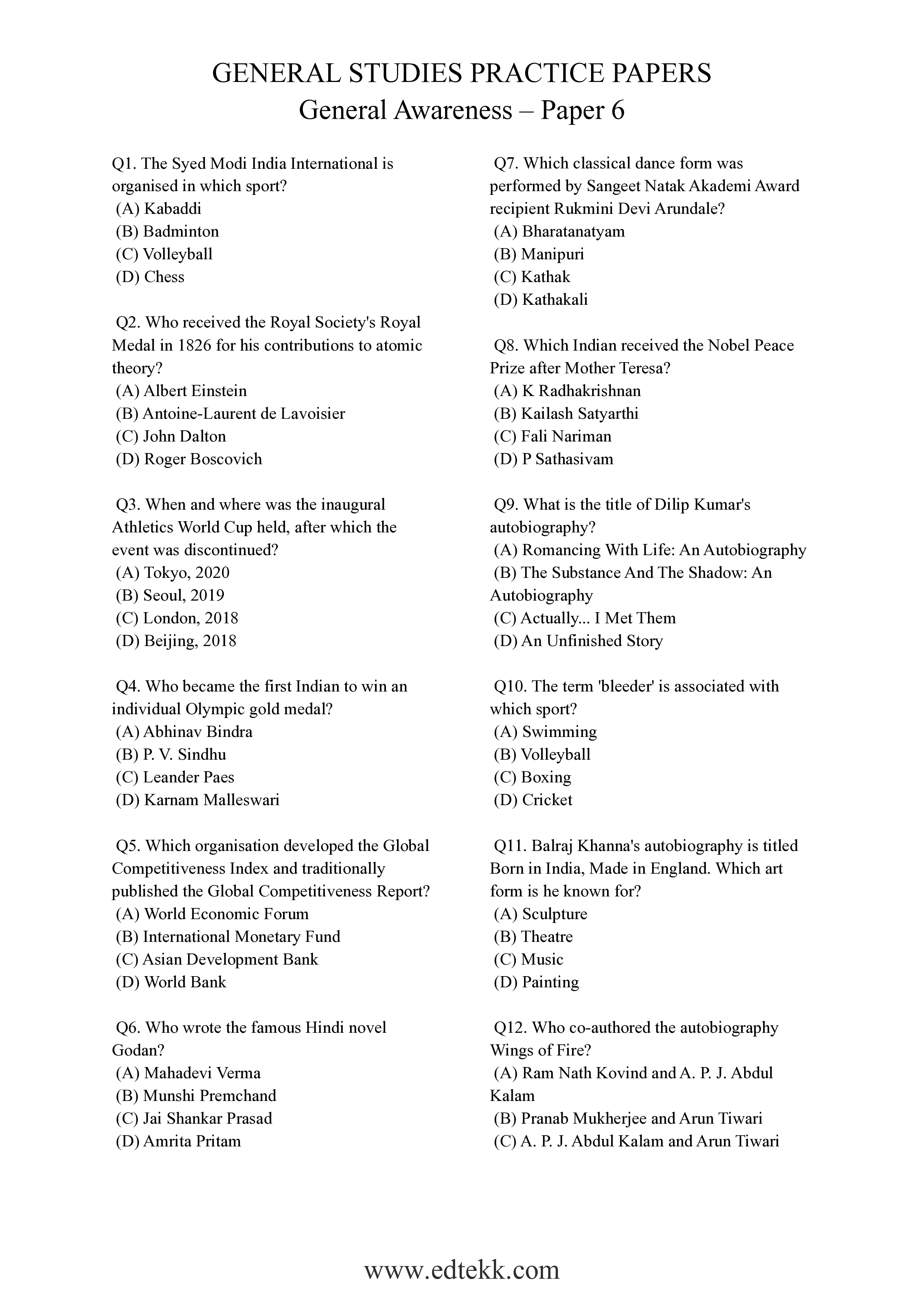
Q1. The Syed Modi India International is organised in which sport?
(A) Kabaddi
(B) Badminton
(C) Volleyball
(D) Chess
Explanation: The Syed Modi India International is an international badminton tournament organised in India. It is named after Syed Modi, an accomplished Indian badminton player, and forms part of the international badminton competition calendar under the Badminton World Federation (BWF).
Q2. Who received the Royal Society’s Royal Medal in 1826 for his contributions to atomic theory?
(A) Albert Einstein
(B) Antoine-Laurent de Lavoisier
(C) John Dalton
(D) Roger Boscovich
Explanation: John Dalton received the Royal Society’s Royal Medal in 1826 in recognition of his contributions to atomic theory. He proposed that matter consists of indivisible atoms and that atoms of different elements combine in fixed proportions to form chemical compounds. His theory laid the foundation for modern atomic theory.
Q3. When and where was the inaugural Athletics World Cup held, after which the event was discontinued?
(A) Tokyo, 2020
(B) Seoul, 2019
(C) London, 2018
(D) Beijing, 2018
Explanation: The inaugural and only edition of the Athletics World Cup was held in London, United Kingdom, in 2018. The competition featured national teams competing in track and field events. The event was discontinued after its inaugural edition, making London 2018 its only edition.
Q4. Who became the first Indian to win an individual Olympic gold medal?
(A) Abhinav Bindra
(B) P. V. Sindhu
(C) Leander Paes
(D) Karnam Malleswari
Explanation: Abhinav Bindra became the first Indian to win an individual Olympic gold medal by winning the men’s 10-metre air rifle event at the 2008 Beijing Olympics. India had previously won Olympic gold medals in field hockey, but none in an individual event.
Q5. Which organisation developed the Global Competitiveness Index and traditionally published the Global Competitiveness Report?
(A) World Economic Forum
(B) International Monetary Fund
(C) Asian Development Bank
(D) World Bank
Explanation: The World Economic Forum (WEF) developed the Global Competitiveness Index and traditionally published the Global Competitiveness Report. The index assesses countries on factors such as institutions, infrastructure, technological readiness, innovation and macroeconomic conditions. WEF is an international organisation headquartered in Geneva, Switzerland, and is known for its annual meeting in Davos.
Q6. Who wrote the famous Hindi novel Godan?
(A) Mahadevi Verma
(B) Munshi Premchand
(C) Jai Shankar Prasad
(D) Amrita Pritam
Explanation: Munshi Premchand authored the famous Hindi novel Godan, published in 1936. The novel portrays the struggles of Indian peasants, particularly through the life of its central character, Hori. It is widely regarded as one of the most significant works of modern Hindi literature.
Q7. Which classical dance form was performed by Sangeet Natak Akademi Award recipient Rukmini Devi Arundale?
(A) Bharatanatyam
(B) Manipuri
(C) Kathak
(D) Kathakali
Explanation: Rukmini Devi Arundale was a renowned Bharatanatyam dancer, choreographer and cultural revivalist. She received the Sangeet Natak Akademi Award in 1957 for her contribution to Indian classical dance. She played a significant role in revitalising Bharatanatyam and founded Kalakshetra in Chennai, an institution dedicated to Indian classical arts and cultural education.
Q8. Which Indian received the Nobel Peace Prize after Mother Teresa?
(A) K Radhakrishnan
(B) Kailash Satyarthi
(C) Fali Nariman
(D) P Sathasivam
Explanation: Kailash Satyarthi received the Nobel Peace Prize in 2014, jointly with Malala Yousafzai, for their efforts to protect children’s rights and promote education. Mother Teresa received the Nobel Peace Prize in 1979. Satyarthi was therefore the Indian recipient who received this award after Mother Teresa.
Q9. What is the title of Dilip Kumar’s autobiography?
(A) Romancing With Life: An Autobiography
(B) The Substance And The Shadow: An Autobiography
(C) Actually… I Met Them
(D) An Unfinished Story
Explanation: The Substance and the Shadow: An Autobiography is the autobiography of legendary Indian actor Dilip Kumar. Published in 2014, the book chronicles his childhood, acting career, personal relationships and experiences in Indian cinema.
Q10. The term ‘bleeder’ is associated with which sport?
(A) Swimming
(B) Volleyball
(C) Boxing
(D) Cricket
Explanation: A ‘bleeder’ is a term associated with boxing. It describes a boxer who is particularly susceptible to cuts and bleeding during a bout, often because of existing scar tissue or vulnerable facial areas. Severe bleeding may result in the referee or ringside doctor stopping the contest.
Q11. Balraj Khanna’s autobiography is titled Born in India, Made in England. Which art form is he known for?
(A) Sculpture
(B) Theatre
(C) Music
(D) Painting
Explanation: Balraj Khanna was an Indian-born British artist and writer known primarily for his paintings. His autobiography, Born in India, Made in England, describes his life and artistic journey. Therefore, painting is the correct answer.
Q12. Who co-authored the autobiography Wings of Fire?
(A) Ram Nath Kovind and A. P. J. Abdul Kalam
(B) Pranab Mukherjee and Arun Tiwari
(C) A. P. J. Abdul Kalam and Arun Tiwari
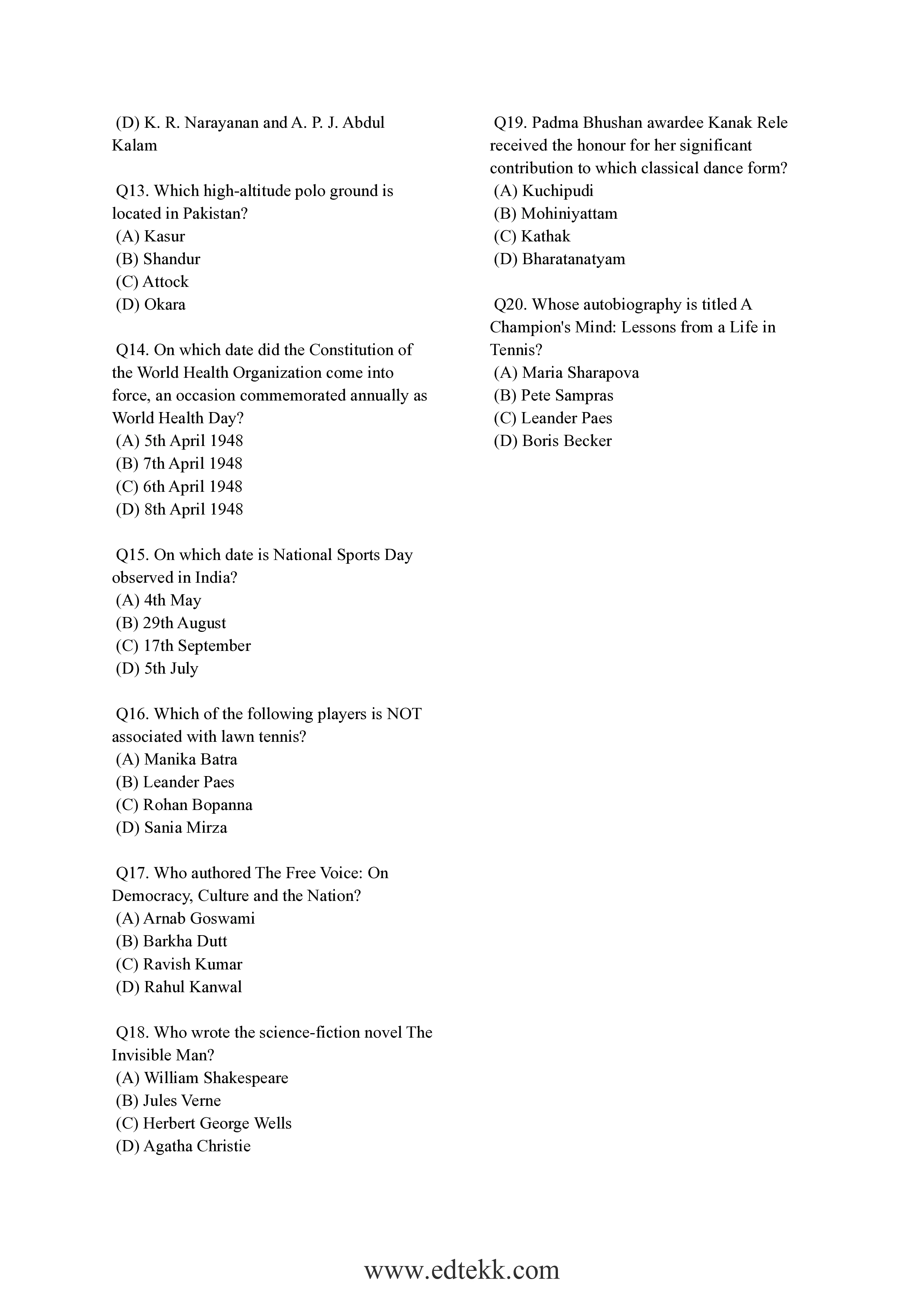
(D) K. R. Narayanan and A. P. J. Abdul Kalam
Explanation: Wings of Fire is the autobiography of former Indian President Dr. A. P. J. Abdul Kalam, co-authored with Arun Tiwari and published in 1999. It recounts Kalam’s childhood, education, scientific career and contributions to India’s missile development programmes.
Q13. Which high-altitude polo ground is located in Pakistan?
(A) Kasur
(B) Shandur
(C) Attock
(D) Okara
Explanation: Shandur Pass, situated between Gilgit-Baltistan and Khyber Pakhtunkhwa in Pakistan, is famous for its high-altitude polo ground. Located at approximately 3,700 metres above sea level, it hosts the annual Shandur Polo Festival, a major sporting and cultural event in the region.
Q14. On which date did the Constitution of the World Health Organization come into force, an occasion commemorated annually as World Health Day?
(A) 5th April 1948
(B) 7th April 1948
(C) 6th April 1948
(D) 8th April 1948
Explanation: The Constitution of the World Health Organization (WHO) came into force on 7 April 1948, marking its formal establishment. World Health Day is observed annually on 7 April to commemorate this occasion and promote awareness of global public health issues.
Q15. On which date is National Sports Day observed in India?
(A) 4th May
(B) 29th August
(C) 17th September
(D) 5th July
Explanation: National Sports Day is celebrated in India on 29 August, the birth anniversary of Major Dhyan Chand. He was a legendary Indian hockey player renowned for his exceptional skills and contributions to India’s Olympic hockey achievements. The day promotes sports, physical fitness and sporting excellence.
Q16. Which of the following players is NOT associated with lawn tennis?
(A) Manika Batra
(B) Leander Paes
(C) Rohan Bopanna
(D) Sania Mirza
Explanation: Manika Batra is associated with table tennis, not lawn tennis. She is an Indian table tennis player who has represented India at international competitions, including the Olympic Games. Leander Paes, Rohan Bopanna and Sania Mirza are associated with lawn tennis.
Q17. Who authored The Free Voice: On Democracy, Culture and the Nation?
(A) Arnab Goswami
(B) Barkha Dutt
(C) Ravish Kumar
(D) Rahul Kanwal
Explanation: The Free Voice: On Democracy, Culture and the Nation was authored by Ravish Kumar and published in 2018. The book examines democracy, freedom of expression, media independence and contemporary Indian society. It highlights the relationship between journalism, political discourse and democratic values.
Q18. Who wrote the science-fiction novel The Invisible Man?
(A) William Shakespeare
(B) Jules Verne
(C) Herbert George Wells
(D) Agatha Christie
Explanation: H. G. Wells, whose full name was Herbert George Wells, wrote the science-fiction novel The Invisible Man, published in 1897. It tells the story of Griffin, a scientist who discovers a method of becoming invisible and faces the consequences of his experiment. Wells is regarded as a pioneer of modern science fiction.
Q19. Padma Bhushan awardee Kanak Rele received the honour for her significant contribution to which classical dance form?
(A) Kuchipudi
(B) Mohiniyattam
(C) Kathak
(D) Bharatanatyam
Explanation: Kanak Rele was a renowned Indian classical dancer, choreographer and academic associated primarily with Mohiniyattam. She received the Padma Bhushan in 2013 for her contributions to Indian classical dance. She established the Nalanda Dance Research Centre and played a significant role in researching, teaching and promoting Mohiniyattam.
Q20. Whose autobiography is titled A Champion’s Mind: Lessons from a Life in Tennis?
(A) Maria Sharapova
(B) Pete Sampras
(C) Leander Paes
(D) Boris Becker
Explanation: A Champion’s Mind: Lessons from a Life in Tennis is the autobiography of former American tennis player Pete Sampras. The book discusses his professional career, competitive experiences, achievements and the mental approach that contributed to his success in tennis.
Question Paper Images