Get additional practice in General Awareness with General Studies Practice Paper 7, suitable for various Indian competitive examinations. This question set includes multiple-choice questions, answers and explanations to help aspirants evaluate their preparation and revise general knowledge for SSC, Railway, Banking, Police Constable and Police SI exams.
Test Details
Topic: General Awareness
Total Questions: 20
Question Format: MCQs – Single Correct Answer
Suitable for: SSC exams, Railway exams, Banking exams, Police Constable, Police SI
Download All Papers in This Series (PDF)
Questions and Answers
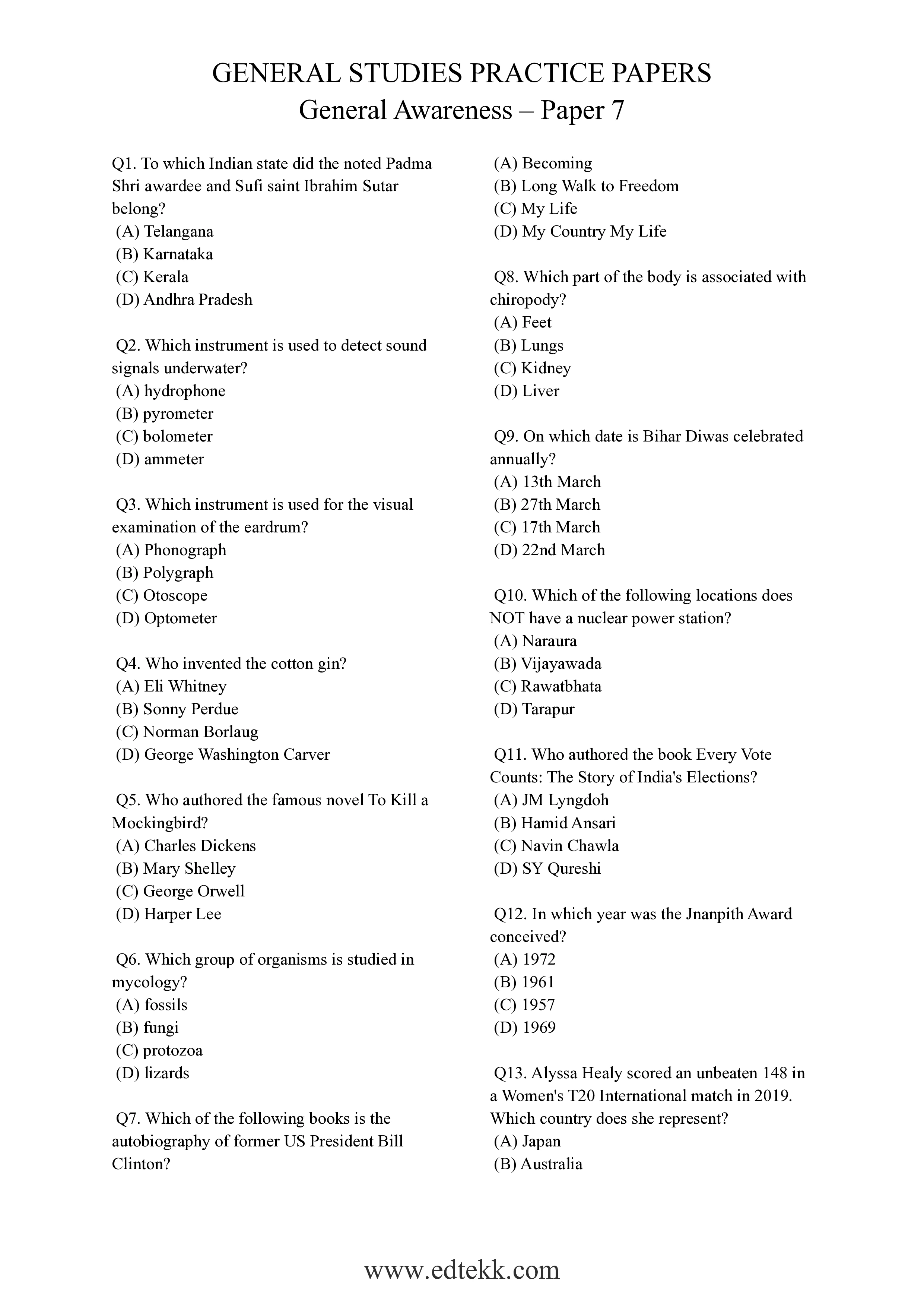
Q1. To which Indian state did the noted Padma Shri awardee and Sufi saint Ibrahim Sutar belong?
(A) Telangana
(B) Karnataka
(C) Kerala
(D) Andhra Pradesh
Explanation: Ibrahim Sutar belonged to Karnataka. He was a renowned social worker, folk singer and spiritual speaker known for promoting communal harmony through his programmes and discourses. He received the Padma Shri in 2018 in recognition of his contributions to social work.
Q2. Which instrument is used to detect sound signals underwater?
(A) hydrophone
(B) pyrometer
(C) bolometer
(D) ammeter
Explanation: A hydrophone is an instrument used to detect and receive sound waves underwater. It functions similarly to a microphone but is specifically designed for underwater acoustic measurements. Hydrophones are widely used in oceanography, marine research, underwater communication, acoustic monitoring and submarine detection.
Q3. Which instrument is used for the visual examination of the eardrum?
(A) Phonograph
(B) Polygraph
(C) Otoscope
(D) Optometer
Explanation: An otoscope is a medical instrument used to examine the external ear canal and tympanic membrane (eardrum). It typically contains a light source and a magnifying lens, enabling healthcare professionals to identify conditions such as inflammation, ear infections and eardrum perforations.
Q4. Who invented the cotton gin?
(A) Eli Whitney
(B) Sonny Perdue
(C) Norman Borlaug
(D) George Washington Carver
Explanation: Eli Whitney is conventionally credited with inventing the cotton gin in 1793. The machine mechanically separated cotton fibres from their seeds, greatly increasing processing efficiency. Its widespread adoption transformed cotton production in the United States and contributed to the expansion of plantation slavery.
Q5. Who authored the famous novel To Kill a Mockingbird?
(A) Charles Dickens
(B) Mary Shelley
(C) George Orwell
(D) Harper Lee
Explanation: To Kill a Mockingbird was authored by Harper Lee and published in 1960. Set in the American South during the 1930s, the novel explores racial injustice, prejudice, morality and compassion through the experiences of Scout Finch and her father, Atticus Finch.
Q6. Which group of organisms is studied in mycology?
(A) fossils
(B) fungi
(C) protozoa
(D) lizards
Explanation: Mycology is the branch of biology concerned with the scientific study of fungi, including mushrooms, moulds and yeasts. It examines their classification, structure, reproduction, genetics and ecological roles. Fungi are important in decomposition, food production, medicine and various industrial processes.
Q7. Which of the following books is the autobiography of former US President Bill Clinton?
(A) Becoming
(B) Long Walk to Freedom
(C) My Life
(D) My Country My Life
Explanation: My Life is the autobiography of former US President Bill Clinton, published in 2004. It covers his childhood, education, political career, presidency and personal experiences. Clinton served as the 42nd President of the United States from 1993 to 2001.
Q8. Which part of the body is associated with chiropody?
(A) Feet
(B) Lungs
(C) Kidney
(D) Liver
Explanation: Chiropody is a branch of healthcare concerned with the examination, diagnosis and treatment of conditions affecting the feet. It is commonly associated with podiatry and includes the management of foot skin disorders, nail problems and structural abnormalities.
Q9. On which date is Bihar Diwas celebrated annually?
(A) 13th March
(B) 27th March
(C) 17th March
(D) 22nd March
Explanation: Bihar Diwas is celebrated annually on 22 March to commemorate the formation of Bihar as a separate province in 1912. On this date, Bihar was separated from the Bengal Presidency during British rule. The day celebrates the state’s history, culture and heritage.
Q10. Which of the following locations does NOT have a nuclear power station?
(A) Naraura
(B) Vijayawada
(C) Rawatbhata
(D) Tarapur
Explanation: Vijayawada in Andhra Pradesh does not have an operational nuclear power station. Narora in Uttar Pradesh, Tarapur in Maharashtra and Rawatbhata in Rajasthan are established nuclear power station locations in India. Vijayawada is associated with conventional thermal power generation.
Q11. Who authored the book Every Vote Counts: The Story of India’s Elections?
(A) JM Lyngdoh
(B) Hamid Ansari
(C) Navin Chawla
(D) SY Qureshi
Explanation: Every Vote Counts: The Story of India’s Elections was written by Navin Chawla, a former Chief Election Commissioner of India. Published in 2019, the book examines India’s electoral system, the organisation of elections and the challenges involved in conducting democratic exercises on such a large scale.
Q12. In which year was the Jnanpith Award conceived?
(A) 1972
(B) 1961
(C) 1957
(D) 1969
Explanation: The Jnanpith Award was conceived and established in 1961 by the Bharatiya Jnanpith organisation. It recognises outstanding contributions to Indian literature in recognised Indian languages. The first award was presented in 1965 to Malayalam writer G. Sankara Kurup for his literary work Odakkuzhal.
Q13. Alyssa Healy scored an unbeaten 148 in a Women’s T20 International match in 2019. Which country does she represent?
(A) Japan
(B) Australia
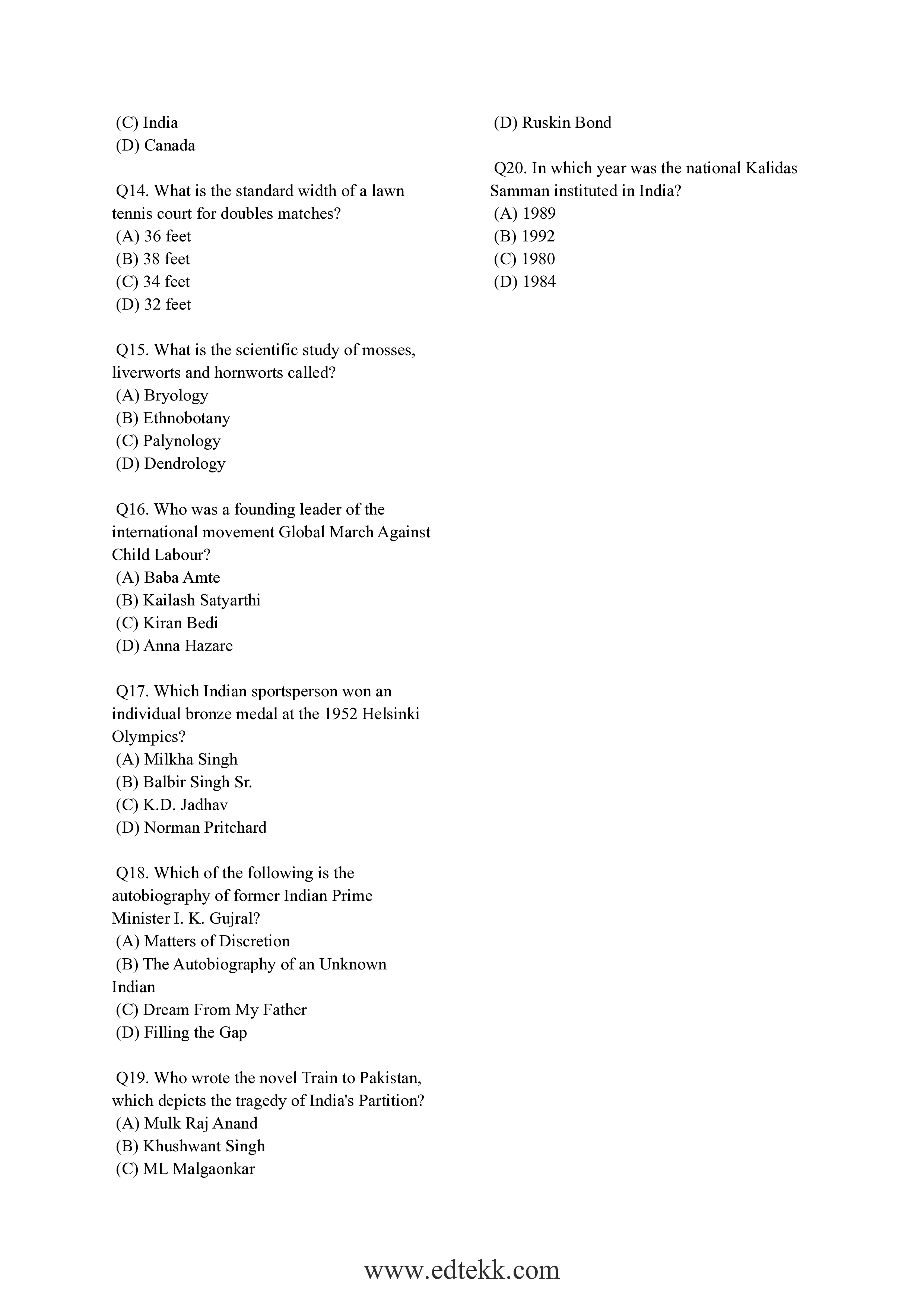
(C) India
(D) Canada
Explanation: Alyssa Healy is an Australian cricketer and former captain of the Australian women’s cricket team. She scored an unbeaten 148 against Sri Lanka in a Women’s T20 International in 2019. Her innings set a record for the highest individual score in women’s T20I cricket at that time.
Q14. What is the standard width of a lawn tennis court for doubles matches?
(A) 36 feet
(B) 38 feet
(C) 34 feet
(D) 32 feet
Explanation: The standard lawn tennis court is 36 feet wide for doubles and 27 feet wide for singles. Both formats use a court length of 78 feet. The additional width in doubles includes the side alleys used during play.
Q15. What is the scientific study of mosses, liverworts and hornworts called?
(A) Bryology
(B) Ethnobotany
(C) Palynology
(D) Dendrology
Explanation: Bryology is the branch of botany concerned with the study of bryophytes, including mosses, liverworts and hornworts. It covers their classification, structure, reproduction, ecology and evolution. The term is derived from the Greek word bryon, meaning moss.
Q16. Who was a founding leader of the international movement Global March Against Child Labour?
(A) Baba Amte
(B) Kailash Satyarthi
(C) Kiran Bedi
(D) Anna Hazare
Explanation: Kailash Satyarthi was a founding leader of the Global March Against Child Labour, an international movement launched in 1998 to campaign against child labour and promote children’s rights. He also founded Bachpan Bachao Andolan. In 2014, he received the Nobel Peace Prize for his efforts to protect children from exploitation.
Q17. Which Indian sportsperson won an individual bronze medal at the 1952 Helsinki Olympics?
(A) Milkha Singh
(B) Balbir Singh Sr.
(C) K.D. Jadhav
(D) Norman Pritchard
Explanation: Khashaba Dadasaheb Jadhav (K.D. Jadhav) won an individual bronze medal in wrestling at the 1952 Helsinki Summer Olympics. He became the first Indian athlete to win an individual Olympic medal after India’s independence, marking a significant achievement in Indian sporting history.
Q18. Which of the following is the autobiography of former Indian Prime Minister I. K. Gujral?
(A) Matters of Discretion
(B) The Autobiography of an Unknown Indian
(C) Dream From My Father
(D) Filling the Gap
Explanation: Matters of Discretion: An Autobiography is the autobiography of Inder Kumar Gujral, former Prime Minister of India. Published in 2011, it recounts his personal experiences, political journey and diplomatic career. He served as India’s Prime Minister from 1997 to 1998.
Q19. Who wrote the novel Train to Pakistan, which depicts the tragedy of India’s Partition?
(A) Mulk Raj Anand
(B) Khushwant Singh
(C) ML Malgaonkar
(D) Ruskin Bond
Explanation: Khushwant Singh wrote Train to Pakistan, a celebrated novel published in 1956. Set in the fictional village of Mano Majra on the India-Pakistan border, it depicts the communal violence, displacement and human tragedy associated with the Partition of India in 1947.
Q20. In which year was the national Kalidas Samman instituted in India?
(A) 1989
(B) 1992
(C) 1980
(D) 1984
Explanation: The Kalidas Samman was instituted by the Government of Madhya Pradesh in 1980–81. It recognises distinguished contributions to classical music, classical dance, theatre and plastic arts. Named after the Sanskrit poet and playwright Kalidasa, the award honours outstanding artistic achievements.
Question Paper Images