Strengthen your historical knowledge with Indian History Practice Paper 4, created for candidates preparing for SSC exams, RRB NTPC, RRB Group D, Police Constable and Police SI. The practice set features relevant General Studies MCQs covering Indian History, along with correct answers and explanations to help aspirants assess their preparation and revise important concepts.
Test Details
Topic: Indian History
Total Questions: 20
Question Format: MCQs – Single Correct Answer
Suitable for: SSC exams, RRB NTPC, RRB Group D, Police Constable, Police SI
Download All Papers in This Series (PDF)
Questions and Answers
Q1. Who was popularly known as the “Grand Old Man of India”?
(A) Raja Ram Mohan Roy
(B) Gopal Krishna Gokhale
(C) Dadabhai Naoroji
(D) Bal Gangadhar Tilak
Explanation: Dadabhai Naoroji is popularly known as the “Grand Old Man of India”. He was an early nationalist leader and served as President of the Indian National Congress three times. He developed the Drain Theory, which explained how British colonial rule systematically transferred India’s wealth to Britain.
Q2. Which emblem appears at the centre of the Indian national flag?
(A) Tiger
(B) Lotus
(C) Ashoka Chakra
(D) Elephant
Explanation: India’s national flag features a navy-blue Ashoka Chakra with 24 equally spaced spokes at the centre of its white band. The wheel represents the Dharma Chakra and is associated with righteousness and progress. Its design is based on the wheel depicted on the Lion Capital of Ashoka at Sarnath. The Constituent Assembly adopted the present national flag on 22 July 1947.
Q3. Who founded the Khudai Khidmatgar movement, a non-violent movement against British colonial rule, in 1929?
(A) K. M. Ashraf
(B) Abbas Tyabji
(C) Khan Abdul Ghaffar Khan
(D) Mohammed Yasin Khan
Explanation: Khan Abdul Ghaffar Khan founded the Khudai Khidmatgar movement in 1929 in the North-West Frontier Province of British India. Also known as the Red Shirt Movement, it promoted non-violent resistance against British colonial rule. Its members played an important role in the Indian freedom struggle through organised peaceful mobilisation.
Q4. During whose reign did the Persian traveller Abdur Razzaq visit India?
(A) Dev Rai I
(B) Dev Rai II
(C) Krishna Dev Rai I
(D) Krishna Rai II
Explanation: The Persian traveller Abdur Razzaq visited the Vijayanagara Empire during the reign of Deva Raya II (1422–1446 CE). He arrived around 1443 CE as an envoy of the Timurid ruler Shah Rukh. His travel account provides valuable information about the empire’s wealth, administration and urban life.
Q5. Who was the first woman to become the Speaker of the Lok Sabha?
(A) Sumitra Mahajan
(B) Meira Kumar
(C) Kiran Bedi
(D) Indira Gandhi
Explanation: Meira Kumar became the first woman Speaker of the Lok Sabha in 2009, during the Fifteenth Lok Sabha. She served until 2014. Before entering politics, she was a member of the Indian Foreign Service (IFS). Her election marked a significant milestone in women’s representation in India’s parliamentary institutions.
Q6. In which Indian state is the famous Sanchi Stupa located?
(A) Bihar
(B) Madhya Pradesh
(C) Uttar Pradesh
(D) Maharashtra
Explanation: The Great Stupa at Sanchi is located in Madhya Pradesh, approximately 46 km northeast of Bhopal. Originally commissioned by Emperor Ashoka in the third century BCE, it became one of India’s most important Buddhist monuments. Its later expansions and elaborately carved gateways reflect the development of Buddhist architecture over several centuries.
Q7. To whom is the ancient Indian treatise Natya Shastra traditionally attributed?
(A) Bharata Muni
(B) Kalidasa
(C) Tholkappiyar
(D) Ilango Adigal
Explanation: The Natya Shastra is traditionally attributed to Bharata Muni. This ancient Sanskrit treatise covers theatre, dance, music, dramatic composition, and performance techniques. It explains foundational concepts such as Rasa (aesthetic experience) and Bhava (emotional states), which have profoundly influenced Indian performing arts and classical aesthetic theory.
Q8. Who was the Prime Minister of India during Operation Blue Star in 1984?
(A) Rajiv Gandhi
(B) Indira Gandhi
(C) Charan Singh
(D) Morarji Desai
Explanation: Indira Gandhi was Prime Minister during Operation Blue Star, conducted by the Indian Army in June 1984 at the Golden Temple complex in Amritsar. The operation aimed to remove armed militants occupying the complex. It had significant political, religious and social consequences and intensified tensions in Punjab.
Q9. Which of the following was not a prescribed ethical principle of Ashoka’s Dhamma?
(A) Obedience to parents
(B) Charity
(C) Faith in the Buddhist Sangha
(D) Respect for elders
Explanation: Ashoka’s Dhamma emphasised moral conduct, respect for parents and elders, kindness, charity, non-violence and tolerance towards different religious communities. It was a broad ethical and social philosophy intended to promote harmony and moral responsibility. Mandatory faith in the Buddhist Sangha was not a prescribed principle of Dhamma, which was intended to have wider social applicability beyond Buddhism.
Q10. Which Mughal emperor commissioned the construction of the Red Fort in Delhi?
(A) Shah Jahan
(B) Babur
(C) Akbar
(D) Aurangzeb
Explanation: Shah Jahan commissioned the Red Fort in Delhi, with construction beginning in 1638 and completion in 1648. Its prominent red sandstone walls contrast with palaces and other structures featuring marble. The fort became the principal imperial residence of the Mughal emperors in Delhi.
Q11. Which movement led by Mahatma Gandhi challenged the British salt monopoly?
(A) Quit India Movement
(B) Salt Satyagraha
(C) Swadeshi Movement
(D) Non-Cooperation Movement
Explanation: The Salt Satyagraha was a non-violent civil disobedience movement launched by Mahatma Gandhi in 1930 against the British salt tax and monopoly. Gandhi began the historic Dandi March from Sabarmati Ashram on 12 March 1930 and reached Dandi on 6 April, where he broke the salt law by making salt.
Q12. Which Veda contains some of the earliest references to medicinal plants, healing practices and remedies associated with Ayurveda?
(A) Yajurveda
(B) Rigveda
(C) Samaveda
(D) Atharvaveda
Explanation: The Atharvaveda contains early references to healing practices, medicinal plants, diseases and remedies associated with the origins of Ayurveda. These references reflect an early stage in the development of Indian medical knowledge. Ayurveda subsequently evolved into a systematic medical tradition with its own theories of health, diagnosis and treatment.
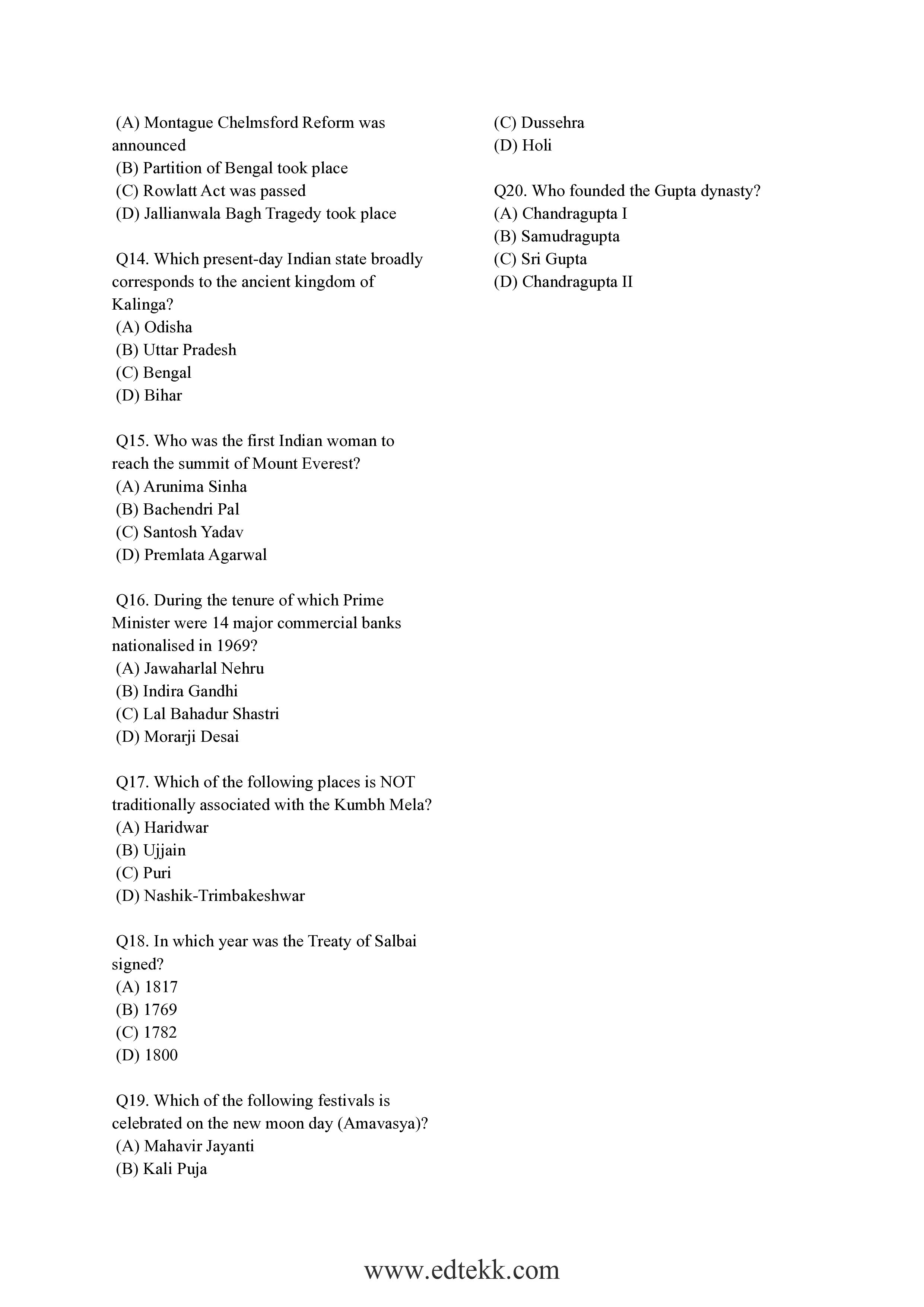
Q13. Which of the following events did NOT occur in 1919?
(A) Montague Chelmsford Reform was announced
(B) Partition of Bengal took place
(C) Rowlatt Act was passed
(D) Jallianwala Bagh Tragedy took place
Explanation: The Partition of Bengal took place in 1905 under Lord Curzon and was annulled in 1911. The Montagu-Chelmsford Reforms were announced in 1918, while the Rowlatt Act was passed and the Jallianwala Bagh massacre occurred in 1919. Therefore, the Partition of Bengal is the event that did not occur in 1919.
Q14. Which present-day Indian state broadly corresponds to the ancient kingdom of Kalinga?
(A) Odisha
(B) Uttar Pradesh
(C) Bengal
(D) Bihar
Explanation: Ancient Kalinga broadly corresponds to present-day Odisha, although its historical boundaries extended into neighbouring regions. Emperor Ashoka conquered Kalinga around 261 BCE. The devastation caused by the war deeply affected him and contributed to his subsequent emphasis on Dhamma, non-violence and moral governance.
Q15. Who was the first Indian woman to reach the summit of Mount Everest?
(A) Arunima Sinha
(B) Bachendri Pal
(C) Santosh Yadav
(D) Premlata Agarwal
Explanation: Bachendri Pal became the first Indian woman to summit Mount Everest on 23 May 1984. She achieved this feat as a member of an Indian mountaineering expedition. Her accomplishment established a major milestone in Indian mountaineering and inspired generations of women to pursue adventure sports and mountaineering.
Q16. During the tenure of which Prime Minister were 14 major commercial banks nationalised in 1969?
(A) Jawaharlal Nehru
(B) Indira Gandhi
(C) Lal Bahadur Shastri
(D) Morarji Desai
Explanation: Indira Gandhi’s government nationalised 14 major commercial banks on 19 July 1969. The decision aimed to expand banking services, increase credit availability to agriculture and small industries, promote financial inclusion and reduce the concentration of economic power in private hands.
Q17. Which of the following places is NOT traditionally associated with the Kumbh Mela?
(A) Haridwar
(B) Ujjain
(C) Puri
(D) Nashik-Trimbakeshwar
Explanation: The Kumbh Mela is traditionally associated with four principal pilgrimage locations: Prayagraj, Haridwar, Nashik-Trimbakeshwar and Ujjain. Puri, located in Odisha, is not among these four traditional Kumbh Mela sites. Therefore, Puri is the correct answer.
Q18. In which year was the Treaty of Salbai signed?
(A) 1817
(B) 1769
(C) 1782
(D) 1800
Explanation: The Treaty of Salbai was signed in 1782, bringing the First Anglo-Maratha War (1775–1782) to an end. It established approximately 20 years of relative peace between the British East India Company and the Marathas, until the Second Anglo-Maratha War broke out in 1803.
Q19. Which of the following festivals is celebrated on the new moon day (Amavasya)?
(A) Mahavir Jayanti
(B) Kali Puja
(C) Dussehra
(D) Holi
Explanation: Kali Puja is celebrated on the new moon day (Amavasya) of the Hindu month of Kartik, generally coinciding with Diwali. Dedicated to Goddess Kali, the festival is particularly popular in West Bengal, Assam and Odisha. Among the given options, Kali Puja is the correct answer because it is specifically associated with Amavasya.
Q20. Who founded the Gupta dynasty?
(A) Chandragupta I
(B) Samudragupta
(C) Sri Gupta
(D) Chandragupta II
Explanation: Sri Gupta is generally regarded as the founder of the Gupta dynasty, which emerged around the late third century CE. His successor, Ghatotkacha, continued the dynasty, while Chandragupta I expanded its political influence and laid the foundations for the Gupta Empire’s rise as a major power in northern India.
Question Paper Images