Complete another stage of your General Studies preparation with Indian Polity and Constitution Practice Paper 10. Designed for SSC, Railway, Police Constable and Police SI examinations, this set offers 20 MCQs on India’s constitutional system, political institutions and governance, with answers and explanations for effective revision.
Test Details
Topic: Indian Polity and Constitution
Total Questions: 20
Question Format: MCQs – Single Correct Answer
Suitable for: SSC exams, Railway exams, Police Constable, Police SI
Download All Papers in This Series (PDF)
Questions and Answers
Q1. In which Indian state is the Rashtriya Janata Dal (RJD) a prominent political party?
(A) Punjab
(B) Rajasthan
(C) Bihar
(D) Haryana
Explanation: The Rashtriya Janata Dal (RJD) is a prominent political party in Bihar. Founded by Lalu Prasad Yadav in 1997 following a split from the Janata Dal, the party has maintained a significant presence in Bihar politics and has participated in state and national coalition governments.
Q2. Which Article declares that the Directive Principles of State Policy are not enforceable by courts?
(A) Article 38
(B) Article 40
(C) Article 37
(D) Article 39
Explanation: Article 37 establishes that the Directive Principles of State Policy are not enforceable by any court. However, it declares them fundamental to the governance of the country and makes it the duty of the State to apply these principles while making laws and formulating policies.
Q3. Which Part of the Indian Constitution deals with Union Territories?
(A) Part IX
(B) Part X
(C) Part VIII
(D) Part XI
Explanation: Part VIII of the Indian Constitution (Articles 239–242) deals with Union Territories. It provides for their administration by the President through appointed administrators and includes special constitutional arrangements for certain Union Territories having legislatures.
Q4. Which of the following is NOT a recognised category of parliamentary questions in India?
(A) Unstarred question
(B) Short-notice question
(C) Starred question
(D) Long-notice question
Explanation: Parliamentary questions are classified into three recognised categories: starred questions, unstarred questions and short-notice questions. Starred questions require oral answers and may be followed by supplementary questions, whereas unstarred questions receive written answers. Short-notice questions concern urgent matters of public importance and are admitted with shorter notice.
Q5. Which constitutional authority formally summons the Houses of Parliament in India?
(A) Prime Minister
(B) Speaker
(C) President
(D) Vice President
Explanation: The President of India formally summons each House of Parliament under Article 85 of the Constitution. The President exercises this power on the aid and advice of the Council of Ministers. The interval between the last sitting of one session and the first sitting of the next cannot exceed six months.
Q6. Who appoints the Advocate General of a State in India?
(A) Prime Minister of India
(B) President of India
(C) Governor of the State
(D) Chief Minister of the State
Explanation: The Governor of a State appoints the Advocate General under Article 165. The Advocate General is the highest law officer of the State and must possess the qualifications required for appointment as a High Court judge.
Q7. What is the maximum constitutional strength of the Lok Sabha?
(A) 550
(B) 540
(C) 560
(D) 530
Explanation: Under Article 81, the constitutional maximum strength of the Lok Sabha is 550 elected members: up to 530 representatives from states and up to 20 from Union Territories. The earlier provision for nominating two Anglo-Indian members ceased to operate following the 104th Constitutional Amendment. The present sanctioned elected strength is 543.
Q8. How many categories of Fundamental Rights are currently recognised under the Indian Constitution?
(A) 6
(B) 7
(C) 5
(D) 8
Explanation: The Indian Constitution currently recognises six categories of Fundamental Rights: Right to Equality, Right to Freedom, Right against Exploitation, Right to Freedom of Religion, Cultural and Educational Rights, and Right to Constitutional Remedies. The Right to Property is no longer a Fundamental Right; it is protected as a constitutional right under Article 300A.
Q9. How many Election Commissioners serve alongside the Chief Election Commissioner in the Election Commission of India?
(A) Four
(B) One
(C) Three
(D) Two
Explanation: The Election Commission of India is a three-member constitutional body comprising the Chief Election Commissioner and two Election Commissioners. All three participate in administering elections to Parliament, State Legislatures, and the offices of the President and Vice-President. Decisions are generally taken collectively, with the majority view prevailing in case of disagreement.
Q10. Which political party in India is associated with the broom election symbol?
(A) Janata Dal (United)
(B) Indian National Congress
(C) Samajwadi Party
(D) Aam Aadmi Party
Explanation: The Aam Aadmi Party (AAP), founded in 2012, uses the broom as its election symbol. The symbol is associated with the party’s emphasis on cleanliness, anti-corruption and political reform, reflecting its stated commitment to transparent governance.
Q11. Which of the following is NOT an All India Service?
(A) Indian Forest Service
(B) Indian Administrative Service
(C) Indian Engineering Service
(D) Indian Police Service
Explanation: The Indian Engineering Service is not an All India Service. The three All India Services are the Indian Administrative Service (IAS), Indian Police Service (IPS) and Indian Forest Service (IFoS).
Q12. In which year were the first ten Fundamental Duties added to the Indian Constitution?
(A) 1955
(B) 1947
(C) 1976
(D) 1985
Explanation: The initial ten Fundamental Duties were added to the Indian Constitution in 1976 through the 42nd Constitutional Amendment Act. These duties emphasise citizens’ responsibilities towards the Constitution, the nation and society. An eleventh Fundamental Duty was subsequently added through the 86th Constitutional Amendment Act, 2002.
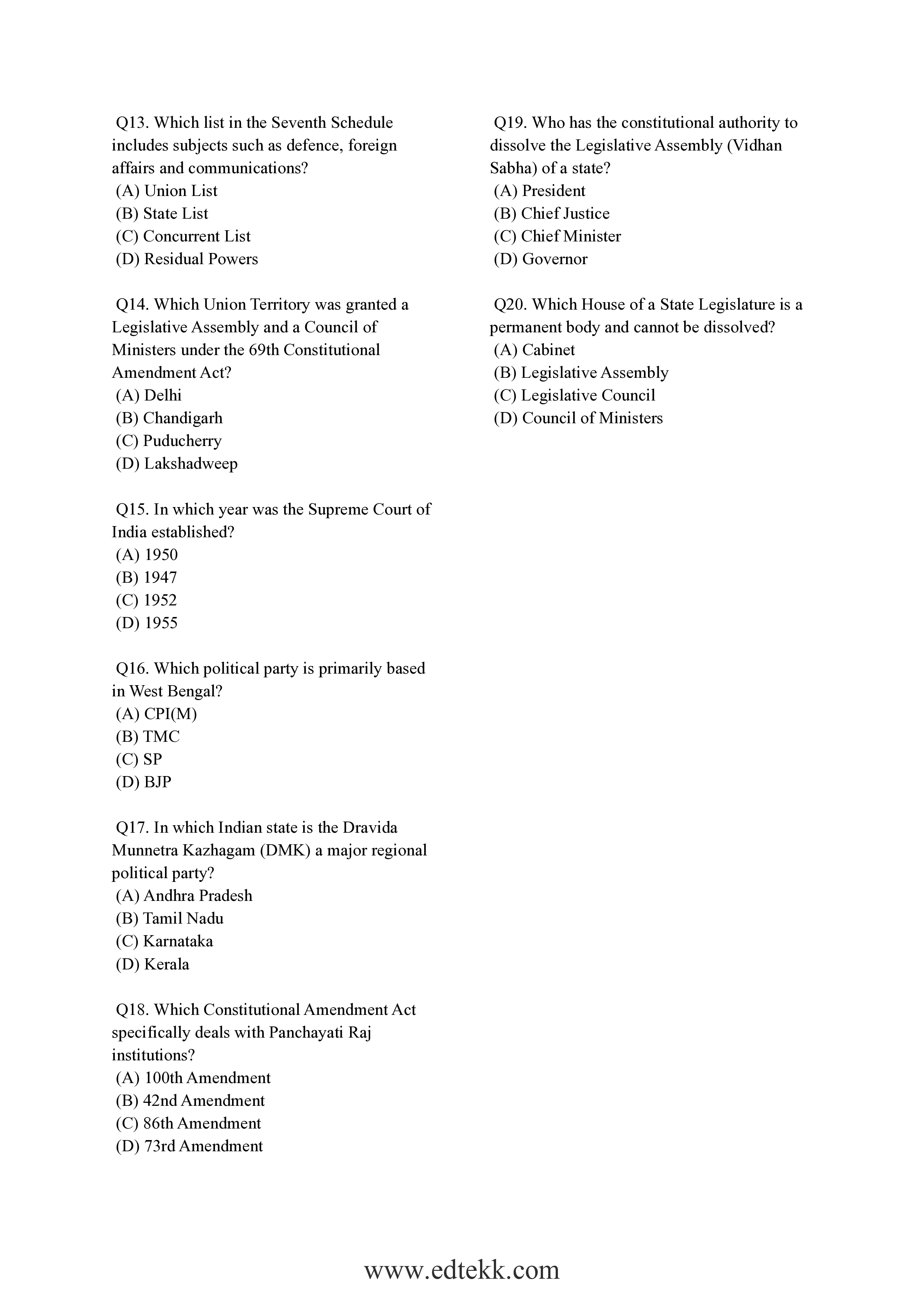
Q13. Which list in the Seventh Schedule includes subjects such as defence, foreign affairs and communications?
(A) Union List
(B) State List
(C) Concurrent List
(D) Residual Powers
Explanation: The Union List in the Seventh Schedule contains subjects on which Parliament ordinarily has exclusive legislative authority. These include defence, foreign affairs, banking, currency, railways and communications, subject to the Constitution’s provisions. The Union List facilitates nationally coordinated legislation on matters of countrywide importance.
Q14. Which Union Territory was granted a Legislative Assembly and a Council of Ministers under the 69th Constitutional Amendment Act?
(A) Delhi
(B) Chandigarh
(C) Puducherry
(D) Lakshadweep
Explanation: The 69th Constitutional Amendment Act, 1991, provided special constitutional status to Delhi by designating it as the National Capital Territory of Delhi. It introduced Article 239AA, providing for a Legislative Assembly and a Council of Ministers headed by the Chief Minister, subject to specified constitutional limitations.
Q15. In which year was the Supreme Court of India established?
(A) 1950
(B) 1947
(C) 1952
(D) 1955
Explanation: The Supreme Court of India was established on 28 January 1950, shortly after the Constitution came into effect on 26 January 1950. It succeeded the Federal Court of India, which had been established in 1937. The Supreme Court is the apex judicial authority in the Indian judicial system.
Q16. Which political party is primarily based in West Bengal?
(A) CPI(M)
(B) TMC
(C) SP
(D) BJP
Explanation: The All India Trinamool Congress (TMC) is primarily based in West Bengal. Founded by Mamata Banerjee in 1998 after her separation from the Indian National Congress, it became a major political force and formed the state government in 2011.
Q17. In which Indian state is the Dravida Munnetra Kazhagam (DMK) a major regional political party?
(A) Andhra Pradesh
(B) Tamil Nadu
(C) Karnataka
(D) Kerala
Explanation: The Dravida Munnetra Kazhagam (DMK) is a major regional political party in Tamil Nadu. Founded in 1949 by C. N. Annadurai, it emerged from the Dravidian political movement and has played a central role in the state’s government and politics.
Q18. Which Constitutional Amendment Act specifically deals with Panchayati Raj institutions?
(A) 100th Amendment
(B) 42nd Amendment
(C) 86th Amendment
(D) 73rd Amendment
Explanation: The 73rd Constitutional Amendment Act, 1992, is specifically associated with Panchayati Raj institutions. It granted constitutional status to rural local self-government and introduced provisions relating to regular elections, reservation of seats, a five-year tenure and the institutional framework for democratic decentralisation.
Q19. Who has the constitutional authority to dissolve the Legislative Assembly (Vidhan Sabha) of a state?
(A) President
(B) Chief Justice
(C) Chief Minister
(D) Governor
Explanation: Under Article 174(2)(b), the Governor has the constitutional authority to dissolve the State Legislative Assembly, ordinarily acting on the advice of the Council of Ministers headed by the Chief Minister. Limited discretionary questions may arise in exceptional constitutional circumstances. During President’s Rule, dissolution may also occur through the constitutional mechanism under Article 356.
Q20. Which House of a State Legislature is a permanent body and cannot be dissolved?
(A) Cabinet
(B) Legislative Assembly
(C) Legislative Council
(D) Council of Ministers
Explanation: The Legislative Council is a permanent House in States having bicameral legislatures and is not subject to dissolution. Its members normally serve six-year terms, with one-third retiring every two years.
Question Paper Images