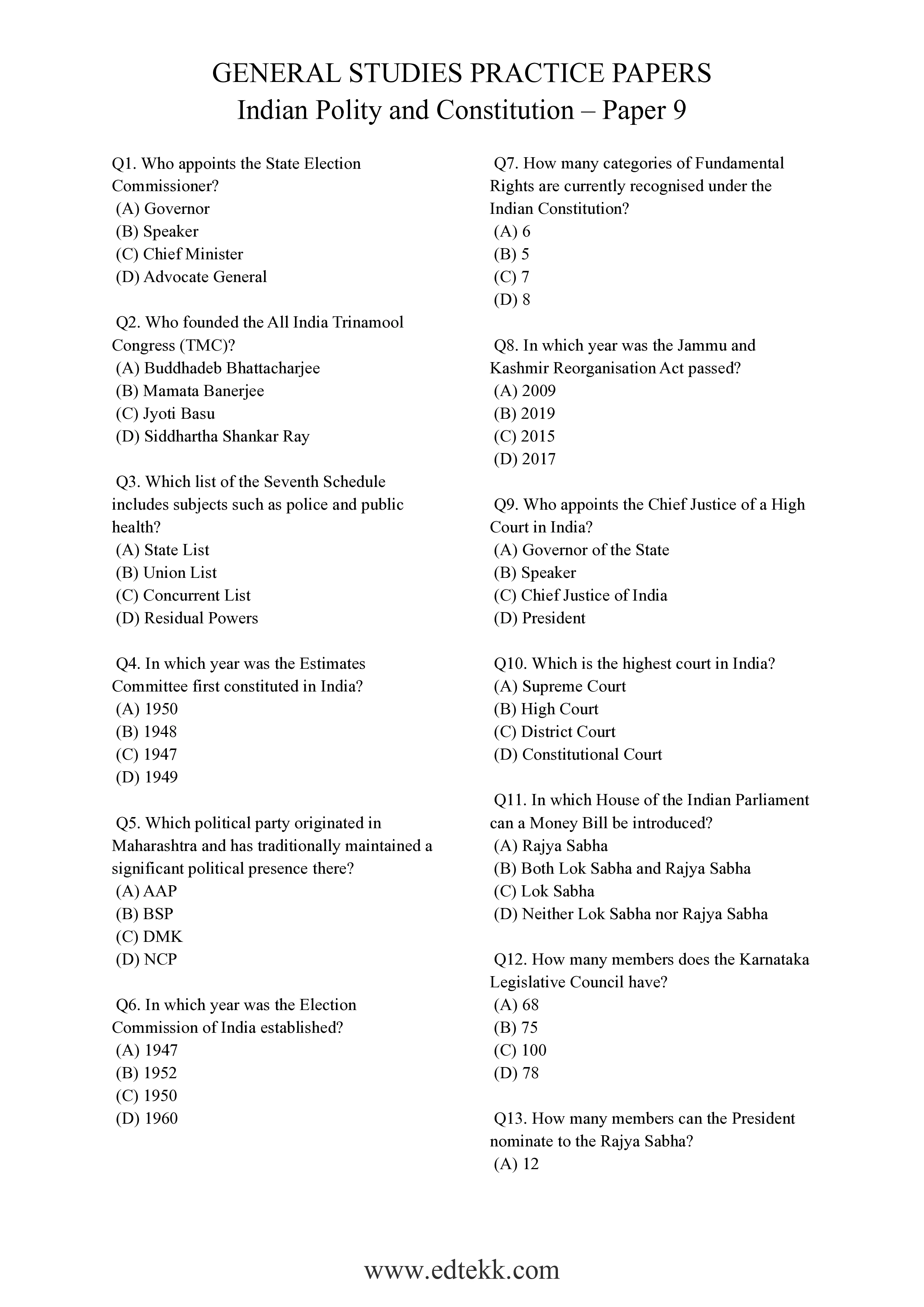
Take your General Studies preparation further with Indian Polity and Constitution Practice Paper 9. Suitable for SSC, Railway, Police Constable and Police SI aspirants, this paper includes 20 multiple-choice questions on important constitutional and political topics, helping candidates practise with reliable answers and explanations.
Test Details
Topic: Indian Polity and Constitution
Total Questions: 20
Question Format: MCQs – Single Correct Answer
Suitable for: SSC exams, Railway exams, Police Constable, Police SI
Download All Papers in This Series (PDF)
Questions and Answers
Q1. Who appoints the State Election Commissioner?
(A) Governor
(B) Speaker
(C) Chief Minister
(D) Advocate General
Explanation: The Governor appoints the State Election Commissioner under Article 243K. The State Election Commission conducts elections to Panchayats and Municipalities. The State Election Commissioner can be removed only in the manner and on the grounds applicable to a High Court judge.
Q2. Who founded the All India Trinamool Congress (TMC)?
(A) Buddhadeb Bhattacharjee
(B) Mamata Banerjee
(C) Jyoti Basu
(D) Siddhartha Shankar Ray
Explanation: Mamata Banerjee founded the All India Trinamool Congress (TMC) on 1 January 1998 after separating from the Indian National Congress. She has remained the party’s principal leader and has served as the Chief Minister of West Bengal.
Q3. Which list of the Seventh Schedule includes subjects such as police and public health?
(A) State List
(B) Union List
(C) Concurrent List
(D) Residual Powers
Explanation: Police and public health are subjects included in the State List (List II) of the Seventh Schedule of the Indian Constitution. State legislatures have the primary authority to make laws on these subjects, subject to constitutional provisions that permit Parliament to legislate in specified circumstances.
Q4. In which year was the Estimates Committee first constituted in India?
(A) 1950
(B) 1948
(C) 1947
(D) 1949
Explanation: The Estimates Committee was constituted for the first time in 1950. It is a parliamentary financial committee consisting of 30 members elected exclusively from the Lok Sabha. Its functions include examining budget estimates, suggesting administrative improvements and recommending measures to achieve economy in public expenditure.
Q5. Which political party originated in Maharashtra and has traditionally maintained a significant political presence there?
(A) AAP
(B) BSP
(C) DMK
(D) NCP
Explanation: The Nationalist Congress Party (NCP) originated in Maharashtra and has traditionally maintained a significant political presence there. Founded in 1999 by Sharad Pawar and others, it became an important participant in Maharashtra’s coalition politics before experiencing a major split in 2023.
Q6. In which year was the Election Commission of India established?
(A) 1947
(B) 1952
(C) 1950
(D) 1960
Explanation: The Election Commission of India was established on 25 January 1950, one day before the Constitution came into force on 26 January 1950. It is an independent constitutional authority responsible for administering elections in India. National Voters’ Day is celebrated annually on 25 January to commemorate its establishment.
Q7. How many categories of Fundamental Rights are currently recognised under the Indian Constitution?
(A) 6
(B) 5
(C) 7
(D) 8
Explanation: The Indian Constitution currently recognises six categories of Fundamental Rights: Right to Equality, Right to Freedom, Right against Exploitation, Right to Freedom of Religion, Cultural and Educational Rights, and Right to Constitutional Remedies. The Right to Property was removed from the list of Fundamental Rights by the 44th Constitutional Amendment Act, 1978, and is now protected under Article 300A.
Q8. In which year was the Jammu and Kashmir Reorganisation Act passed?
(A) 2009
(B) 2019
(C) 2015
(D) 2017
Explanation: The Jammu and Kashmir Reorganisation Act was passed in 2019. It provided for the division of the former State of Jammu and Kashmir into two Union Territories: Jammu and Kashmir, with a legislature, and Ladakh, without a legislature. The reorganisation came into effect on 31 October 2019.
Q9. Who appoints the Chief Justice of a High Court in India?
(A) Governor of the State
(B) Speaker
(C) Chief Justice of India
(D) President
Explanation: Under Article 217, the President appoints the Chief Justice of a High Court after consultation with the Chief Justice of India and the Governor of the concerned state. The appointment follows the constitutional consultation process and judicial collegium conventions. Neither the Governor nor the Chief Justice of India independently makes the appointment.
Q10. Which is the highest court in India?
(A) Supreme Court
(B) High Court
(C) District Court
(D) Constitutional Court
Explanation: The Supreme Court of India is the highest judicial authority in the country. It exercises original, appellate and advisory jurisdiction, interprets the Constitution and safeguards constitutional supremacy. High Courts are the highest courts within their respective territorial jurisdictions but remain subordinate to the Supreme Court in the judicial hierarchy.
Q11. In which House of the Indian Parliament can a Money Bill be introduced?
(A) Rajya Sabha
(B) Both Lok Sabha and Rajya Sabha
(C) Lok Sabha
(D) Neither Lok Sabha nor Rajya Sabha
Explanation: Under Article 109, a Money Bill can be introduced only in the Lok Sabha, with the President’s recommendation. The Rajya Sabha cannot amend it but may recommend changes within fourteen days. The Lok Sabha may accept or reject these recommendations. If the Rajya Sabha fails to return the Bill within fourteen days, it is deemed passed by both Houses.
Q12. How many members does the Karnataka Legislative Council have?
(A) 68
(B) 75
(C) 100
(D) 78
Explanation: The Karnataka Legislative Council has 75 members. Karnataka has a bicameral legislature consisting of the Legislative Assembly and Legislative Council. The Council is a permanent body, with approximately one-third of its members retiring every two years.
Q13. How many members can the President nominate to the Rajya Sabha?
(A) 12
(B) 11
(C) 13
(D) 14
Explanation: The President nominates 12 members to the Rajya Sabha under Article 80(1)(a) of the Constitution. These members are selected for their special knowledge or practical experience in literature, science, art and social service. Their nomination enables individuals with expertise in these fields to contribute to parliamentary deliberations.
Q14. How many regular sessions does the Indian Parliament traditionally hold each year?
(A) 7
(B) 3
(C) 5
(D) 2
Explanation: The Indian Parliament traditionally holds three regular sessions annually: the Budget Session, Monsoon Session and Winter Session. However, the Constitution does not prescribe a fixed number of sessions; Article 85 requires that no more than six months elapse between parliamentary sittings in successive sessions.
Q15. The Shiromani Akali Dal is a prominent regional political party in which Indian state?
(A) Haryana
(B) Punjab
(C) Rajasthan
(D) Himachal Pradesh
Explanation: The Shiromani Akali Dal (SAD) is a significant regional political party primarily based in Punjab. It has historically represented Sikh political interests and played an important role in the state’s electoral politics and government formation.
Q16. Which Article of the Indian Constitution deals with the appointment and tenure of the Prime Minister and other Union Ministers?
(A) Article 74
(B) Article 76
(C) Article 75
(D) Article 77
Explanation: Article 75 of the Indian Constitution deals with the appointment, tenure and other provisions relating to the Union Council of Ministers. The President appoints the Prime Minister, while other ministers are appointed on the Prime Minister’s advice. Ministers hold office during the President’s pleasure, and the Council of Ministers is collectively responsible to the Lok Sabha.
Q17. Which legislative body has the authority to make laws on subjects included in the State List?
(A) Lok Sabha
(B) State Legislature
(C) Rajya Sabha
(D) President
Explanation: State Legislatures generally have the power to make laws on subjects included in the State List under the Seventh Schedule. These include public order, police, agriculture and public health. However, Parliament can also legislate on these subjects under specified circumstances, including a national emergency or a Rajya Sabha resolution under Article 249.
Q18. Who has the constitutional authority to remove a Governor from office?
(A) Prime Minister
(B) Chief Minister
(C) Chief Justice of India
(D) President
Explanation: The President can remove a Governor under Article 156, which provides that the Governor holds office during the President’s pleasure. Consequently, the Governor’s normal five-year term is not guaranteed, and removal may occur before the term expires.
Q19. Who founded the Bahujan Samaj Party (BSP)?
(A) Mayawati
(B) Kanshi Ram
(C) Mulayam Singh Yadav
(D) Nitish Kumar
Explanation: Kanshi Ram founded the Bahujan Samaj Party (BSP) in 1984 to represent the political interests of Bahujans, including Dalits, Adivasis, Other Backward Classes and other marginalised communities. Mayawati subsequently emerged as its prominent leader and served multiple terms as Chief Minister of Uttar Pradesh.
Q20. To whom are the Fundamental Duties under Article 51A addressed?
(A) State
(B) Government
(C) Legislature
(D) Citizens
Explanation: Fundamental Duties are addressed to the citizens of India under Article 51A of the Constitution. They prescribe moral and civic responsibilities, including respecting the Constitution, protecting national unity, safeguarding public property and promoting harmony. They encourage responsible citizenship and contribute to national development.
Question Paper Images