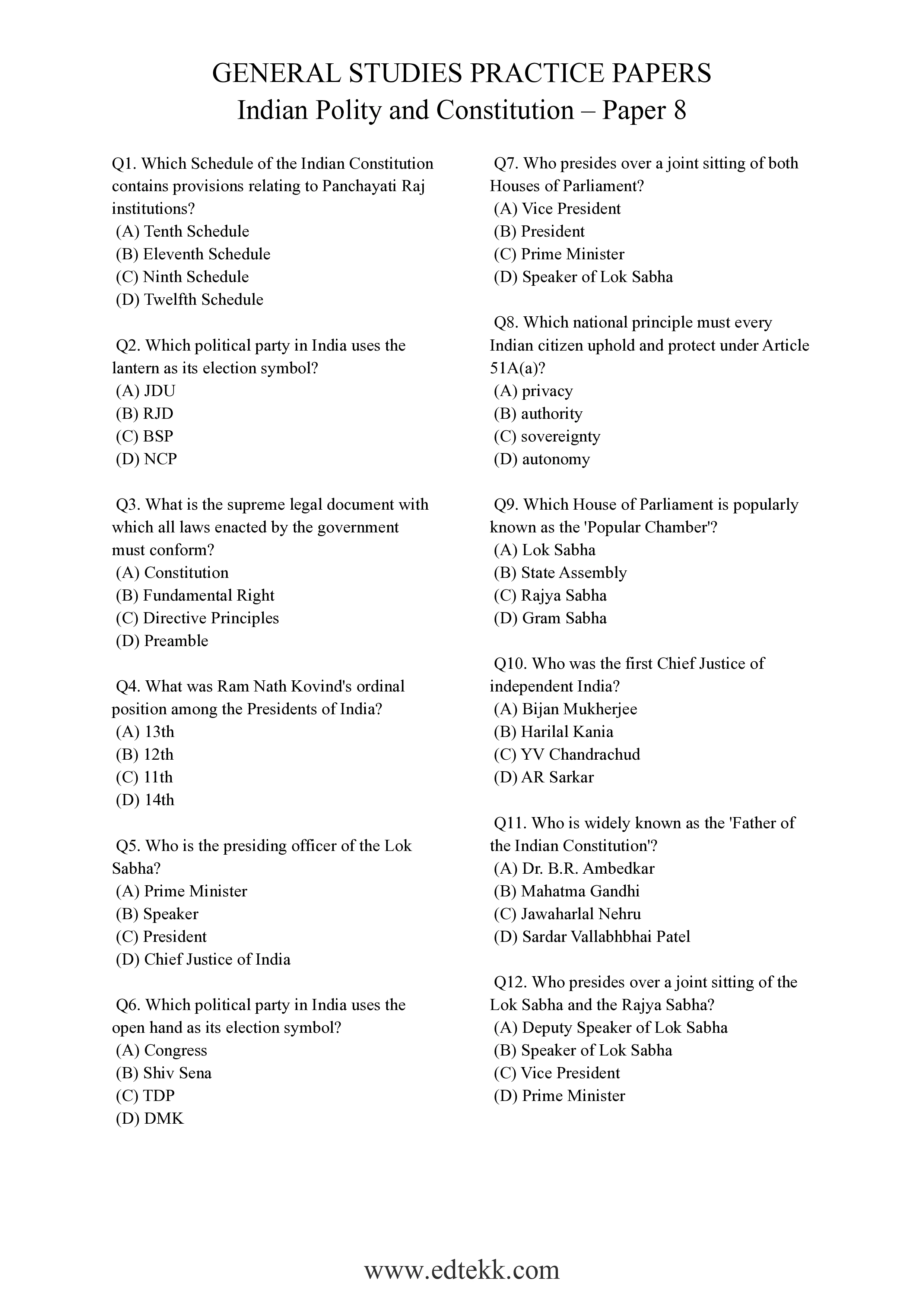
Assess your preparation for competitive examinations with Indian Polity and Constitution Practice Paper 8. This General Studies question set contains 20 MCQs relevant to SSC, Railway, Police Constable and Police SI exams, focusing on constitutional knowledge, political structures and governance with accurate answers and explanations.
Test Details
Topic: Indian Polity and Constitution
Total Questions: 20
Question Format: MCQs – Single Correct Answer
Suitable for: SSC exams, Railway exams, Police Constable, Police SI
Download All Papers in This Series (PDF)
Questions and Answers
Q1. Which Schedule of the Indian Constitution contains provisions relating to Panchayati Raj institutions?
(A) Tenth Schedule
(B) Eleventh Schedule
(C) Ninth Schedule
(D) Twelfth Schedule
Explanation: The Eleventh Schedule of the Indian Constitution contains 29 subjects relating to Panchayati Raj institutions. It was added through the 73rd Constitutional Amendment Act, 1992. These subjects include agriculture, rural housing, drinking water, roads, education and poverty alleviation. The Schedule provides a framework for the devolution of responsibilities to Panchayats.
Q2. Which political party in India uses the lantern as its election symbol?
(A) JDU
(B) RJD
(C) BSP
(D) NCP
Explanation: The Rashtriya Janata Dal (RJD), founded by Lalu Prasad Yadav in 1997, uses the lantern as its election symbol. The party is primarily influential in Bihar and has played an important role in the state’s political landscape.
Q3. What is the supreme legal document with which all laws enacted by the government must conform?
(A) Constitution
(B) Fundamental Right
(C) Directive Principles
(D) Preamble
Explanation: The Constitution is the supreme law of India, and all laws enacted by the legislature must conform to its provisions. The judiciary may declare legislation unconstitutional if it violates constitutional requirements. Fundamental Rights are important limits on state power, but constitutional validity also depends on other applicable constitutional provisions.
Q4. What was Ram Nath Kovind’s ordinal position among the Presidents of India?
(A) 13th
(B) 12th
(C) 11th
(D) 14th
Explanation: Ram Nath Kovind was the 14th President of India. He assumed office on 25 July 2017 and served until 25 July 2022. He succeeded Pranab Mukherjee and was succeeded by Droupadi Murmu, India’s first tribal woman President.
Q5. Who is the presiding officer of the Lok Sabha?
(A) Prime Minister
(B) Speaker
(C) President
(D) Chief Justice of India
Explanation: The Speaker is the presiding officer of the Lok Sabha and is elected by its members under Article 93. The Speaker maintains order, regulates debates and ensures compliance with parliamentary procedures. In the Speaker’s absence, the Deputy Speaker or another authorised member may preside. The Speaker also certifies Money Bills under Article 110.
Q6. Which political party in India uses the open hand as its election symbol?
(A) Congress
(B) Shiv Sena
(C) TDP
(D) DMK
Explanation: The Indian National Congress (INC) uses the open right-hand palm as its election symbol. The symbol was allotted to the Congress (I) faction in 1978 following a party split and has remained the party’s principal electoral identifier.
Q7. Who presides over a joint sitting of both Houses of Parliament?
(A) Vice President
(B) President
(C) Prime Minister
(D) Speaker of Lok Sabha
Explanation: Under Article 118(4), the Speaker of the Lok Sabha presides over a joint sitting of Parliament. In the Speaker’s absence, the Deputy Speaker presides; if unavailable, the Deputy Chairman of the Rajya Sabha presides. If these officers are also unavailable, another member determined under the applicable parliamentary rules presides.
Q8. Which national principle must every Indian citizen uphold and protect under Article 51A(a)?
(A) privacy
(B) authority
(C) sovereignty
(D) autonomy
Explanation: Under Article 51A(a) of the Indian Constitution, every citizen has a Fundamental Duty to uphold and protect the sovereignty, unity and integrity of India. This duty emphasises national unity, independence and the protection of the country’s constitutional values.
Q9. Which House of Parliament is popularly known as the ‘Popular Chamber’?
(A) Lok Sabha
(B) State Assembly
(C) Rajya Sabha
(D) Gram Sabha
Explanation: The Lok Sabha is known as the Popular Chamber or House of the People because its members are directly elected by the citizens of India through universal adult suffrage. It represents the people at the national level and plays a central role in legislation, financial matters and parliamentary accountability.
Q10. Who was the first Chief Justice of independent India?
(A) Bijan Mukherjee
(B) Harilal Kania
(C) YV Chandrachud
(D) AR Sarkar
Explanation: Justice Harilal Jekisundas Kania was the first Chief Justice of independent India and the first Chief Justice of the Supreme Court of India. He assumed office on 26 January 1950, when the Constitution came into force, and served until 1951.
Q11. Who is widely known as the ‘Father of the Indian Constitution’?
(A) Dr. B.R. Ambedkar
(B) Mahatma Gandhi
(C) Jawaharlal Nehru
(D) Sardar Vallabhbhai Patel
Explanation: Dr. B. R. Ambedkar is widely known as the Father of the Indian Constitution because he chaired the Drafting Committee of the Constituent Assembly and played a leading role in preparing the constitutional text. The Constitution was ultimately adopted through the collective efforts of the Constituent Assembly.
Q12. Who presides over a joint sitting of the Lok Sabha and the Rajya Sabha?
(A) Deputy Speaker of Lok Sabha
(B) Speaker of Lok Sabha
(C) Vice President
(D) Prime Minister
Explanation: The Speaker of the Lok Sabha presides over a joint sitting of both Houses of Parliament under Article 118(4). In the Speaker’s absence, the Deputy Speaker presides. If both are unavailable, the Deputy Chairman of the Rajya Sabha or another person determined under the applicable rules may preside.
Q13. Which Article of the Indian Constitution deals with the establishment and constitution of the Supreme Court?
(A) Article 141
(B) Article 32
(C) Article 124
(D) Article 226
Explanation: Article 124 of the Indian Constitution deals with the establishment and constitution of the Supreme Court of India. It provides for the composition of the Court, appointment of judges, their qualifications, tenure and removal. Article 32 deals with constitutional remedies, Article 141 with binding judicial precedents and Article 226 with High Court writ jurisdiction.
Q14. What is the commonly used designation for the elected head of a Gram Panchayat?
(A) Mayor
(B) Sarpanch
(C) Commissioner
(D) President
Explanation: A Sarpanch is generally the elected head of a Gram Panchayat in India. The Sarpanch presides over meetings and helps coordinate village-level development and welfare activities. The title varies by state; alternatives include Pradhan and Mukhiya.
Q15. What is the geographical area from which voters elect their representative called?
(A) Constituency
(B) Voting Area
(C) Election Area
(D) Legislative Area
Explanation: A constituency is a defined geographical area from which voters elect a representative to a legislative body. Constituencies are established for elections to Parliament and State Legislatures, with eligible voters within each constituency participating in the election.
Q16. Who heads the Union Council of Ministers?
(A) Speaker of the Lok Sabha
(B) President of India
(C) Vice President of India
(D) Prime Minister of India
Explanation: The Prime Minister heads the Union Council of Ministers and coordinates the functioning of the government. Although executive power is formally vested in the President, the President ordinarily acts on the aid and advice of the Council of Ministers headed by the Prime Minister.
Q17. Which provision of the Indian Constitution protects freedom of the press as part of the freedom of speech and expression?
(A) Article 21
(B) Article 15
(C) Article 17
(D) Article 19(1)(a)
Explanation: Freedom of the press is protected under Article 19(1)(a) of the Indian Constitution as part of the fundamental right to freedom of speech and expression. Although the Constitution does not expressly mention freedom of the press, the Supreme Court has recognised it as an essential component of this fundamental right.
Q18. Which body has the authority to remove the Speaker of the Lok Sabha?
(A) Lok Sabha itself
(B) Prime Minister
(C) President
(D) Chief Justice of India
Explanation: Under Article 94(c), the Speaker of the Lok Sabha may be removed by a resolution passed by a majority of all the then members of the House, with at least fourteen days’ notice. Under Article 96, the Speaker cannot preside during consideration of the removal resolution but may participate in proceedings and vote in the first instance.
Q19. What is the system of rural local self-government in India known as?
(A) Lok Sabha
(B) Gram Sabha
(C) Panchayati Raj
(D) Samiti Sabha
Explanation: Panchayati Raj is the system of rural local self-government in India. It generally provides elected institutions at village, intermediate and district levels. The Gram Sabha, comprising persons registered on the electoral rolls of a village within the Panchayat area, facilitates direct participation and local accountability.
Q20. Which Article of the Indian Constitution provides for the establishment of the Finance Commission?
(A) Article 270
(B) Article 280
(C) Article 260
(D) Article 250
Explanation: Article 280 of the Constitution of India provides for the establishment of the Finance Commission. The President constitutes the Commission every five years or earlier, if necessary. Its principal responsibility is to recommend the distribution of tax revenues between the Union and the States and the principles governing grants-in-aid to States.
Question Paper Images